Oil Pump Assembly Dimensions: Spec Guide for Buyers
Procurement teams buy oil pump assemblies on fit, not on marketing claims. The real question is whether the envelope, shaft interface, mounting pattern, and port geometry match the engine and lubrication system you are sourcing for. In aftermarket supply, dimensional control matters as much as casting quality and gear finish. A few tenths of a millimetre on a locating boss or drive flats can change installation effort, backlash, or oil-pressure behaviour. This guide focuses on the dimensions that actually drive acceptance, the checks that reduce mismatch risk, and the commercial terms that keep MOQ, unit price, and lead time from turning into surprises. Driventus is an independent aftermarket manufacturer; brand names are referenced for fitment only. We manufacture in Taizhou, Zhejiang, and supply B2B customers in more than 60 countries under IATF 16949:2016 and ISO 9001:2015 systems. If you are validating a replacement part, start with the drawing, compare it with a measured sample, and confirm the part-number cross-reference before release.
Which dimensions decide fit first
For procurement, the first job is to separate cosmetic similarity from functional fit. On an oil pump assembly, the dimensions that matter most are the ones that locate the part, seal it, and keep the rotating elements in range. If those are wrong, nothing else saves the order.
The priority features are usually:
Overall housing envelope
Mounting-hole centre distance
Drive shaft, spline, flats, or keyway interface
Inlet and outlet port positions
Gasket-face geometry and flatness
Locating boss or pilot diameter
Rotor pocket depth and internal clearance
Runout and concentricity of rotating elements
Relief-valve spring length and opening pressure
A practical buyer spec should list nominal dimensions and acceptance limits side by side. That is the difference between a useful sourcing document and a catalogue note. For example, a locating boss may need a pilot fit of +0.00 / -0.03 mm, while a housing envelope might allow ±0.20 mm. Those tolerances are not decorative; they tell you whether the part will install cleanly and behave predictably under load.
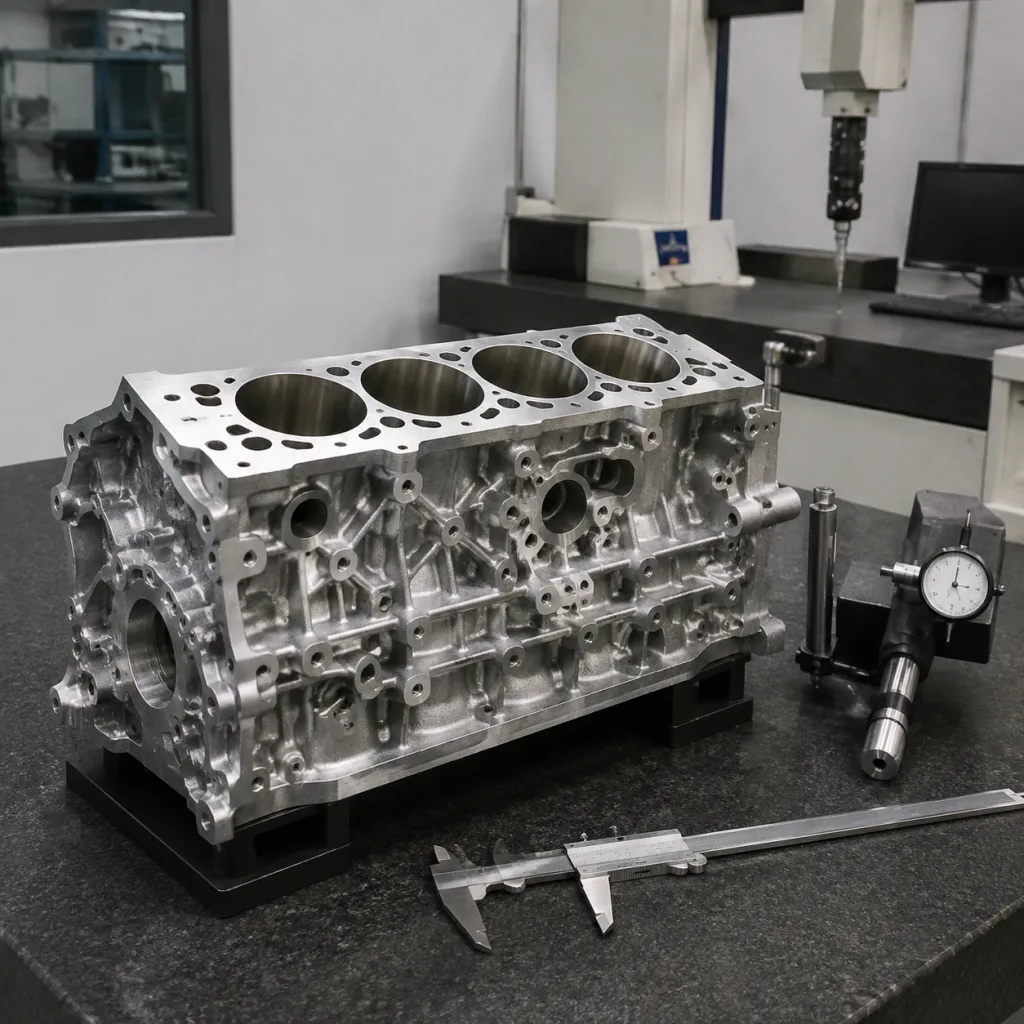
Use measured sample values, not only nominal catalogue data. A supplier can claim the correct family fit and still miss on one critical boss, port centre, or seal surface. If the part is a replacement, compare the OE drawing with a physical sample using calipers, gauge tools, or a CMM, then lock the acceptance standard before volume release.
A quick spec table buyers can use
The table below shows the dimensions commonly controlled on an oil pump assembly purchase spec. Exact values depend on the engine family, but the ranges indicate the level of control buyers should expect from a qualified supplier.
Feature
Typical control point
Common procurement tolerance
Housing envelope
L × W × H
±0.10 to ±0.30 mm
Mounting hole pitch
Centre-to-centre
±0.05 to ±0.15 mm
Locating boss diameter
Pilot fit
+0.00 / -0.03 mm
Rotor pocket depth
Internal clearance
±0.03 to ±0.08 mm
Shaft or drive interface
Flats / spline / keyway
±0.02 to ±0.10 mm
Gasket-face flatness
Sealing surface
0.03 to 0.10 mm max
Radial runout
Rotating elements
0.03 to 0.05 mm max
Backlash
Gear or rotor clearance
Engine-specific, verify by drawing
Relief-valve spring free length
Installed specification
±0.20 to ±0.50 mm
Relief-valve opening pressure
Bench test range
±5% to ±10%
Port centre position
Inlet/outlet alignment
±0.10 to ±0.25 mm
Wall thickness at threaded bosses
Cast integrity
2.5 to 4.0 mm minimum, application-specific
</tr></thead><tbody> </tbody></table>If the pump includes a relief valve, specify the spring free length, installed height, and opening-pressure range. For many passenger-car programmes, the opening pressure may sit around 350 to 550 kPa, but that number must follow the OE drawing or the engine target, not a generic market assumption. A unit can match bolt pattern and still fail if the valve cracks open too early or too late.
Wall thickness deserves the same attention as port position. Thin threaded bosses and cast sections are often the first areas to fail during pressure cycling or installation torque. If the application sees repeated cold starts, ask for pressure-cycle validation, not just a first-piece dimension report.
Why materials and machining affect the numbers
Dimensional control only holds when the process is stable. Oil pump housings are commonly aluminium alloy or cast iron, while rotors, shafts, or gears are usually heat-treated steel. Sealing faces need clean machining. Bearing and bushing bores need coaxiality after finishing, not just a good-looking cast surface.
A buyer-ready process route should be visible in the supplier file. Typical control steps are casting or blank forging, rough machining, heat treatment where applicable, finish machining, deburring, washing, final gauging, pressure test, and packing. If the supplier cannot explain where the critical dimensions are created and where they are verified, repeatability is hard to trust.
Driventus operates under IATF 16949:2016 and ISO 9001:2015, with incoming material checks, in-process gauging, and final dimensional inspection. For some markets, buyers also request REACH (EC) No 1907/2006 material declarations when the application calls for them. For high-temperature validation, thermal cycling and bench endurance tell you more than visual inspection alone.
Published standards commonly referenced in programme documents include:
IATF 16949:2016
ISO 9001:2015
REACH (EC) No 1907/2006
SAE J2527 for durability-related test planning where applicable
A practical inspection package usually includes a first article report with the key dimensions, go/no-go gauges for mounting features, and a flow/pressure record at the target test speed. Driventus is an independent aftermarket manufacturer; brand names are referenced for fitment only.
How to verify fit before you buy
The safest workflow is simple: compare the candidate part with the OE reference and a physical sample before you commit to volume.
1. Confirm the engine code, application year, and OE part cross-reference. 2. Measure the mounting face, port centres, and drive interface on the existing part. 3. Check the gasket outline and locating features against the mating surface. 4. Request a dimensional report from the supplier, not only a catalogue description. 5. Verify flow and pressure data at the intended operating speed and oil grade. 6. Approve a sample build before releasing production quantities. 7. Lock the acceptance standard in writing, including sampling level, inspection tools, and rework rules.
If the application is a direct replacement, match the OE 06A107065-style reference only when that cross-reference is already established in your own system or in the supplier documentation. Never rely on family names alone. Small changes in rotor depth or relief-valve geometry can produce a part that bolts on but does not behave correctly under load.
For sample approval, insist on a measured report that lists nominal, actual, upper and lower tolerance, and inspection method. A yes/no conformity statement is not enough data to release a purchase order for volume.
What paperwork lowers sourcing risk
A strong supplier file should include the drawing revision, inspection plan, material certificate, and packaging specification. For import teams, commercial paperwork matters too, because inconsistent part labelling can create delays at receiving and customs.
Ask for these documents before approval:
Dimensional drawing with revision level
First article inspection or sample report
Material certificate and heat-treatment record
Pressure and flow test summary
PPAP-style submission where required by the buyer
Packing list with part number and carton quantity
Commercial quote showing MOQ, unit price breaks, and standard lead time
Tie the commercial terms to the technical risk. The supplier should state MOQ by variant, price at 100, 500, and 1,000 units, and whether tooling, sample fees, or test charges are separate. Many aftermarket pump programmes quote 30 to 50 days for sample preparation and 25 to 45 days for repeat production after approval, but the real lead time should run from drawing freeze and deposit receipt.
When comparing offers, check for:
MOQ by part number and packaging variant
Price ladder by annual volume and one-off order size
Sample charge policy and whether it is creditable against production
Lead time for first article, pilot batch, and mass production
Incoterms, carton configuration, and pallet quantity
You can review our catalog, check the quality system, and ask about custom manufacturing if the target application needs a revised port position, housing thickness, or drive interface. For broader engine-component programmes, see engine components.
When custom dimensions are worth the effort
Custom work makes sense when the engine programme has packaging limits, a non-standard mounting pattern, or a legacy part with poor availability. It is also practical when a distributor needs a private-label replacement with modified inlet orientation or different gasket geometry.
Customisation is most useful when:
The OE part is discontinued
The installation envelope is restricted
A pump body must clear adjacent accessories
The purchaser needs a controlled private cross-reference
An OEM or Tier-1 programme requires approved drawing control
The buyer needs a revised MOQ or packaging split for regional distribution
For these cases, freeze the critical dimensions first, then review prototype samples against the mating engine and lubrication targets. That reduces field-return risk and makes approval easier across multiple warehouses and repair chains. A well-run custom project also defines the commercial gates up front: prototype price, tooling amortisation, minimum order quantity, and target production lead time after drawing sign-off.
In practice, custom dimensions are worth the effort when a 0.1 to 0.2 mm change in boss position, port angle, or rotor depth solves a known fit or pressure issue. If the redesign changes material thickness or machining datum structure, require a new first article and new flow test data before release.
Frequently asked questions
Mounting-hole pitch, housing envelope, drive interface, gasket-face flatness, and inlet and outlet port positions matter most. These features determine fit, sealing, and rotation. For replacement sourcing, rotor pocket depth and runout are also critical because they affect pressure stability. Buyers should also confirm relief-valve spring length and opening pressure when the part uses an integrated regulator.
No. Catalogue images are not enough for fitment control. Ask for a dimensional drawing, sample report, and measured cross-reference against the OE reference. A physical comparison is the safest way to confirm compatibility before volume purchase. If possible, require a first article report listing actual measured values, inspection method, and batch date so later lots can be compared against the approved sample.
Yes, when the application justifies it. We support custom manufacturing for defined port positions, mounting patterns, and housing details after drawing review and sample approval. Use the contact form to discuss the target engine and required measurements. For custom projects, please also share target MOQ, forecast volume, required lead time, and any packaging or labeling rules so we can quote accurately.
If you need a dimensional check, cross-reference support, or a production quotation, send your drawing and target volume through our contact page: /contact.html