Oil Filter Housing Packaging Requirements for Export
Oil filter housings do not fail in transit for one reason. They fail because a machined gasket face rubbed against a divider, an M14 or M18 port took a corner impact, a plastic cap became a stacking point, or a 45-day sea shipment turned minor moisture into visible staining. By the time the carton reaches a distributor, repair-chain warehouse, Tier-1 dock, or assembly line, the supplier and buyer are already arguing about whether the issue is production quality, freight handling, or packaging design.
That is why oil filter housing packaging requirements export buyers should not be treated as a generic carton note. They belong in the RFQ, control plan, supplier quality agreement, and incoming inspection standard. A useful specification covers the part condition, critical surfaces, cleanliness target, carton strength, pallet build, label data, validation method, and evidence required when damage is reported.
Driventus manufactures engine and powertrain components in Taizhou, Zhejiang, under IATF 16949:2016 and ISO 9001:2015 systems for B2B aftermarket, OEM, Tier-1, and repair-chain supply programmes.
RFQ Decision Framework: What Must Be Fixed Before Price
Do not leave packaging until after sampling. Once tooling, MOQ, carton artwork, and pallet patterns are already priced, every improvement becomes a cost argument. Define the export pack before tooling, sampling, PPAP-style approval activity, or price confirmation begins.
Oil filter housings may ship as raw castings, machined components, or assembled units with cooler connections, caps, bypass valves, sensors, O-rings, pressure-regulating features, M12/M14/M18 threaded ports, oil galleries, and gasket faces. The pack has to match that condition. Buyers reviewing our catalog or discussing custom manufacturing should specify packaging alongside material grade, machining tolerance, leak-test pressure, cleanliness target, marking method, and inspection level.
Use the RFQ to lock the commercial and technical decisions that change packaging cost:
Part condition: raw casting, machined component, assembled housing, or housing with cooler, cap, sensor, valve, O-rings, and seals.
Protection level: individual PE bag of 0.04–0.08 mm, VCI bag where validated, cavity tray, EPE foam insert, corrugated divider, thread cap, port plug, desiccant, or sealed kit bag.
Sales unit: 1 pc retail box, 2–6 pcs inner box, 10–24 pcs master carton, kit set, or bulk service-pack format.
Export route: 30–45 day sea freight, 5–10 day air freight, courier parcel, LCL consolidation, or FCL container shipment.
MOQ driver: casting batch, machining setup, custom tray tooling, printed carton MOQ, label format, or pallet configuration.
Visible price lines: standard export carton, individual box, custom tray, VCI, desiccant, printed label, and pallet.
Lead-time impact: 3–7 days for packaging artwork approval, 7–15 days for custom carton or tray procurement, and longer when moulded tray tooling is new.
Destination rules: REACH (EC) No 1907/2006 expectations for restricted substances in packaging materials sold into the EU, plus ISPM 15 if wood packaging is used.
Label data: part number, batch number, quantity, country of origin, gross weight, net weight, carton dimensions, barcode format, revision level, and handling symbols.
Driventus is an independent aftermarket manufacturer; brand names are referenced for fitment only.
Failure Modes: Where Oil Filter Housings Get Damaged
Start with the failure, then choose the material. A thicker carton does not protect a threaded oil port if the port is still touching another casting. A clean PE bag does not protect a machined face if the part can bounce inside the tray.
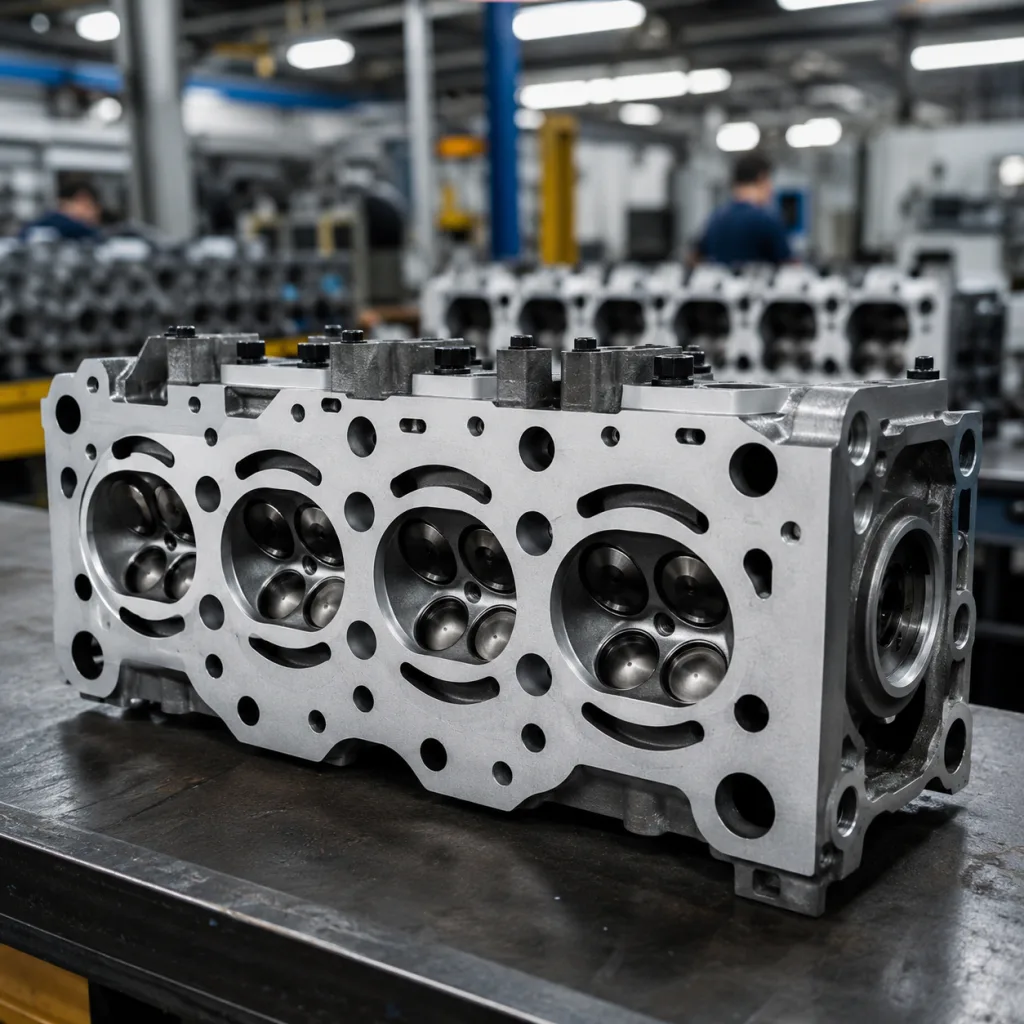
The highest-risk areas are sealing lands, threaded ports, oil passages, flange faces, pressure-valve seats, O-ring grooves, plastic cap interfaces, sensor bosses, and cooler connections. Cosmetic scuffs on non-machined casting areas may be acceptable under an agreed visual standard. Damage on functional areas can cause leakage, assembly delay, gauge failure, or warranty claims.
For aluminium housings, part-to-part contact during 30- to 45-day ocean freight can create abrasion and contact staining. For assembled housings, plastic caps, sensor connectors, and integrated valves can crack when carton compression turns them into load-bearing points. A practical baseline is simple: no metal-to-metal contact, no visible dent on machined sealing faces, no thread deformation preventing gauge fit, and no debris inside oil galleries after unpacking.
Housing feature
Packaging failure mode
Control that actually addresses it
Machined gasket face
Scratches, dents, embedded carton fibres
Individual PE bag plus cavity tray, foam separator, or face-up orientation with 3–5 mm clearance
Threaded oil port
Impact damage, gauge failure, cross-thread risk
Plastic thread cap or port plug fitted after final inspection; verify retention during shake check
O-ring groove
Contamination, nicked edge, compressed seal
Clean bagging after final inspection; avoid direct loading against dividers
Plastic cap or valve
Cracking under vertical load
Do not use as a stacking contact point; maintain clearance in the tray cavity
Sensor boss or connector
Bent pins, broken latch
Dedicated cavity clearance and connector guard; prevent side pressure from the carton wall
Internal oil gallery
Dust, metal particles, moisture
Port plugging, clean bagging, and cleanliness check before packing
</tr></thead><tbody> </tbody></table>Packaging can also create contamination. Recycled cardboard dust, loose foam particles, staples, torn tape, and low-grade plastic film all become customer complaints when they appear on sealing faces or inside oil passages. Where cleanliness limits matter, define them in the control plan: no visible chips, no loose packing fibres on functional surfaces, and a buyer-approved milligram residue limit for washed internal galleries when required.
Route-Based Pack Selection: Carton, Tray, Pallet, or All Three
The right export pack depends on the route, not just the part weight. Courier parcels need drop resistance. LCL shipments need protection against repeated handling and mixed cargo. FCL sea freight needs pallet compression, moisture control, and stable stacking. Air freight may reduce transit time but still exposes cartons to sorting, vibration, and warehouse transfers.
For most oil filter housing export programmes, specify the pack as a system:
Inner protection: individual PE bag of 0.04–0.08 mm, VCI bag where corrosion risk is confirmed, or sealed clean bag for machined housings.
Positioning: moulded pulp tray, EPE foam, corrugated divider, or thermoformed tray to stop part-to-part contact; allow 3–10 mm clearance around critical features depending on part mass.
Master carton: double-wall corrugated board for heavier cast housings; common export targets are 5-ply board, ECT 44 or equivalent, or burst strength around 275–350 psi where agreed.
Carton weight: keep gross weight below 15–20 kg for manual handling unless the buyer permits heavier units and warehouse equipment is confirmed.
Carton fill: avoid more than 5 mm free movement after closure; use top pads or void fill so trays cannot lift during vibration.
Pallet material: ISPM 15-compliant wood pallet or export-grade plywood pallet when required by destination customs.
Pallet build: no carton overhang, corner boards for compression resistance, stretch film of 20–25 micron or buyer-approved equivalent, top cover, pallet strap where needed, and two-way or four-way fork access as specified.
Pallet limits: define maximum pallet height, often 1,100–1,250 mm for warehouse handling or container planning, and maximum gross pallet weight according to buyer equipment.
Moisture control: desiccant, container dry bags, or VCI only when justified by route duration, climate, material, and storage time.
Mixed-SKU shipments need extra discipline. Avoid combining similar housings in one carton unless each inner box is physically separated and labelled. Receiving teams can easily confuse references that share casting geometry but differ in port angle, sensor provision, cooler interface, or gasket pattern. If mixed pallets are unavoidable, require SKU-by-SKU pallet maps and carton numbering such as 1/40, 2/40, and 3/40 that matches the packing list.
Traceability Deep-Dive: Labels and Documents That Prevent Delays
A carton label is not just a sticker. It is the link between the physical part, the production lot, the inspection record, the commercial invoice, and the warehouse receipt. When that link breaks, distributors lose FIFO control and OEM or Tier-1 buyers lose the ability to isolate a suspect batch quickly.
Minimum carton label content should include part number, buyer part number if different, description, quantity, batch or lot number, production date or packing date, carton number, revision level where applicable, gross weight, net weight, carton dimensions, and country of origin. If the buyer uses an internal numbering system, repeat the same cross-reference in the order confirmation, carton label, pallet label, and packing list. Where an OE-style reference is used for identification, use a generic fitment convention such as OE 06A107065 only when provided by the buyer and do not imply vehicle manufacturer approval.
Barcode rules should be agreed before mass production, not after the first shipment arrives. Common buyer formats include Code 128, GS1-128, QR code, and Data Matrix. The barcode data string must match the packing list exactly, including leading zeroes, hyphens, suffixes, and revision codes. Require 100% barcode readability at packing, label placement on two adjacent carton faces for pallet scanning, and print contrast strong enough to remain readable after stretch wrapping.
Export documents normally include commercial invoice, packing list, bill of lading or air waybill, certificate of origin if required, material declaration when requested, inspection report, and packaging photos for first shipment or revised packaging. The packing list should show carton count, pieces per carton, gross and net weight, pallet number, SKU split, and total CBM. A mismatch between carton label, packing list, and commercial invoice can delay customs clearance or block warehouse receipt even when the parts are correct. Driventus aligns production and inspection records with its quality system, certified to IATF 16949:2016 and ISO 9001:2015.
Approval Sequence: Prove the Pack Before Mass Shipment
A packaging sample should be approved before full export release, especially when a buyer is launching a new oil filter housing range, changing suppliers, changing MOQ, moving from bulk to retail-ready packaging, or adding a new destination warehouse. The approval should test the pack as shipped, not a hand-built ideal version.
Follow a short validation sequence:
1. Confirm part orientation and clearance in the tray or divider, including 3–5 mm minimum clearance around machined faces and sensor features unless the design requires a tighter locator. 2. Close the carton and shake it manually for 30–60 seconds to detect part movement, tray lift, or contact noise. 3. Reopen and inspect gasket faces, threads, ports, caps, valves, and plastic features after simulated handling. 4. Check carton compression after pallet stacking for the planned container load height and storage time. 5. Drop-check a representative carton from normal manual handling height if the buyer requires it; define face, edge, and corner drops before testing. 6. Verify barcode readability after stretch wrapping and after label exposure to rubbing or humidity. 7. Confirm label placement on at least two visible carton faces when warehouse scanning is required. 8. Open a packed carton after humidity exposure or a short transport trial to check moisture staining, softened cartons, and odour transfer from packaging material. 9. Record packed carton gross weight within the agreed tolerance, typically ±0.5 kg or a buyer-defined warehouse tolerance.
Formal packaging test methods can be specified by the buyer or logistics provider. Where applicable, use recognised procedures such as ASTM D4169 for distribution performance testing or ISTA packaged-product test procedures. Do not specify a test level without confirming package weight, shipment mode, pallet pattern, and destination handling profile.
Keep photographs of the approved configuration: empty tray, loaded tray, bagged part, protected thread or port, inner box, master carton, carton label, pallet pattern, pallet label, and sealed pallet. These images become evidence when a forwarder repacks cargo, LCL freight is consolidated, or a distributor reports damage weeks after receipt.
Receiving Scenario: What Import Teams Should Check First
Imagine a pallet arrives with crushed top cartons, water marks on one side, and two similar references on the same pallet. The receiving team should not open everything and mix it into stock. It should preserve evidence, confirm traceability, and separate packaging damage from part damage.
Use the agreed export packaging as an incoming checklist:
Compare carton labels against purchase order, packing list, and barcode data before cartons are moved into stock.
Record pallet condition before unloading if carton crushing, broken stretch film, water marks, leaning pallets, or puncture damage is visible.
Check carton count, inner quantity, mixed-SKU separation, carton numbering, and pallet map against the packing list.
Inspect random samples by AQL or buyer-defined sampling for thread caps, port plugs, bag sealing, tray fit, label adhesion, and surface condition.
Inspect functional areas first: machined gasket faces, threaded ports, O-ring grooves, cooler interfaces, sensor bosses, and plastic caps.
Photograph damaged cartons before opening and photograph the part position inside the carton before removing the parts.
Isolate affected lot numbers when functional damage is found; do not mix suspect cartons with accepted stock.
Report discrepancies with carton number, pallet number, batch number, part number, quantity affected, damage type, and clear photographs.
Repeat-order data should feed the supplier scorecard. Track claim rate by shipment, damage type, route, forwarder, carton design, and pallet pattern. If the same route shows recurring humidity, compression, or handling damage, revise the carton grade, pallet height, separator design, port protection, stretch-wrap method, or container moisture control.
For buyers defining oil filter housing packaging requirements export programmes should treat pack design as part of product quality. A stable standard protects the component, reduces receiving disputes, supports repeatable supply across regions, and makes MOQ, unit price, lead time, and claim responsibility easier to manage.
Frequently asked questions
At minimum, specify individual protection, no part-to-part contact, thread caps or port plugs where needed, labelled master cartons, export pallets, and traceable batch identification. Machined faces, threads, ports, plastic features, and sensor connectors should not contact other parts or carton walls during shipment.
VCI is useful when corrosion risk is confirmed by material, route, humidity, and storage duration. Many aluminium housings need clean sealed PE bags, port protection, desiccant, and container moisture control rather than VCI. The buyer and supplier should validate the selected method before mass shipment.
Common references include ISPM 15 for wood packaging in international trade, ASTM D4169 for distribution performance testing, ISTA packaged-product test procedures, REACH (EC) No 1907/2006 for restricted substances, plus IATF 16949:2016 and ISO 9001:2015 for quality management.
If you are preparing an RFQ for oil filter housings, share the part drawings, annual volume, target MOQ, destination market, logistics route, and packaging preference with Driventus. We can review the specification, separate packaging cost drivers, and help you [request a quote](/contact.html).