aftermarket replacement parts · 2026-06-13

Motor Mount Replacement Cost: Buyer Cost Factors

Motor mount replacement cost is often treated as a workshop invoice, but procurement teams need to measure the full economic impact. The unit price of the mount is only one input. Total landed and installed cost can also include rubber compound consistency, metal bracket accuracy, hydraulic fluid sealing, packaging loss, warranty exposure, catalogue accuracy, and labour time across the repair network. A low purchase price becomes expensive if the mount transmits excessive NVH, collapses early under engine torque, leaks fluid, or forces technicians to rework the installation. This guide explains the cost drivers that matter when sourcing aftermarket engine mounts for distributors, wholesalers, OEM service programmes, and multi-location repair chains. It shows how design, validation testing, documentation, and supplier controls affect replacement economics. Driventus is an independent aftermarket manufacturer; brand names are referenced for fitment only.

Cost structure: part price is not the full cost

For a retail repair, the visible invoice usually combines parts and labour. For B2B buyers, the calculation should separate ex-factory price, freight, duty, warehousing, handling damage, catalogue maintenance, fitment coverage, and warranty cost. A rubber-metal engine mount may look inexpensive as a component, but a high claim rate can erase margin across a distributor programme.

A stronger sourcing model separates the price paid to the supplier from the cost created after the part enters the network. Packaging that crushes in transit, bracket holes that need force during installation, or rubber hardness that varies between batches can all raise the real motor mount replacement cost even when the purchase order price looks competitive.

Typical aftermarket variables include:

</tr></thead><tbody> </tbody></table>A front torque mount for a small transverse engine is not cost-equivalent to a hydraulic mount supporting a larger powertrain. Hydraulic mounts require tighter sealing control, compatible internal fluid, and more careful damping validation. Electronically controlled active mounts add sensors, valves, or vacuum-control features, which can change both the part cost and the failure risk. Many standard aftermarket ranges exclude these designs unless confirmed programme volume supports tooling, testing, and data management.

Typical replacement ranges and labour assumptions

Repair-market pricing varies by country, workshop rate, engine layout, mount position, and whether one mount or a complete set is replaced. Procurement teams should not use a single consumer repair price as a sourcing target. A more reliable approach is to build a matrix around mount type, installation access, and expected claim exposure.

Cost element What affects it Procurement impact
Component priceRubber grade, metal stamping thickness, hydraulic chamber design, bonding processDirect purchasing cost and target margin
Freight and packagingCarton strength, pallet density, corrosion protection, part weightLanded cost and warehouse damage rate
Installation timeAccess position, bolt alignment, bracket geometryRepair-chain labour hours and bay utilisation
Warranty exposureRubber ageing, bond failure, hydraulic leakage, dimensional driftReturns, credits, technician time, customer retention
Range complexityNumber of SKUs, left/right variants, engine-code coverageInventory turns and catalogue accuracy

</tr></thead><tbody> </tbody></table>For repair chains, labour time is often the larger variable. Mounts located near the timing side, subframe, or transmission support may require engine support equipment and additional removal steps. Some applications also require related components to be loosened or removed before the mount can be accessed. If a replacement part has bolt holes outside tolerance, incorrect sleeve height, or bracket geometry that sits under load, the technician may lose 15–45 minutes aligning the assembly. At scale, that cost is material.

A practical B2B costing model should include expected labour disruption as well as invoice price. When evaluating a supplier, request dimensional reports for critical interfaces such as mounting hole centre distance, sleeve length, bracket flatness, locating pin position, and thread engagement depth. These checks help prevent a cheap part from becoming an expensive bay-time problem.

Material and design choices that change service life

Engine mounts work under static engine weight, cyclic torque, temperature exposure, oil contamination, road vibration, and repeated acceleration and braking loads. The correct rubber compound, insert geometry, metal preparation, and bonding process are central to predictable service life.

Common technical controls for aftermarket replacement mounts include:

  • Rubber hardness controlled by Shore A testing, with part-specific targets rather than one universal value.
  • Natural rubber or synthetic blends selected for fatigue resistance, heat exposure, ozone resistance, and oil splash risk.
  • Phosphate, e-coat, zinc coating, or similar corrosion protection on steel brackets and sleeves.
  • Rubber-to-metal bonding control, including surface preparation, adhesive application, mould temperature, pressure, and cure time.
  • Hydraulic mount leak testing where the design uses internal fluid chambers.
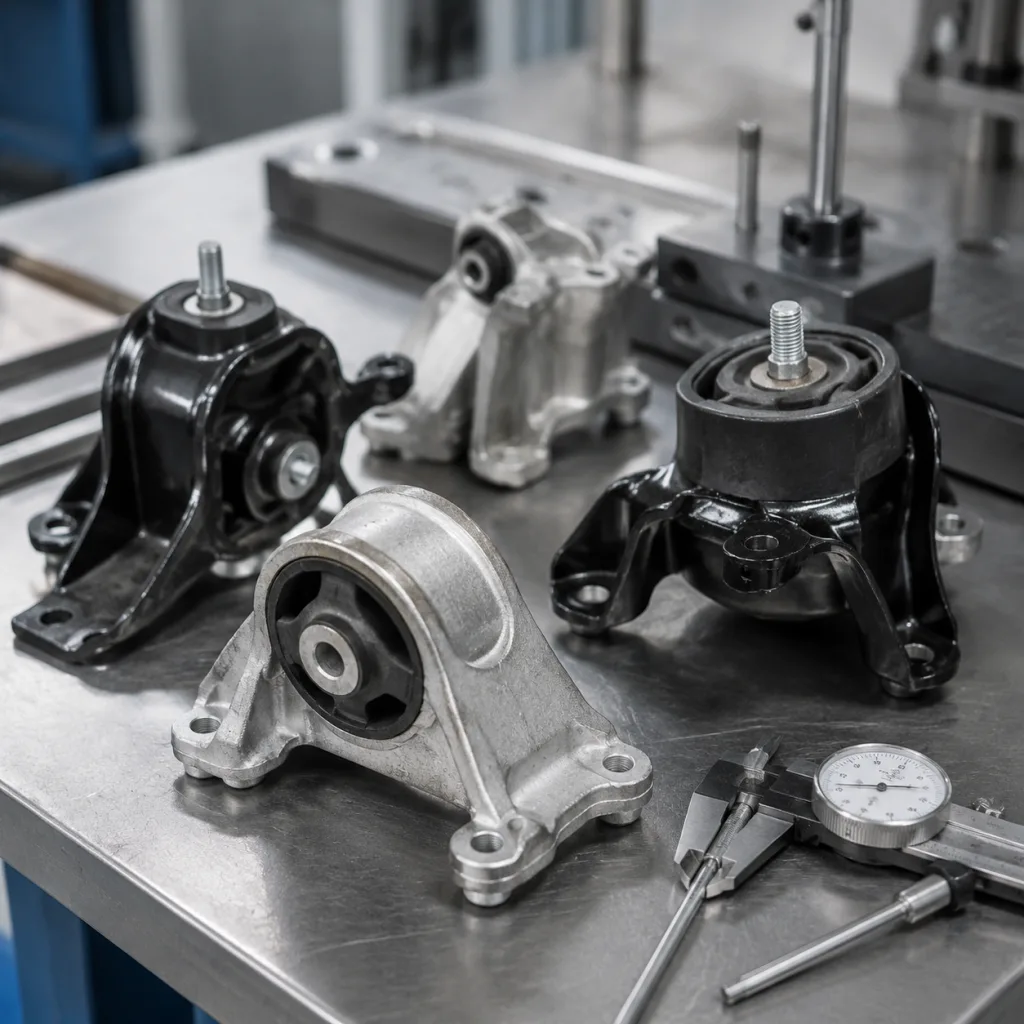
  • Dimensional inspection of bolt holes, locating pins, sleeve heights, thread positions, and bracket angles against approved drawings.

These controls influence motor mount replacement cost because they affect comeback rates and customer complaints. A mount that is too soft may improve idle feel but allow excessive engine movement during launch or gear changes. A mount that is too stiff may control movement but transmit vibration into the cabin, creating an NVH complaint even if the part has not failed structurally. For distributors, both outcomes can become returns, credits, or lost workshop confidence.

Design details also matter. Void shape, rubber volume, bracket stiffness, sleeve length, and hydraulic chamber layout all influence how the mount carries load and isolates vibration. Substituting materials or simplifying geometry without validation can change the driving feel of the vehicle. That is why sourcing should compare not only external appearance but also functional behaviour.

Driventus applies process controls under IATF 16949:2016 and ISO 9001:2015. Material compliance can also be reviewed against REACH (EC) No 1907/2006 for EU supply chains where applicable. Buyers can review our quality system before supplier qualification.

Validation checks to reduce warranty cost

A credible aftermarket mount should be validated for fit, load support, damping behaviour, and environmental durability. The exact test plan depends on mount design and customer requirements, but buyers should expect more than visual sample approval. A mount can look correct on the bench and still create alignment, vibration, or durability issues after installation.

Recommended validation evidence includes:

Mount type Common application Relative part cost Labour sensitivity Main sourcing risk
Solid rubber-metal mountEngine side, gearbox side, torque reactionLow to mediumLow to mediumRubber hardness variation and bond strength
Hydraulic engine mountHigher NVH-control applicationsMedium to highMediumFluid leakage, diaphragm durability, incorrect damping rate
Strut or dogbone mountTorque control in transverse layoutsLow to mediumLowBushing void geometry and sleeve alignment
Complete bracket assemblyMount supplied with cast or stamped bracketMedium to highMediumHole position, thread quality, casting porosity
Active or vacuum-controlled mountSelected premium or diesel applicationsHighHighFunctional mismatch and connector or valve differences

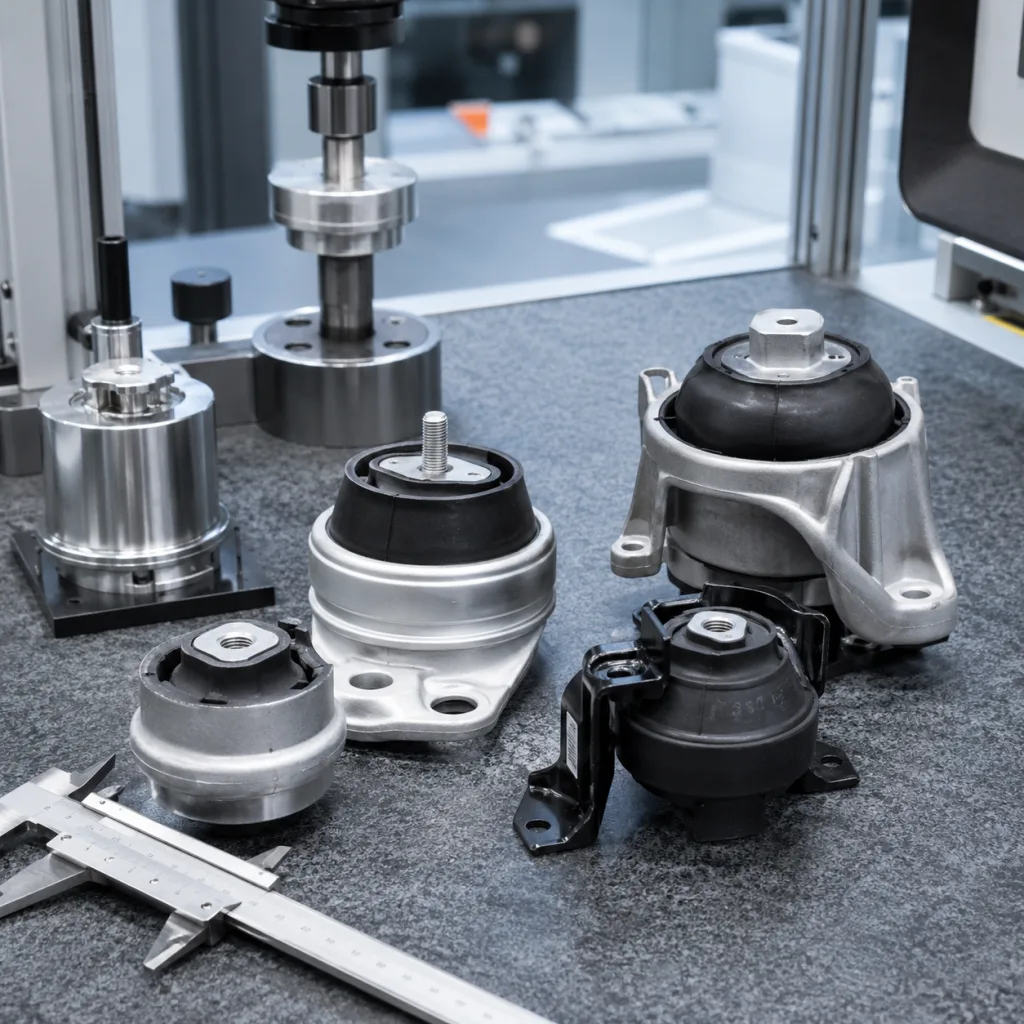
</tr></thead><tbody> </tbody></table>Procurement teams should also ask whether samples were checked on a vehicle, installation fixture, or both. Fixture-based checks are useful for repeatability and dimensional comparison, while vehicle fit checks identify access issues, bracket conflicts, hose clearance, body clearance, and installation sequence problems. For hydraulic or controlled mounts, functional checks should confirm that the replacement behaves as intended in the application, not merely that it can be bolted into place.

For aftermarket cataloguing, OE part-number cross-references should be treated as fitment references, not claims of vehicle manufacturer approval. A database entry may show formats such as OE 06A… or OE 11251… where relevant to the application, but every reference should be validated against engine code, production year, mount position, transmission type, and regional vehicle specification. Driventus is an independent aftermarket manufacturer; brand names are referenced for fitment only.

How distributors and repair chains can control total cost

The fastest way to improve replacement economics is not always to choose the lowest unit price. For high-volume programmes, cost control usually comes from range planning, inspection discipline, packaging design, clear catalogue data, and warranty feedback loops.

A practical sourcing checklist:

  • Group SKUs by platform, engine code, transmission type, and mount position to avoid duplicate inventory.
  • Confirm whether the part is supplied as an insert, complete mount, or bracket assembly.
  • Check carton labelling, barcode format, country-of-origin marking, and pallet configuration before shipment.
  • Require batch traceability for rubber compound, metal parts, bonding process, hydraulic filling where applicable, and final inspection.
  • Define acceptable cosmetic standards for castings, coatings, rubber flash, and visible mould marks.
  • Track claims by failure mode: vibration, collapse, leakage, installation mismatch, corrosion, or noise.
  • Compare claim rate against sales volume and vehicle application, not only total return count.

This information should flow back into purchasing decisions. If one SKU creates repeated NVH complaints, the answer may be a compound or damping review rather than a price negotiation. If claims cluster around broken cartons or missing labels, packaging and warehouse handling may be the real cost driver. If installers report difficult alignment, dimensional controls and sample approval should be tightened before the next order.

Driventus supplies aftermarket engine and powertrain parts through distributor and programme channels. Buyers can review our catalog for current coverage and discuss custom manufacturing when a mount requires dedicated tooling, private-label packaging, regional data support, or application-specific validation.

For OEM service suppliers and Tier-1 sourcing teams, the commercial file should include drawing control, PPAP-style documentation where requested, material declarations, packaging specifications, revision history, and agreed inspection levels. This reduces ambiguity before the first container ships and gives both sides a clearer basis for handling any later quality issue.

Sourcing questions before confirming a programme

Before final price negotiation, buyers should establish the technical and commercial boundary conditions. The following questions help separate a short-term quotation from a controlled supply programme.

Validation item Purpose Evidence to request
Dimensional inspectionConfirms installation fit and bracket interfaceInitial sample inspection report with critical dimensions
Static load testChecks deflection under engine weightLoad-deflection curve or specified pass/fail record
Dynamic fatigue testEvaluates durability under repeated torque movementCycle count, load range, failure criteria
Rubber hardness testControls NVH and support characteristicsShore A measurement by batch or inspection lot
Bond strength checkConfirms rubber-to-metal adhesionDestructive or process validation data
Salt spray or corrosion checkAssesses metal protectionTest duration and coating specification
Leak test for hydraulic mountsConfirms chamber integrityPressure or vacuum leak-test record

</tr></thead><tbody> </tbody></table>For import managers, Incoterms, MOQ, payment terms, inspection terms, and consolidation with other powertrain components may affect landed cost as much as the part price. Combining mounts with adjacent product lines such as gaskets, water pumps, pistons, or crankshaft-related components can improve container utilisation when demand timing is aligned. The benefit is strongest when packaging dimensions, pallet plans, and shipment dates are reviewed together rather than after production is complete.

The most reliable quotation package includes drawings or sample references, OE cross-reference targets, annual forecast, launch schedule, target markets, packaging requirements, inspection requirements, and expected documentation level. That gives the supplier enough information to quote a stable programme rather than a generic part number, and it gives the buyer a clearer way to compare motor mount replacement cost across suppliers on a like-for-like basis.

Frequently asked questions

For repair invoices, labour time and mount access are often the largest drivers. For B2B sourcing, warranty rate, packaging loss, dimensional accuracy, catalogue accuracy, and landed cost can be more important than the ex-factory unit price.

Not always. Some repair procedures replace only the failed mount, while others recommend checking all mounts because one collapsed mount can overload the rest. Repair chains should define inspection criteria by vehicle platform, mount position, mileage, and failure mode.

Ask for dimensional inspection reports, material and hardness data, bonding or leak-test records, packaging specifications, traceability method, validation evidence, and certification evidence such as IATF 16949:2016 and ISO 9001:2015 where applicable.

If you are comparing engine mount suppliers or building a regional aftermarket programme, share your target SKUs, annual forecast, validation needs, and packaging requirements to [request a quote](/contact.html).

Request a Quote
Question Why it matters
What mount type is being quoted: rubber-metal, hydraulic, strut, or full bracket assembly?Prevents price comparison between non-equivalent parts
Which dimensions are controlled as critical-to-fit?Reduces installation rework and alignment complaints
What is the expected production lead time after sample approval?Supports launch planning and stock build
What packaging is included in the quotation?Affects landed cost, damage rate, and warehouse handling
Are rubber, adhesive, coating, and hydraulic-fluid batches traceable?Supports warranty analysis and recall containment
What validation reports can be supplied with samples?Confirms performance before volume order
Can private label or regional catalogue data be supported?Reduces distributor relabelling and data work