control arm · 2026-06-26

Lower Control Arm Replacement: OE Match Checks

Lower control arm replacement looks straightforward until small deviations start multiplying into claims. For distributors, workshop groups, importers, and private-label programmes, the real risk is rarely an obviously bad part. It is the arm that almost fits, the ball joint that installs with too much resistance, or the bushing that behaves differently from one lot to the next.

That is why lower control arm replacement sourcing should be reviewed as a control problem, not just a price exercise. Buyers need clean installation, stable alignment under load, and service life that holds up across different road conditions, climates, and driver profiles. They also need packaging discipline, lot traceability, and lead times that do not create stock gaps.

This article breaks the topic into practical buying angles: what to check first, where programmes fail, how to compare construction types, what test evidence matters, and which supplier questions reveal whether the source is truly ready for repeat business. Driventus is an independent aftermarket manufacturer; brand names are referenced for fitment only.

Start with the fitment decision, not the catalogue size

A broad application list can win attention, but it does not protect you from returns. In lower control arm replacement, fit accuracy is the first gate because the part affects wheel position, steering stability, tyre wear, and clearance around adjacent components at the same time.

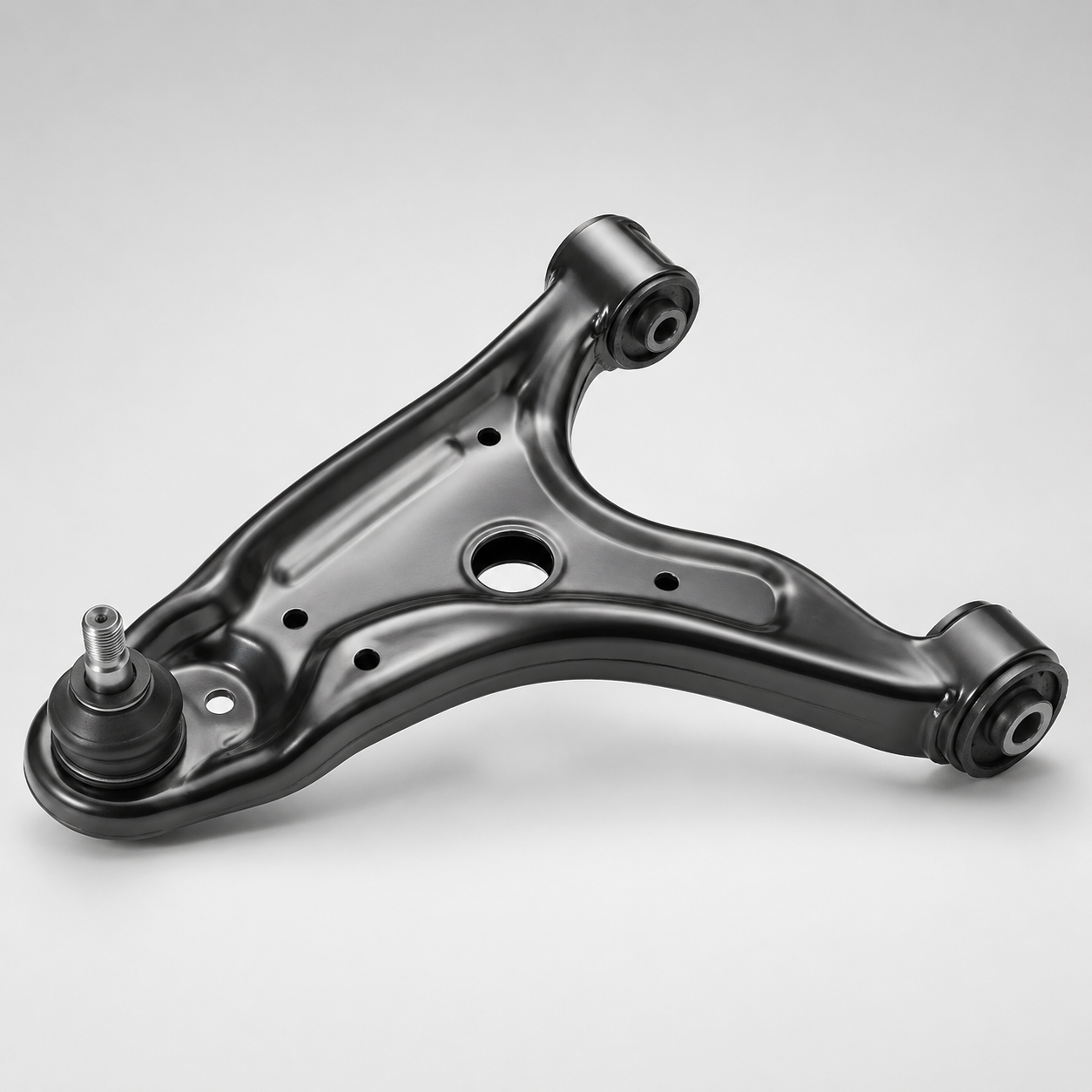
Before reviewing commercial terms, buyers should confirm whether the supplier can match the OE reference or approved master sample on the dimensions that actually decide installability:

  • Pivot centre-to-centre distance
  • Ball joint stud taper and thread size
  • Bush outer diameter and installed offset
  • Mounting hole position and bracket width
  • Overall arm profile clearance to subframe and brake components

Useful first-article limits are usually tight but realistic. Many passenger-vehicle programmes expect critical machined locations within ±0.3 mm, stamped or welded locations within ±0.5 mm, and taper geometry held to the OE reference tolerance on the drawing. If the OE drawing is unavailable, the supplier should define the approved master sample as the dimensional benchmark and state the measurement method clearly.

This is where lower control arm replacement programmes often separate strong suppliers from average ones. A small shift in one mounting point can create bolt preload during installation. A taper that is slightly wrong can slow assembly or damage confidence at the workshop. An arm profile that sits too close to surrounding hardware may pass a superficial visual check and still fail in service.

Ask for batch-level dimensional records, not just one good sample. A credible approval file usually includes first-article data, routine lot results, and a capability target such as Cpk 1.33 or better on critical-to-fit dimensions. If private labelling is part of the project, confirm whether the supplier can lock tooling, markings, and packaging by application through custom manufacturing.

Compare construction types by failure risk, not by material label

Not every arm body should be judged the same way. Lower control arm replacement parts may use stamped steel, forged steel, cast steel, or aluminium depending on the OE design. The right question is not which material sounds better. It is which construction best matches the original design intent and which manufacturing risks need controlling.

</tr></thead><tbody> </tbody></table>For buyers, that comparison changes the audit focus. A stamped arm raises questions about fixture stability and weld repeatability. A forged or cast steel arm pushes attention toward porosity, machining precision, and heat-treatment discipline. An aluminium arm demands more scrutiny around raw material quality, machining control, and crack prevention.

The wear components deserve separate evaluation because they usually decide field life faster than the arm body itself.

Bushings

Bushing performance depends on compound formulation, rubber-to-metal bond quality, and hardness consistency. A supplier should be able to state the target Shore A range and the test method used for both incoming materials and finished-part verification. In many OE-style programmes, Shore A 55-75 is common, but lower control arm replacement should follow the original application rather than a catalogue average. Buyers should also ask for compression set, ozone resistance, and bond-strength data with the relevant test standard identified.

Ball joints

The ball joint needs the correct articulation angle, preload range, and sealing performance. Housing crimp quality, stud finish, grease retention, and boot durability all matter. If the ball joint is sourced externally, ask how sub-supplier approval and lot control are handled inside the wider quality system, especially under IATF 16949:2016 and ISO 9001:2015. At minimum, the specification should cover stud taper angle, thread size, pull-out resistance, rotational torque, and boot leak resistance, with units and batch acceptance limits defined.

Ask for a validation pack that mirrors real claim exposure

Testing matters most when it answers the failures you are likely to pay for. In lower control arm replacement, that usually means fitment disputes, noise or wear complaints, corrosion claims, and safety-related concerns around joint retention.

Feature Stamped steel arm Forged/cast steel arm Aluminium arm
Typical useHigh-volume passenger vehiclesHeavier-duty or geometry-specific designsWeight-sensitive platforms
Strength-to-weight balanceModerateHigh strength, higher massGood weight reduction
Corrosion managementRequires robust coatingRequires robust coatingNeeds surface protection and process control
Manufacturing focusWeld consistency, fixture accuracyPorosity, machining accuracy, heat treatmentMaterial quality, machining accuracy
Common failure riskWeld distortion or coating lossDimensional variation or poor joint seatingCracking from weak process control

</tr></thead><tbody> </tbody></table>A good validation file is specific. It shows inspection frequency, sample size, acceptance criteria, and sample retention practice. It also explains what happens after a failure: whether the test is repeated on a fresh sample, how nonconformance is documented, and who signs off on disposition.

Salt spray data is useful, but it should not dominate the review. Typical aftermarket requests may range from 96 to 240 hours of neutral salt spray depending on coating system and destination market. Even so, lower control arm replacement decisions usually turn more on geometry retention, ball joint security, bushing durability, and how well the coating survives normal handling and installation.

For pilot approval, buyers often use 3-5 pieces for dimensional validation, 5-10 pieces for coating and assembly review, and a separate destructive sample set for durability work. Whatever the exact quantity, the supplier should define the logic in advance rather than improvising after results come back.

Where the destination market requires it, the supplier should also be ready to confirm substance compliance, including REACH (EC) No 1907/2006.

Watch these failure modes during incoming inspection

Most lower control arm replacement problems do not begin in the workshop. They begin earlier, when process drift, poor packaging, or inconsistent subcomponents slip through receiving control.

The repeat offenders are familiar:

  • Mixed bushing compounds across lots: uneven ride behaviour, NVH variation, and unpredictable service life
  • Weak welding fixture control: mounting-point shift and alignment problems
  • Insufficient anti-corrosion coverage at edges or welds: early rust complaints
  • Incorrect ball joint taper machining: difficult knuckle installation or improper seating
  • Poor packaging restraint: damaged boots, chipped coating, or handling marks in transit
  • Incomplete traceability: slow containment and weak root-cause response after returns appear

Incoming inspection should not be elaborate, but it should be disciplined. Visual checks, label verification, sampling of critical dimensions, and packaging review cover most early-warning points. For higher-volume importers, periodic cut-section review of weld areas or bush bonding adds another layer of confidence.

A practical control plan is to inspect 100% for part number, side marking, and visible coating condition, then sample critical dimensions at AQL 1.0 or tighter on routine lots. When onboarding a new supplier, many buyers temporarily tighten the gate and inspect the first three shipments in full before moving to standard sampling.

One more point is easy to overlook: left-hand and right-hand segregation. Mislabelled mirrored parts remain one of the most avoidable warehouse failures in lower control arm replacement supply, yet they still generate unnecessary returns and service delays.

Run supplier approval as a cross-functional Q-and-A

The fastest way to expose sourcing weakness is to let engineering, quality, and purchasing ask different questions about the same programme. Lower control arm replacement approval works best when the supplier must answer technical fit, durability, traceability, and commercial continuity in one pack.

Recommended approval checklist:

  • Drawing or key-dimension report against OE sample
  • Material specification for arm body, bushes, and ball joint components
  • Surface treatment description and corrosion test data
  • Ball joint and bushing durability results
  • PPAP-style documentation where agreed for programme supply
  • Batch traceability method from raw material to finished carton
  • Export packaging specification and drop/handling protection details
  • Certification details for IATF 16949:2016 and ISO 9001:2015
  • MOQ, annual volume expectation, and call-off flexibility by SKU
  • Standard lead time for stocked parts versus made-to-order lines
  • Reorder point logic and emergency replenishment option

The commercial discussion should be linked to service expectations, not treated as a separate exercise. A stocked lower control arm replacement line may carry MOQ of 50-100 units per SKU with lead times around 25-45 days. A low-run or private-label variant may move to 200-500 units per SKU and 45-75 days once packaging, marking, and pre-shipment control are included.

Price breaks at 100, 300, and 500 units are worth requesting because list price alone rarely shows the full landed-cost picture. If the buyer needs two-week replenishment, a slightly higher unit price can still be the cheaper model once backorders, lost workshop capacity, and customer churn are considered.

Approval should therefore end with operational questions, not just lab results. Can the supplier hold buffer stock? Support split shipments? Keep the same part number stable across reorder cycles without engineering drift? If the range covers many vehicles, the application structure inside our catalog should also be clear by platform, engine, and production year to reduce ordering mistakes.

Driventus supports aftermarket and private-label supply with controlled manufacturing, dimensional inspection, and export documentation. Application-specific packaging, bundled hardware, and customised marking can be built into project review before SOP.

Use this benchmark when comparing one supplier against another

When buyers compare lower control arm replacement sources side by side, the broadest SKU count is rarely the best predictor of success. A better benchmark is repeatability: the ability to deliver the same fit, wear behaviour, and documentation quality shipment after shipment.

Prioritise suppliers that can show:

  • Consistent dimensional conformity across batches
  • Controlled bushing hardness and bond quality
  • Verified ball joint retention and articulation performance
  • Corrosion protection suited to the target region
  • Traceable production records linked to shipment lots
  • Responsive engineering support for private-label or programme changes
  • Clear commercial terms for MOQ, price breaks, and lead-time commitment

That combination reduces returns, shortens installation time, and makes warranty handling less expensive. In practice, lower control arm replacement is won by process control as much as by product design.

If a source offers aggressive pricing but weak evidence on fitment, durability, or traceability, the savings are usually temporary. If a source can prove repeatability, the programme is easier to scale.

To discuss current requirements, fitment review, or a private-label chassis programme, use request a quote.

Frequently asked questions

Ask for dimensional inspection data, material details, ball joint and bushing test results, corrosion test records, the traceability method, packaging specification, MOQ and lead-time confirmation, and certification status under IATF 16949:2016 and ISO 9001:2015.

The most common issues are incorrect geometry, ball joint taper mismatch, inconsistent bushing hardness, weak coating coverage, and shipping damage to boots or painted surfaces. These problems typically lead to fitment complaints, noise concerns, or premature wear claims.

No. Corrosion data is useful, but it does not confirm fitment accuracy or joint durability. Buyers should review dimensional records, retention tests, articulation checks, and bushing bond performance alongside coating results.

If you are comparing suppliers for chassis and suspension programmes, Driventus can provide technical review, sample support and export supply information. Contact our team here: /contact.html

Request a Quote
Test area What it checks Typical buyer concern addressed
CMM or fixture inspectionMounting geometry and critical dimensionsFitment disputes and alignment issues
Ball joint pull-out/push-out testingJoint retention integritySafety-related failure risk
Articulation torque testingJoint movement within specified rangeSteering feel and premature wear
Bushing bond testingRubber-to-metal adhesionNoise, vibration and early separation
Salt spray testingCoating corrosion resistancePremature rust in coastal or winter markets
Fatigue or road-load simulationCyclic durability under loadWarranty exposure in fleet service