diagnostics · 2026-06-04

How to Diagnose a Cracked Cylinder Head: Symptoms and Checks

A cracked cylinder head can show up as coolant loss, white exhaust smoke, misfire, hard starting, oil contamination, or repeat overheating. For procurement teams, workshop managers, rebuilders, and warranty teams, the key is to confirm the failure mode before approving replacement. Misdiagnosis can lead to avoidable returns, claim rejections, duplicate labour, and disputes when the real cause was a head gasket, injector seal, thermostat, radiator restriction, pressure cap fault, torque error, or an earlier overheating event. This guide explains how to diagnose cracked cylinder head issues using symptom pattern analysis, cooling-system pressure testing, combustion-gas checks, compression and leak-down testing, borescope inspection, and bench testing after removal. It also explains when repair is not technically defensible and replacement is the lower-risk sourcing decision. Driventus is an independent aftermarket manufacturer; brand names are referenced for fitment only. Our components and processes are produced under IATF 16949:2016 and ISO 9001:2015 quality controls, with material and compliance practices aligned to REACH (EC) No 1907/2006 where applicable.

Common symptoms that point to a cracked head

The first step in diagnosing a suspected crack is separating cylinder-head damage from head gasket failure, injector faults, EGR cooler leakage, oil cooler failure, or ordinary cooling-system leakage. A cracked cylinder head rarely shows up as a single isolated symptom. More often, the complaint appears as a repeatable pattern across coolant behaviour, combustion quality, oil condition, exhaust appearance, and temperature stability.

Typical signs include:

  • Unexplained coolant loss with no visible external leak from hoses, radiator, heater core, water pump, cap, or expansion tank
  • White exhaust vapour after warm-up, especially if it has a sweet coolant smell and does not disappear like normal cold-start condensation
  • Milky oil, a rising oil level, or oil contamination in the coolant reservoir
  • Persistent overheating after thermostat, fan, radiator, cap, and water-pump checks have been completed
  • Rough idle, misfire, or hard starting that repeatedly follows one cylinder after plug, coil, injector, and wiring checks
  • Bubbles in the expansion tank during cranking, snap-throttle, or acceleration testing
  • Residual pressure in the cooling system after the engine has cooled fully
  • One spark plug, glow plug, piston crown, or combustion chamber that appears unusually clean from coolant steam cleaning

A cracked cylinder head often behaves differently as the engine warms up. A fine crack may seal when cold, open as the metal expands, and leak only under combustion pressure. In other cases, coolant may seep into a cylinder after shutdown, causing a rough start, white smoke, or a temporary misfire that clears after a few seconds. A gasket leak can create similar symptoms, so one symptom alone is not enough.

Document the complaint before testing: mileage, overheating history, recent gasket work, coolant type, pressure-cap rating, oil condition, DTCs, and whether coolant loss occurs under load or after overnight parking. For B2B claims, this record matters because it helps distinguish a part-quality issue from an installation error or upstream cooling-system failure. If the engine has repeated overheating history, the risk of head distortion and heat-related cracking rises sharply.

Step-by-step diagnostic checks

Use a structured sequence so the result is repeatable and defensible. Move from low-intrusion checks to more conclusive tests before removing the cylinder head. That reduces unnecessary teardown and gives procurement and warranty teams better evidence when deciding whether to replace, remanufacture, or reject a return claim.

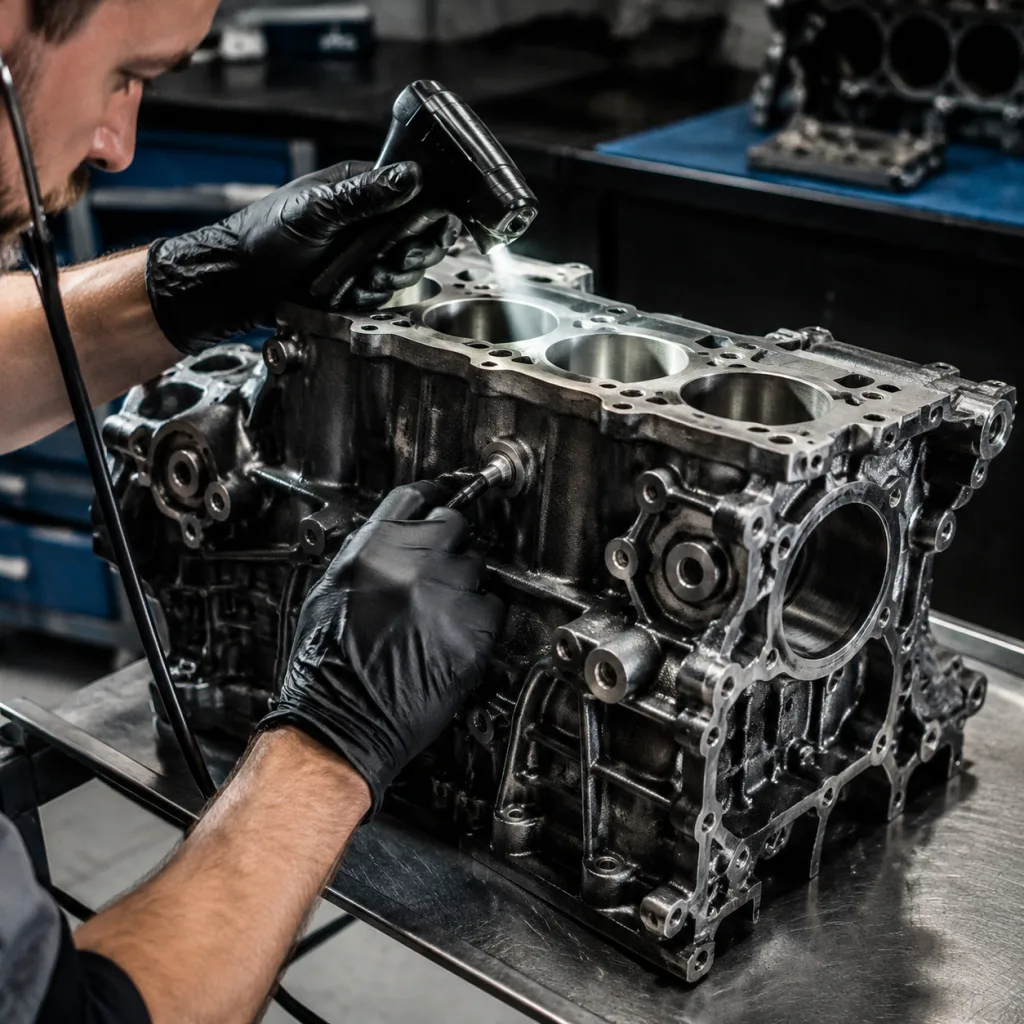
1. Confirm the complaint: road-test if safe, monitor temperature, check for misfire codes, and note when white smoke, coolant loss, or pressure build-up occurs. 2. Visual inspection: inspect hoses, clamps, cap, radiator, water pump, heater core, thermostat housing, expansion tank, freeze plugs, oil cooler, and EGR cooler. A visible external leak must be corrected before an internal leak is assumed. 3. Cooling-system pressure test: pressurise the system to the specified cap rating on a cold engine and observe pressure decay. Inspect externally first, then remove spark plugs or injectors where appropriate and check whether coolant appears in a cylinder. 4. Hot pressure observation: after warm-up, watch for rapid pressure rise, bubbling, or coolant ejection. Combustion pressure entering the cooling system can raise pressure faster than normal thermal expansion. 5. Combustion-gas test: use a block tester or exhaust-gas analyser at the expansion tank or radiator neck to confirm whether combustion gases are present in the coolant. A positive result supports internal leakage, but it does not prove whether the cause is a crack or a gasket. 6. Compression test: compare all cylinders for abnormal low readings. One low cylinder, or two adjacent low cylinders, should be interpreted with gasket, valve, ring, and head-crack possibilities in mind. 7. Leak-down test: bring the suspect cylinder to top dead centre on compression and listen for air escaping through the intake, exhaust, crankcase, or cooling jacket. Bubbles in the coolant during leak-down are a strong sign of a combustion-to-coolant path. 8. Borescope inspection: look for steam-cleaned piston crowns, coolant droplets, rust marks, washed cylinder walls, or a clean patch near a valve seat. Compare all cylinders rather than judging one image in isolation. 9. Oil and coolant checks: inspect for emulsion, oil film in the reservoir, abnormal coolant smell, and evidence that an oil cooler or coolant-to-oil heat exchanger has not caused the contamination.

If one cylinder repeatedly shows low compression, coolant traces, bubbles during leak-down, and no external leak, remove the head for bench inspection. That is usually the most reliable way to confirm how to diagnose cracked cylinder head damage instead of inferring it from vehicle behaviour alone. Record test values, engine temperature, pressure-test duration, and photographs before removal; those details are useful for warranty assessment, supplier communication, and fleet maintenance history.

Bench inspection and crack confirmation

Once the head is removed, clean it thoroughly before inspection. Carbon deposits, gasket residue, sealant, corrosion, and coolant scale can hide fine fractures. Use the correct cleaning method for the material: aggressive blasting or careless scraping can damage aluminium surfaces, alter measured flatness, or obscure the original failure evidence. Before machining, mark the suspect cylinder and photograph the chamber, gasket face, deck, valve area, and coolant passages.

Use the following checks:

</tr></thead><tbody> </tbody></table>Common crack locations vary by material and combustion load. Aluminium heads often crack between valve seats, from a valve seat to a spark-plug or injector bore, or from a combustion chamber into a water jacket. Diesel heads can also crack around injector bores and pre-combustion chambers because of local heat concentration. Cast iron heads may crack near exhaust bridges, bolt holes, or freeze-damaged coolant passages. The exact location matters because a surface blemish outside a loaded sealing area is very different from a crack that connects combustion pressure to coolant.

Pressure testing is especially important because not every crack is visible at room temperature. A professional test may seal the coolant passages, apply controlled air pressure, and check for bubbles or pressure loss while submerged or under wet inspection. If the head leaks only when heated, the bench test should simulate that condition where the equipment allows it.

A crack that reaches the water jacket is generally not suitable for simple resurfacing. If the head has local hot spots, valve-seat movement, excessive corrosion around coolant ports, repeated distortion, or a pressure leak after cleaning and retest, replacement is usually more reliable than repair. For sourcing teams, the bench report should identify the crack location, inspection method, pressure-test result, flatness result, and whether the failure is consistent with overheating, freeze damage, casting porosity, or installation-related stress.

Cracked head versus head gasket failure

These faults are often confused because both can allow combustion gas, coolant, and oil to move where they should not. The repair path is different, and so is the sourcing decision. A gasket failure is more common after overheating, uneven torque, incorrect bolt reuse, poor surface finish, block-deck distortion, liner protrusion errors, or contamination during assembly. A cracked head is a base-material or heat-damage failure in which the metal itself has opened a leakage path.

Practical distinctions

  • Gasket failure often affects two adjacent cylinders, one fire ring, or one coolant passage and one cylinder.
  • Cracked head may show intermittent symptoms that worsen as metal expands under heat and load.
  • Gasket failure can sometimes be corrected if the head and block are within flatness limits and the fasteners, torque sequence, and surface finish are correct.
  • Cracked head usually requires replacement if the crack enters a combustion chamber, valve-seat area, injector bore, or water jacket.
  • Gasket failure often leaves witness marks on the gasket, including fire-ring breach, coolant tracking, or localised erosion.
  • Cracked head may leave a clean cylinder, repeated pressure-test loss, or a visible fracture after dye penetrant, magnetic particle, or pressure inspection.

The removed gasket should always be inspected together with the head and block. Look for combustion tracking, fretting, incorrect gasket thickness, damaged dowels, pulled threads, uneven bolt stretch, and surface finish problems. A new head installed on a distorted block or with an unresolved cooling restriction may fail again, which can be misread as a defective replacement part.

For procurement teams, this distinction matters because a head returned as defective may actually be a gasket, installation, overheating, or cooling-system issue upstream. That creates unnecessary warranty cost and distorts failure analysis. The objective is to confirm the root cause before ordering a replacement from our catalog, approving a claim, or planning a remanufacture decision. A reliable diagnosis should combine in-vehicle symptoms, test data, teardown evidence, and bench inspection rather than relying on the phrase "blown head" as a catch-all description.

Replacement decision and sourcing checks

If diagnosis confirms cracking, the next step is to verify whether the head is repairable, remanufacturable, or must be replaced. The decision should account for crack location, material, engine duty cycle, machining allowance, availability, downtime cost, and the risk of repeat failure. A head for a fleet, distributor programme, or workshop chain should not be sourced on price alone; dimensional accuracy and test evidence matter more when labour, warranty handling, and vehicle downtime are included.

Key sourcing checks include:

  • Material type: aluminium or cast iron, including any application-specific heat-treatment or casting requirements
  • Valve-train configuration: SOHC, DOHC, pushrod, cam-carrier design, hydraulic or mechanical lash arrangement
  • Fuel-system interface: petrol, diesel, direct injection, injector bore design, glow-plug or spark-plug location
  • Cooling-passage layout and combustion-chamber geometry
  • OE cross-reference, for example OE 06A107065 when applicable to the application
  • Casting number, engine code, production year range, and emission-standard variant
  • Valve-seat, guide, cam-bore, and deck-face condition if supplying a bare or semi-finished head
  • Surface finish and flatness requirements after machining
  • Pressure-test status and inspection records
  • Packaging strength, corrosion protection, and transit-damage controls

For B2B buyers, replacement heads should be evaluated against dimensional match, machining allowance, and traceability. Confirm whether the supply requirement is for a bare casting, machined bare head, assembled head, or application-ready unit with valves, springs, seals, cam hardware, plugs, and fittings. The wrong supply level can create assembly delays even when the casting itself is correct.

It is also important to confirm what evidence accompanies the part. Useful supplier documentation may include batch identification, material specification, pressure-test result, machining inspection, visual inspection record, and corrective-action process for nonconforming parts. If the programme requires a bespoke casting, custom manufacturing may be appropriate. If you are validating a supplier, review the quality system for inspection controls, test records, calibration discipline, packaging validation, and corrective-action process. Driventus is an independent aftermarket manufacturer; brand names are referenced for fitment only.

When to stop repair and replace the part

A repair attempt is only sensible when the crack location, engine application, and post-repair test result support long-term reliability. Welding, stitching, seat replacement, or local machining may be possible in limited cases, but these processes can introduce distortion, alter heat treatment, or leave a hidden leak path. For high-duty commercial use, warranty-sensitive programmes, or engines with expensive labour exposure, replacement is often the lower-risk decision once a structural crack is confirmed.

A head should usually be replaced when one or more of the following are present:

  • Crack enters a combustion chamber or coolant jacket
  • Crack extends into an injector bore, spark-plug hole, valve bridge, or critical sealing face
  • Seat area is fractured, loose, recessed, or moving under heat
  • Pressure test shows repeated leakage after cleaning and retest
  • Machining would remove too much material to remain within service limits
  • Cam bores, bolt bosses, or deck surface show distortion beyond the available correction range
  • Corrosion around coolant passages prevents reliable gasket sealing
  • The head has suffered repeated overheating and measurable distortion
  • Previous repair has failed or created additional distortion
  • Repair cost approaches the cost of a validated replacement

Published service literature and workshop practice vary by engine family, so use the vehicle maker's repair procedure where available and verify the actual part condition. Do not assume that resurfacing solves a cracked head; resurfacing corrects deck finish and flatness, while a crack is a material-continuity problem. After replacement, address the upstream cause as well: blocked radiator cores, weak caps, non-operating fans, incorrect coolant mix, stuck thermostats, air pockets, injector over-fuelling, and exhaust restrictions can all contribute to repeat overheating.

For buyers, a supplier should be able to provide traceability, test evidence, and consistent packaging to reduce transit damage and returns. Workshop documentation should include test results before removal, bench confirmation, photographs, and the reason repair was rejected. That record protects both sides of the transaction and makes future failure analysis cleaner. If you need programme support or a quotation, you can request a quote.

Frequently asked questions

A cooling-system pressure test combined with a combustion-gas test is the fastest first pass. It will not prove a crack on its own, but it narrows the fault before removal and helps decide whether compression, leak-down, borescope, or bench inspection is needed next.

Only in limited cases. Small surface cracks outside combustion and coolant paths may be repairable by a qualified specialist, but cracks into a chamber, injector bore, valve-seat area, or coolant jacket usually justify replacement because the risk of repeat leakage is high.

Confirm compression balance, leak-down direction, combustion-gas presence, gasket witness marks, deck flatness, and bench pressure-test results. If the same symptom returns after a correct gasket replacement, inspect the head for cracking, distortion, and coolant-passage leakage.

If you need a verified replacement path, technical clarification, or sourcing support, contact Driventus through /contact.html.

Request a Quote
Check method What it shows What to look for
Dye penetrantSurface-breaking cracks on non-porous materialsFine lines around valve seats, injector bores, pre-combustion areas, spark-plug holes, or coolant passages
Magnetic particle inspectionFerrous crack detectionSurface and near-surface defects on cast iron heads, especially around exhaust bridges and bolt bosses
Pressure testingInternal passage leakagePressure loss, wet spots, bubbles under submerged testing, or seepage between coolant and combustion areas
Vacuum testingValve-seat and port sealing conditionLeakage past seats that may be unrelated to a crack but can explain compression complaints
Straightedge and feeler gaugeWarpage across deck faceDistortion that exceeds the engine maker's service limit, often after overheating
Surface roughness checkGasket sealing readinessFinish that is too rough, too smooth, grooved, or locally damaged for the specified gasket type
Seat and guide inspectionHeat damage and mechanical movementLoose seats, valve recession, guide movement, localised cracking, or metal transfer