Camshaft Phaser Hyundai Manufacturer China Sourcing
Camshaft phasers for Hyundai-fit engines are precision variable valve timing components, not generic rotating parts. Buyers sourcing from China need evidence of dimensional control, oil-pressure response, locking-pin function, and repeatable assembly cleanliness. Driventus Auto Parts manufactures engine and powertrain components in Taizhou, Zhejiang, and supplies aftermarket distributors, OEM/Tier-1 programmes, and repair chain procurement teams in more than 60 countries. For a camshaft phaser Hyundai manufacturer China sourcing project, the priorities are practical: stable drawings, controlled metallurgy, validation records, and export documentation that stand up to buyer audits. Driventus is an independent aftermarket manufacturer; brand names are referenced for fitment only. This article outlines what procurement teams should verify before issuing an RFQ, including production scope, MOQ, lead time, quality standards, and cross-reference handling for Hyundai-fit applications.
What procurement teams should verify before sourcing
A camshaft phaser changes camshaft angle relative to the crankshaft using engine oil pressure controlled by the VVT solenoid. For Hyundai-fit applications, sourcing risks typically show up as vane leakage, weak return spring torque, poor lock-pin release, noisy cold starts, and unstable phase response after thermal cycling.
Before placing a trial order, buyers should request the following evidence:
- Application list by engine family, year range, intake/exhaust position, and chain or belt timing layout.
- OE-style cross-reference format where relevant, such as OE 06A… or OE 11251… conventions only when provided in buyer data.
- 2D drawing with critical dimensions and tolerance zones.
- Material specification for rotor, stator, sprocket, cover plate, spring, seal and locking pin.
- Functional test data for locking, leakage, phasing angle, response time and noise.
- Process flow from incoming material to CNC machining, heat treatment, washing, assembly and final inspection.
- Packaging specification for sea freight, air freight or distributor shelf stock.
A supplier should also confirm whether the part is intended for aftermarket replacement, private label distribution, or an OEM/Tier-1 development route. These channels require different documentation depth and different launch timelines.
For buyer-side due diligence, ask for a sample gate package that shows the exact part number, test date, operator ID, gauge list, and measured values for at least 3 pieces per lot. A credible supplier should be able to explain what happens when one characteristic drifts out of spec, how quarantine is triggered, and how replacement stock is controlled before shipment.
Driventus manufacturing scope for Hyundai-fit camshaft phasers
Driventus produces camshaft phasers and related engine timing components as part of its engine component range. Buyers can review adjacent product families through our catalog and engine-specific categories at [/products/engine-components.html].
For Hyundai-fit phaser projects, the typical manufacturing scope includes CNC-machined sprockets, precision rotor and stator assemblies, controlled spring loading, locking pin fitting, oil passage cleaning, and end-of-line functional testing. We can supply neutral-pack aftermarket products, customer-labelled packaging, or drawing-controlled parts through custom manufacturing when buyer drawings and validation plans are available.
Typical sourcing parameters are:
| Item | Standard supply approach | |
|---|---|---|
| Product type | Intake and exhaust camshaft phasers for selected Hyundai-fit engines | |
| Buyer type | Aftermarket distributor, wholesaler, Tier-1 buyer, repair chain sourcing team | |
| MOQ | Usually 300-500 pieces per reference after sample approval | |
| Sample lead time | 25-45 days, depending on tooling and stock status | |
| Mass production lead time | 45-75 days after deposit, packaging approval and QC file release | |
| Documentation | Inspection report, material declaration, packaging data, batch traceability | |
| Packaging | Neutral box, customer artwork, bulk tray, or export carton |
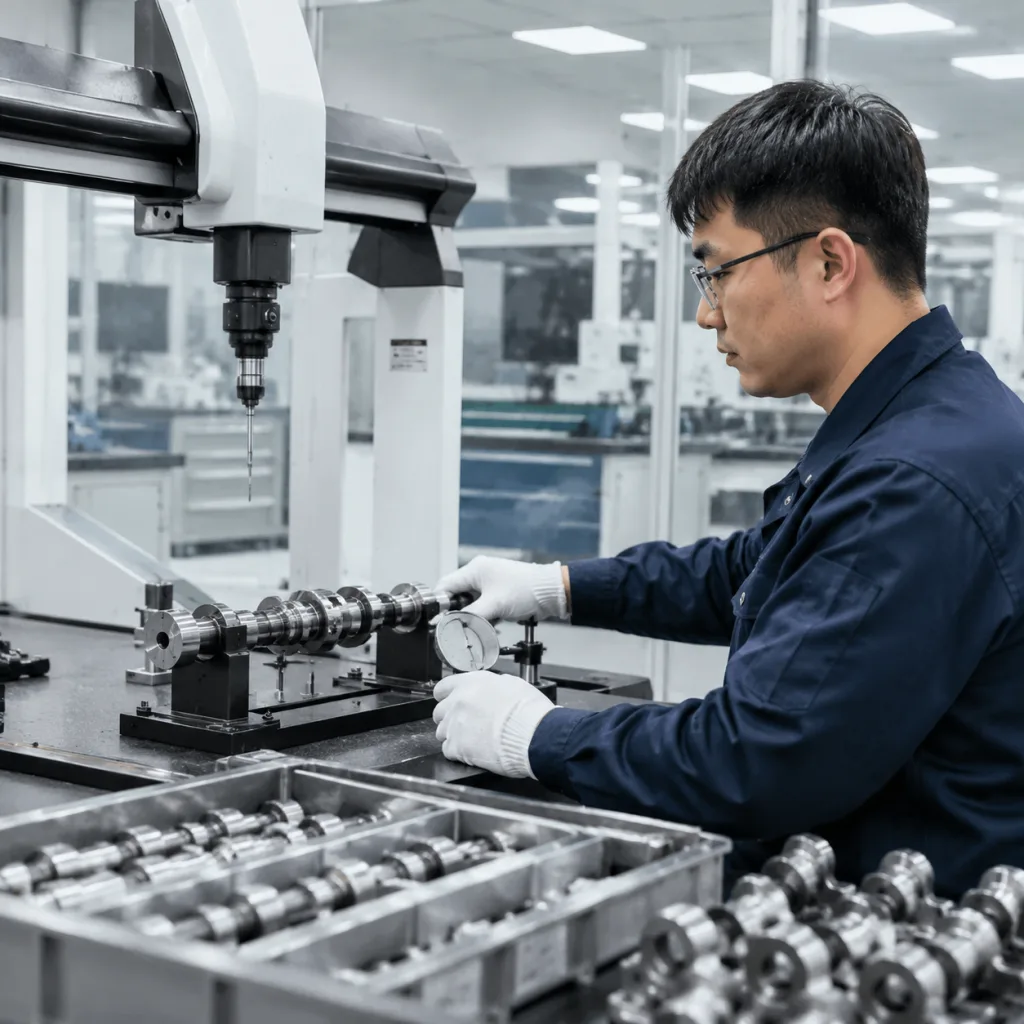
| Characteristic | Why it matters | Common control method |
|---|---|---|
| Sprocket tooth profile | Timing chain engagement and noise | Profile gauge or CMM sampling |
| Rotor-to-stator clearance | Leakage and response stability | Precision measurement and functional test |
| Lock pin height | Cold-start locking and release | Height gauge and oil-pressure release test |
| Sealing surface finish | Internal leakage control | Surface roughness inspection |
| Assembly cleanliness | Prevents oil control blockage | Washing process control and visual inspection |
| Angular travel | Correct valve timing range | Functional test bench |
| Evaluation point | What to ask | Procurement impact |
|---|---|---|
| MOQ flexibility | Can samples, pilot lots and mixed references be combined? | Reduces launch stock risk |
| Tooling ownership | Who owns new fixtures, gauges or dies? | Affects long-term control and transferability |
| Batch traceability | Are production date, lot and test records linked? | Supports claims analysis |
| Audit access | Can the factory support on-site or remote audits? | Confirms process capability |
| Export experience | Which documents are supplied for EU, UK, US, Canada, Australia or Brazil shipments? | Reduces customs and receiving delays |
| After-sales response | What is the claim review process? | Improves distributor service level |