tensioner pulley · 2026-06-17

How to Choose a Tensioner Pulley Supplier

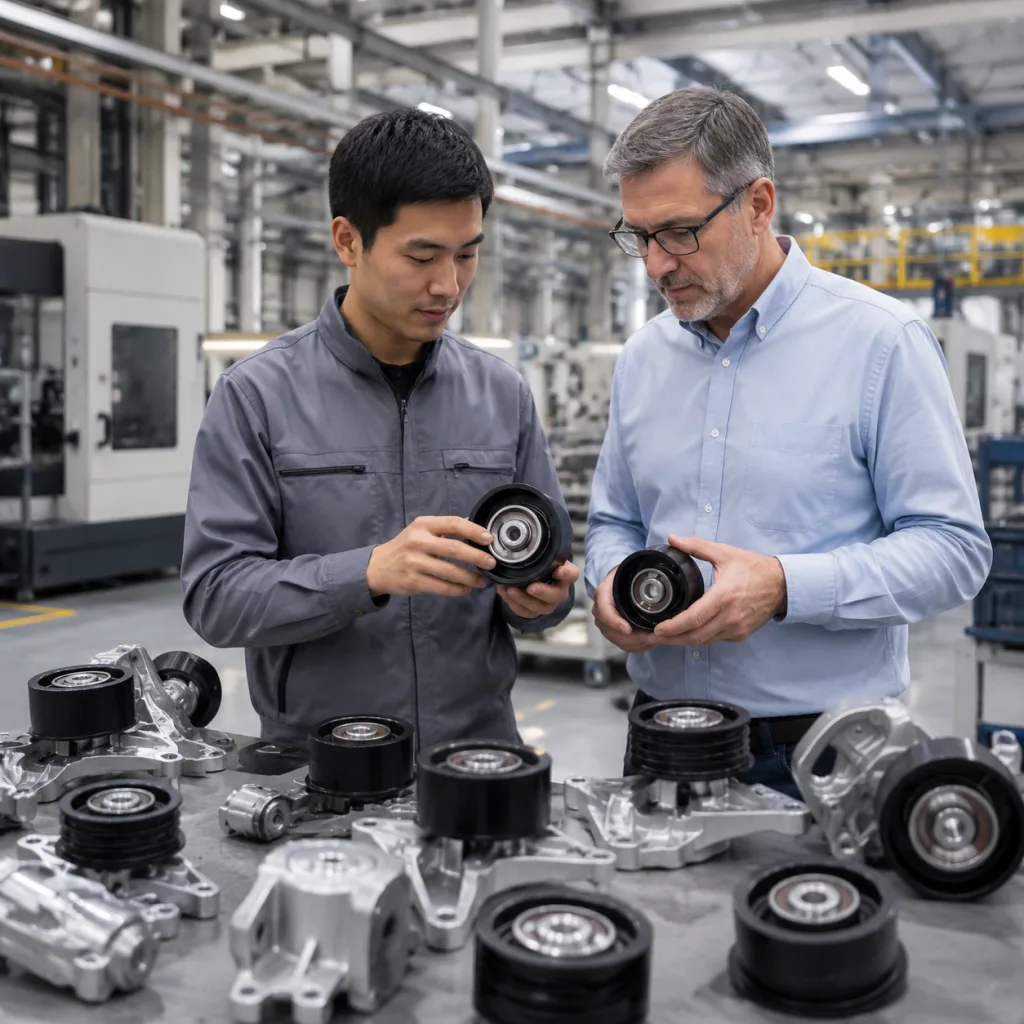
A tensioner pulley looks simple until a bearing growls, an offset drifts, a groove runs out, or a plastic wheel deforms after heat exposure. For importers, repair-chain buyers, and sourcing engineers, the supplier decision should not start with the cheapest catalogue match. It should start with proof: fitment data, controlled dimensions, validated bearing performance, traceable lots, export-safe packaging, and repeatable production across engine families. This article reframes how to choose a tensioner pulley supplier as a sourcing decision with engineering consequences. Use it during RFQ screening, sample approval, and factory audit to separate capable manufacturers from catalogue sellers. Driventus manufactures engine and powertrain components in Taizhou, Zhejiang, and exports to 60+ countries. Driventus is an independent aftermarket manufacturer; brand names are referenced for fitment only.

Decision Point 1: Can the Supplier Prove the Pulley Fits?

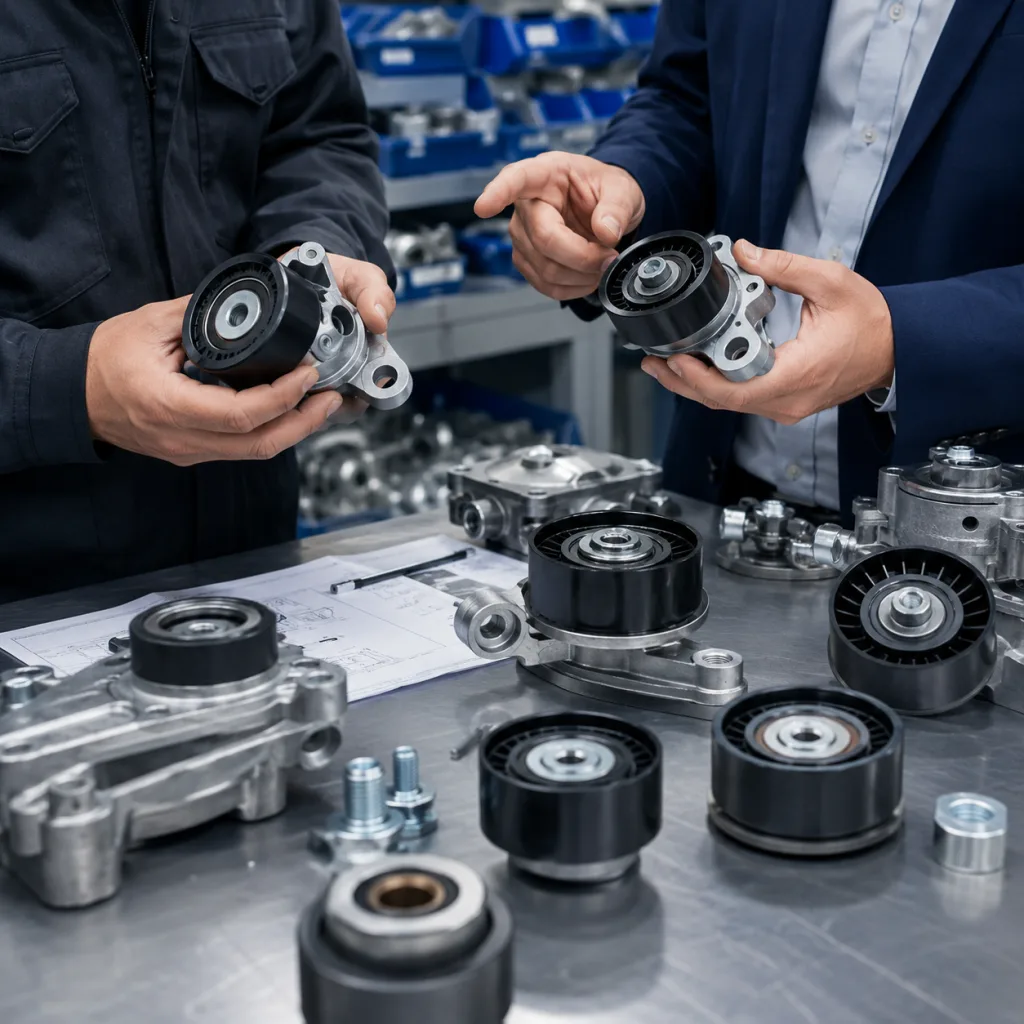
Fitment is the first filter because a pulley can look correct and still fail on the engine. Ask the supplier to prove the full application range you need, including fixed idler pulleys, automatic tensioner pulley assemblies, overrunning alternator pulleys, and pulley-bearing subassemblies for timing, auxiliary, or serpentine drives.

A usable fitment file should show:

  • Vehicle make, model, engine code, year range, belt position, and drive type
  • OE part-number cross-references already used in your data set, such as OE 06A… or OE 11251… where relevant
  • Pulley outside diameter, width, bore, offset, groove count, pitch, and bearing designation
  • Functional dimensions with tolerances, such as OD ±0.10 mm, width ±0.10 mm, bore H7 or a defined press-fit range, and offset ±0.20 mm for tight belt-alignment applications
  • Material, including PA66-GF30, PA66-GF35, stamped steel with zinc coating, machined steel, or aluminium alloy
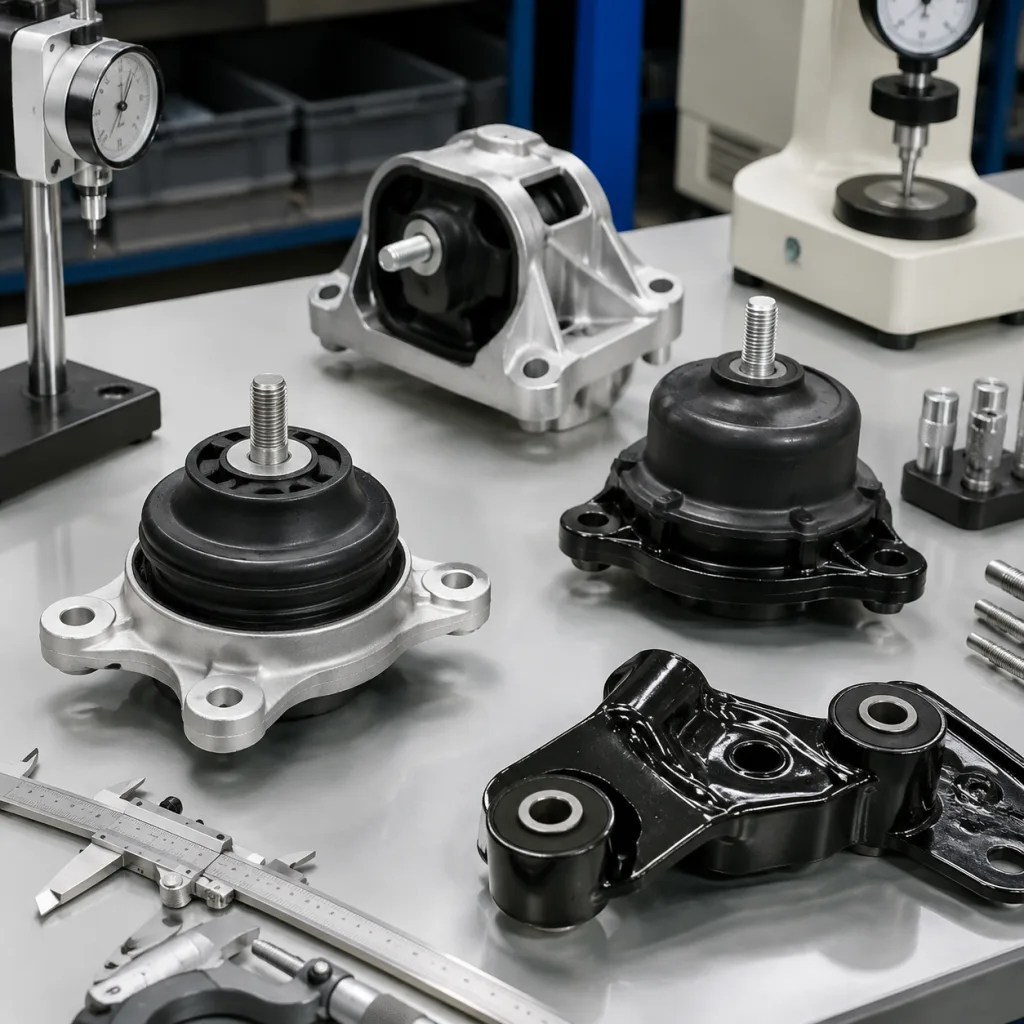
  • Supply format: pulley only, pulley with bearing, or complete tensioner assembly with bracket, spring, damper, bolt, and dust cover

Reject approvals based only on photos or catalogue interchange. A 1 mm offset error can create belt edge wear, noise, misalignment, abnormal bearing load, and early belt failure. A bearing with the same external size can also be wrong if internal clearance, grease, seal design, or load rating differs from the application.

For a broad aftermarket programme, compare your target SKUs against measured drawings, not images. You can review our catalog as a reference, but the approval question remains the same: which dimensions control belt alignment, which bearing specification is used, and which SKUs share tooling, bearings, or packaging?

Where Tensioner Pulley Suppliers Usually Fail

Most supplier failures do not start with one dramatic defect. They start with weak process ownership: one company quotes, another moulds or stamps, a third sources bearings, and nobody can explain the control points.

Use this audit table during pre-qualification:

</tr></thead><tbody> </tbody></table>Then ask the factory to name its safety- and function-critical characteristics. Typical answers should include bore size, bearing press-fit, pulley runout, groove geometry, bracket interface, assembled height, bolt torque interface, spring torque, damping performance, and bearing rotation noise.

For moulded pulleys, go deeper: glass-fibre content, moisture conditioning, mould temperature, shrinkage, and insert location. For steel pulleys, check forming cracks, coating thickness, concentricity, weld quality where applicable, and post-plating corrosion risk. If the supplier cannot discuss these issues in process terms, the risk is not theoretical. It may simply be waiting for installation.

Documentation That Actually Reduces Sourcing Risk

Certificates help only when they match the manufacturing site and product scope. A trading certificate, expired certificate, or general export certificate does not prove that pulley production is controlled.

Start with IATF 16949:2016 or ISO 9001:2015, then verify the issuing body, site address, scope, and expiry date. For European Union supply, material compliance declarations may also be needed under REACH (EC) No 1907/2006. If your market has specific labelling, packaging, substance, or importer-documentation rules, include them in the purchase specification before quotation.

A strong supplier file should include:

  • IATF 16949:2016 or ISO 9001:2015 certificate covering automotive component manufacturing
  • Control plan for the pulley or tensioner assembly family, with critical characteristics marked
  • PFMEA or equivalent risk review covering bearing press-fit, runout, noise, cracking, corrosion, mixed parts, and wrong labelling
  • Incoming inspection records for bearings, springs, brackets, fasteners, dampers, grease, seals, and moulded or stamped parts
  • Production part approval documents when required by OEM, Tier-1, fleet, or private-label customers
  • Gauge calibration records for micrometers, bore gauges, height gauges, runout testers, torque tools, spring testers, hardness testers, salt-spray equipment, and noise equipment
  • Non-conforming product procedure with corrective action examples from real production issues

Set the record-retention rule before placing the order. For example, require each production batch to keep inspection records for 3–5 years, retain first-piece and last-piece results for each shift, and identify lots by part number, production date, assembly line, bearing lot, and operator or inspector code.

For higher-volume programmes, ask for Cpk or Ppk data on key dimensions such as offset, bore, runout, and assembled height. A stable process should usually target Cpk ≥1.33 for critical characteristics unless your project specification says otherwise.

Driventus operates under IATF 16949 and ISO 9001 controls. Buyers can review our quality system as part of supplier screening and use the same evidence list when comparing other factories.

Documentation That Actually Reduces Sourcing Risk

Spec Deep-Dive: What the Test Report Must Prove

Testing should connect the drawing, the batch, and the approval decision. If a supplier sends a report that says only “tested OK,” it is not a validation record. It is a statement.

A useful report identifies the part number, drawing revision, batch, bearing lot, sample size, test duration, acceptance criteria, and failure mode. It should cover the pulley and, where relevant, the complete tensioner assembly under load, speed, temperature, and contamination conditions that reflect engine use.

Key validation points include:

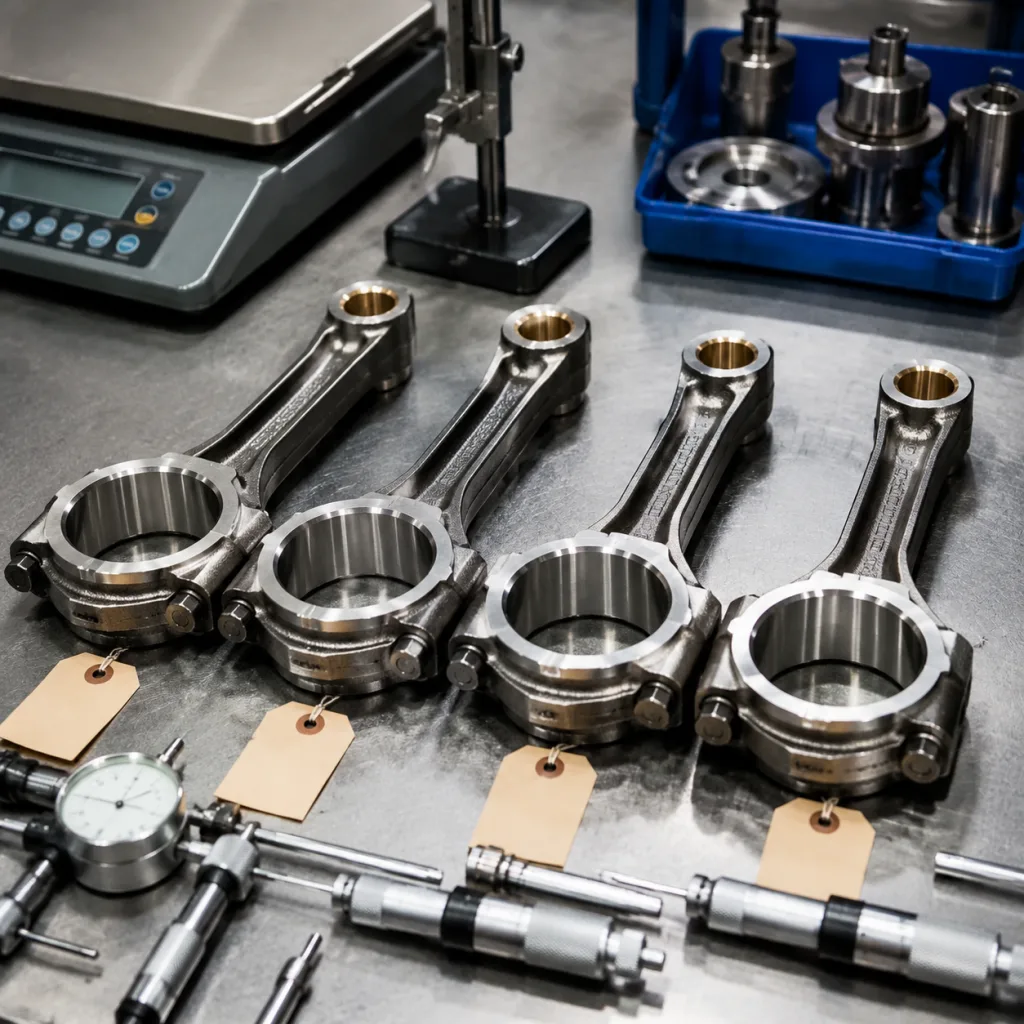
  • Dimensional inspection against drawing: bore, outside diameter, width, offset, groove profile, assembled height, bracket holes, and bolt interface
  • Radial and axial runout after bearing press-fit or final assembly, often controlled in the 0.05–0.15 mm range depending on pulley diameter and application
  • Bearing rotation noise, starting torque, and running torque, with limits recorded in N·cm or mN·m rather than judged only by hand feel
  • Bearing seal integrity and grease retention after speed, temperature, and contamination exposure
  • High- and low-temperature cycling for plastic pulley stability, such as -40°C to 120°C or the range defined by the target application
  • Salt spray or corrosion checks for steel components, with coating thickness and red-rust acceptance criteria stated
  • Belt tracking on a representative engine layout or bench fixture, checking belt wander, edge contact, noise, vibration, and pulley temperature rise
  • Endurance testing under specified radial load and rotational speed, with load, speed, duty cycle, ambient temperature, and stopping criteria recorded

Ask for before-and-after values: runout, bearing torque, noise grade, surface condition, grease leakage, crack inspection, and dimensional change after thermal exposure. If the supplier claims a 100,000 km equivalent endurance result, request the conversion logic: radial load, rpm, duty cycle, temperature, total hours, and failure definition.

Also watch for irrelevant standards. SAE J2527 is commonly associated with brake dynamometer testing, not tensioner pulley validation. ECE R-83 applies to vehicle emissions, not pulley durability. When irrelevant standards replace real dimensional, endurance, or bearing-performance data, treat it as a warning sign.

Price Comparison: Cheap Quote or Controlled Risk?

A low unit price can hide expensive risk: mixed shipments, unstable dimensions, weak carton protection, unclear bearing substitution, and high return rates. Compare suppliers with a technical-commercial score, not a price sheet alone.

Failure mode to prevent What to request Practical acceptance point
Hidden outsourcingProcess flow chart, equipment list, and subcontractor listCritical steps identified, with in-house control or approved outsourcing
Bearing substitutionBearing drawing, clearance class, seal type, grease class, load rating, and approved supplier recordSame specification used for samples and mass production
Dimensional driftDrawing with tolerances, inspection plan, and gauge listCritical dimensions measured by batch, not only during sample stage
Press-fit damageHousing bore tolerance, press force range, and fixture designBearing seated squarely without race deformation or brinelling
Lost traceabilityBatch code format, lot traveller, and retention periodShipment traceable to bearing lot, moulding or stamping lot, and assembly date
Export damageDrop-test method, anti-rust protection, bag type, carton strength, and export pallet specificationParts survive export handling without corrosion, dents, mixed SKUs, or label loss
Unapproved changesWritten process for material, bearing, tool, grease, seal, or coating changesBuyer approval required before functional changes enter shipment

</tr></thead><tbody> </tbody></table>Build the quotation around real order economics. For mature fast-moving SKUs, MOQ may be one export carton, one pallet, or 100–500 pieces depending on part size and packing density. For slow-moving or custom SKUs, MOQ may be driven by bearing purchase quantity, resin colour batch, stamping setup, mould changeover, or private-label carton printing. In those cases, 500–2,000 pieces can be reasonable if the supplier explains the cost driver.

Use price breaks to expose manufacturing logic. Ask for 100, 300, 500, 1,000, and 3,000 pieces per SKU. Separate tooling, sample, packaging, inspection, and freight-preparation costs where relevant. Confirm whether the price includes the specified bearing brand or grade, grease, seal type, coating, bolt, dust cover, inner box, barcode label, master carton, pallet, and export mark.

For private-label programmes, confirm carton artwork control, barcode format, pallet dimensions, country-of-origin marking, and spare-label management. For OEM or Tier-1 projects, check whether the supplier can support APQP-style milestones, drawing reviews, material approval, production trial review, and engineering change control. Driventus supports custom manufacturing for buyers who need a specific pulley geometry, bearing specification, material choice, or packaging configuration.

Price Comparison: Cheap Quote or Controlled Risk?

Step-by-Step RFQ and Sample Approval Workflow

The cleanest way to choose a supplier is to make every candidate answer the same requirement. A structured RFQ removes guesswork and makes price, capability, documentation, and service level comparable.

Send this RFQ package:

1. Target part list with annual volume by SKU, first-order quantity, and expected reorder frequency 2. OE cross-reference list using your existing references only, such as OE 06A… where applicable 3. Drawings or measured dimensions, including tolerances for bore, OD, width, offset, runout, groove profile, and assembled height 4. Material requirements, bearing specification, grease and seal expectations, coating requirement, and restricted-substance expectations 5. Required certificate level, such as IATF 16949:2016 or ISO 9001:2015 6. Packaging specification, inner box size, labelling format, barcode type, master carton limit, pallet requirement, and drop-test expectation 7. Sample quantity, inspection report format, test report requirement, retained-sample rule, and approval deadline 8. Incoterms, destination port, payment terms, currency, forecast window, price-validity requirement, and split-shipment rules 9. Warranty data required for claims review, including installation mileage, photos, vehicle application, failure description, batch code, and returned sample policy

When samples arrive, measure first. Do not install them immediately. Check pulley runout, bearing noise, belt alignment, installation fit, bolt engagement, rotation torque, and any abnormal temperature or vibration during trial operation. For routine approval, measure at least 3–5 samples per SKU from the submitted lot. For new tooling or higher-risk applications, use 10 samples and require the supplier to keep matching retention samples.

Record the result as approved, conditionally approved, or rejected. Tie the decision to drawing revision, sample date, and inspection report number.

If the first sample fails, do not simply ask for another sample. Ask for root-cause analysis. A useful reply should identify whether the problem came from drawing interpretation, bearing selection, mould shrinkage, stamping setup, press-fit force, tooling wear, inspection method, or packaging damage. It should also state containment action for finished stock, corrective action, responsible person, target completion date, and verification result.

That is the practical answer to how to choose a tensioner pulley supplier: define the requirement, verify production control, test the samples, review the records, compare MOQ, price, and lead time against engineering risk, and approve only when the evidence matches the purchase risk.

Frequently asked questions

Request a business licence, IATF 16949:2016 or ISO 9001:2015 certificate, product drawing, control plan, PFMEA or risk review, inspection report, bearing specification, material declaration, packaging specification, and sample test report. For repeat supply, also ask for traceability records, change-control rules, calibration records, and corrective action procedures.

No. OE cross-reference helps identify fitment, but approval should also include measured dimensions, pulley offset, bearing specification, runout, belt tracking, material, coating, packaging, and sample testing. Driventus is an independent aftermarket manufacturer; brand names are referenced for fitment only.

Lead time depends on SKU status, tooling, bearing availability, packaging, inspection requirements, and order size. For established active items, many factories quote around 30–45 days after deposit. Made-to-order items often need 45–60 days. New or custom items need additional time for tooling, samples, testing, and approval.

If you are comparing suppliers for a pulley programme, send your SKU list, annual volume, target market, drawing or measured sample data, bearing expectations, MOQ target, lead-time requirement, and packaging rules. Driventus can review fitment data and provide a structured quotation when you [request a quote](/contact.html).

Request a Quote
Evaluation item Low-risk answer Higher-risk answer
MOQSKU-level MOQ aligned with forecast, tooling status, bearing availability, and packaging typeOne MOQ for all items regardless of demand or stock turnover
Lead time30–45 days for active items and 45–60 days for made-to-order items after deposit, where realisticLead time changes after order placement or starts only after all materials are sourced
Sample policySamples made from production tooling with inspection report and batch traceabilityHand-finished samples without process route or bearing-lot traceability
Price validity30–90 day validity with bearing, steel, resin, exchange-rate, and freight adjustment rules statedInformal quotation with unclear bearing brand, grease, material, or carton cost
Payment logicDeposit, balance, and inspection timing defined before productionPayment terms negotiated after goods are ready, creating shipment risk
Warranty handlingDefined claim data, return sample review, containment timing, and corrective action timingReplacement only, no root-cause analysis or field data review
DocumentationPacking list, invoice, certificate, inspection record, and origin documents available to scheduleDocuments prepared only after shipment delay or customer escalation