How to Choose a Cylinder Sleeve Supplier
Choosing a cylinder sleeve supplier is both a technical and commercial decision. A sleeve is not just a replacement wear surface; it influences bore geometry, heat transfer, oil retention, ring sealing, and the long-term serviceability of the engine block. For importers, wholesalers, OEM buyers, and repair-chain category teams, the largest risk is often not the quoted unit price. It is inconsistent wall thickness, unstable metallurgy, poor honing control, incomplete inspection records, or packaging damage that turns into warranty exposure across many locations. This guide explains how to choose a cylinder sleeve supplier for wet and dry liners, with a practical process covering material verification, drawing control, machining capability, quality documentation, audit points, MOQ, lead time, samples, and logistics. It is written for procurement teams comparing Chinese and global sources for aftermarket or private-label supply. Driventus is an independent aftermarket manufacturer; brand names are referenced for fitment only.
1. Define the sleeve programme before requesting prices
Before asking for a quotation, define the sleeve families, annual volumes, target markets, and technical evidence required. A supplier cannot quote accurately from a part name alone. Cylinder sleeves differ by application type, liner construction, flange geometry, sealing method, bore finish, and whether the item is supplied semi-finished or ready to install.
For a structured RFQ, provide:
- Sleeve type: dry liner, wet liner, flanged liner, or centrifugally cast sleeve.
- Sample, 2D drawing, 3D model, or controlled reference part.
- Bore size, outer diameter, flange height, wall thickness, and total length.
- Required finish: semi-finished bore, finished hone, or plateau-honed.
- Target vehicle or engine family, using OE cross-reference style only where applicable, such as OE 06A… or OE 11251….
- Annual forecast, first-order quantity, and delivery schedule.
- Packaging requirement: bulk, boxed, kit-set, or private label.
- Market compliance expectations, including REACH (EC) No 1907/2006 where materials, coatings, rust preventives, or packaging chemicals are relevant.
If the programme covers multiple engine families, group SKUs by sleeve type, diameter range, and finish requirement before sending the RFQ. This helps the factory judge machining capacity, fixture needs, inspection load, and consolidation options. A part-by-part list is still necessary, but supplier discussions are usually more productive when the commercial logic is visible.
For buyers building a new range, review our catalog and engine component categories before finalising the RFQ list. The most useful supplier discussions start with part families, forecast logic, and validation expectations, not single isolated samples.
2. Verify material, casting, and machining capability
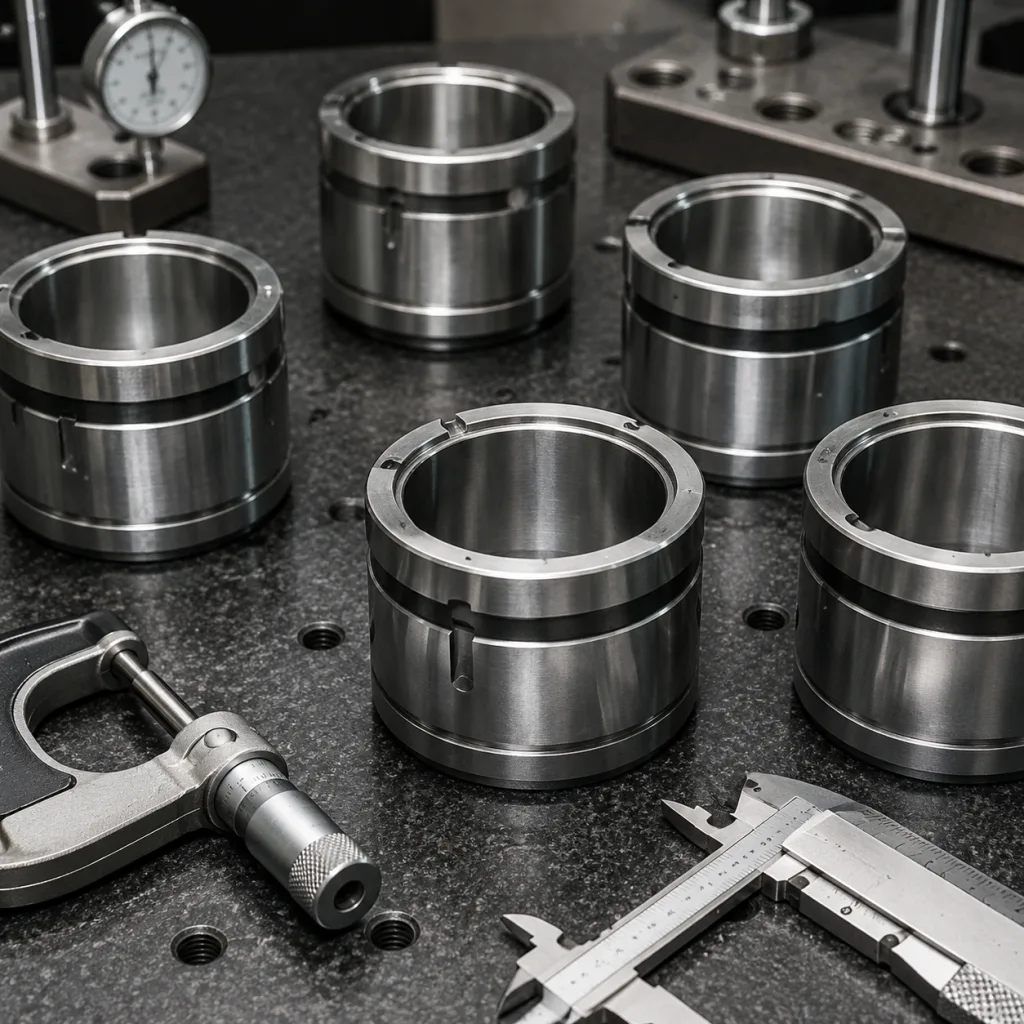
Cylinder sleeve performance depends heavily on material stability and machining repeatability. Many sleeve failures are linked to poor cast structure, uneven hardness, porosity, wall-thickness variation, or a bore finish that does not match the intended ring pack. A credible supplier should explain how castings are produced, how machining datums are controlled, and how bore geometry is verified after honing.
Typical sleeve materials include grey cast iron and alloyed cast iron, selected for wear resistance, machinability, damping, and thermal conductivity. For wet liners, corrosion resistance and sealing land control become even more important because the sleeve is exposed to coolant and must seal reliably at the block interface. Procurement teams should ask for hardness range, chemical analysis, metallographic inspection method, and dimensional capability data instead of accepting a broad claim such as “standard material”.
| Item to verify | Why it matters | Evidence to request |
|---|---|---|
| Base material and alloying | Controls wear, heat transfer, machinability, and service life | Material specification, chemical analysis, hardness report |
| Casting process | Affects porosity, roundness, wall consistency, and machining allowance | Process flow, sample inspection, section analysis |
| Heat treatment or stress relief | Reduces movement during machining and service | Process record, hardness trend, supplier standard |
| Bore geometry | Supports ring sealing, oil control, and compression stability | Roundness, cylindricity, taper, and surface roughness data |
| Flange and seating faces | Helps prevent head gasket, protrusion, and sealing issues | Flatness, parallelism, height, and seating-face records |
| Honing specification | Determines oil retention and break-in behaviour | Ra/Rz values, crosshatch control, plateau-hone report where applicable |
| Batch traceability | Enables containment if a defect occurs | Lot number, inspection record, packing label system |
| Commercial factor | What to ask | Procurement risk if unclear |
|---|---|---|
| MOQ by SKU | Is MOQ per part number, per family, or per order? | Excess inventory on slow-moving engines |
| Lead time | What is sample, pilot, and repeat-order timing? | Missed seasonal or tender delivery windows |
| Tooling and setup | Are special fixtures or gauges required? | Hidden cost after quotation approval |
| Packaging | Is each sleeve protected against impact, dust, and corrosion? | Bore damage, rust, and receiving rejects |
| Label data | Does the label include part number, batch, quantity, origin, and customer code? | Poor warehouse traceability |
| Incoterms | FOB, CIF, DAP, or other terms? | Incorrect landed-cost comparison |
| Consolidation | Can mixed SKUs ship together under one schedule? | Higher freight cost and fragmented stock arrival |
| After-sales response | What is the complaint response time? | Slow containment during warranty events |