Head Gasket Leak Full Engine Gasket Kit Sourcing Guide
A head gasket leak is rarely a one-part purchasing problem. Once an engine has overheated, mixed oil and coolant, or lost cylinder pressure, workshops normally remove the cylinder head and disturb 15–80 adjacent sealing points depending on engine architecture. For distributors, repair chains, importers and engine rebuilders, the head gasket leak full engine gasket kit becomes a high-risk SKU: it must match the engine family and include the correct cylinder head gasket thickness, valve cover gasket, intake and exhaust gaskets, valve stem seals, O-rings, washers and ancillary seals. A wrong bore diameter, omitted coolant O-ring or mismatched oil seal can stop a bay for 24–72 hours and create a claim larger than the kit value. This guide connects field symptoms with likely gasket failure causes, explains what to inspect before ordering, and shows how to define kit content, tolerances, approval steps and order quantities that reduce bay delays and missing-part claims. Driventus is an independent aftermarket manufacturer; any brand names or OE references are used for fitment identification only.
Symptom-to-cause diagnosis before kit selection
A full kit should not be selected only from an engine code or a catalogue line. Buyers supplying repair networks need a repeatable diagnostic process so branches order the right sealing package, avoid over-supplying small repairs and reduce warranty exposure. In practice, a head gasket repair approval form should capture test method, measured value, technician name, vehicle mileage and overheating history before the part is issued.
Field symptom
Likely gasket-related cause
Inspection point before replacement
Practical trigger value
Coolant loss with no external drip
Combustion gas entering the coolant jacket
Cooling system pressure test and block test fluid result
Pressure loss >10% in 10–15 min or positive CO₂ test
White exhaust smoke after warm-up
Coolant entering the combustion chamber
Spark plug condition and cylinder leak-down test
Adjacent cylinder imbalance >10–15% or wet plug tip
Milky oil or rising oil level
Coolant passing into an oil gallery
Oil sample, breather condition and timing cover inspection
Visible emulsion or unexplained oil level rise >3–5 mm
Bubbles in expansion tank
Cylinder pressure crossing the fire ring
Compression balance and radiator cap pressure check
Continuous bubbles under load or cap not holding rated pressure
External oil leak at cylinder head corner
Oil feed or drain sealing failure
Head-to-block joint, cam carrier and valve cover area
UV dye trace from head joint after surface cleaning
</tr></thead><tbody> </tbody></table>A head gasket leak full engine gasket kit is appropriate when the cylinder head is removed and associated gaskets will be disturbed during repair. If the confirmed leak is limited to a valve cover, external coolant flange or thermostat housing, a top-end kit or targeted sub-kit may be enough. A practical rule for repair chains is to release a full kit when at least one cylinder head is removed, the engine has exceeded 100,000–150,000 km, oil and coolant have mixed, or the job includes timing cover, oil pan or manifold removal. Release a smaller kit when the cylinder head remains installed and the confirmed leak is isolated by pressure test, dye test or visual inspection.
Repair chains should record the diagnosis code, mileage, overheating history, coolant condition, compression or leak-down readings, and pressure-test result before approving a complete kit issue. That documentation helps purchasing teams separate genuine head gasket repairs from general oil and coolant leak work. It also supports demand planning: true head-gasket jobs may have lower order frequency but higher kit complexity, while valve-cover and coolant-outlet leaks should be forecast as faster-moving sub-kits.
Inspection steps after cylinder head removal
The removed gasket provides useful evidence, but it should not be treated as the only failed component. Overheating, incorrect clamping load, poor surface preparation and deck distortion can damage the wider sealing system and lead to a repeat leak even when the replacement parts are correct. Buyers should require installers to measure the engine before closing a warranty claim; otherwise procurement cannot distinguish a kit defect from an unrepaired machining issue.
Recommended inspection sequence:
Check cylinder head flatness with a precision straight edge and feeler gauges across length, width and diagonal positions. As a common screening target, many aluminium heads require total deviation below 0.05–0.10 mm across the full length, but the engine maker’s service limit must take priority.
Measure block deck flatness and inspect for corrosion, erosion or pitting around coolant ports. Local pitting deeper than 0.05 mm near a fire ring or coolant passage should trigger machining or engineering review before reassembly.
Confirm the surface finish is suitable for the gasket type. MLS gaskets normally require a smoother, controlled finish than composite gaskets; many programs target roughly Ra 0.4–1.2 µm for MLS and avoid rotary abrasive discs that create waviness.
Inspect head bolt holes for pulled threads, liquid contamination, debris or damaged seating faces. Blind holes should be dry before torqueing because trapped oil or coolant can create hydraulic lock and false clamp load.
Check fire-ring impressions for uneven clamp marks, blow-by paths or local hot spots. Dark tracks between cylinders often indicate combustion leakage, detonation, low clamp load or deck movement.
Inspect timing cover, intake manifold and exhaust manifold sealing faces when they are included in the repair. Warped plastic intake flanges and corroded coolant outlets are frequent repeat-leak causes.
Confirm whether torque-to-yield head bolts must be replaced separately or supplied in a bundled program. If bolts are not included, the kit insert and carton should state “head bolts not included” to avoid installer assumptions.
For procurement teams, the key point is traceability. Returned kits should be reviewed together with workshop inspection notes, photos and measurement records. Minimum evidence for a technical claim should include gasket lot number, installation mileage, failure mileage, head flatness readings, block-deck observations, bolt replacement status, coolant type, and at least four photos: full gasket, suspected leak path, head surface and block surface. A gasket showing local burning between cylinders may indicate distortion, detonation, overheating or insufficient clamping. A gasket with uniform crush but local coolant staining may point to surface pitting, corrosion or coolant contamination. These differences affect whether the purchasing response should be a specification review, a technical bulletin, installer training or a claim rejection supported by evidence.
What a complete kit should include
Kit content depends on engine architecture, repair scope and market practice, but B2B customers should define a controlled bill of materials for each application. A missing O-ring can stop a workshop bay even when the main head gasket is correct, and a duplicated low-value seal can create unnecessary cost across thousands of kits. For each engine, the approved BOM should show item description, material, quantity, drawing or sample reference, critical dimension and packing location.
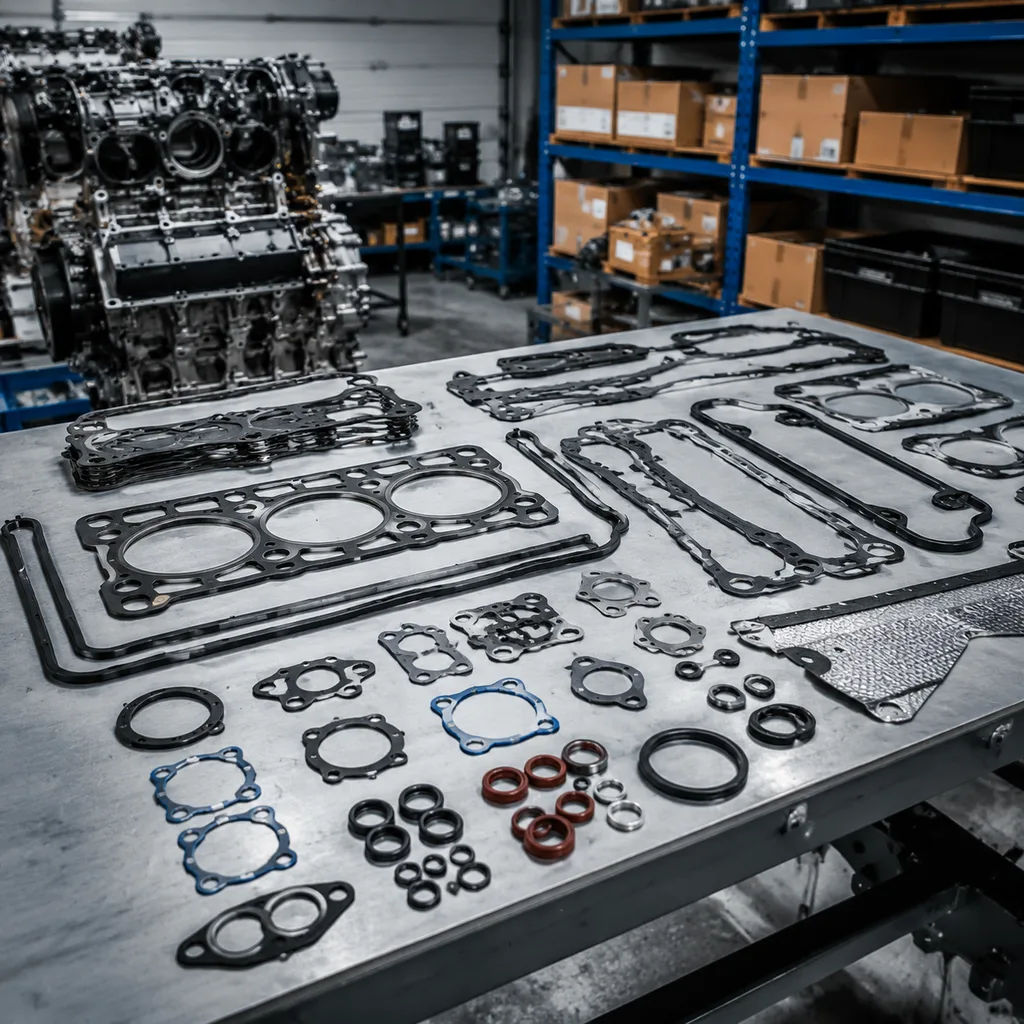
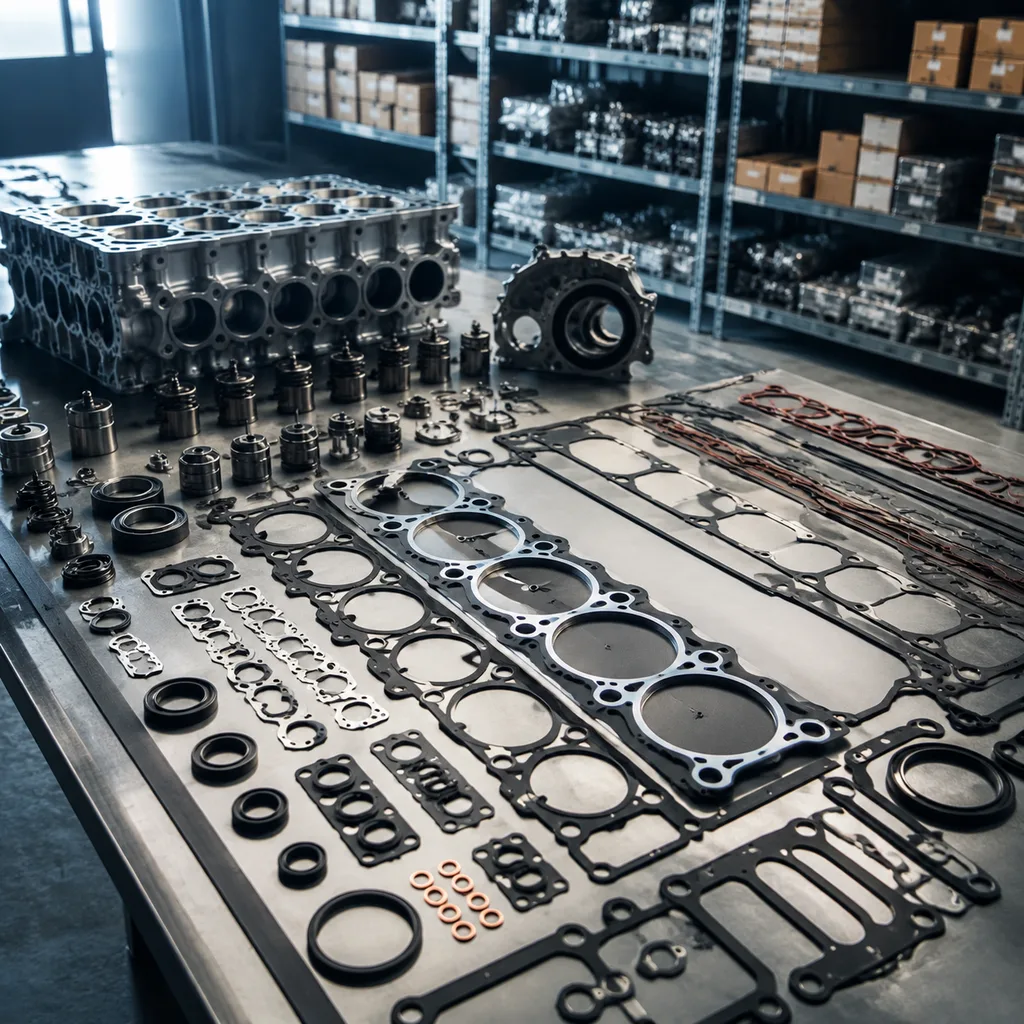
Typical full engine gasket kit content includes:
Cylinder head gasket in MLS, composite or graphite-faced construction depending on application, with bore diameter, oil/coolant hole pattern and nominal compressed thickness confirmed before sampling.
Valve cover gasket and spark plug tube seals where applicable. Long rubber gaskets should be checked for relaxed length, corner radius and bolt-hole alignment before mass packing.
Intake manifold gasket set, including upper/lower plenum gaskets where a two-piece intake is common in the repair market.
Exhaust manifold gasket set, including turbo-to-manifold, turbo outlet and EGR flange seals where the engine variant requires them.
Valve stem seals, normally packed by intake/exhaust position if materials or colors differ.
Camshaft, crankshaft and auxiliary shaft oil seals where specified, with shaft diameter, housing diameter, seal width and rotation direction verified.
Water pump, thermostat housing and coolant outlet gaskets, including O-rings sized by inside diameter, cross-section and material grade.
Oil pan gasket, sump seal or liquid sealant specification. If liquid sealant is excluded, state the required sealant type in the insert instead of leaving the installer to guess.
Timing cover seals, plugs and O-rings, separated by sub-pack where the repair sequence requires staged installation.
EGR, turbocharger oil feed, turbocharger oil return and coolant line seals where applicable, especially on turbocharged diesel and GDI engines.
Small O-rings, washers, grommets and service plugs packed by engine zone or sub-assembly to prevent loss during unpacking.
For aftermarket programs, packaging structure matters as much as the headline part number. A practical format is one master kit with labelled inner bags such as “Cylinder Head,” “Valve Cover,” “Intake,” “Exhaust/Turbo,” “Cooling,” “Oil Seals” and “Bottom End.” For small seals under 15 mm outside diameter, use sealed mini-bags or compartment cards rather than loose packing. Cartons should carry customer part number, Driventus part number where used, application summary, batch or lot code, quantity, production date and barcode. For export pallets, outer cartons should be strong enough for multi-leg transport and should avoid compressing MLS beads or bending long gaskets.
Driventus can pack gaskets by engine zone, label sub-bags and align carton labels with distributor part numbers. Buyers can review related engine sealing products in our catalog and the engine component range at /products/engine-components.html. Where a customer needs a private-label kit, revised content list, regional packaging format or market-specific material choice, custom manufacturing is available after drawing, sample and application confirmation.
Materials, tolerances and validation controls
A replacement kit must match the engine’s thermal load, coolant chemistry, oil exposure and clamping design. The cylinder head gasket carries the highest repair risk, but low-cost small seals can also cause repeat jobs if elastomer compatibility, bead height or dimensional control is poor. Procurement specifications should therefore list measurable controls rather than only “OE quality” wording.
Component
Common material
Key control item
Practical tolerance or test target
Procurement note
Cylinder head gasket
MLS stainless steel or composite
Bore diameter, thickness, coating adhesion
Bore typically controlled within ±0.10–0.20 mm; thickness variant must match catalogue step
Thickness must follow engine repair condition and catalogue data
Valve cover gasket
ACM, NBR, FKM or silicone
Compression set and oil resistance
Hardness commonly ±5 Shore A; compression set checked after heat ageing
High-temperature engines may need upgraded elastomer
Intake gasket
Rubber-coated metal, fibre or moulded rubber
Port alignment and bead height
Port mismatch should be minimized, commonly ≤0.5 mm against sample/drawing
Misalignment can affect sealing and drivability
Exhaust gasket
Stainless steel, graphite laminate or perforated metal
Heat resistance and crush recovery
Heat-cycle review for turbo positions; check delamination and relaxation
Turbo applications need special heat-cycle review
Oil seals
FKM, ACM or NBR
Lip geometry and shaft contact
ID/OD/width verified to drawing; spring fit and lip defects checked visually
Verify direction marks and dust lip design
O-rings and washers
NBR, EPDM, FKM, copper, aluminium or coated steel
ID, cross-section, hardness and fluid compatibility
Elastomer cross-section often held to ±0.08–0.15 mm by size class
Wrong material can fail in coolant, oil or fuel exposure
</tr></thead><tbody> </tbody></table>Relevant management and compliance references include IATF 16949:2016 for automotive quality management, ISO 9001:2015 for process control, and REACH (EC) No 1907/2006 for chemical substance obligations in the EU supply chain. For engine programs sold into regulated markets, buyers should also consider emissions-related durability context under rules such as ECE R-83 where applicable to the vehicle system.
Driventus applies incoming material checks, dimensional inspection, production batch control and sample retention through its quality system. Depending on the application, validation may include compression recovery, heat ageing, oil immersion, coolant exposure, coating adhesion, seal bead inspection, hardness checks and visual review of stamped or moulded features. Typical approval work for a new kit includes first-article measurement of critical gaskets, teardown count against the BOM, trial fit on sample engine components where available, carton drop or transport review for export packing, and retention of one approved golden sample. The exact control plan should be agreed by engine family, annual volume, warranty exposure and customer inspection standard.
Ordering checks for distributors and repair chains
Most disputes around a head gasket leak full engine gasket kit come from application ambiguity rather than one visible defect. Several engines may share displacement but differ in bore size, timing cover layout, emissions equipment, oil pan design or gasket thickness. Procurement teams should require structured data before releasing purchase orders or approving private-label artwork.
Minimum sourcing checklist:
Engine code, displacement, fuel type and production year range.
Cylinder count, bore size and available gasket thickness options. For diesel engines, piston protrusion may determine thickness step, so catalogues should not collapse all steps into one SKU.
Turbocharged, supercharged or naturally aspirated variant, including turbo oil and coolant line seal requirements.
Timing system type and whether timing cover gaskets are included.
Oil pan design: formed rubber, cork-rubber, steel carrier or liquid sealant.
Emissions equipment that changes EGR, cooler or secondary-air gasket content.
OE cross-reference convention where used, for example OE 06A… or OE 11251….
Language, barcode, insert sheet and carton labelling requirements.
MOQ, lead time, inspection standard and acceptable quality limit.
Whether head bolts, sealant, installation notes or instruction sheets are excluded or bundled.
For importers, sample approval should include one physical kit teardown against the bill of materials. Count every washer, plug and O-ring, then photograph each sub-pack and carton label. For multi-location repair chains, repeat the same exercise after the first shipment to confirm that production packing matches the approved sample, not only the quotation spreadsheet.
Commercial logic should be set before tooling or artwork begins. As a planning reference, repeat catalogue items may support MOQs around 100–300 kits per part number when materials and packing are standard; new or slow-moving applications, private labels, special elastomer grades or unique cartons may require 300–1,000 kits or an agreed mixed-container plan. Sample preparation is commonly 2–4 weeks after BOM confirmation if drawings, samples and materials are available. Mass production lead time is often 30–60 days after sample approval, packaging artwork approval and deposit, with longer timing for new tooling, MLS stamping dies, moulded rubber parts or peak-season capacity. Price should be built from gasket construction, elastomer grade, number of small parts, labour for sub-bagging, carton specification, inspection level and annual volume—not only from kit weight.
Driventus exports engine and powertrain components to more than 60 countries from Taizhou, Zhejiang. For a controlled quotation, provide the engine application list, expected annual demand, target market, cross-reference requirements, inspection level, target price band if available, and packaging specification when you request a quote.
Reducing repeat leaks after installation
A correct kit does not guarantee a successful repair if installation variables are uncontrolled. Buyers supplying workshops can reduce claims by attaching concise technical notes to high-volume SKUs and by requiring photos or measurements for warranty review. The best insert is short, application-specific and focused on the 5–8 actions most likely to prevent a comeback.
Useful installation controls include:
Clean mating surfaces without aggressive grinding that changes surface finish. Avoid fibre discs and hard abrasives that can round edges, embed particles or create local low spots.
Confirm dowel pins are present and correctly seated. Missing dowels can allow head movement and shear the coating or fire ring.
Use the specified torque sequence, torque stage and angle procedure for the engine. A typical procedure may involve stepped torque plus 90°/90° angle stages, but the exact service data must be followed.
Replace torque-to-yield bolts where the repair specification requires it. Reused stretched bolts can give correct wrench readings but low clamping force.
Avoid additional sealant on coated MLS head gaskets unless the engine procedure specifies it. Extra sealant can alter clamp load or block oil/coolant passages.
Flush contaminated cooling systems before final fill. Oil residue, rust, scale or wrong coolant chemistry can attack rubber seals and cause overheating.
Verify fan operation, thermostat function, water pump condition and radiator flow after repair. A new gasket will fail if the original overheating cause remains.
Recheck for combustion gas in coolant if the engine had severe overheating, cracked head risk or repeated pressure rise.
Run the engine to operating temperature, inspect under pressure, then recheck coolant level after cool-down according to the service procedure.
A repeat leak within a short mileage interval should trigger a structured review: returned gasket condition, cylinder head flatness record, block deck notes, bolt replacement evidence, coolant condition and installation images. For B2B warranty handling, define thresholds in advance: missing installation data may place the claim on hold; confirmed BOM error or dimensional nonconformity should trigger containment of the lot; repeated failures on one application should trigger catalogue-fitment review or an installer bulletin. This process separates part nonconformity from unresolved engine damage and helps category managers decide whether to continue, revise, retrain or delist a specific application.
Frequently asked questions
Use a full kit when the repair requires cylinder head removal and multiple sealing joints will be disturbed. It is especially appropriate after overheating, oil-coolant mixing, engine overhaul, high-mileage repair, or when timing cover, manifold and cooling seals are removed during access. If the issue is limited to an external valve cover, thermostat housing or coolant outlet leak and the cylinder head remains installed, a smaller sub-kit may be sufficient.
Yes. Driventus can align kit labels, sub-bag structure and carton markings with distributor part numbers after application and bill-of-material confirmation. Private packaging, barcode labels, insert sheets and market-specific content can be discussed during sample approval and purchase order planning. Buyers should approve a physical teardown sample before mass production.
Provide engine code, vehicle application range, fuel type, bore size if known, gasket thickness option if applicable, target market, annual volume, MOQ expectations, packaging requirements and any OE-style cross-reference convention such as OE 06A… or OE 11251…. Photos, drawings or physical samples help confirm small seals, variant differences and sub-bag packing.
If you are building a gasket kit range for distributors, rebuilders or repair chains, Driventus can review application data, BOM content, MOQ, lead time and sample requirements before production. Send your requirements through /contact.html.