control arm · 2026-06-14

Changing a Control Arm: B2B Buying Guide

Changing a control arm is often viewed as a workshop repair, but for distributors, repair chains, and import managers it is also a sourcing decision with direct warranty impact. A suspension arm that fits poorly, uses inconsistent bushings, or ships without traceable inspection data can create repeat claims across many vehicle applications. Buyers need to assess the part as an engineered assembly: forged, cast, stamped, or aluminium body; ball joint interface; rubber or hydraulic bushing; coating system; fastener compatibility; and export packaging. Driventus manufactures control arms for independent aftermarket programmes and supports catalogue cross-reference, private-label packaging, and batch documentation. This guide explains what procurement teams should verify before volume ordering, how to compare specifications, and which evidence to request from a supplier. Driventus is an independent aftermarket manufacturer; brand names are referenced for fitment only.

Why Control Arm Replacement Drives Procurement Risk

A control arm links the wheel hub or steering knuckle to the chassis and controls wheel movement through its bushings and ball joint. In the workshop, the repair may be routine. In procurement, the risk is broader because one vehicle platform can use multiple arm geometries across model years, drive layouts, suspension packages, and regional builds.

For B2B buyers, the common failure modes are predictable:

  • Incorrect geometry: ball joint taper, bushing spacing, or bracket angle does not match the OE layout.
  • Premature bushing wear: rubber hardness, bonding, sleeve position, or void pattern differs from the intended load case.
  • Weak corrosion protection: coating breaks down during salt exposure or after stone impact.
  • Packaging damage: ball joint studs, dust boots, or painted surfaces are damaged in warehouse handling or ocean freight.
  • Incomplete cross-reference data: applications are listed too broadly, causing returns from repair networks.

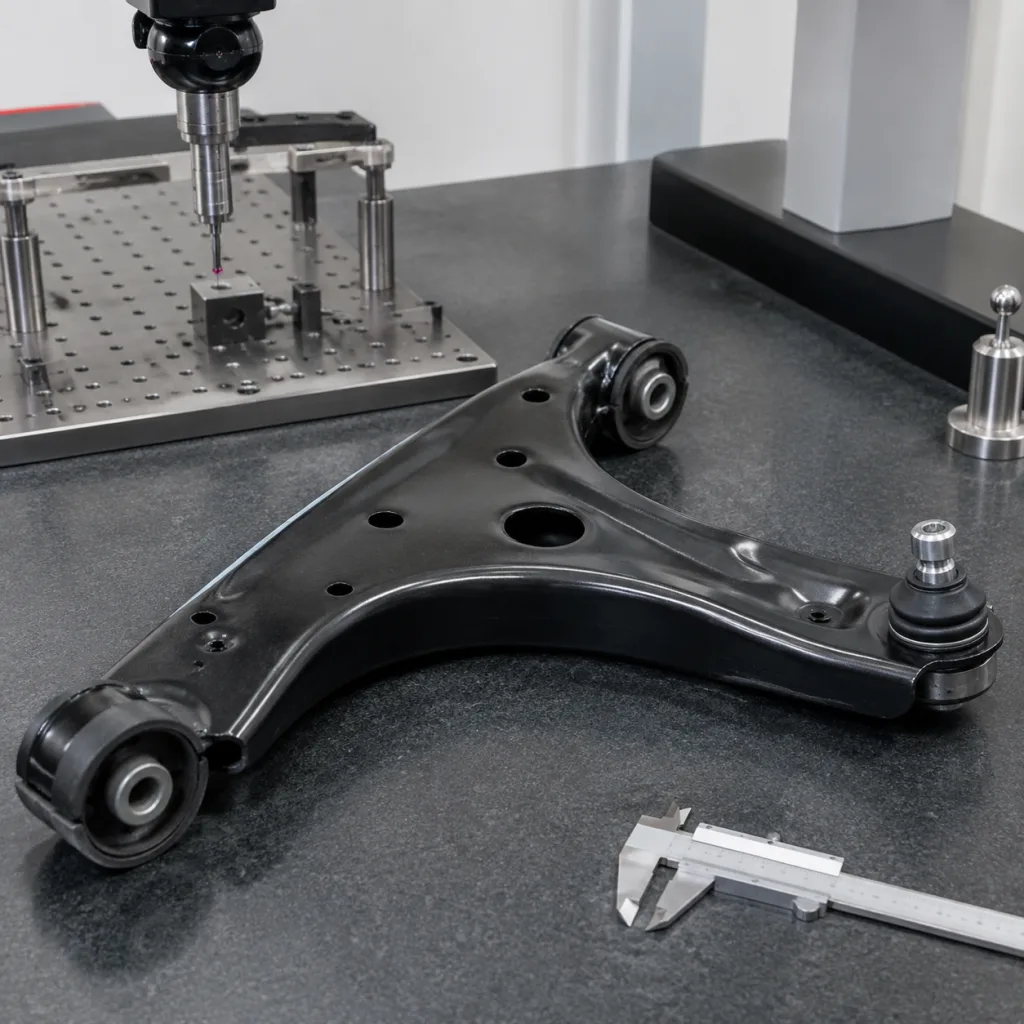
A qualified supplier should confirm each control arm by sample drawing, 3D scan, OE part-number cross-reference where available, and application data. If a buyer is consolidating SKUs, the engineering team should verify that left-hand and right-hand arms, stabiliser link brackets, sensor mounting points, and ball joint pre-installation status are separated correctly in the catalogue. Buyers can review our catalog for the types of suspension and chassis parts typically managed in aftermarket programmes.

Key Specifications to Verify Before Ordering

Changing a control arm at scale requires more than matching the general shape of the removed part. The replacement must install without modification, preserve wheel alignment range, and withstand the load path designed for that suspension layout. Procurement teams should request dimensional and material confirmation before first shipment, especially for high-volume applications or private-label launches.

</tr></thead><tbody> </tbody></table>For production control, Driventus works under IATF 16949:2016 and ISO 9001:2015 quality management frameworks. Buyers should request a control plan, process flow, incoming material inspection method, and final inspection report. These records are more useful than a general certificate alone because they show how the supplier manages the exact part family.

Where chemicals and surface treatments are involved, European buyers should also request supplier declarations related to REACH (EC) No 1907/2006. If the product is sold with rubber parts, documentation should address restricted-substance risk in rubber compounds, protective oils, adhesives, coatings, and packaging materials where applicable.

Material and Manufacturing Options

Control arm construction is determined by OE design, load path, cost target, and vehicle segment. Buyers should not change materials without engineering review. A forged steel arm, for example, cannot be replaced by a stamped assembly unless the application was engineered and validated for that format.

Specification area What to verify Procurement relevance
Arm constructionForged steel, cast aluminium, stamped steel, or welded assemblyAffects weight, fatigue behaviour, tooling cost, and target market price
Ball joint interfaceStud taper, thread size, articulation angle, boot material, grease fillPrevents fitment issues, steering noise, and early joint wear after installation
Bushing designRubber compound, durometer range, bonding method, void orientation, inner sleeve dimensionsControls NVH, durability, and alignment stability
Mounting geometryCentre-to-centre distances, bracket thickness, hole diameter, angular offsetDetermines bolt-up accuracy and wheel alignment result
Surface protectionE-coating, phosphate plus paint, zinc-rich coating, or aluminium treatmentReduces corrosion claims in winter-road and coastal markets
PackagingStud protector, boot guard, anti-corrosion bag, carton burst strengthPrevents warehouse, courier, and ocean-freight damage

</tr></thead><tbody> </tbody></table>### Bushing and Ball Joint Considerations

The bushing is not a generic rubber insert. Its stiffness, void orientation, sleeve concentricity, and bonding integrity affect steering feel, tyre wear, braking stability, and cabin noise. Suppliers should state the rubber hardness control range, ageing test method, and whether bushings are pressed in-house or purchased from an approved sub-supplier.

The ball joint must match the mating knuckle. Buyers should confirm stud taper, thread, nut type, articulation range, pull-out strength, rotational torque, and boot sealing. Dust boot failures are a frequent warranty trigger because road grit and water quickly damage the joint once sealing is lost.

For private-label customers, Driventus can support custom manufacturing for packaging, bushing specification, coating selection, and inspection documentation. Customisation should be controlled by drawing revision, sample approval, and change-management rules rather than informal email confirmation.

Validation Tests and Quality Evidence

A buyer does not need every laboratory test for every reorder, but first-article approval should include evidence that the part meets dimensional, material, and durability expectations. For critical suspension components, objective data reduces the risk of field returns and helps warranty teams separate product issues from installation or vehicle-condition problems.

Recommended evidence includes:

  • Material certificate for the steel or aluminium batch.
  • Dimensional report against drawing or approved sample.
  • Ball joint torque, articulation, and pull-out inspection record.
  • Bushing press-fit, bonding, and sleeve-position inspection method.
  • Coating thickness and corrosion-resistance test result.
  • Packaging drop or transport simulation result for export cartons.
  • Batch traceability code linked to production date and inspection lot.

Salt spray testing may be performed using recognised methods such as ASTM B117 where specified by the buyer. Dimensional measurement can be supported by CMM inspection, gauges, or fixture checks depending on the part geometry. For process management, the supplier should maintain nonconforming-product controls, corrective-action records, and internal audit schedules under its quality system.

Driventus is based in Taizhou, Zhejiang, and manufactures engine, powertrain, and selected chassis-related assemblies for export markets. The company supplies B2B customers in more than 60 countries and supports documentation packages for importers, wholesalers, and multi-location repair chains. No aftermarket manufacturer should claim vehicle-maker approval unless a formal agreement exists; Driventus does not make such claims.

Buying Checklist for Distributors and Repair Chains

Before changing supplier, adding a new SKU group, or launching a control arm line, buyers should run a structured approval process. The checklist below is suitable for import managers, category teams, and repair-chain procurement departments.

Construction type Typical strengths Watch points for buyers
Forged steelHigh strength, good fatigue resistance, suitable for heavy load pathsRequires controlled heat treatment, machining accuracy, and robust coating
Stamped steelCost-effective for high-volume applications, often lighter than forged designsWeld quality, bracket location, seam protection, and coating coverage are critical
Cast aluminiumLower weight, common on passenger-car front suspensionCasting porosity, machining datum control, insert quality, and thread protection need review
Welded steel assemblyFlexible for complex shapes, brackets, and platform-specific variationsWeld penetration, distortion, fixture repeatability, and post-weld corrosion protection must be controlled

</tr></thead><tbody> </tbody></table>For multi-location repair chains, installation feedback should be captured in a standard form: noise complaint, bolt alignment issue, boot damage, alignment range, mileage at return, and whether adjacent parts were replaced. This data helps separate product defects from installation errors, collision damage, worn connected components, or incomplete alignment work.

Distributors should also define a service-parts policy. Some programmes require control arms with pre-installed ball joints and bushings to reduce workshop time and simplify warranty responsibility. Others prefer bare arms in limited cases, but that approach increases technician dependence and can create disputes over whether a later failure came from the arm, the pressed-in component, or the installation process.

What to Confirm During and After Installation

Although this article is a buying guide, replacement quality still depends on correct workshop practice. A technically sound product can fail early if bolts are tightened at full suspension droop, if the knuckle taper is contaminated, if old locking hardware is reused against service guidance, or if alignment is skipped after the repair.

Procurement teams supplying repair chains should include installation notes or QR-linked technical sheets where local regulations allow. The content should remind technicians to:

  • Compare the new arm with the removed part before installation.
  • Inspect adjacent parts, including strut, tie rod end, stabiliser link, wheel bearing, and subframe mounting points.
  • Use new fasteners where the vehicle repair procedure specifies torque-to-yield bolts or locking nuts.
  • Tighten bushing bolts at normal ride height when required by the suspension design.
  • Apply specified torque values from the vehicle service data, not generic estimates.
  • Perform wheel alignment after suspension work.

Changing a control arm may also reveal prior accident damage or corrosion around chassis pick-up points. If mounting holes do not line up, the part should not be forced into position. The technician should inspect the subframe, knuckle, and mounting areas before continuing. For B2B warranty control, suppliers and buyers should agree in advance on the evidence required for claims: photos, installation date, mileage, batch code, vehicle application, and failure description.

Buyers planning a new control arm range can request a quote with target applications, annual volume, packaging requirements, and documentation needs.

Frequently asked questions

Check fitment data, OE cross-reference where available, sample dimensions, bushing specification, ball joint interface, coating test evidence, packaging strength, MOQ, lead time, and warranty process. Ask for IATF 16949:2016 or ISO 9001:2015 certification and part-specific inspection records.

Sometimes, but application consolidation must be verified by geometry and fitment data. Similar-looking arms may differ in ball joint taper, bushing angle, bracket position, stabiliser link mount, sensor provision, or left-right orientation. Broad catalogue coverage without engineering confirmation increases return risk.

Provide application details, installation position, sample photos or drawings, OE-style reference if available, annual volume, packaging format, target market, documentation requirements, and preferred Incoterms. For private label, include label, barcode, carton, and pallet requirements.

If you are reviewing a control arm sourcing programme, Driventus can evaluate fitment data, samples, packaging, and inspection requirements. Send your application list or drawings through /contact.html

Request a Quote
Buying step Minimum check Preferred evidence
Fitment confirmationApplication list by model, year, engine, drive layout, and positionOE cross-reference where available, sample comparison, 3D scan report
Sample approvalVisual inspection and trial installationDimensional report and workshop feedback from multiple vehicles
Supplier capabilityManufacturing route and key equipmentIATF 16949:2016 or ISO 9001:2015 certificate plus process flow
Durability reviewBushing, ball joint, and coating test planBatch test records, validation summary, and corrective-action history
Packaging approvalCarton, label, barcode, and protection methodDrop-test result, pallet loading plan, and container-loading guidance
Commercial controlMOQ, lead time, Incoterms, warranty handlingAnnual forecast, safety stock plan, and claim-analysis process