Flywheel vs Mahle Alternative: What Buyers Should Check
When procurement teams compare a flywheel against a Mahle alternative, the useful question is not the brand name. It is whether the part matches the OE interface, the vehicle duty cycle, and the documentation expected by your market. A flywheel that fits on the bench can still fail on balance, ring gear durability, clutch-face runout, or starter engagement. That is why buyers should verify dimensions, material route, machining accuracy, and traceability before placing volume orders. Driventus is an independent aftermarket manufacturer; brand names are referenced for fitment only. For buyers covering adjacent engine parts, the same discipline applies across the full programme, from catalog items to sample-built parts. The goal is to reduce returns, avoid installation disputes, and keep the supplier file clean for customs, technical review, and internal approval.
What buyers should compare first
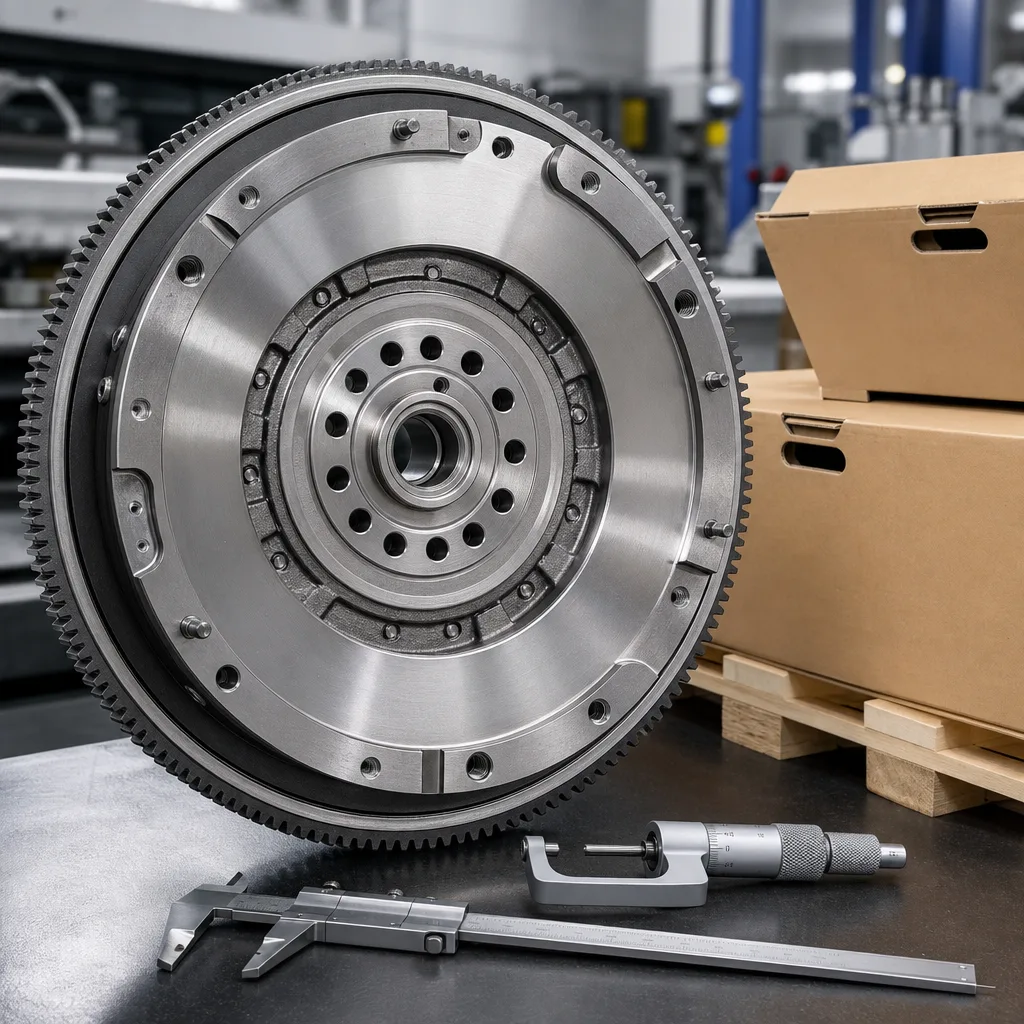
A flywheel purchase is a fitment decision before it is a price decision. Start with the OE drawing, the transmission type, and the engine family, then check whether the application uses a single-mass or dual-mass design. If you are comparing a Mahle alternative, the relevant benchmark is the same OE reference and the same service condition, not the marketing label.
The first three filters are simple:
Crank flange pattern and pilot location
Ring gear tooth count and starter engagement depth
Friction-face diameter, offset, and clutch compatibility
If those do not align, the part is not a direct replacement. For adjacent engine parts and related assemblies, see our catalog and engine components.
Side-by-side technical checks
The practical difference between options is usually hidden in the detail. A lower purchase price can be acceptable if the part is fully interchangeable and backed by consistent process control. It is not acceptable if the supplier is changing mass, machining sequence, or ring gear design without a controlled validation step.
Check
OE-style flywheel
Replacement alternative
Fitment basis
OE drawing and vehicle application
Same OE reference, confirmed by sample or drawing
Dynamic behaviour
Balance and inertia controlled to spec
Must match the same mass and balance target
Ring gear
Correct tooth count, pitch, and press fit
Must survive starter engagement and heat cycles
Friction surface
Machined for clutch contact and runout
Must hold the same surface finish and flatness
Documentation
Traceable batch records
Supplier pack should include inspection data
</tr></thead><tbody> </tbody></table>If a supplier cannot show how the part was checked, the comparison is incomplete. That is especially true for dual-mass applications, where spring rate and damping performance matter as much as geometry.
Specifications to request in every RFQ
Procurement teams should request the same data set every time. That reduces quoting noise and makes the technical review faster.
OE reference, engine code, and transmission type
Flywheel type: single-mass, dual-mass, or conversion
Tooth count and ring gear outside diameter
Friction-face diameter and offset
Bolt circle, bolt-hole count, and pilot location
Finished mass and target inertia if the drawing calls for it
Face runout, parallelism, and balance limits
Material route: cast iron, steel, or other approved base material
Heat treatment, hardness target, and surface protection
Sample quantity, packaging requirements, and annual demand
If you do not have a complete part number, send photos, measurements, and the old part. For non-catalog applications, custom manufacturing can be used to match a sample or a drawing revision.
A good RFQ reduces both price variance and technical risk. A weak RFQ usually creates a lower quote and a higher rejection rate.
Quality system and compliance controls
For export markets, quality control is part of the commercial offer. Driventus operates under quality system controls aligned with IATF 16949:2016 and ISO 9001:2015, with material and chemical compliance managed for REACH (EC) No 1907/2006 where applicable. For buyers in the EU and UK, that paperwork matters as much as the physical part.
Typical control points for a flywheel programme include:
Incoming material verification
Machining dimension checks on the critical faces and bolt pattern
Tooth profile inspection on the starter ring gear
Runout and balance verification before packing
Batch traceability tied to inspection records
These controls do not remove the need for customer-side validation, but they do reduce the chance of a hidden variation reaching the line. They also make supplier audits easier when the part moves from sample approval into repeat order status.
When to choose stock replacement or custom build
The sourcing decision usually falls into one of three buckets.
Situation
Best route
Why
Standard OE replacement
Stock programme
Fastest path, lowest setup cost
Small variation in finish or packaging
Controlled alternative
Keeps the same fitment while meeting market needs
Non-standard drawing or conversion project
Custom build
Needed for geometry, mass, or ring gear changes
</tr></thead><tbody> </tbody></table>If the vehicle originally used a dual-mass flywheel, do not assume a solid unit is interchangeable. That change can alter NVH, clutch life, and launch feel. It should only be used when the conversion has been validated for the exact engine and transmission combination.
For buyers managing multi-country supply, the commercial questions are lead time, MOQ, inspection depth, and re-order stability. Those are easier to manage when the supplier can support both catalog supply and custom manufacturing.
Frequently asked questions
Include the OE reference, engine and transmission code, tooth count, bolt pattern, mass target, runout limit, and expected annual volume. Photos and a used sample help if the part is not fully identified.
Only if the application has a validated conversion path. A direct swap can change NVH, clutch loading, and drivability. The replacement must be approved for the exact engine and transmission combination.
Ask for inspection records, batch traceability, material confirmation, and compliance data for REACH (EC) No 1907/2006 where relevant. For larger programmes, sample approval and dimensional reports are also useful.
If you need an OE-cross-referenced quotation, sample review, or a supply plan for volume orders, send the details through [request a quote](/contact.html).