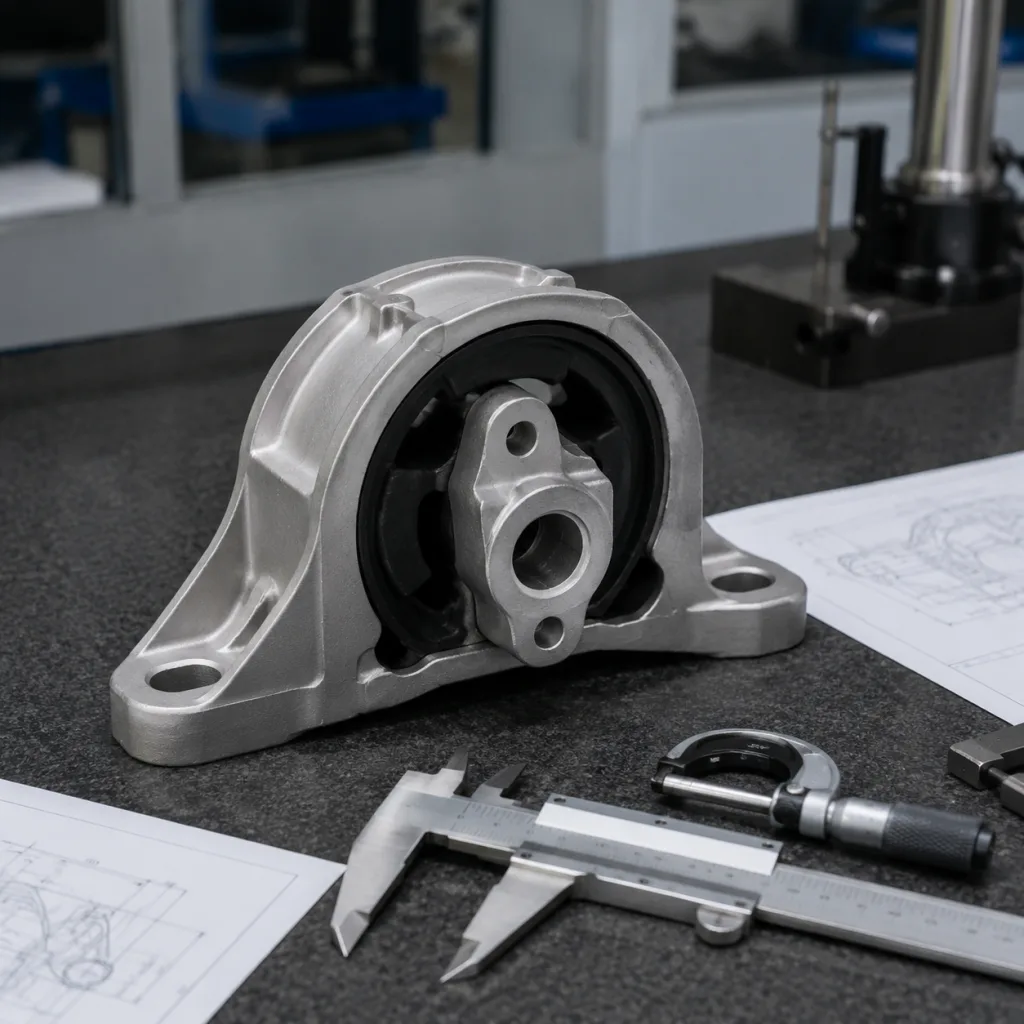
Engine mounts support engine and transmission mass, limit powertrain movement, and isolate vibration before it reaches the body structure. For procurement teams, the selected engine mount material directly affects durability, NVH performance, warranty exposure, and landed cost. A mount can match the visible shape of an OE reference and still fail early if the elastomer compound, rubber-to-metal bonding, insert hardness, coating, or hydraulic sealing process is not suited to the application.
Driventus manufactures independent aftermarket engine mounts and related powertrain components in Taizhou, Zhejiang for distributors, repair chains, OEM programmes, and Tier-1 supply. This guide focuses on how buyers should decide between natural rubber, EPDM, NBR, silicone, blended compounds, and hydraulic mount constructions. It also outlines what to request from a supplier, including compound data, dimensional tolerances, adhesion testing, fatigue validation, and compliance documentation. Driventus is an independent aftermarket manufacturer; brand names are referenced for fitment identification only.
Start with the duty cycle, not the part shape
An engine mount is not just a bracket with rubber between two metal parts. It is a tuned rubber-metal or hydraulic component that has to carry static load, limit powertrain movement, isolate vibration, and survive heat, chemicals, and installation stress. If sourcing starts with appearance or cross-reference only, failures tend to show up later as sagging, clunking, excess cabin vibration, or bond failure.
The first question is simple: what will the mount face in service? Consider load direction, heat soak, oil mist, coolant splash, road salt, service torque, and whether the vehicle sees stop-start driving, rough roads, or frequent towing. That context tells you which engine mount material is viable and which is not.
A practical RFQ should cover both the elastomer and the hardware. If the drawing only shows dimensions, the spec is incomplete. Buyers should identify rubber type, hardness range, bonding method, insert material, coating, torque reference, inspection points, and test requirements. If the part is hydraulic, add fluid compatibility, sealing method, leak criteria, and damping targets.
Which material wins in each scenario?
The right engine mount material depends on the job. There is no universal best choice, only better choices for specific thermal, chemical, and NVH conditions.
Material type
Best fit scenario
Strengths
Weak spots
Sourcing note
Natural rubber (NR)
Conventional bonded mounts in low to moderate heat zones
Strong elasticity, good fatigue resistance, strong vibration isolation
Weaker against petroleum oils, ozone, and sustained high heat
Common for OE-equivalent and cost-sensitive aftermarket mounts when oil exposure is controlled
EPDM
Weather-exposed or coolant-adjacent mounts
Good resistance to heat, ozone, water, and many coolant formulations
Poor resistance to petroleum oils and fuels
Better near cooling-system or exterior exposure zones than near oil leak risk
NBR
Oil-prone applications
Better resistance to petroleum oils and fuels than NR or EPDM
Lower ozone and weathering resistance unless protected
Useful when oil contamination is expected, but ageing must be validated
SBR blends
Value-line vibration parts
Predictable processing and controlled cost
Often weaker fatigue, rebound, and heat resistance than higher-grade NR blends
Needs careful validation before high-load or high-temperature use
Silicone rubber
High-temperature isolation needs
Stays flexible at elevated and low temperatures
Higher cost, lower tear strength in some formulations, and different bonding needs
Use selectively, not as a default replacement for standard mounts
Hydraulic mount elastomer with fluid chamber
Premium NVH-control programmes
Frequency-dependent damping and better idle isolation
More complex tooling, sealing, fluid handling, and inspection
Requires strict process control and leak testing
</tr></thead><tbody> </tbody></table>There is a trade-off behind every choice. A compound that is too hard can reduce engine movement but send more vibration into the cabin. A compound that is too soft may isolate idle vibration well but allow excess roll under load. A low quote can also hide a higher total programme cost if the part sags early, shifts alignment, or generates repeat labour claims.
Spec the numbers buyers should lock down
A useful RFQ for engine mounts uses measurable values, not vague descriptions. Exact limits depend on the application, but the following items usually belong in a sourcing package.
Recommended specification checklist
Rubber hardness: Shore A target with an agreed tolerance, such as ±5 Shore A.
Static deflection: measured under a defined load, direction, temperature, and fixture condition.
Dynamic stiffness: measured at a stated frequency, amplitude, preload, and temperature.
Compression set: used to estimate long-term height retention.
Tensile strength and elongation: confirm compound consistency and expose formulation drift.
Tear resistance: important around voids, ribs, and bonded edges.
Rubber-to-metal adhesion: tested after bonding and, where required, after ageing or fluid exposure.
Metal insert dimensional tolerance: hole position, thread engagement, sleeve height, and stud alignment.
Surface protection: zinc plating, e-coating, phosphate, paint, or agreed coating with salt-spray target.
Torque and thread requirements: thread class, stud grade, nut compatibility, and tightening conditions.
Marking and traceability: batch date, cavity, mould number, shift, or carton-level traceability.
Packaging: corrosion prevention, rubber deformation prevention, and export-ready pallet labelling.
Critical interfaces deserve tighter control than cosmetic surfaces. Hole diameter, centre distance, sleeve length, bracket flatness, stud perpendicularity, and locating features all affect installation. If those values drift, fitters may force the part into place, preload the rubber, and shorten service life.
The engine mount material spec should also tie back to the drawing revision and approved sample. Without that link, different suppliers may quote the same part number while building different compounds, hardness targets, coatings, or internal constructions. For multi-SKU programmes, high-load, high-heat, and hydraulic mounts should sit in a higher-risk validation bucket than simple low-stress brackets.
Driventus can review customer drawings, physical samples, and application lists through custom manufacturing. Where customers source from existing references, purchasing teams can also compare available part families in our catalog.
Compliance is a factory issue and a part issue
Engine mounts are not usually certified as stand-alone emissions or braking components, but they still need disciplined control. A factory certificate shows that a plant follows a management system. It does not prove that every mount design has passed a customer-specific validation plan.
Driventus operates under IATF 16949:2016 and ISO 9001:2015 quality management frameworks. These systems support control plans, incoming inspection, traceability, corrective action, and continuous improvement for automotive production.
Relevant compliance and documentation topics may include:
IATF 16949:2016: automotive quality management system requirements for the automotive supply chain.
ISO 9001:2015: quality management system requirements across manufacturing operations.
REACH (EC) No 1907/2006: chemical substance compliance for products placed on the EU market.
RoHS Directive 2011/65/EU, where contractually applicable: often relevant to mixed assemblies, though many mechanical rubber-metal mounts are assessed under broader chemical compliance requests.
IMDS or material declarations: often required for OE, Tier-1, or regulated-market programmes.
Customer-specific requirements: PPAP level, ISIR, control plan format, inspection reports, packaging rules, and change notification procedures.
Factory controls for rubber-metal mounts usually include compound batch verification, raw rubber storage control, metal surface preparation checks, adhesive mixing and application control, mould temperature monitoring, curing time control, flash trimming inspection, and final dimensional checks. Hydraulic mounts add fluid fill volume, diaphragm integrity, crimp quality, damping consistency, and leak testing.
Procurement teams should request a current certificate package, process flow, control plan, and sample inspection report. Driventus provides documentation through its quality system for qualified B2B enquiries. Driventus is an independent aftermarket manufacturer; brand names are referenced for fitment identification only.
How validation should be staged
Material selection has to be confirmed by test. A visual match to an OE sample helps with shape and construction, but it does not prove service performance. Validation should combine dimensional, material, and functional checks that match the part risk.
Test item
Why it matters
Typical acceptance basis
First article dimensional inspection
Confirms tooling, stamping, machining, and assembly accuracy
Customer drawing, approved sample report, or agreed critical dimensions
Shore A hardness test
Confirms compound consistency
Agreed compound specification and tolerance
Static load-deflection test
Verifies support height and stiffness under defined load
Drawing curve, benchmark sample, or customer requirement
Dynamic stiffness test
Checks NVH behaviour
Frequency, amplitude, preload, and temperature defined in the test method
Rubber-to-metal adhesion test
Confirms bond strength and surface prep quality
Cohesive rubber tear or agreed minimum value
Heat ageing test
Assesses hardness change, cracking, and loss of elasticity
Time and temperature agreed by application
Oil, coolant, or fluid exposure test
Assesses swelling, softening, hardening, and property change
Fluid type, exposure time, and temperature defined by customer
Compression set test
Evaluates long-term deformation risk
Agreed time, temperature, and maximum set value
Fatigue cycling
Confirms durability under repeated loading
Cycle count and load profile agreed in the validation plan
Salt-spray test for metal parts
Evaluates coating durability
Contractual hours and corrosion acceptance level
Hydraulic leak and damping test
Verifies sealed construction and functional damping
Leak limit, damping curve, or customer-specific test method
</tr></thead><tbody> </tbody></table>For aftermarket distribution, validation should also include fitment trials across representative vehicle applications. One SKU can cover multiple models, engine sizes, years, or regional variants, so the approved application list needs review before mass production.
Cross-references using OE-style numeric formats should be used only when the customer’s reference list already identifies the application. Driventus does not claim approval or endorsement by any vehicle manufacturer. Brand names, when used in catalogues or fitment lists, are for identification only.
What sourcing teams should confirm before ordering
The commercial decision has to match the technical decision. A premium compound is wasted if batch consistency is weak. A low-cost compound becomes expensive if it drives warranty claims in a hot, oily, or high-load application.
Before placing a production order, confirm:
Application list and required OE cross-reference format.
Annual volume, first order quantity, and forecast by SKU.
Drawing status: customer drawing, reverse-engineered sample, or existing Driventus tooling.
Target material, hardness, coating, and validation level for each part family.
Required approval documents: PPAP, ISIR, material report, dimensional report, test report, or certificate of conformity.
Warranty feedback process, failure evidence requirements, and corrective action timing.
Change-control expectations for compound, tooling, process, or sub-supplier updates.
Carton strength, pallet stability, label accuracy, and corrosion prevention are part of the product spec, not afterthoughts. Rubber-metal mounts can be damaged by poor stacking, trapped moisture, or compression during long shipments. In repair-chain programmes, consistent fitment and predictable install time matter just as much as lab results because technicians quickly identify parts that require forcing, rework, or extra adjustment.
Driventus supplies B2B engine mount programmes for aftermarket distributors, wholesalers, OEM/Tier-1 projects, and multi-location repair chains. For existing references, buyers can review our catalog. For drawings, samples, or revised material targets, use custom manufacturing. To compare MOQ, tooling status, validation scope, and lead time, buyers can request a quote.
Frequently asked questions
Natural rubber and NR-based blends are common because they provide good elasticity, vibration isolation, and fatigue resistance. EPDM, NBR, silicone, and hydraulic constructions are selected when heat, oil exposure, coolant exposure, weathering, or NVH targets require different properties.
Request IATF 16949:2016 or ISO 9001:2015 certificates, dimensional reports, material data, Shore A hardness results, adhesion testing, load-deflection data, ageing test results, and compliance declarations such as REACH where applicable. For higher-risk parts, ask for PPAP, IMDS, fatigue results, and hydraulic leak or damping test data if relevant.
Yes. Driventus can review drawings, samples, target materials, application lists, and test requirements for custom manufacturing. Tooling feasibility, validation scope, MOQ, and lead time are confirmed after technical review.
If your team is comparing engine mount material options for a distribution or OEM programme, Driventus can review drawings, samples, application lists, and validation requirements. Send your target volumes and technical files via /contact.html.