Engine Mount Genesis Manufacturer China Sourcing Guide
If you are sourcing an `engine mount genesis manufacturer china` supplier for Genesis applications, the real decision is not just whether the part fits. You need repeatable dimensions, stable rubber compound behavior, bracket weld quality, packaging discipline, and documentation that clears customs and passes vendor review. Driventus supplies engine mounts from Taizhou, Zhejiang as an independent aftermarket manufacturer; brand names are referenced for fitment only. We support B2B buyers who need controlled supply, audit-ready records, and lead-time commitments for aftermarket distribution, OEM/Tier-1 supply, and repair-chain programmes. For buyers comparing suppliers in China, the most practical filters are `IATF 16949:2016`, `ISO 9001:2015`, `REACH (EC) No 1907/2006`, and disciplined tooling and inspection control. The sections below focus on how to decide, where programs fail, and what to ask before you release an RFQ.
Start with the failure modes, not the part name
Most sourcing mistakes happen before sampling. A buyer sees a Genesis fitment label, assumes interchangeability, and misses the variables that actually control performance: engine code, drivetrain layout, side of vehicle, mount style, and bracket geometry. A mount that looks correct can still create vibration, misalignment, or early bond failure if the application data is incomplete.
A useful RFQ should begin with the failure you want to avoid. For example, if the current part fails on noise, ask for compound hardness, load-deflection behavior, and hydraulic fill stability. If it fails on cracking or separation, ask for bond strength, compression set, heat aging, and corrosion exposure. If installation complaints are common, request photos of the installed and failed part so the factory can check bracket angle and stud position against the actual vehicle condition.
Ask for:
OE cross-reference or drawing number
Vehicle series, engine code, and side designation
Photos of installed and failed parts
Required hardness range and dimensional tolerance
Packaging, label, and pallet rules
Restricted-substance declaration, including `REACH (EC) No 1907/2006`
Sample quantity and approval method
That approach narrows the quote faster than a generic part request and reduces the chance of approving the wrong sub-variant.
Compare mount constructions before you compare prices
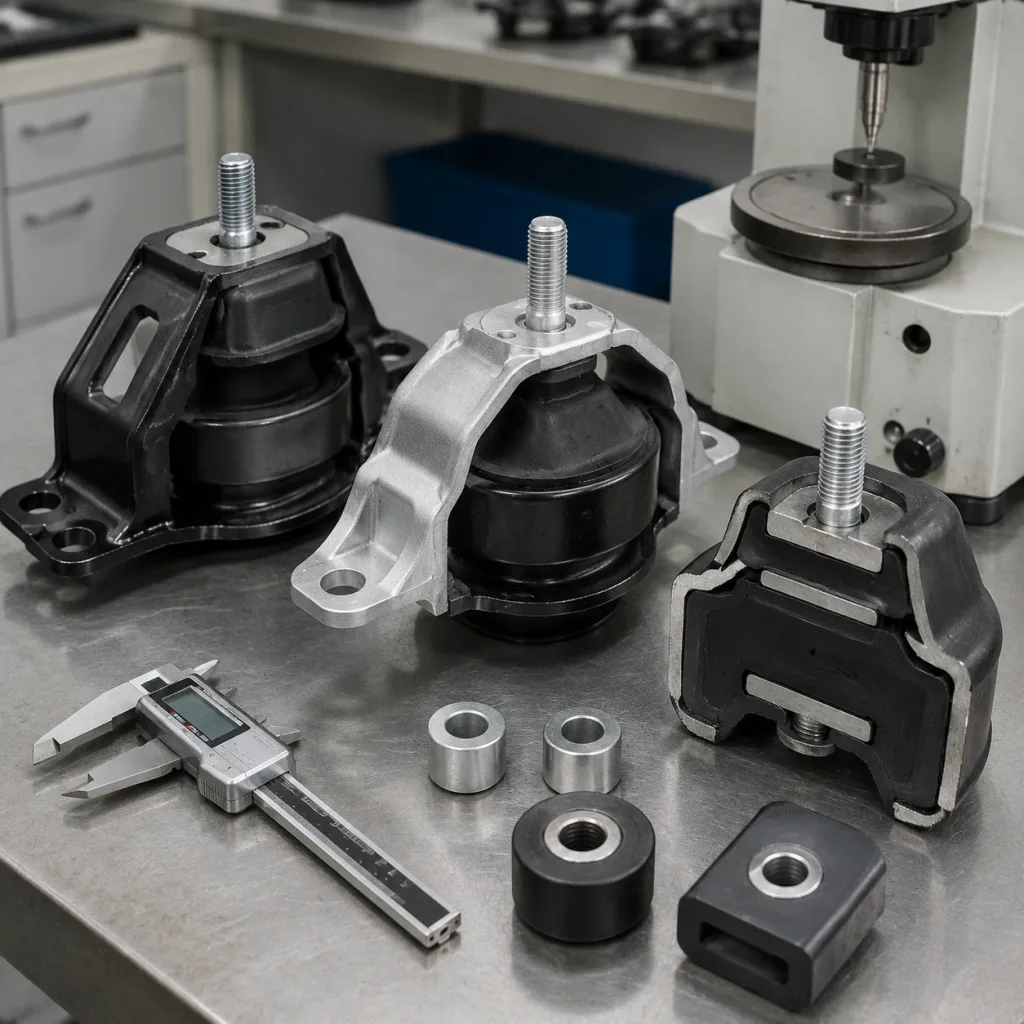
Engine mounts are not one product category. They differ in how they carry load, isolate vibration, and age in service. The construction choice affects cost, durability, sample timing, and the amount of validation you should require.
Mount type
Typical construction
Best use
Procurement note
Conventional rubber-metal
Moulded elastomer bonded to a steel bracket
High-volume replacement parts
Lowest complexity; verify durometer, compression set, and bond strength
Hydraulic
Elastomer body with internal fluid chamber
NVH-sensitive applications
Requires tighter leak, temperature, and endurance validation
Active or electronically controlled
Mount with sensor or solenoid function
Premium trim or OE-equivalent programmes
Higher BOM, more test points, and stricter connector requirements
</tr></thead><tbody> </tbody></table>For buyers, the key comparison is not only unit price. A standard rubber-metal mount usually delivers the lowest cost and fastest replenishment. Hydraulic and active versions can look attractive at quote stage, but they often carry longer approval cycles, more documentation, and more packaging sensitivity. If the programme is price-driven, define the acceptable trade-off up front: quieter ride, shorter life, or higher warranty exposure.
Spec the part like a control item, not a commodity
A mount becomes easy to source only after the specification is disciplined. The factory needs to know what must stay tight and what can move. That means separating critical dimensions from cosmetic or packaging details, then attaching real acceptance criteria to each one.
A practical control spec might require critical hole-center and stud-location dimensions within `±0.2 mm`, non-critical bracket features within `±0.5 mm`, rubber hardness at `55±5 Shore A` for comfort-biased applications or `65±5 Shore A` for stiffer control-focused mounts, and static load-deflection performance within a defined engineering window. For hydraulic mounts, ask for fluid-fill tolerance, leak-rate limit, and temperature-cycle target. For bonded rubber designs, include tensile strength, elongation, and compression set targets so the factory is not guessing at compound quality.
Common material and performance checkpoints include:
Rubber tensile strength above `12 MPa`
Elongation above `250%`
Compression set below `35%` after the agreed heat-aging cycle
Bond-pull or peel strength sufficient to prevent separation under vibration
Corrosion resistance for exposed brackets, where applicable
The more explicit the spec, the fewer sample rounds you need. It also makes supplier comparison easier because every quote is answering the same technical question.
Check the evidence package before you approve samples
Visual inspection is not enough for an engine mount. A supplier that wants serious B2B business should be able to show dimensional data, bonding verification, load-deflection results, and durability evidence matched to the duty cycle. If the product is hydraulic, ask for leak testing and thermal cycling records, not just a clean sample photo.
Define pass/fail logic before the first sample arrives. A workable approval set can include `Cpk` targets of `1.33` or higher on critical dimensions, zero open defects, no visible rubber-to-metal bond failure after the agreed fatigue cycle, and no fluid leakage after thermal cycling. For cold-weather programmes, request low-temperature impact or cold-soak testing. For durability-sensitive programmes, ask for the test cycle count in writing instead of accepting a vague “passed” note.
Request these documents:
Signed material declaration
Control plan and incoming inspection criteria
Sample report with measured dimensions and tolerances
Packaging approval and label artwork
Traceability code format
Test method summary with acceptance thresholds
If your internal process uses PPAP-style review, ask for it explicitly even for aftermarket supply. That makes the factory quote the approval workload, not just the part price, and it shortens the internal release cycle on your side.
Use lead time and MOQ as a truth test
Lead time and MOQ reveal how real a quotation is. A supplier can offer a low unit price and still fail the programme if the production slot, tooling status, or compound approval path is unclear. The right question is not “what is your price?” but “can you repeat this order under the same terms?”
As a working benchmark, stocked or repeat-tooling parts may ship in about `15-25 days` after order confirmation. New tooling or compound requalification can push first delivery to `35-60 days`, depending on sample approval and material lock. MOQ may start in the low hundreds per SKU for repeat parts, but custom packaging, private label, or buyer-specific hardness targets can raise the opening commitment. Always confirm whether the quote is `EXW`, `FOB`, or `CIF`, because freight and export handling can materially change landed cost.
Before award, confirm:
First-article timing
Tooling ownership and maintenance terms
Raw material approval window
Production slot reservation
Forecast stability and safety stock rules
MOQ by SKU and packaging configuration
Price breaks at `500`, `1,000`, and `3,000` units
Lead-time change trigger if forecast moves more than `20%`
If the programme needs private label or buyer-specific carton rules, lock those details before PO release. Packaging changes after the fact are a common source of delay and hidden cost.
When Driventus is the right fit for Genesis programs
Driventus is an independent aftermarket manufacturer; brand names are referenced for fitment only. That matters because it keeps the commercial file clean when you are sourcing across regions or customer channels.
We supply engine mounts alongside pistons, crankshafts, gaskets, water pumps, and turbochargers in engine components, which helps buyers consolidate vendors and reduce inbound complexity. Where a programme needs branded packaging or drawing-controlled changes, our custom manufacturing team can align labels, cartons, and part marking with your specification.
For a Genesis engine-mount programme, the fastest route to a usable quotation is to send the OE cross-reference, vehicle generation, engine code, side designation, annual forecast, target market, packaging spec, and required approval standard. If you also include dimensional targets, hardness range, and test expectations, we can quote with fewer assumptions and give you a clearer MOQ and lead-time position.
If you are qualifying a Genesis programme, send the OE cross-reference, photo set, annual volume, and target market requirements. We can then quote the part, confirm documentation, and schedule samples through request a quote.
Frequently asked questions
Yes. We supply independent aftermarket parts built to buyer specifications and fitment references. We do not claim OEM approval. You should still validate dimensions, compound hardness, and installation geometry before release. For a formal approval, define the target tolerance band, test cycle, and packaging standard before sampling.
Send the OE cross-reference if available, vehicle application, photos, drawing or sample, annual volume, packaging needs, and any restricted-substance requirements. Clear input shortens quotation time and reduces sample revisions. For a tighter quote, include hardness target, key dimensions with tolerance, expected monthly call-off, and whether you need stocked or made-to-order supply.
Yes. Through our custom manufacturing workflow, we can align carton design, barcodes, label copy, and pallet rules to your programme. Tooling status and MOQ depend on the part design and approval scope. We can also quote by order size and packaging level so you can compare landed cost across different release plans.
If you are building a Genesis engine mount supply programme, share your fitment data and volume forecast so we can review the right option with you. Start here: /contact.html