Engine Compression Test Failure: Engine Block Causes and Fixes
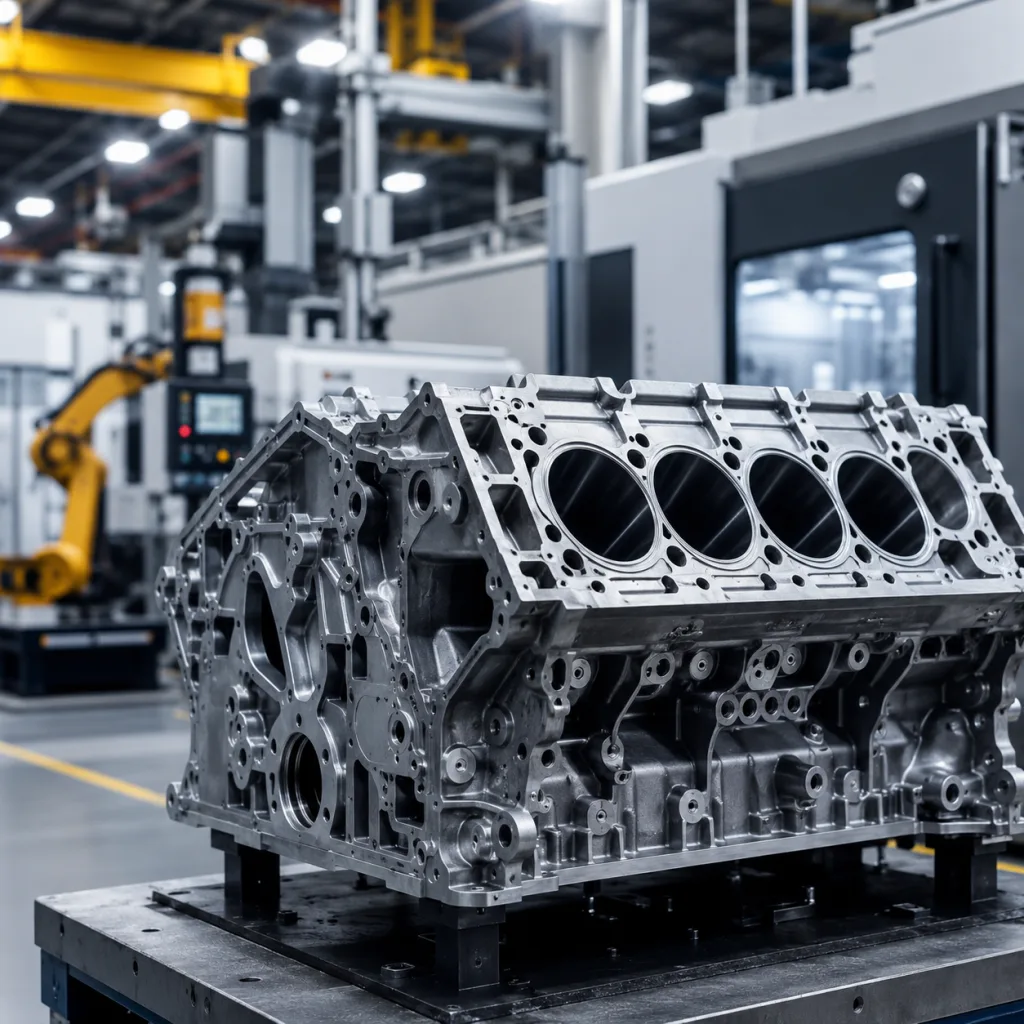
A low compression reading does not identify the failed component by itself; it only confirms that one cylinder is not sealing properly. The loss may come from valves, the head gasket, ring pack, or the engine block. When the block is the source of the engine compression test failure engine block symptoms, the usual causes are cracked water jackets, deck distortion, worn or scored bores, and heat or cavitation damage that compromises the casting.
For buyers and rebuild shops, the first step is to confirm the root cause before ordering parts. Machining only makes sense if the casting still has usable wall thickness and the bore geometry can be restored within specification. Driventus is an independent aftermarket manufacturer; brand names are referenced for fitment only. Our blocks are produced under IATF 16949:2016 and ISO 9001:2015 controls, with material and compliance checks that support REACH (EC) No 1907/2006 requirements where applicable.
What the reading pattern tells you
Compression testing is most useful when you compare cylinders against each other, not when you read one value in isolation. A single low cylinder usually points to a localized sealing issue such as a damaged bore, cracked piston, or leaking valve. Two adjacent low cylinders often indicate a head gasket breach or a deck surface that is no longer flat enough to seal evenly. Low readings across several cylinders can indicate timing issues, valve leakage, or broader mechanical wear.
The pattern matters because it narrows the inspection path before any parts are ordered. If the readings are uneven but the engine still starts and runs, you may be dealing with an early-stage block issue rather than a total failure. If the engine recently overheated, the block deserves immediate attention: heat can distort the deck, open a crack near a coolant passage, or damage the cylinder wall finish enough to reduce ring seal. A compression test is only the first screen. Follow it with leak-down testing, coolant inspection, and visual examination of the block before deciding whether the casting can be reused.
Block faults that commonly lower compression
Fault
Typical sign
Block-level inspection
Deck warp
Adjacent cylinders low, uneven gasket imprint, repeated head gasket failure
Low reading improves during wet compression test, blow-by, oil consumption
Bore gauge, taper and ovality measurement, visual inspection for vertical damage
Porosity or casting defect
Persistent sealing failure in the same area, coolant seepage without visible external damage
Pressure test, close visual inspection, magnaflux or dye penetrant where appropriate
</tr></thead><tbody> </tbody></table>Block faults are not all equally repairable. Minor deck distortion can sometimes be corrected by machining if the remaining thickness stays within the engine maker's limit. Cylinder wear is only serviceable when the bore can be restored with honing or oversize machining and the wall thickness remains safe. If the damage extends into a water jacket, main web, or other structural area, the casting usually stops being a practical rebuild candidate. In that case, replacement normally gives a better long-term result than trying to salvage a weakened block.
Inspection sequence before you order parts
1. Record dry compression readings for every cylinder and note the spread between the highest and lowest values. 2. Repeat the test as a wet compression check where appropriate to see whether oil temporarily improves sealing. 3. Run a leak-down test and identify whether air escapes through the intake, exhaust, crankcase, or cooling system. 4. Inspect the bores with a borescope for scoring, rust, wash marks, broken ring-land evidence, and vertical crack lines. 5. Check deck flatness with a straightedge and feeler gauge, then compare the result to the engine maker's service limit. Many OEM limits are in the 0.05 mm to 0.10 mm range across the deck, but always verify the specific engine specification. 6. Measure bore diameter, taper, and ovality at several heights in the cylinder. 7. Inspect main bearing saddles, coolant jackets, and oil galleries for heat staining, erosion, or cavitation damage. 8. Review prior repair history to see whether the block has already been machined, sleeved, or repaired in the same area.
This sequence separates block faults from top-end faults and gives the sourcing team the measurements needed to decide whether a repairable casting can stay in service. It also prevents a common mistake: buying rings, gaskets, or valves when the real issue is structural damage in the block. If the block fails the inspection on more than one measure, replacement is usually the faster and safer path than another round of disassembly.
Repair, sleeve, or replace the block
Option
Best use case
Main risk
Machine and resurface
Minor deck distortion, bores still within limits, and no evidence of structural cracking
Not enough material remaining after machining, or surface finish still not suitable for sealing
Sleeve one or more cylinders
Local bore damage in an otherwise sound casting
Sleeve fit, heat transfer, sealing quality, and cost versus the remaining value of the block
Replace the block
Cracks, heavy wear, porosity, repeated failure, or an unacceptably thin wall after previous machining
Higher unit cost, but lower technical risk and less rework exposure
</tr></thead><tbody> </tbody></table>The decision is rarely about one defect alone. A block with slight wear but strong wall thickness may be worth machining if the vehicle is high value and downtime is not critical. A block with a crack, an overheated deck, and a history of prior repair is a different case: the repair may look acceptable on the bench and still fail under load. Sleeving can work well when the damage is localized, but it adds complexity and must be done with correct interference fit, sleeve depth control, and final finish. Replacement becomes the practical option when the crack enters the water jacket, the bore damage exceeds available oversize, or a previous rebuild has already removed too much material. In fleet work, a clean replacement often gives better downtime control than a marginal repair that may fail again in service.
What to specify when sourcing a replacement
A replacement block should be ordered against measurable data, not just the model name. The key specification points are bore size, deck height, main bore alignment, coolant and oil passage layout, sensor boss locations, and whether the block is supplied bare, machined, or with plugs installed. If the engine family has regional variants or emissions-specific changes, those details must be confirmed before purchase because small casting differences can affect fitment and assembly time.
For current coverage, see our catalog and engine components. If you need a non-standard casting, custom manufacturing is the right route for regional variants, machining changes, or package-specific requirements. Our quality system explains how inspection records, traceability, and release checks are controlled.
For procurement, ask for:
Dimensional report and inspection record
Material specification and heat-treatment status
Bore, deck, and main bore tolerances
Compliance statement for REACH (EC) No 1907/2006 where applicable
Packaging and traceability details for export
Lead time, MOQ, and sample policy
Confirmation of plugs, galleries, and threaded holes included at supply
Photos or sample measurements if the application uses a non-standard engine variant
Frequently asked questions
Yes. A cracked cylinder wall, warped deck, heavy bore wear, or casting porosity can all reduce sealing. Confirm it with leak-down testing, borescope inspection, and block measurements before you buy parts.
Replace it when cracks reach the water jacket or main web, when bore wear is beyond service limit, or when previous machining has already removed too much material. At that point, repair risk is usually higher than replacement risk.
Send the engine code, cylinder count, bore measurements, deck height if known, photos of the damage, target market, and annual volume. That lets us confirm fitment and tell you whether a standard or custom block is the better option.
If you need a replacement block or a dimensional check for a fitment review, send the engine code and measurements via [request a quote](/contact.html).