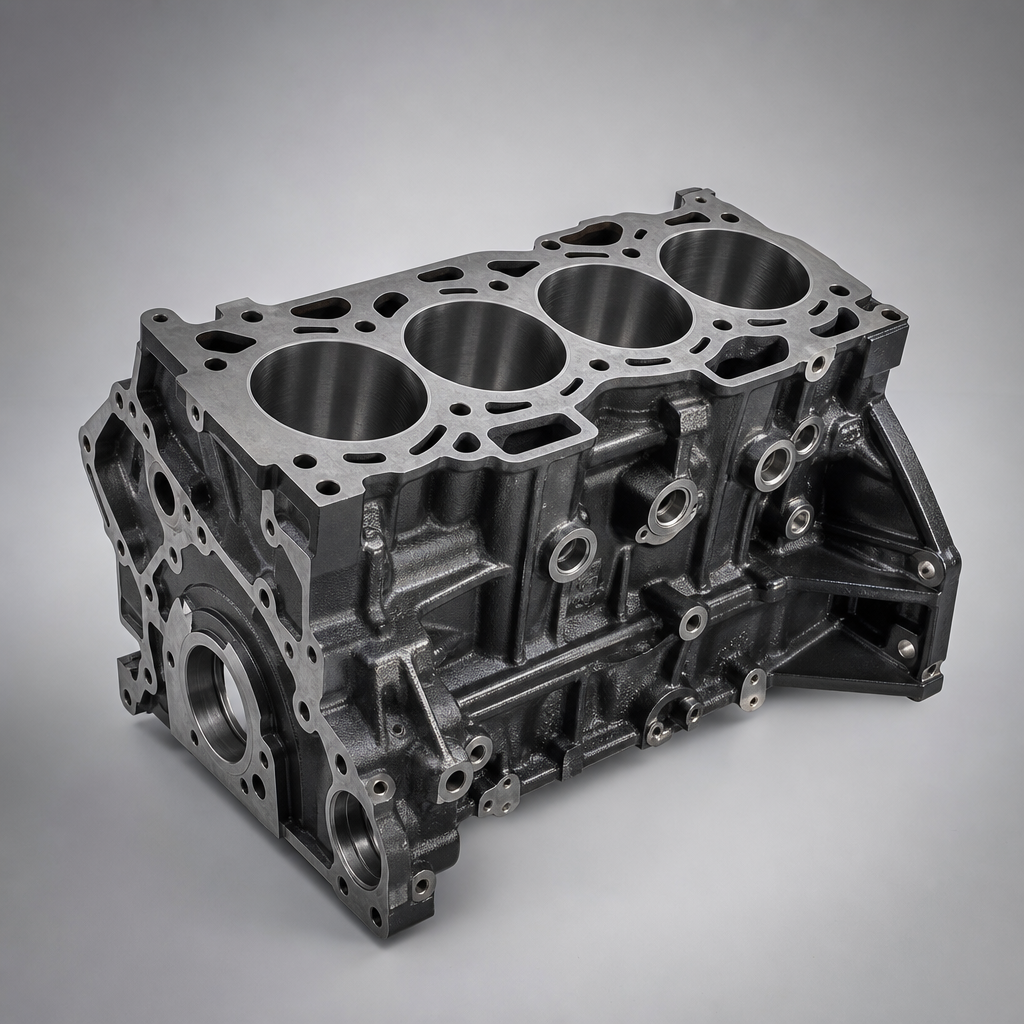
Choosing an engine block Peugeot supplier is not a catalogue-only decision. Procurement teams need to verify casting integrity, machining capability, dimensional control, documentation, packaging, and continuity of supply across the engine families they plan to sell. A block that looks correct at quotation stage can still create warranty exposure if bore geometry, deck flatness, oil-gallery cleanliness, or main-bearing alignment is not controlled from batch to batch.
This guide is written for import managers, sourcing engineers, and aftermarket category buyers assessing China-based supply for Peugeot-fit engine block programmes. It explains what to prepare before RFQ, how MOQ and lead time are usually determined, which audit questions to ask, what validation evidence to review, and how to reduce commercial risk before sample ordering or annual contract negotiation.
Driventus is an independent aftermarket manufacturer. Peugeot and other vehicle brand names are referenced only to identify fitment and application scope; they do not indicate approval, endorsement, or authorisation by any vehicle manufacturer.
What procurement teams should define before RFQ
A precise RFQ reduces quotation gaps and prevents later disputes over machining scope, packaging, inspection records, and responsibility for development work. For engine blocks, the RFQ should go beyond the vehicle model name. It should identify the engine family, displacement, fuel type, emissions market, and the exact supply condition required: raw casting, semi-finished casting, fully machined bare block, or a block supplied with plugs and dowels fitted.
For Peugeot-fit applications, buyers often source across several generations of petrol and diesel engines. The same commercial vehicle name can use different blocks depending on build year, destination market, emissions level, and engine code. A complete RFQ package should normally include:
Target application range by engine code (e.g., DV6TED4, EP6FDT, DW10CTED4), displacement (e.g., 1.6L HDi, 1.6L THP, 2.0L HDi), model year, fuel type, and market.
Verified OE part-number cross-references where available, supplied by the buyer’s own catalogue or technical database.
Required supply condition: raw casting, machined bare block, short-block-ready block, or block with fitted plugs and dowels.
Key dimensions and features, including bore size (e.g., 75.0 mm ±0.01 mm), deck height (e.g., 214.5 mm ±0.05 mm), main tunnel size (e.g., 54.0 mm ±0.02 mm), liner type (wet or dry), oil-gallery layout, coolant passages, sensor bosses, and mounting points.
Annual volume forecast, first order quantity, safety stock requirement, and expected call-off pattern.
Packaging requirements such as export carton, wooden case, palletisation, corrosion protection, barcode label format, and mixed-SKU rules.
Destination country, requested Incoterms, and any country-specific documentation requirements.
Documentation expectations, such as dimensional reports, material certificates, process control plans, PPAP-style files, or batch traceability records.
Driventus can review sourcing data against our catalog and engine component manufacturing scope at /products/engine-components.html. For non-catalogue variants, buyers should state whether reverse engineering, drawing development, tooling, fixtures, or validation support is expected before quotation.
Manufacturing scope for Peugeot-fit engine blocks
Engine block supply involves more than buying a casting. The key distinction is whether the supplier controls machining, inspection, cleaning, and final packing internally, or depends on multiple outside processors. A more integrated production route gives buyers fewer handover points, stronger traceability, and a clearer audit trail.
A typical Driventus engine block production route can include casting sourcing or controlled casting production, heat treatment where specified, CNC machining, line boring or honing, deck milling, threaded-hole machining, oil and coolant gallery cleaning, pressure testing where applicable, final dimensional inspection, rust prevention, and export packing.
The table below shows common purchasing scopes and their procurement implications:
Supply scope
Typical buyer use case
Main sourcing risk
Recommended verification
Raw casting
Buyer has its own machining line
Porosity, shrinkage, inconsistent stock allowance
Casting drawing, material certificate, CT scan or section checks for critical zones
Semi-finished block
Buyer performs final machining
Datum mismatch and variable machining allowance
Datum plan, machining allowance report (e.g., 0.5 mm ±0.1 mm on deck), pilot sample measurement
Fully machined bare block
Aftermarket distribution or engine remanufacturing
Bore, deck, main tunnel, threaded holes, gallery cleanliness
Full dimensional report (e.g., bore roundness ≤0.01 mm, deck flatness ≤0.05 mm), pressure or leak test (e.g., 2 bar for 30 seconds), cleanliness check (e.g., no chips >1 mm)
Block with plugs/dowels fitted
Repair-chain or assembly-ready supply
Plug sealing and component fit consistency
Torque records (e.g., 25 Nm ±2 Nm), plug retention check (e.g., pull test >500 N), assembly audit
</tr></thead><tbody> </tbody></table>For importers and aftermarket distributors, the fully machined bare block is often the most practical SKU because it reduces domestic machining, labour, and inspection burden. It also requires stronger supplier control. Bore roundness, cylindricity, main-bearing tunnel alignment, deck height, and surface finish should be verified before production release, especially for first orders and newly developed references.
MOQ, lead time, and order planning
MOQ and lead time depend on casting availability, machining fixture status, annual demand, inspection requirements, and packaging format. Buyers should separate three timelines: sample development, first mass-production order, and repeat production. Treating them as one lead-time figure can hide tooling, casting, fixture, or packaging bottlenecks.
Typical planning ranges for engine block sourcing are:
Existing catalogue item with available fixtures: sample preparation commonly takes 15-30 days after technical confirmation. MOQ: 50-100 pieces per SKU.
Existing casting with a new machining variant: sample development commonly takes 35-60 days, depending on fixture changes, CNC programming, and inspection workload. MOQ: 100-200 pieces per SKU.
New casting or reverse-engineered block: development can require 75-120 days or more, subject to drawing validation, casting trials, machining trials, and sample approval. MOQ: 200-500 pieces per SKU.
Repeat production orders: lead time is normally 30-45 days when forecasts, casting stock, consumables, and packaging materials are planned in advance. MOQ: 50-100 pieces per SKU.
MOQ should be discussed at SKU level. A buyer may want several Peugeot-fit block models in one shipment, but casting minimums, CNC setup time, inspection workload, and packaging preparation still apply to each reference. For slower-moving applications, a practical approach is to agree a launch order of 50-100 pieces, evaluate receiving and installer feedback, then maintain rolling quarterly or semi-annual forecasts for replenishment.
When evaluating an engine block Peugeot supplier, ask whether MOQ is driven by casting batch size, machining efficiency, packaging materials, inspection requirements, or commercial preference. The answer helps buyers understand how flexible the supplier can be when demand fluctuates or when a pilot programme needs cautious volume control.
Quality standards, audits, and compliance evidence
Engine block procurement should be evaluated through both management-system certification and part-specific evidence. Driventus operates under IATF 16949:2016 and ISO 9001:2015 frameworks for automotive quality management. These standards do not replace product validation, but they help buyers assess document control, traceability, corrective action, production control, calibration, and customer-specific requirement handling.
Buyers importing into the EU, UK, US, Canada, Australia, Brazil, and other regulated markets should request documents relevant to their product scope and import obligations. For engine components, material and chemical compliance may include REACH (EC) No 1907/2006 declarations where applicable to the buyer’s supply chain. Engine blocks themselves are not approved under complete-vehicle emissions standards such as ECE R-83; however, the final engine build must not compromise applicable emissions conformity. Buyers should be cautious of supplier claims that confuse component supply with original equipment approval or complete vehicle certification.
A practical supplier audit should cover:
Valid IATF 16949:2016 and ISO 9001:2015 certificates, including scope, site, expiry date, and issuing body.
Incoming casting inspection procedures and rejection criteria (e.g., porosity limit: max 2 mm diameter, 5 per 100 cm²).
CNC machine list, fixture maintenance plan, tool-control method, and preventive maintenance records.
Control plan for bore machining (e.g., tolerance ±0.01 mm, surface finish Ra 0.8 µm), main tunnel machining (e.g., tolerance ±0.02 mm), deck milling (e.g., flatness ≤0.05 mm), threaded holes (e.g., M10 x 1.5, depth 20 mm ±0.5 mm), and critical sealing surfaces.
Gauge calibration records traceable to recognised measurement systems (e.g., ISO 17025).
Nonconforming product segregation and corrective action procedure.
Batch traceability from casting lot to finished goods label.
Packaging drop (e.g., 1 m drop test), moisture (e.g., VCI bag, desiccant 5 g per block), and corrosion-prevention controls for sea freight.
More detail on Driventus procedures is available through our quality system. Remote audits can be supported with certificates, process flow charts, inspection examples, sample reports, and production photographs. On-site audits can include process walk-throughs, gauge review, packing assessment, and sample measurement verification.
Dimensional and material checks to specify
The engine block is the reference structure for rotating assembly alignment, sealing, lubrication, cooling, and accessory mounting. Small deviations can lead to high warranty costs after installation, particularly when issues appear only after the engine has been assembled and put into service. Procurement teams should therefore specify measurable acceptance criteria in the purchase agreement rather than relying on visual approval or catalogue matching alone.
Common technical checks with typical tolerances include:
Cylinder bore geometry: bore diameter (e.g., 75.0 mm ±0.01 mm), taper (≤0.005 mm), roundness (≤0.005 mm), cylindricity (≤0.01 mm), and surface finish (Ra 0.8 µm ±0.2 µm) according to the drawing or approved sample.
Deck surface: flatness (≤0.05 mm), roughness (Ra 1.6 µm ±0.4 µm), distance to crankshaft centreline (e.g., 214.5 mm ±0.05 mm), and compatibility with the intended gasket type.
Main bearing tunnel: bore size (e.g., 54.0 mm ±0.02 mm), alignment (≤0.01 mm), roundness (≤0.01 mm), cap register fit (e.g., H7/g6), and bearing seating condition where applicable.
Oil and coolant galleries: position (e.g., ±0.5 mm), thread quality (e.g., M12 x 1.5, class 6H), cleanliness (e.g., no chips >1 mm), sealing surface integrity, and absence of machining chips or sand residue.
Threaded holes and bosses: thread depth (e.g., 20 mm ±0.5 mm), pitch (e.g., 1.5 mm), perpendicularity (≤0.1 mm), location (e.g., ±0.2 mm), and resistance to pull-out defects (e.g., >1000 N).
Casting integrity: absence of cracks, major porosity (max 2 mm diameter, 5 per 100 cm²), cold shuts, inclusions, or leakage paths in critical sealing and load-bearing areas.
Hardness and material: confirmation against the agreed cast iron (e.g., GG25, HB 190-240) or aluminium alloy specification (e.g., A356-T6, HB 80-100).
Plug and dowel installation: correct location (e.g., ±0.1 mm), retention (e.g., pull test >500 N), sealing (e.g., leak test at 2 bar for 30 seconds), and fit where these items are supplied assembled.
A useful pre-shipment inspection package for a fully machined block includes at least one full dimensional report per batch or per agreed sampling plan (e.g., AQL 1.0, normal level II), material certificate, pressure or leak test record where applicable, inspection photos, and packing photos. For higher-risk first orders, buyers may request 100% checking of critical dimensions until process capability (Cpk ≥ 1.33) is demonstrated and claim history is stable.
If a buyer has an existing OE sample but no drawing, Driventus can support custom manufacturing through sample measurement, drawing preparation, feasibility review, and pilot production. Any reverse-engineered data should be frozen before mass production, with revision control, approval responsibility, and change-notification rules agreed in writing.
Packaging, labelling, and import readiness
Engine blocks are dense, machined components with corrosion-sensitive surfaces. Damage during sea freight can erase any savings from a low unit price. Packaging should therefore be treated as a technical specification item, not as an afterthought added after production.
For export orders, buyers should define:
Individual protection for the deck, bores, threaded holes, gasket surfaces, and other machined areas (e.g., foam inserts, plastic caps on all threaded holes).
Anti-rust oil (e.g., VCI oil, 10-15 µm film thickness), VCI bag (e.g., 100 µm thickness), desiccant (e.g., 5 g per block), or another corrosion-prevention method suitable for the planned transit and storage duration (e.g., 6 months in tropical conditions).
Inner supports that prevent movement inside the carton, crate, or wooden case (e.g., polyurethane foam, 50 kg/m³ density).
Label fields including part number, buyer SKU, batch number, quantity, country of origin, and barcode if required (e.g., Code 128, GS1-128 format).
Wood packaging compliance, such as ISPM 15 treatment and marking, where applicable for international shipment.
Spare labels (e.g., 2 per pallet), pallet maps, and packing list format for warehouse receiving.
Import managers should confirm HS code handling (e.g., 8409.91 for engine blocks), invoice description (e.g., "Cast iron engine block for Peugeot 1.6L HDi, fully machined"), certificate requirements (e.g., certificate of origin, fumigation certificate), and any country-specific documents before shipment. Brazil, for example, can require careful consistency across the invoice, packing list, bill of lading, and import registration. The EU and UK may require buyers to maintain chemical compliance records, including REACH (EC) No 1907/2006 declarations where relevant to product and supply-chain obligations.
The supplier should also explain how mixed-SKU pallets are controlled. Engine blocks that appear similar may have different sensor bosses, oil gallery plugs, deck details, or accessory-mounting points. Mis-picking can be difficult to detect at warehouse receiving unless carton labels, pallet maps, and batch references are clear.
Commercial risk controls for supplier selection
Unit price is only one part of landed cost. A low quote can become expensive if warranty claims, dimensional disputes, late shipments, or documentation errors are not controlled. Buyers should compare suppliers using measurable criteria rather than relying only on the headline price.
Recommended comparison points include:
Evaluation item
Why it matters
Evidence to request
Certification scope
Confirms the quality system covers automotive component production
IATF 16949:2016 and ISO 9001:2015 certificates
Manufacturing control
Reduces dependence on unverified subcontractors
Machine list, process flow, in-process inspection records
Technical communication
Prevents fitment and drawing interpretation errors
Claim procedure (e.g., 48-hour response), corrective action format (e.g., 8D)
</tr></thead><tbody> </tbody></table>For a buyer qualifying a new engine block Peugeot supplier, a staged launch is safer than placing a full annual order immediately. Start with technical confirmation, then sample approval (e.g., 5-10 pieces), pilot shipment (e.g., 50-100 pieces), warehouse receiving review, installer or remanufacturer feedback where applicable, and finally annual volume allocation. Acceptance criteria, inspection responsibility, replacement policy, and claim-handling rules should be defined before the first container is loaded.
Driventus is an independent aftermarket manufacturer. Any Peugeot, Citroën, DS, or other brand names used in commercial communication are used solely to identify compatibility and application scope, not to imply endorsement, authorisation, or original equipment approval.
How Driventus supports Peugeot-fit programmes
Driventus manufactures and exports engine and powertrain components from Taizhou, Zhejiang, supplying aftermarket distributors, OEM and Tier-1-related projects, and multi-location repair chains in more than 60 countries. For engine block programmes, our role is to provide controlled manufacturing, technical clarification, quality documentation, and export-ready packing rather than simple spot trading.
Support can include catalogue matching, OE cross-reference review based on buyer-provided data, engineering review of samples, machining feasibility checks, batch inspection, and export packing design. Where an item is outside regular production, the team can assess casting availability, tooling, fixture requirements, development timing, and validation needs before confirming commercial terms.
For buyers building a Peugeot-fit range, the strongest process is to submit a priority SKU list with annual demand, destination market, target packaging, required supply condition, and any known OE references. Driventus can then confirm available models, development items, MOQ logic, sample timing, inspection options, and document package choices. Procurement teams can also combine engine blocks with related products such as pistons, gaskets, water pumps, crankshafts, and turbocharger components when programme planning supports container consolidation.
To begin, send technical details through request a quote, including engine code, displacement, model year range, market, required supply condition, packaging needs, and annual forecast. This allows the commercial and engineering teams to respond with a realistic sourcing proposal rather than a generic price list.
Frequently asked questions
Provide engine code (e.g., DV6TED4, EP6FDT), displacement (e.g., 1.6L), model year range (e.g., 2010-2018), fuel type, destination market, required supply condition (e.g., fully machined bare block), annual forecast (e.g., 500 pieces), packaging requirement (e.g., export carton, VCI protection), and any verified OE cross-reference. Photos, drawings, or samples improve accuracy when the block is not already in regular production.
Trial quantities may be possible for existing catalogue items or sample development projects. MOQ depends on casting availability, machining setup, inspection requirements, and packaging. Buyers should separate sample quantity (e.g., 5-10 pieces), pilot order quantity (e.g., 50-100 pieces), and repeat-order MOQ (e.g., 100-200 pieces) during negotiation.
IATF 16949:2016 and ISO 9001:2015 are relevant quality management standards. REACH (EC) No 1907/2006 may be relevant for chemical compliance obligations in Europe. Part-specific dimensional, material, inspection, and traceability requirements should still be agreed for each engine block.
No. Driventus is an independent aftermarket manufacturer; brand names are referenced for fitment only. We do not claim approval, endorsement, authorisation, or original equipment status from any vehicle manufacturer.
If you are qualifying an engine block Peugeot supplier for aftermarket distribution, repair-chain supply, or programme sourcing, Driventus can review your RFQ package and confirm feasible options. Send the application data and forecast through /contact.html