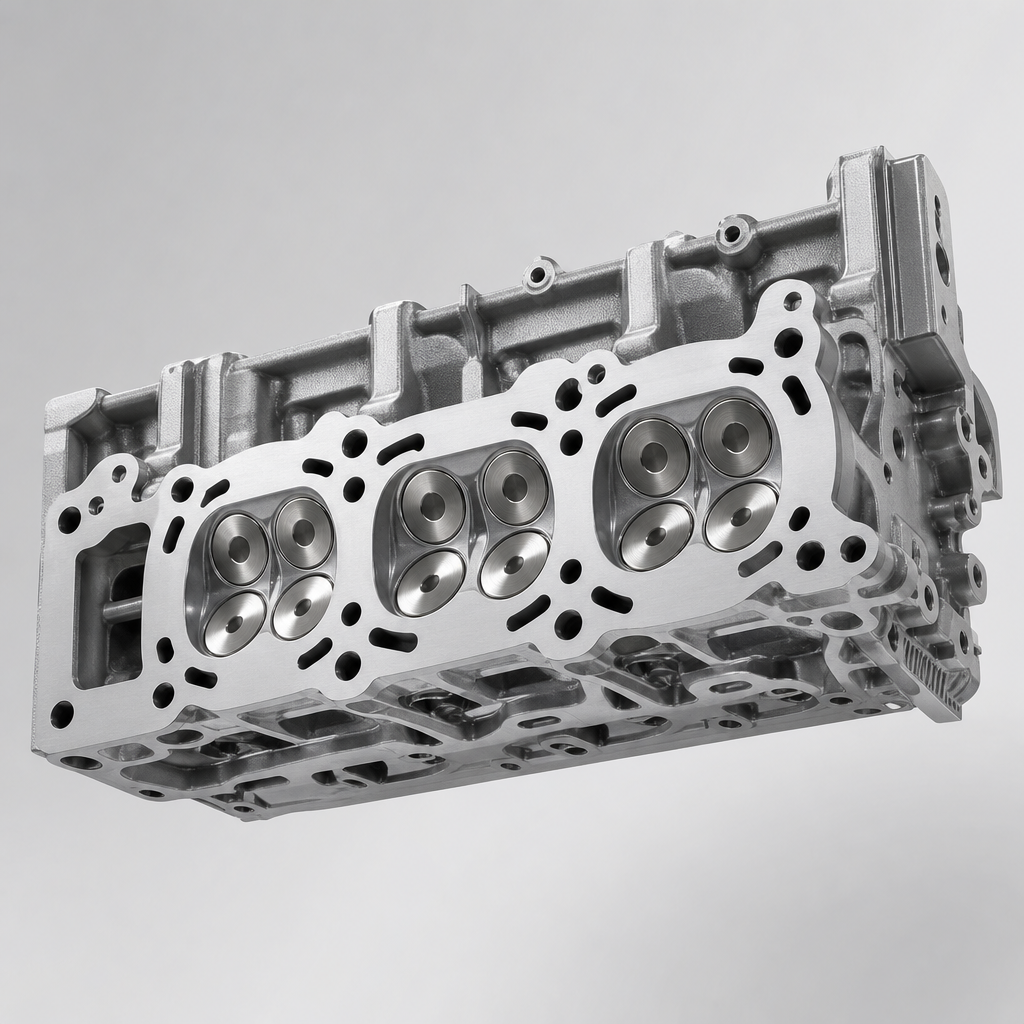
Engine Block Mercedes-Benz Manufacturer China Sourcing Guide
Choosing an engine block Mercedes-Benz manufacturer China buyers can qualify is an engineering and supply-chain decision, not a simple unit-price comparison. The block defines cylinder geometry, crankshaft alignment, coolant flow, lubrication stability, head-gasket sealing, and long-term durability. For importers, repair-chain buyers, and Tier-1 sourcing teams, the evaluation should be based on measurable evidence: casting integrity, bore and main-journal tolerances, deck flatness, cleanliness, traceability, warranty containment, and repeat-order capacity.
Driventus manufactures engine and powertrain components in Taizhou, Zhejiang, and supplies B2B customers in more than 60 countries. We support aftermarket distribution, private-label programs, and custom manufacturing for engine block assemblies and related components. Driventus is an independent aftermarket manufacturer; vehicle brand names are referenced for fitment identification only. This guide explains how to qualify a Chinese engine block supplier for Mercedes-Benz applications using practical audit points, documentation checks, engineering validation, MOQ and lead-time planning, and inspection evidence instead of unsupported claims or informal sample approval.
What procurement teams should verify before sourcing
For Mercedes-Benz-fitment engine blocks, procurement risk is concentrated in a limited number of technical and commercial controls. A capable supplier should be able to explain how raw casting control, machining, washing, inspection, packaging, shipment, and claim feedback are managed as one connected process with recorded limits, not only verbal assurances.
Start by defining the application scope. Confirm whether the supplier offers bare castings, semi-finished blocks, fully machined blocks, or block assemblies with liners, plugs, bushings, dowels, oil squirters, threaded inserts, core plugs, and selected hardware. Buyers should provide drawings when available, material requirements, target OE-style cross-reference format if used internally, and the relevant engine family, displacement, or engine code. Ordering from photographs alone creates unnecessary risk, especially where similar engine architectures have different ports, threads, sensor bosses, coolant passages, oil gallery plugs, or mounting faces.
Key qualification points include:
Fitment range: passenger car, van, light commercial, or industrial derivative application.
Material: grey cast iron, compacted graphite iron, or aluminium alloy, depending on the engine design.
Machining status: rough machined, finish machined, or ready for assembly after buyer inspection.
Dimensional controls: cylinder bores, main bearing tunnel, deck height, oil gallery position, threaded holes, dowel locations, and gasket surfaces.
Practical tolerances: agree drawing-specific limits; as references, finish-honed bore size may require control within ±0.01–0.03 mm, deck flatness often within 0.03–0.08 mm over the sealing face, and main tunnel alignment within tight CMM or line-bore limits defined by the buyer.
Test scope: pressure testing, leak testing, hardness testing, dimensional reporting, cleaning validation, and visual inspection.
Documentation: inspection reports, material records, process flow, control plan, packaging specification, and traceability records.
Commercial terms: MOQ, tooling responsibility, lead time, sample policy, payment terms, and after-sales containment.
A credible supplier will also distinguish replacement aftermarket supply from any OE production or vehicle-manufacturer approval claim. Driventus is an independent aftermarket manufacturer; brand names are used only to identify fitment.
Factory profile: what Driventus can support
Driventus is a vertically integrated Chinese manufacturer of engine and powertrain components based in Taizhou, Zhejiang. Our product range includes pistons, crankshafts, gaskets, water pumps, turbochargers, and engine block-related components. Buyers can review engine components through our catalog and the engine-focused category page at /products/engine-components.html.
For engine blocks, procurement teams usually need one of three supply models:
Feasibility review, tooling support, PPAP-style documentation where agreed
</tr></thead><tbody> </tbody></table>MOQ depends on casting complexity, machining scope, part weight, packaging method, and whether production tooling already exists. For an existing replacement application, buyers commonly discuss MOQ by part number and shipment lot; a practical starting range may be 20–50 pieces for heavier established blocks, while mixed-container or program orders may be structured across several related SKUs. For a new casting, MOQ is usually higher because pattern cost, fixture cost, trial casting, destructive checks, and machining validation must be amortised; 100–300 pieces or an annual call-off agreement is often more realistic than a single small order. Exact MOQ is confirmed after drawing and application review.
Lead time depends on the production route. Existing application samples may be prepared faster than new tooling projects. Typical planning assumptions are 15–30 days for an available sample or pilot lot after specification confirmation, 45–75 days for repeat mass production depending on foundry and machining capacity, and 90–150 days for a new casting program that requires pattern or die work, trial casting, heat treatment where applicable, machining validation, pressure testing, cleaning approval, packaging trial, and final buyer sign-off. A realistic sourcing plan separates engineering validation from the first mass shipment instead of compressing both into one deadline.
Quality system, certification, and audit evidence
Procurement teams should treat certification as a starting point, not a substitute for part-level validation. Driventus operates under IATF 16949:2016 and ISO 9001:2015 frameworks for automotive quality management. Buyers can review our quality system as part of supplier pre-qualification.
For an engine block program, audit evidence should include both system-level and product-level records. Useful documents include:
IATF 16949:2016 and ISO 9001:2015 certificates within the validity period.
Process flow chart covering casting, machining, cleaning, testing, packing, and shipment.
Control plan with inspection frequency, sample size, acceptance criteria, and reaction plan.
Material certificate or chemistry report for casting batches, including heat or melt number where applicable.
Dimensional inspection report for critical-to-function features, ideally identifying datum scheme, gauge type, operator, and inspection date.
Pressure or leak test records for coolant jackets and oil passages, with pressure, hold time, medium, and leakage criterion stated.
Gauge calibration records for bore gauges, CMM equipment, thread gauges, roughness testers, torque tools, hardness testers, and pressure-test equipment.
Nonconformity handling procedure and corrective-action format, preferably using 8D or equivalent containment logic.
Traceability method linking production batch, casting lot, machining cell, inspection data, and shipment details.
For EU and UK importers, REACH (EC) No 1907/2006 may be relevant to substances in articles, protective oils, coatings, and packaging materials. For North American and Australian buyers, documentation expectations often focus on traceability, warranty response, packaging durability, and clear country-of-origin marking. Brazilian importers commonly require accurate HS code support, complete commercial invoices, and strong carton or pallet specifications for long transit routes.
A factory audit should go beyond checking certificates in an office. It should follow the process route from incoming material to packed goods. For engine blocks, special attention should be paid to cleaning, rust prevention, thread protection, machined-surface protection, gauge control, and segregation of conforming and nonconforming parts. Ask to see live records from the last three production lots, not only prepared sample files; the buyer should be able to connect a casting mark or batch code to inspection reports and packing labels.
Engineering controls for Mercedes-Benz-fitment engine blocks
An engine block is not interchangeable simply because its outer shape appears correct. A Mercedes-Benz-fitment block must control the geometry and interfaces that support the crankshaft, pistons, cylinder head, oil circuit, cooling circuit, accessories, and sealing system.
Important control characteristics normally include:
Cylinder bore diameter and cylindricity: affects piston clearance, oil consumption, operating noise, compression stability, and ring sealing. Buyer-approved limits may include bore size, taper, out-of-round, plateau-hone roughness, and cross-hatch angle.
Main bearing tunnel alignment: affects crankshaft rotation, bearing load distribution, oil film reliability, and long-term crankshaft life. Line-bore or line-hone control should be checked with calibrated gauges or CMM methods.
Deck flatness and surface finish: affects head-gasket sealing, combustion-gas containment, coolant sealing, and oil leakage prevention. A typical surface-finish requirement may be expressed as Ra or Rz, with MLS gaskets often requiring tighter finish control than composite gaskets.
Head bolt thread position and depth: affects clamping load, repeat repairability, and resistance to thread pull-out. Go/no-go thread gauges and depth checks should be part of the plan.
Oil gallery location and cleanliness: affects lubrication pressure, oil delivery, and debris-related failure risk. Burrs, blasting media, chips, and casting sand are high-risk contaminants.
Coolant jacket integrity: affects pressure retention, hot-spot control, corrosion performance, and thermal stability. Leak-test settings should be documented rather than described generally.
Crankcase ventilation and plug sealing: affects leakage, oil mist control, and emissions-related system function.
Accessory and sensor interfaces: affect compatibility with pumps, brackets, sensors, filter housings, and market-specific emissions equipment.
Typical inspection package
A buyer-approved inspection package can include CMM reporting, bore gauge records, thread gauge checks, surface roughness records, hardness readings, pressure test results, and cleanliness checks. For higher-risk applications, sample sectioning, metallurgical evaluation, porosity review, or additional endurance-related validation may be agreed before release. Practical sampling may be 100% visual and leak testing for every block, with first-piece and last-piece dimensional checks per machining shift, plus full layout inspection on sample, pilot lot, and agreed periodic intervals.
Material and process questions
Ask whether the block is cast iron or aluminium, whether liners are inserted or integral, and whether heat treatment or stress-relief processing is used. For aluminium blocks, liner interference, casting porosity, deck stability, galvanic corrosion control, and thread strength require special attention. For cast iron blocks, hardness consistency, graphite structure, main-tunnel machining stability, and burr control in oil passages are common audit points. Buyers should specify whether hardness is checked in HBW, which locations are measured, and what range is acceptable for machining and wear performance.
The buyer and supplier should also agree which features are critical-to-function and how they will be measured. Without this agreement, a sample may appear acceptable visually while still carrying risk in bore geometry, bearing alignment, pressure retention, or cleaning quality.
Commercial terms: MOQ, lead time, packaging, and logistics
For a buyer searching for an engine block Mercedes-Benz manufacturer China supply partner, commercial clarity is as important as technical competence. Engine blocks are heavy, high-value parts with limited tolerance for freight damage. A small packaging error can turn an attractive factory price into sorting, warranty, or customer-claim cost after arrival.
The following points should be confirmed before purchase order release:
Item
What to confirm
Why it matters
MOQ
Quantity per part number, per shipment, and per private-label carton
Controls inventory exposure and landed cost
Sample policy
Sample price, lead time, test report, and freight term
Defines how validation starts
Lead time
Existing part versus new casting, machining fixture, or tooling
Prevents unrealistic launch planning
Payment term
Deposit, balance, LC, or buyer-specific approval
Aligns finance and production schedule
Packaging
Individual protection, rust prevention, pallet type, drop resistance
Reduces transit damage
Incoterms
EXW, FOB, CIF, DAP, or another agreed term
Clarifies freight responsibility
Traceability
Batch code, carton label, inspection record link
Speeds claim containment
Documentation
Invoice, packing list, certificate, test report, and origin marking
Supports customs clearance and customer records
</tr></thead><tbody> </tbody></table>Price logic should separate the block cost into casting weight and yield, machining time, consumable tooling, inserts or liners, plugs and hardware, leak testing, washing, packaging, and inland freight. A heavy iron block with more machining hours may cost less in tooling but more in freight; an aluminium block may require more porosity control, insert management, and surface protection. For private label, add carton artwork, plate or label cost, barcode management, and possible minimum print quantities. Tooling for a new program should be quoted separately from unit price, with ownership, maintenance, modification cost, and end-of-program handling stated in writing.
For sea freight, carton strength and pallet structure should match engine block mass, stacking conditions, vibration, and humidity exposure. Rust prevention may include protective oil, VCI material, sealed bags, desiccant, or a buyer-approved alternative. Threaded holes, machined decks, bore surfaces, dowel holes, and gasket faces need physical protection, not only outer carton padding. For blocks above roughly 25–40 kg, buyers should consider wooden crate, reinforced carton-on-pallet, or foam-supported individual packing, with forklift entry, strap tension, corner protection, and moisture barrier agreed before shipment.
If the project requires private-label cartons or market-specific documentation, confirm artwork approval, barcode format, country-of-origin marking, carton test expectations, and pallet labelling before mass packing. Buyers should also define whether mixed containers, consolidated shipments, or spare packaging materials are required for downstream distribution.
Cross-reference, fitment, and application data management
For engine blocks sold into the aftermarket, fitment data must be controlled carefully. Buyers may use OE-style part-number cross-references only when they are relevant to the confirmed application data and permitted in the buyer’s catalog system. Driventus does not claim approval, sponsorship, or endorsement by any vehicle manufacturer.
Fitment verification should include:
Engine code or family information supplied by the buyer.
Displacement, fuel type, aspiration, and production year range.
Cylinder head compatibility, bolt pattern, dowel locations, and gasket layout.
Crankshaft, piston, connecting rod, oil pump, and timing-system compatibility.
Market variation differences between EU, UK, US, Canadian, Australian, Brazilian, and other regional applications.
Emissions-package or model-year differences that may affect sensors, plugs, ports, and auxiliary equipment.
Catalogues can contain errors when vehicles share similar engine architecture but differ in emissions package, accessory mounting, cooling routing, or sensor layout. Before launch, a distributor should compare the sample block with an original sample, approved drawing, or buyer-controlled reference part. Photographs of all faces, port locations, deck surface, main tunnel, casting marks, threaded positions, plugs, oil gallery entries, coolant passages, and packaging should be stored with the part record.
A useful application record includes engine code, vehicle platform, production date range, transmission notes if relevant, related gasket kit, piston size, crankshaft compatibility, oil pump interface, and exclusions. If a block is sold in standard bore, oversize, with liners installed, or as a short-block-ready component, the catalogue record should state that clearly. Claims often occur when the commercial part number does not distinguish between a bare casting, semi-finished machining state, and fully machined replacement block.
For buyers needing drawing-controlled parts, Driventus can review custom manufacturing requirements. A controlled project can define dimensions, materials, inspection levels, surface treatments, packaging, traceability, and change-notification rules before production.
Recommended supplier audit checklist
A structured audit helps sourcing teams compare suppliers consistently. It also reduces dependence on informal claims about experience with European vehicles, premium applications, or difficult engine families.
Use the checklist below during remote or on-site qualification:
1. Business scope: confirm the factory is a manufacturer or has direct control over casting and machining resources. 2. Certification: review IATF 16949:2016 and ISO 9001:2015 certificates and match company name, address, and scope. 3. Engineering review: request feasibility feedback on drawings, samples, or target applications before discussing price only. 4. Casting control: verify raw material inspection, melting records, mould control, core control, pouring temperature control, shakeout, shot blasting, and defect segregation. 5. Machining control: check fixtures, CNC capability, tool life management, coolant management, datum control, and in-process gauging. 6. Testing: confirm pressure test method, test pressure, holding time, acceptance criteria, equipment calibration, and record retention. 7. Cleaning: inspect washing, drying, oil gallery cleaning, chip removal, compressed-air practices, and protection against residual debris. 8. Metrology: review CMM capability, bore measurement equipment, thread gauges, roughness measurement, hardness testing, master parts, and calibration records. 9. Traceability: verify batch marking, production date control, operator or line records, inspection records, and links to shipment cartons or pallets. 10. Packaging: inspect palletisation, machined-surface protection, moisture control, drop resistance, and shipping label accuracy. 11. Change control: confirm written notification before material, tooling, process, inspection method, packaging, or sub-supplier changes. 12. Claims handling: review 8D or corrective-action process, response timing, containment method, replacement policy, cost responsibility, and evidence retention.
For importers comparing several factories, assign scores to each area and weight them by risk. Dimensional control, pressure testing, cleaning, and traceability should carry more weight than office presentation or general sales experience. A practical scorecard might weight engineering and dimensional control at 30%, casting quality at 20%, leak testing and cleanliness at 20%, packaging at 10%, traceability and change control at 10%, and commercial responsiveness at 10%. A lower unit price is not a saving if the buyer must sort inventory after arrival or manage repeated field complaints.
When to choose a Chinese manufacturer for engine block sourcing
A Chinese manufacturer can be a practical option when the buyer needs stable export supply, multi-part consolidation, cost control, and engineering support. The decision is strongest when the supplier can provide repeatable machining quality, clear documentation, responsive commercial communication, and packaging suitable for long-distance transport.
An engine block Mercedes-Benz manufacturer China sourcing project is usually suitable when:
The buyer has clear application data, sample parts, or drawings.
Annual demand supports MOQ and shipping economics.
The distributor can run incoming inspection or validation before market release.
Packaging and labelling requirements can be standardised.
The buyer requires related parts such as pistons, gaskets, crankshafts, water pumps, turbochargers, or other engine components from one supplier group.
The project allows time for sample review, dimensional confirmation, pressure testing, cleaning verification, and packaging approval before mass shipment.
It may be unsuitable when the buyer needs a one-off repair part, lacks the ability to validate fitment, or requires a vehicle manufacturer-approved part for a warranty-specific repair. In those cases, the procurement path may be different. It is also risky when the buyer asks the factory to identify the application from photos only, refuses sample validation, or compresses tooling, trial casting, machining approval, and first shipment into the same deadline.
For B2B buyers, the main advantage is not only purchase price. It is the ability to set a controlled specification, audit the process, verify documentation, and build repeat supply. Driventus supports this approach with application review, sample discussion, inspection documentation, export packaging, and related engine-component sourcing. To start a sourcing review, buyers can request a quote with engine details, target quantities, destination market, expected annual volume, required machining status, packaging needs, and any drawing or sample information available.
Frequently asked questions
Yes. Private-label supply can be discussed for qualified B2B buyers. Requirements should include part scope, MOQ, carton design, labelling rules, inspection documents, traceability method, and destination market. Driventus is an independent aftermarket manufacturer; brand names are referenced for fitment only.
Provide the engine family or code, vehicle application, material preference, bare or machined block requirement, target quantity, destination port, packaging requirements, and any OE-style cross-reference already used in your system. Drawings, sample photos, or an original sample improve quotation accuracy.
Yes. These standards support process control, traceability, corrective action, and quality management. They do not replace dimensional validation, material checks, pressure testing, cleanliness review, packaging approval, or buyer sign-off for a specific engine block part number.
Existing applications normally have shorter lead times than new casting or tooling projects. As a planning guide, samples for available applications may take 15–30 days, repeat production may take 45–75 days, and new tooling programs may require 90–150 days before stable mass shipment. Exact timing is confirmed after technical review.
If you are qualifying an engine block supplier for Mercedes-Benz-fitment aftermarket or custom programs, send your application data, target volume, destination market, machining scope, packaging needs, and validation requirements. Driventus can review feasibility and pricing through /contact.html