Engine Block Land Rover OEM Supplier: Sourcing Criteria
When you source an engine block for Land Rover applications, price is only part of the decision. The real test is whether the casting quality, machining control, inspection evidence, and export packing all match the service duty, fitment window, and documentation your warehouse and customer need. Driventus supplies machined blocks for aftermarket and OEM programmes with heat- and lot-level traceability, dimensional inspection, and export packing suitable for mixed freight lanes. Driventus is an independent aftermarket manufacturer; brand names are referenced for fitment only. Before release, buyers should confirm bore centre distance, deck height, main bearing tunnel geometry, coolant and oil gallery machining, thread quality, and the specified surface finish on the gasket face. That reduces rework, limits warranty exposure, and makes incoming inspection straightforward. If you are evaluating a new source, ask for the material report, CMM data, process capability evidence, and a written change-control path before you commit volume.
What procurement teams should verify first
An engine block order should start with fitment evidence, not a catalogue description. For Land Rover programmes, procurement teams should verify the engine family, bore spacing, deck height, main bearing tunnel geometry, coolant and oil gallery machining, accessory mounting faces, and the required gasket surface finish before release. Driventus is an independent aftermarket manufacturer; brand names are referenced for fitment only.
For first-stage screening, ask the supplier to align the part against a specific drawing revision or controlled sample rather than a general model name. That avoids confusion where several engine variants share a family name but differ in deck height, bolt pattern, sensor boss locations, oil return paths, or timing cover interfaces. If the supplier cannot state which dimensions are critical to fit, the programme is not ready for sourcing.
Use this document set for the first discussion:
Drawing or dimensioned sample
Material certificate and heat or lot traceability
Machining route and inspection plan
Packaging and labelling requirements
Target annual volume and call-off pattern
Required release standard, such as PPAP, FAI, or buyer-specific approval
If you need a stocked line item, start with our catalog. If you need a platform-specific change, move to custom manufacturing.
Technical scope for a machined block
Machined engine blocks are usually supplied in one of three states. The right choice depends on how much value you want to add in-house and how much inspection capacity your plant or distributor has. The wrong choice creates avoidable cost in the form of extra machining, duplicated checks, or delayed release to service.
Supply option
Best fit
What should be controlled
Main trade-off
Raw casting
Engineering trials and long development cycles
Casting integrity, shrink allowance, datum stability
Highest downstream machining burden
Semi-finished block
Regional machine shops and reman programmes
Bore alignment, deck finish, thread quality, material condition
Lower entry cost, but more buyer control needed
Fully machined block
Distributors, OEM supply, and repair chains
Final dimensions, leak test, cleanliness, packaging
Highest unit cost, lowest incoming work
</tr></thead><tbody> </tbody></table>Typical operations include rough and finish machining, line boring, cylinder boring or honing, deck milling, tapping, pressure testing, final wash, and corrosion protection. In some programmes, additional work may include dowel installation, gallery plug fitting, serial marking, and preservative oil or VCI packing. The key procurement question is not whether those steps can be done, but whether they are done in a repeatable sequence with measured control points.
For an engine block land rover oem supplier, consistency from batch to batch matters more than a single sample that measures correctly. Buyers should ask for capability data across the critical features, not just a one-off inspection sheet. For launch-critical characteristics, many buyers ask for capability on bore diameter, main bearing bore, deck flatness, and tunnel alignment, with a target `Cpk` of at least `1.33` for stable production and `1.67` where the feature is especially sensitive to fit or sealing.
Quality and compliance file
Quality evidence is where most supplier evaluations are won or lost. A serious engine block source should be able to show control from incoming material through final pack, with traceability that lets the buyer isolate a lot quickly if a problem appears. Our quality system is built around IATF 16949:2016 and ISO 9001:2015 processes, with traceability records designed for fast containment and corrective action.
For EU and UK shipments, the compliance file should usually include:
Material certificates tied to heat or batch number
Dimensional inspection report with critical-to-fit measurements
First article inspection, PPAP, or buyer-specified submission level where required
REACH (EC) No 1907/2006 declaration where materials, coatings, or additives fall in scope
Cleanliness, corrosion protection, and packaging specification for export handling
Nonconformance, deviation, and change-control procedure for revision management
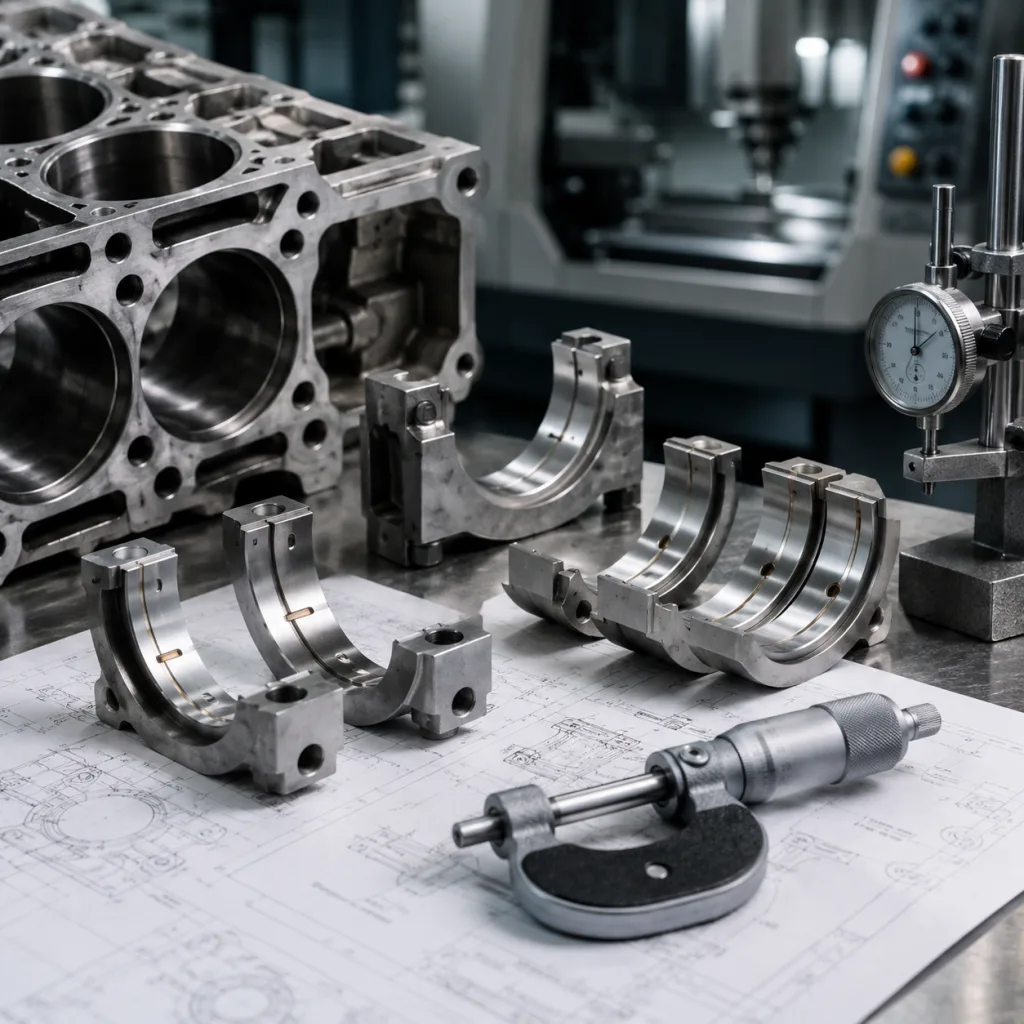
A practical inspection pack should identify the measurement method, gauge resolution, sample size, and acceptance limits. For example, buyers often want CMM data for datums and bore geometry, thread plug-gauge results for tapped holes, and pressure-test records that state test pressure and hold time. For cleanliness, ask whether the supplier uses gravimetric debris measurement, visual cleanliness under controlled lighting, or a customer-specific residue limit.
Not every programme needs every document in the same format, but every programme needs a documented path from raw input to finished part. That is the difference between a sourced component and a controlled supply part. If the supplier cannot describe how a change to a casting source, machining fixture, cleaning process, or coating is approved, the documentation set is incomplete regardless of how good the sample looks.
Lead times, MOQ, and commercial structure
Lead time depends on the starting point. A block that already exists in a stable machining cell is a different exercise from a drawing-based build with new fixtures, gauges, process validation, and packaging development. For a new programme, the practical path is usually a pilot run, dimensional sign-off, then serial replenishment against forecast.
Commercial variables that change MOQ and lead time:
Casting availability and tool status
Number of machining operations and inspection points
Leak test, surface treatment, or corrosion protection requirements
Labelling, palletisation, and export packing specification
Forecast stability and target monthly pull
Spare-part service level and buffer stock requirement
Whether tooling, gauging, and PPAP documentation are included in the unit price
If your demand is lumpy, ask for a buffer stock plan rather than repeated urgent orders. That often lowers total landed cost because the supplier can smooth machining and inspection capacity, reduce setup loss, and keep material allocated to your programme. Buyers should also clarify whether pricing includes tooling amortisation, special gauges, packaging artwork, and test records, because those items can materially change the commercial comparison.
Before release, close the loop with a short validation pack. It should answer three questions: does the block fit, does it hold dimension after machining, and does it arrive in a condition your warehouse can receive without extra cleaning or repacking. That validation should happen before the programme moves from pilot to repeat supply.
Recommended release checklist: 1. Confirm drawing revision, engine family, and target vehicle range. 2. Check CMM data for critical datums, bore alignment, and deck geometry. 3. Verify leak test, thread quality, and surface cleanliness. 4. Approve label, carton count, pallet pattern, and moisture protection. 5. Record change control so future revisions do not bypass approval. 6. Confirm unit-level marking if the programme requires traceability at serial or lot level. 7. Agree the response path for deviations, including hold, sort, rework, and replacement. 8. Lock the acceptance criteria for rework, scrap, and concession handling before serial release.
That process reduces warranty exposure and makes supplier comparison clearer. It also gives purchasing a defensible file when finance asks why one source costs more than another. If your team wants a drawing-based quote or a private-label variant, use request a quote and attach the technical pack. For a controlled pilot, include your target launch quantity, packaging rules, required inspection format, and any mandatory submission standard so the quotation reflects the real scope, not a generic assumption.
Frequently asked questions
Typical files are material certificates, dimensional reports, leak-test records, packing list, and traceability labels. For larger programmes, buyers often also ask for PPAP-style evidence, control-plan summaries, and revision-control confirmation so the supply file can support production release and after-sales traceability.
Yes. For drawing-based work, we review the print, confirm the manufacturing route, align gauges and inspection points, and agree packaging before pilot production. That is the normal path for custom manufacturing, especially when the block must match a defined revision, market, or service part requirement.
No. Depending on the programme, we can supply raw castings, semi-finished blocks, or fully machined blocks. The right format depends on your in-house machining capacity, required quality controls, and target landed cost. Buyers that need more internal value-add often choose a semi-finished route, while repair chains and distributors usually prefer a fully machined block.
Send the drawing, forecast, and target market, and we will respond with a technical-commercial quotation at /contact.html