Engine Bearing Nissan Supplier: Sourcing Guide for Buyers
Procurement teams looking for an engine bearing Nissan supplier need more than a catalogue match. The right source must confirm application fitment, hold tight dimensional tolerances, keep material and lot records, and deliver export documentation that supports supplier approval and inbound inspection. Driventus supplies engine bearings for petrol and diesel applications through export channels in more than 60 countries. We work under IATF 16949:2016 and ISO 9001:2015 systems and support buyers sourcing replacement parts, private-label programmes, or custom manufacturing for specific engine applications.
Driventus is an independent aftermarket manufacturer; Nissan and other brand names are used for fitment reference only. For buyers, the core qualification questions are practical: can the supplier match OE-style dimensions, maintain shell thickness and overlay consistency, provide inspection evidence, and plan shipments across multiple markets without disrupting replenishment? This guide outlines the technical, quality, and commercial points to review when qualifying a bearing source for Nissan applications.
What buyers should verify in a Nissan engine bearing supplier
A qualified supplier should support fitment by engine family, bearing position, and size grade where applicable—not only by vehicle model or year. Nissan applications can vary by engine code, crankshaft condition, and market version, so early technical confirmation prevents avoidable sampling errors.
Before sample approval or order placement, confirm:
OE or aftermarket cross-reference where available, with the application list checked against the requested engine family
Bearing type: main bearing, connecting rod bearing, thrust washer, flange bearing, or complete set
Standard and undersize options, where crankshaft regrinding is common in your market
Material system: steel-backed, copper-lead, aluminium-tin, or tri-metal construction
Coating, overlay, and anti-corrosion requirements
Oil clearance targets, housing bore requirements, and crankshaft journal dimensions
Package quantity, MOQ, carton configuration, and mixed-SKU shipment options
Traceability by batch, lot, or production date code
Test or inspection data for hardness, wall thickness, surface finish, and fatigue-related controls
A strong engine bearing Nissan supplier should also explain how dimensional variation is controlled across production runs. For distributors, repair chains, and programme buyers, repeatability is as important as the first approved sample. If inspection records are unclear, the commercial risk rises quickly—especially on fast-moving engine families with tight bore and journal tolerances.
Engine bearing specifications that affect fit and service life
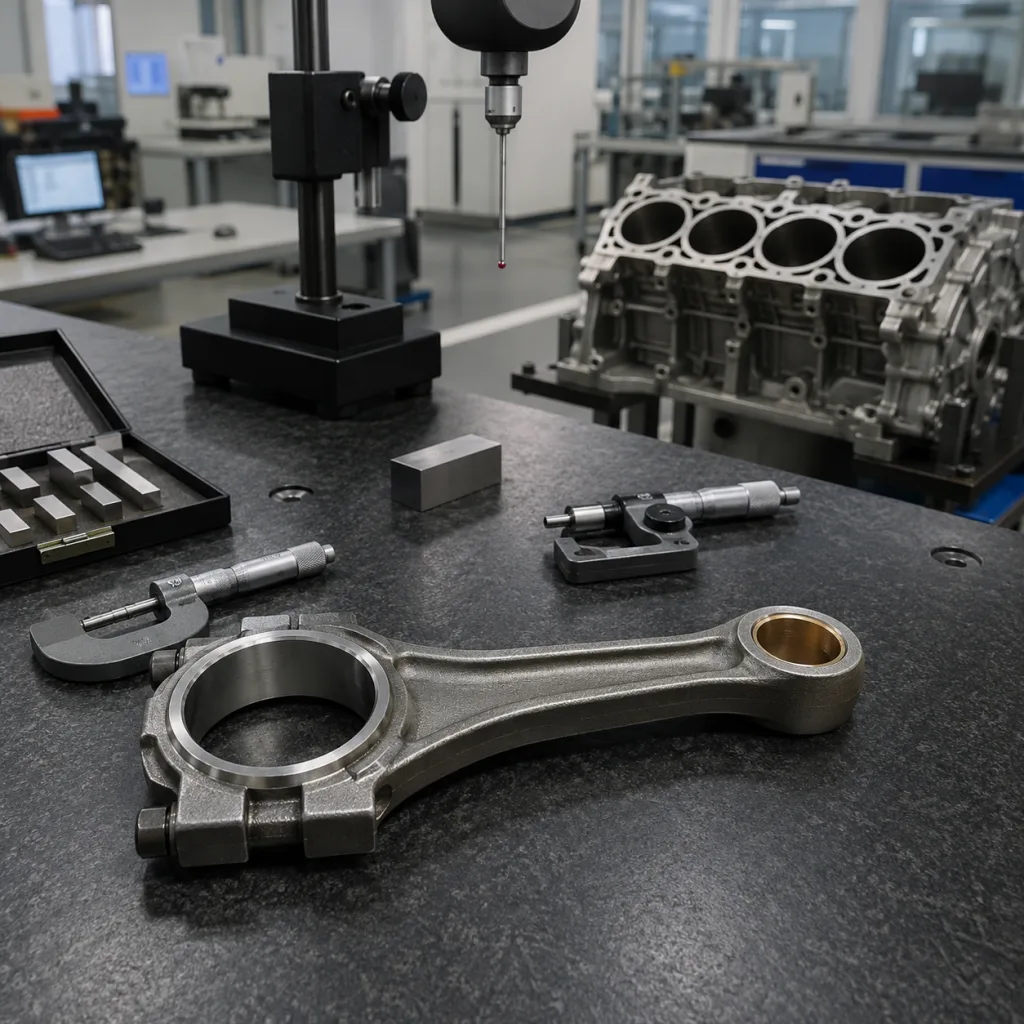
Engine bearings are not interchangeable across all Nissan engines, even when a shell looks similar at first glance. Critical specifications include shell thickness, crush, radial wall thickness, eccentricity, width, oil hole position, locating lug geometry, and overlay thickness. These values must suit the crankshaft journal, housing bore, and expected load conditions.
Spec item
Typical buyer check
Why it matters
Shell thickness
Micrometre measurement
Affects crush, seating, and oil clearance
Radial wall thickness
Batch inspection
Controls oil film formation and load capacity
Width
Caliper or optical check
Helps prevent edge loading and side interference
Back diameter
Go/no-go or fixture check
Supports correct location in the housing bore
Eccentricity
Drawing and inspection record
Helps maintain oil wedge performance under load
Overlay thickness
Process and inspection record
Influences wear resistance and debris tolerance
Surface finish
Visual and instrument check
Supports oil retention and stable break-in
</tr></thead><tbody> </tbody></table>For procurement, the practical issue is not whether one sample fits once. It is whether the supplier can hold the same values through sampling, the first production order, and repeat shipments. At Driventus, product control is connected to documented inspection steps under our quality system. Buyers can review our quality system before requesting samples, drawings, or production quotations.
Commercial sourcing points: MOQ, lead time, and export readiness
Engine bearing supply is usually shaped by two commercial constraints: inventory risk and replenishment speed. Buyers should request MOQ by part family, standard lead time, sample lead time, and packing details during the quotation stage. If the order includes mixed SKUs, the supplier should state whether it can consolidate main bearings, rod bearings, thrust components, and sets in a single shipment.
When evaluating an engine bearing Nissan supplier, check whether the factory can provide:
Commercial invoice and packing list formats suitable for customs clearance
Country-of-origin documentation where required by the destination market
Palletisation, moisture protection, and carton strength suitable for sea freight
Batch marking for receiving inspection and warehouse traceability
Separate timelines for sampling, tooling or packaging confirmation, and production
Clear handling of partial shipments, back orders, and forecast-based replenishment
Driventus supports B2B export programmes for distributors, OEM / Tier-1 supply chains, and repair networks. If your programme includes private label, regional languages, barcode formats, or application-specific packaging, use custom manufacturing to confirm print, pack, and documentation options. For broader category planning, buyers can also review our catalog and the engine component range at /products/engine-components.html.
Validation tests and documents procurement teams should request
A supplier claim is only useful when it is backed by records that procurement, engineering, and quality teams can review. For engine bearings, documentation should support incoming inspection, sample approval, and technical release. Typical files include product specifications, material certificates, dimensional inspection reports, coating or overlay records, corrosion data where relevant, and process control evidence.
Common automotive sourcing references include IATF 16949:2016, ISO 9001:2015, REACH (EC) No 1907/2006, and customer-specific engineering requirements. Depending on the application and market, buyers may also ask how the supplier evaluates wear, fatigue resistance, bonding strength, and performance under thermal and load cycling.
Useful checks during sample approval:
1. Confirm bearing size, position, and material against the drawing, OE reference, or approved application data. 2. Measure oil clearance with the intended crankshaft journal and housing bore. 3. Inspect overlay uniformity, edge condition, oil holes, grooves, and locating lugs. 4. Verify packaging cleanliness, anti-corrosion protection, and label accuracy. 5. Record lot numbers and sample references for traceability during field or warranty review.
The buyer’s objective is not simply installation fit. The goal is stable performance through the service interval, predictable quality at replenishment, and enough documentation to resolve any technical question quickly.
Why buyers audit the factory before placing volume orders
Factory auditing is a standard step in professional sourcing, especially when bearings will be supplied to multiple regions or sold through high-volume repair channels. An audit should confirm process flow, gauge control, incoming material segregation, coating or plating discipline where applicable, and final inspection routines. It should also verify that nonconforming product is isolated, root-cause analysis is documented, and corrective actions are followed through.
A practical audit checklist for engine bearings includes:
Receiving inspection for substrate material and finished shells
Dimensional control using calibrated gauges and controlled measurement methods
Process records for forming, machining, coating, cleaning, and packing steps
Lot traceability from raw input to finished carton
Storage controls for coated or corrosion-sensitive parts
Final inspection sampling plan and release criteria
Export packing, carton label, barcode, and pallet verification
Driventus is based in Taizhou, Zhejiang, with vertically integrated production for engine and powertrain components. This structure helps buyers reduce coordination points across the sourcing chain. For teams qualifying a new engine bearing Nissan supplier, the ability to review production, packaging, inspection, and export documentation through one supplier can shorten approval time and lower launch risk.
How Driventus supports B2B buyers
Driventus supplies engine bearings and related powertrain components to aftermarket distributors, OEM / Tier-1 suppliers, and multi-location repair chains. Our role is to help procurement teams move from application review to sample approval and repeat supply with fewer gaps in technical communication.
What buyers typically receive:
Technical confirmation against the requested Nissan application, engine family, and bearing position
Sample and production quotations with MOQ, lead time, and packing details
Batch traceability and inspection support for inbound quality checks
Export documentation for customs and receiving teams
Support for private label, distributor packaging, or programme-specific carton formats
Documentation aligned with IATF 16949:2016 and ISO 9001:2015 controls
If you are sourcing Nissan engine bearings and need a stable supplier relationship, we can review your part list, annual volume target, packaging requirements, and destination-market approvals. Driventus is an independent aftermarket manufacturer; brand names are referenced for fitment only. For technical and commercial enquiries, please request a quote.
Frequently asked questions
Yes. We can review OE references, application data, and engine-family details, then confirm the matching bearing type, dimensions, material system, and packaging before quotation.
We can provide product specifications, inspection records, batch traceability, and commercial export documents. Certification references include IATF 16949:2016 and ISO 9001:2015.
Yes. We support custom manufacturing, including application-specific packing, label formats, carton configurations, and documentation requirements for distributor and programme orders.
If you need a technical review, sample plan, or volume quotation for Nissan engine bearings, send your specification list and target market requirements here: /contact.html