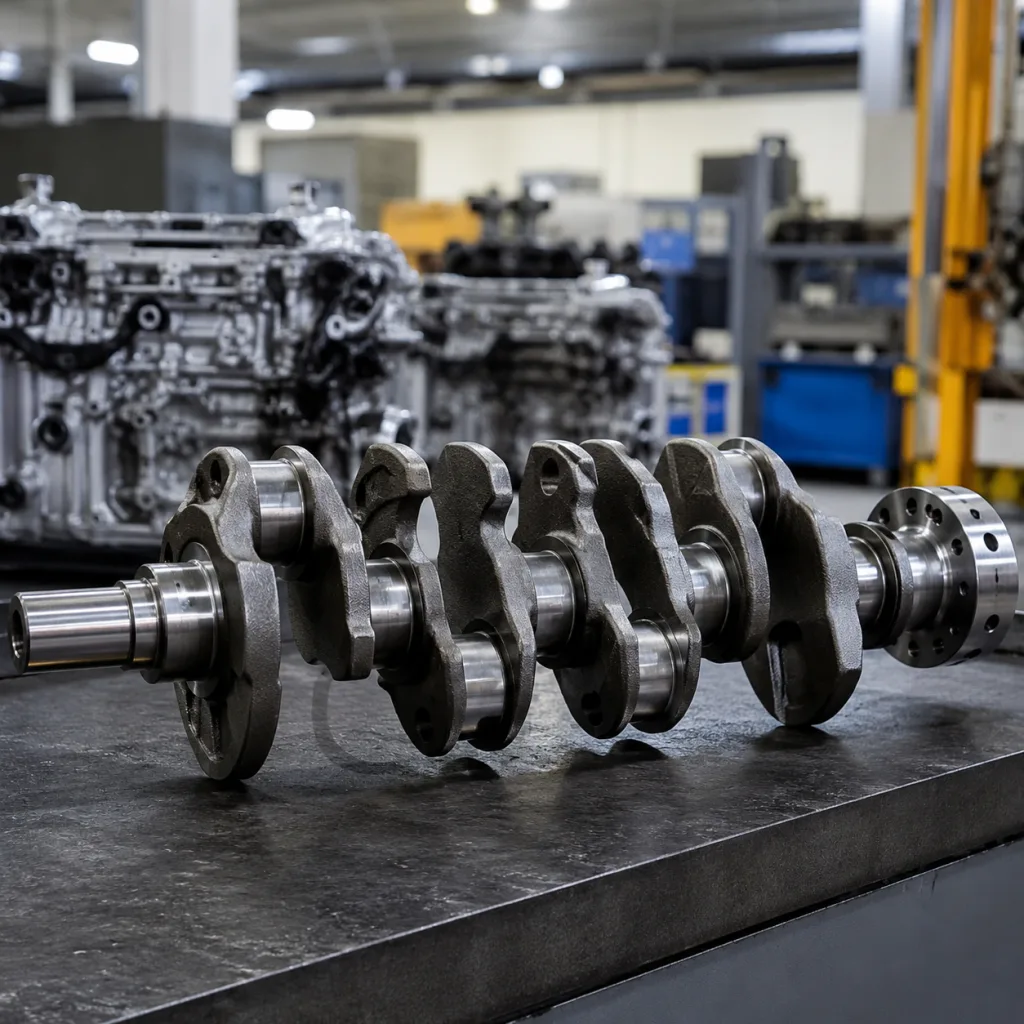
engine bearing · 2026-06-06

Engine Bearing Land Rover Manufacturer China Guide

Sourcing engine bearings for Land Rover applications from China is, above all, a matter of risk control and process capability. Buyers need stable metallurgy, repeatable shell geometry, controlled wall-thickness variation, correct installed crush, reliable corrosion-protective packaging, and shipment-level traceability. Unit price matters, but for importers, distributors, and engine rebuild programs it is rarely the biggest cost once warranty exposure, line stoppages, customs compliance, and field returns are factored in.

For B2B buyers, supplier evaluation should cover the manufacturing route, material control, inspection discipline, process capability, and documentation. Common questions include MOQ by reference and size grade, lead time by order mix, availability of oversize service parts such as 0.25 mm and 0.50 mm, and whether the factory can support private label or drawing-based development with controlled revision history. Driventus manufactures engine and powertrain components for export under IATF 16949:2016 and ISO 9001:2015 controls. This guide sets out practical criteria for assessing a Chinese engine bearing source for Land Rover-related aftermarket demand and similar premium SUV engine platforms.

Because the keyword engine bearing Land Rover manufacturer China often brings up a mix of traders, consolidators, and genuine manufacturers, it is important to separate catalogue marketing from real factory capability early in the RFQ process. A structured review helps buyers judge whether a supplier can hold dimensional consistency from lot to lot, support standard and repair sizes, and provide documentation suitable for the UK, EU, and other regulated markets. The goal is not simply to buy a bearing set that matches a catalogue reference. It is to build a repeatable supply program that protects your brand, customer retention, and warranty budget.

What procurement teams should verify first

When reviewing an engine bearing Land Rover manufacturer China search result, begin with production ownership and compliance basics rather than catalogue breadth alone. A shell may fit the housing, but if fatigue strength, overlay adhesion, or clearance control are weak, the resulting claims can cost far more than any purchase-price saving.

Start by confirming what type of supplier you are dealing with. Some companies control pressing, forming, boring, parting, surface finishing, coating or plating, final inspection, and packing in-house. Others act as trading companies and source from multiple workshops. That does not automatically rule out a trader, but procurement teams need to know who controls the critical process steps, who owns the inspection records, and who carries liability if a field issue appears months after shipment.

Key checks for first-stage supplier qualification:

  • Quality certification: verify active IATF 16949:2016 and ISO 9001:2015 certificates, scope statement, expiry date, and issuing certification body.
  • Manufacturing route: confirm whether the supplier forms shells from steel-backed strip, aluminium alloy strip, or tri-metal material and which steps are internal versus subcontracted.
  • Material route: clarify whether the design is aluminium bi-metal, copper-lead/bronze-based bi-metal, or steel-backed tri-metal with intermediate and overlay layers.
  • Dimensional control: ask for wall-thickness tolerance, shell length tolerance, free-spread range, crush-height validation method, and concentricity or profile-control method after forming.
  • Traceability: require traceability from raw material heat/coil or strip lot through production batch, final inspection lot, and export packing lot.
  • Coating capability: clarify whether standard flash plating, lead-free overlay, tin-based running layer, or polymer coating is available for specific SKUs.
  • Compliance documentation: request declarations for REACH (EC) No 1907/2006, and where applicable, RoHS-related material statements for customer files and packaging material compliance.
  • Validation records: ask for fatigue, bond-strength, hardness, microstructure, and seizure/scuff test data where available.

It is also worth asking for a defined process flow chart. For engine bearings, this should normally cover raw material receiving, lot identification, blanking or strip preparation, forming, sizing or machining, locating feature processing where applicable, deburring, surface treatment or coating, washing, inspection, rust prevention, and pack-out. If a supplier cannot explain the route clearly, with process names, checkpoints, and records, process ownership is usually weak or heavily outsourced.

Another early signal is the quality of engineering communication. A credible manufacturer should be able to discuss how a bearing functions once installed, not just quote nominal dimensions. They should understand that wall-thickness variation affects assembled oil clearance, that installed crush retains the shell and helps transfer heat into the housing, and that surface condition influences hydrodynamic film formation during running-in. In premium SUV and rebuild-market applications, that matters because customers expect quiet operation, stable oil pressure behaviour, and low comeback rates.

If the supplier also supports related bottom-end parts, buyers may be able to reduce vendor count and simplify kit sourcing. Driventus publishes our catalog and related /products/engine-components.html lines for engine programs where bearing sets are sourced together with pistons, rings, gaskets, and crank components.

A credible supplier should also make clear that fitment references do not imply vehicle-maker affiliation. Driventus is an independent aftermarket manufacturer; brand names are referenced for fitment only.

Bearing construction, tolerances and test points that affect field life

For Land Rover-related applications, one of the most common buying mistakes is to treat all shells as interchangeable once the nominal dimensions match. In reality, field life depends on bearing construction, substrate strength, bond integrity, running-layer properties, surface finish, and how consistently oil clearance is controlled across the full set.

An engine bearing works as part of a system that includes housing bore geometry, crankshaft journal diameter and finish, lubrication quality, oil viscosity, and installation accuracy. That is why the most useful supplier discussions move beyond part-number equivalence and focus on how the shell is built and controlled in production. The difference between acceptable service life and early failure is often invisible to the eye. It sits in the bond line, shell profile, running-surface roughness, and lot-to-lot repeatability.

Critical technical items to review

</tr></thead><tbody> </tbody></table>Beyond the table, buyers should check how each of these characteristics is controlled in day-to-day production.

  • Material selection should fit the duty cycle of the target engine family. Aluminium-based bearings are common in many standard-service aftermarket programs because they offer good embeddability and corrosion performance, while tri-metal structures are often chosen where higher fatigue resistance is required.
  • Wall-thickness consistency is one of the most important variables, because even a few microns of variation can materially change assembled clearance. Serious buyers should ask for the nominal wall, tolerance band in millimetres or microns, and capability data for this control characteristic.
  • Crush and free spread should be checked using defined fixtures and work instructions. Too little installed interference can allow shell movement, while too much can distort the bore profile after cap tightening.
  • Surface finish and cleanliness matter because fine debris, poor wash control, or rough running surfaces can contribute to early scoring, wipe, or local hot spots that may later be blamed on oil quality or installer error.
  • Overlay and coating choice should be application-driven, not treated as a generic upgrade. A polymer-coated shell can improve start-stop and mixed-lubrication behaviour in some duty cycles, but only if coating thickness, curing, and adhesion are controlled lot by lot.

Buyers should request a control plan covering incoming strip inspection, in-process dimensional checks, final dimensional verification, and outgoing inspection. For critical dimensions such as shell thickness, developed length, and locating geometry, it is reasonable to ask whether the supplier uses SPC and what reaction plan applies when process drift is detected.

It is also sensible to ask how the supplier handles oversize and undersize service variants. In rebuild markets, standard dimensions are often not enough. If the market requires 0.25 mm, 0.50 mm, or other repair sizes, the supplier should show that the same control logic applies to every grade and that packaging and labels clearly separate variants to prevent warehouse picking errors.

Where private branding is required, the supplier should keep the same process route, corrosion protection, and traceability for neutral and branded packs. Packaging customisation should not reduce VCI protection, desiccant use where specified, or lot-code readability.

MOQ, lead time and audit points for China sourcing

In this product category, MOQ depends on whether you are buying complete engine sets, half sets, or mixed references in a recurring container program. Procurement managers should ask for both standard production MOQ and pilot-order MOQ, because the gap can be significant when branded packaging, oversize variants, or uncommon references are involved.

MOQ should not be viewed on its own. A low MOQ may still be unattractive if the supplier cannot hold finished-goods stock, if repair sizes require separate production campaigns, or if lead times are too long for your replenishment model. In engine-bearing sourcing, commercial flexibility is closely tied to planning discipline and raw-material scheduling.

Typical commercial checkpoints

  • MOQ: often defined by reference, shell size grade, coating option, or packaging format rather than by a simple carton count.
  • Lead time: confirm separately for first orders, repeat orders, and urgent replenishment. Artwork approval, tool validation, and material booking can add days or weeks.
  • Size grading: verify whether standard, 0.25 mm, 0.50 mm, or other repair sizes are available where the market requires them.
  • Forecast locking: ask when raw material is committed against forecast and what variation tolerance is allowed on monthly release quantities.
  • Incoterms: compare FOB, CFR, CIF, and DDP scenarios according to destination, customs structure, and broker capability.
  • Claim handling: require a written procedure for quarantine, trace-back, sample return, containment action, and debit-note review.

For a more realistic lead-time picture, ask the supplier to break the timing into stages:

1. raw material booking or release from stock, 2. forming and sizing or machining schedule, 3. coating or plating queue where relevant, 4. final inspection and packing, 5. export documentation, 6. port cut-off and vessel schedule.

This usually shows whether the quoted lead time comes from actual production planning or from a sales estimate. It also helps buyers build reorder points, especially when multi-SKU container programs combine high runners with low-volume service references.

A factory audit should go well beyond a showroom visit. Walk the forming, machining, coating or plating, washing, inspection, and packing areas. Check the calibration status of micrometers, bore gauges, thickness gauges, and profile gauges; review SPC or patrol-inspection records; examine nonconforming stock segregation; and confirm that operator instructions are revision-controlled. Review the supplier's quality system before the visit, then verify that the documented process is actually visible on the shop floor.

During the audit, pay particular attention to:

  • Incoming material control: how coils, strip, or semi-finished shells are identified, tested, and released.
  • Gauge management: calibration interval, identification status, storage condition, and reaction plan for out-of-calibration results.
  • Segregation of nonconforming product: physical separation, red-tag control, authority for disposition, and rework records.
  • Cleanliness of final stages: washing medium, drying method, rust-preventive application, and sealed packing conditions.
  • Document control: whether drawings, control plans, PFMEA references, and inspection instructions on the line match the latest revision.
  • Traceability at pack-out: whether unit packs and master cartons link back to production lot and final inspection data.

If your program includes non-standard dimensions, mixed-shell kits, or market-specific packaging, ask whether the supplier can support custom manufacturing with drawing control, PPAP-style submission packs, and sample validation.

Finally, ask how the supplier handles capacity peaks. Buyers often find out too late that stable sample orders become unstable in season because the factory prioritises other customers. Capacity planning, overtime policy, and subcontracting controls should therefore be part of the sourcing discussion.

How to compare suppliers beyond unit price

A proper landed-cost model for engine bearings needs to include much more than the ex-works piece price. Procurement teams usually make better long-term decisions when they score suppliers across technical, commercial, and operational criteria instead of negotiating on price alone.

The reason is simple: one field-claim event can wipe out the saving from several cheaper shipments. Warehouse rework, return freight, workshop labour disputes, replacement stock, and brand damage all carry real cost. That is why stronger sourcing decisions usually rely on a weighted scorecard.

Item What to ask the supplier Why it matters
Bearing typeMain bearing, con rod bearing, thrust washer, cam bearingLoad pattern, oil-feed design, and axial-load requirements differ
Base materialAluminium bi-metal, bronze/copper-lead type, or steel-backed tri-metalDrives fatigue strength, conformability, and seizure resistance
Wall toleranceTolerance band in mm and target Cpk/Ppk for key referencesDirectly controls assembled oil clearance
Free spread / crushMeasurement method, gauge type, and sampling frequencyAffects shell retention and heat transfer in housing
Surface finishRunning-surface Ra value and measurement positionInfluences oil-film establishment and running-in behavior
Overlay / plating / coatTin flash, lead-free overlay, sputter or polymer coating where applicableAffects start-up wear, debris tolerance, and anti-seizure behavior
Hardness / bondTest standard, microhardness range, and bond-strength criteriaReduces risk of cracking or delamination under load
CleanlinessFinal wash, drying, rust-prevention medium, and pack-out controlsLowers contamination-related scoring claims

</tr></thead><tbody> </tbody></table>In practical terms, buyers should compare at least five cost layers:

  • Unit purchase price per set or per shell.
  • Packaging and private-label cost including artwork, barcode, label format, and carton specification.
  • Freight and customs cost under the chosen Incoterm.
  • Inventory cost caused by MOQ, long lead time, or a wide oversize-SKU mix.
  • Quality-risk cost including claims processing, sorting, replacement freight, and lost customer confidence.

For buyers serving the EU and UK aftermarket, document quality matters nearly as much as part quality. Product identification, carton labels, batch codes, declarations, and packing lists should stay consistent from shipment to shipment. If a supplier cannot issue stable documents, customs clearance, receiving, and warehouse control costs tend to rise quickly.

The same principle applies to cross-reference handling. Where a customer requests fitment mapping or an OE-style number such as OE 11251..., the supplier should present it only as a fitment reference, without suggesting OEM origin, endorsement, or genuine-part status.

A practical way to compare suppliers is to score each one from 1 to 5 across quality system, technical capability, commercial flexibility, delivery reliability, and communication. Price can then be weighted alongside those categories instead of dominating the decision. This is especially useful when selecting a long-term source for private-label distribution, because the hidden cost of changing suppliers later is usually far higher than expected.

Another often-overlooked signal is response quality during the RFQ stage. Suppliers that answer technical questions clearly, provide requested documents quickly, and flag risks before order placement are usually easier to manage after launch. Slow or vague communication at quotation stage rarely improves once the order is booked.

Questions to ask before placing a trial order

A structured RFQ reduces delays and makes supplier comparison far more objective. For a trial order, ask for a combined data pack that covers both technical and commercial points.

The point of a trial order is not only to see whether the supplier can ship goods. It is also a test of the supplier's operating discipline: quotation accuracy, document control, sample identification, packaging consistency, response speed, and corrective-action handling. Buyers should decide in advance what a successful trial looks like, including sample-approval criteria, target lead time, and required paperwork.

Recommended RFQ content:

  • Application list by engine family and bearing position
  • Reference numbers used in your market and any repair-size requirements
  • Material specification and shell construction
  • Dimensional tolerances for thickness, length, free spread, and target assembled clearance range
  • Test reports for hardness, bond strength, and fatigue where available
  • Coating details and nominal coating thickness range if coated bearings are offered
  • Standard packing quantity, inner-pack method, VCI or anti-corrosion protection, and label format
  • MOQ for trial run and MOQ for repeat volume
  • Lead time for samples, pilot order, and repeat production
  • Warranty and claims workflow
  • REACH (EC) No 1907/2006 declaration and certificate copies

Before placing the order, add a few practical questions that often reveal sourcing risk early:

  • Can the supplier provide sample identification that exactly matches the quoted drawing or reference list?
  • Will the trial order be produced on normal process equipment and standard controls, or hand-selected from a special batch?
  • Can the factory supply inspection records for the exact shipped lot?
  • What is the reaction plan if dimensions, hardness, or coating results fall outside target?
  • How will mixed references or oversize variants be separated in packing and labeling?
  • Who is the technical contact if your customer asks for clarification after receipt?

This is also the right moment to ask for references from export markets with similar quality expectations, such as the EU, UK, US, Canada, or Australia. The objective is not brand association. It is evidence that the supplier understands packaging, paperwork, and consistency requirements in regulated import channels.

If you are comparing several sources, request the same deliverables from each and score them before the sample stage. That approach often exposes weak process control earlier than physical inspection alone.

After sample receipt, review more than basic dimensions. Check label readability, anti-rust condition, lot coding, carton compression strength, sealing quality, and whether the documentation matches the delivered goods exactly. Many operational failures first show up in these details rather than in the shell itself. A well-managed trial order should end with a formal approval record or a corrective-action list, not just a verbal decision to proceed.

When a China bearing supplier is the right fit

A China source can be a strong option when the supplier combines process control, export documentation, and responsive engineering support with workable MOQ and lead time. For aftermarket distributors, that often means stable repeat orders with private-label packaging and predictable replenishment. For rebuilders and OEM/Tier-1-related programs, it may mean controlled development against supplied drawings, target tolerances, and validation criteria.

The right fit usually comes down to alignment between your channel requirements and the supplier's operating model. A distributor focused on broad aftermarket coverage may prioritise range expansion, packaging flexibility, barcode compliance, and stock discipline. An engine rebuilder may care more about shell-thickness consistency, repair-size availability, and technical discussion around clearances, material grade, and running-layer choice. A supplier can be a strong fit for one model and a weak fit for another, so the evaluation should reflect the real business case.

A China bearing supplier is often the right choice when:

  • the factory has a documented quality system and can explain key process controls in technical terms,
  • batch traceability reaches from raw material lot to finished shipment,
  • commercial terms fit your stocking model rather than forcing excess inventory,
  • packaging and labels meet the needs of your warehouse and destination market,
  • engineering support is available for fitment review, drawing discussion, and corrective action,
  • and the supplier has a proven export routine with consistent paperwork and shipment execution.

It may be the wrong fit when communication is purely sales-led, technical records are incomplete, quotations change repeatedly, or sample quality looks acceptable while lot documentation remains weak. Those warning signs usually point to instability that becomes far more expensive after launch.

Driventus supports B2B sourcing programs for engine and powertrain components with documented export processes, batch traceability, and factory-based communication. Buyers evaluating a long-term source should start with the reference list, technical file, and audit checklist, then move to pilot orders and performance review.

A sensible onboarding path is:

1. confirm target references and market requirements, 2. review technical files and certifications, 3. align MOQ, lead time, and packaging details, 4. place a controlled sample or pilot order, 5. evaluate inspection results and documentation quality, 6. then release repeat business with performance monitoring.

This staged approach reduces sourcing risk while giving both buyer and supplier a clear basis for continuous improvement. It is particularly useful when launching a private-label range or replacing an incumbent source with known field history.

Driventus is an independent aftermarket manufacturer; brand names are referenced for fitment only.

If you are reviewing current supply options for bearing sets, related engine components, or a private-label program, you can request a quote with your target references, annual volume, and destination market.

Frequently asked questions

MOQ varies by reference count, bearing position, repair-size mix, coating option, and packaging format. In practice, factories often quote MOQ by SKU or by engine set rather than by a single generic carton quantity. Ask for MOQ separately for samples, pilot orders, and repeat production so you can model inventory carrying cost accurately.

At minimum, request current IATF 16949:2016 and ISO 9001:2015 certificates with the correct manufacturing scope, plus market-relevant material declarations such as REACH (EC) No 1907/2006. During audit, also review calibration records, traceability controls, and test-report formats for key characteristics.

Yes, if the factory has controlled drawing revision management, sample approval discipline, and validation capability. Confirm tooling responsibility, sample lead time, PPAP-style documentation if required, labeling format, and whether shipped batch codes can be matched to your internal ERP or warranty-trace system.

If you need a practical review of MOQ, lead time, technical files or sample planning for engine bearings, send your reference list and destination market details to our team at /contact.html

Request a Quote
Evaluation area Low-risk indicator Risk signal
CertificationCurrent IATF 16949:2016 and ISO 9001:2015 with correct scopeExpired, unclear, or unrelated certificate scope
Process capabilityDocumented control plan, gauge studies, SPC on key dimensionsNo Cpk/Ppk data or only final visual checks
TraceabilityLot-level trace to raw material and shipmentCarton-level trace only
ValidationFatigue, hardness, bond, and material test records availableNo formal validation history
DeliveryConfirmed repeat lead time with scheduling logicLead time changes order to order
MOQ flexibilityPilot run or sample lot possibleFull-volume commitment required upfront
Engineering supportDrawing review and technical feedback loopSales-only communication
PackagingVCI or equivalent corrosion protection, barcode and lot-code optionsGeneric packing with weak labeling