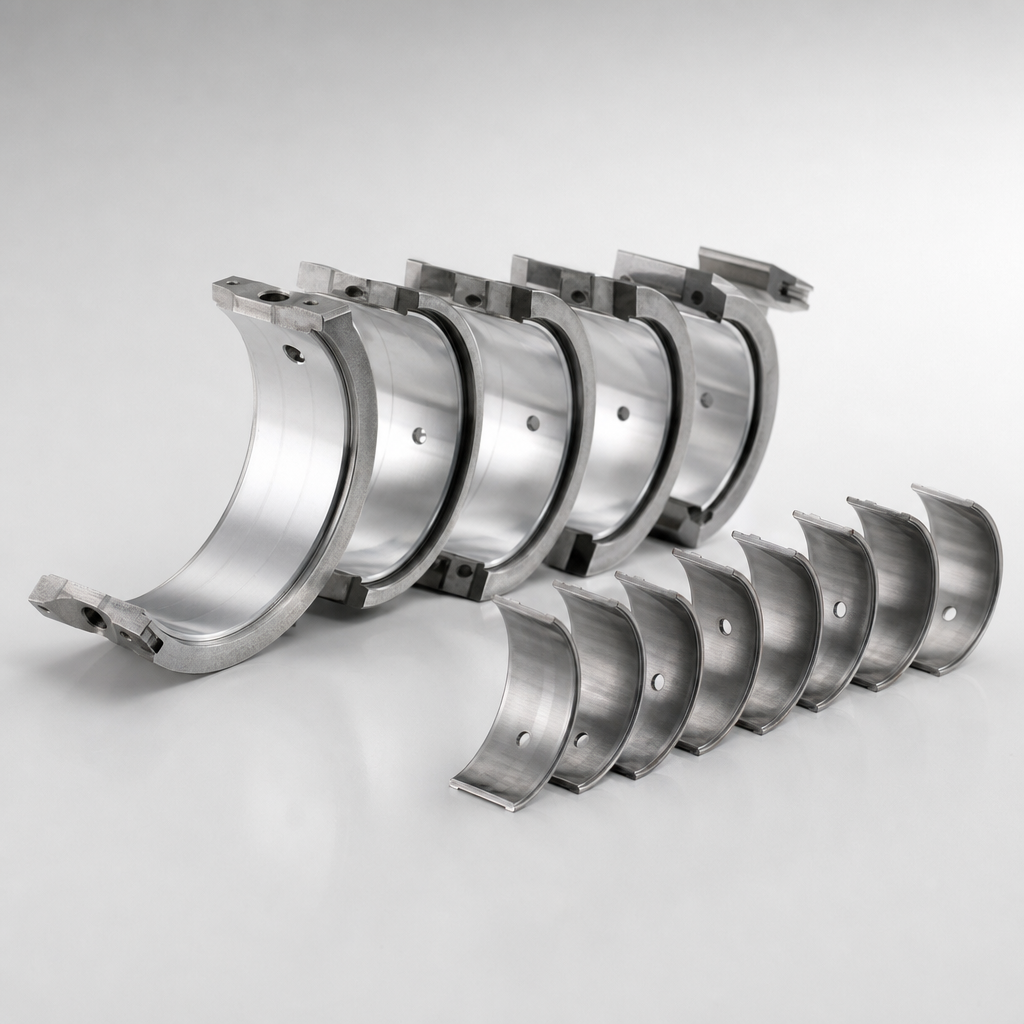
Procurement teams sourcing engine bearings for Infiniti-fit applications need more than a catalogue cross-reference. They need controlled dimensions, consistent metallurgy, packaging that works for regional distribution, and documents that pass supplier approval. Driventus manufactures engine and powertrain components in Taizhou, Zhejiang for aftermarket distributors, OEM and Tier-1 programmes, and multi-location repair chains. Our engine bearing range includes main bearings, connecting rod bearings, thrust bearings, and washer sets for common Asian, European, and American engine families, including Infiniti-fit platforms supported by repair networks and engine rebuilders. This guide explains how to evaluate an engine bearing Infiniti supplier, what technical data to request, how MOQ and lead-time are usually structured, and which quality documents support a factory audit. Driventus is an independent aftermarket manufacturer; brand names are referenced for fitment identification only.
What buyers should confirm before sourcing Infiniti-fit bearings
Engine bearing sourcing is not only a question of model coverage. The part must support oil film stability, conformability, fatigue resistance, embedability, and correct crush under the intended housing conditions. For Infiniti-fit engines, procurement teams usually group demand by engine family, journal diameter, standard and undersize repair demand, and local rebuild practice.
Before issuing an RFQ, confirm these points:
Engine family, displacement, and engine code, not only the vehicle model. Example: VQ35DE vs. VQ37VHR have different journal diameters and oil groove layouts.
Bearing type: main, connecting rod, thrust, washer, or full overhaul kit.
Required size: standard, 0.25 mm undersize, 0.50 mm undersize, or another repair dimension. Tolerances typically ±0.003 mm on wall thickness.
Material system: bi-metal aluminium-tin (e.g., AlSn20Cu), tri-metal copper-lead with overlay (e.g., CuPb24Sn4 with PbSn10Cu2 overlay), or lead-free equivalent (e.g., AlSn12Si2Cu) where required.
Set composition: upper/lower shell count, thrust pieces, and any washers included. For VQ engines, a full set typically includes 5 main bearing pairs, 6 rod bearing pairs, and 2 thrust washers.
Packaging format: loose set, boxed engine set, private-label carton, or workshop kit. Specify carton dimensions (e.g., 200×150×50 mm) and material (corrugated board, minimum 3-ply).
Destination compliance requirements, including REACH (EC) No 1907/2006 for EU market entry where applicable.
Required documentation: inspection report, material declaration, certificate of conformity, PPAP file (Level 2 or 3 typical), or IMDS-style data where needed.
A capable engine bearing Infiniti supplier should be able to convert a model-based inquiry into an engineering bill of materials. If the RFQ only lists a vehicle name, the supplier should ask for engine code, bearing position, size grade, set content, and annual volume before quoting. That early clarification reduces wrong-fitment risk and prevents avoidable sample cycles.
Driventus manufacturing scope for engine bearings
Driventus is a vertically integrated manufacturer of engine and powertrain components. For engine bearings, our production approach focuses on controlled strip material, precision forming, bore geometry, surface finish, and batch traceability. Buyers can review related engine parts in our catalog and engine component families at /products/engine-components.html.
Our bearing supply scope includes:
Product type
Typical application
Sourcing notes
Main bearing sets
Crankshaft support journals, journal diameters 50–80 mm typical
Supplied in standard and common repair undersizes (0.25 mm, 0.50 mm)
Connecting rod bearing sets
Big-end rod journals, journal diameters 45–65 mm typical
High-mix demand for rebuild channels; wall thickness tolerance ±0.003 mm
Thrust bearings / washers
Crankshaft axial control, thickness 2.0–3.5 mm typical
Dimensional matching with the main bearing set is critical; flatness ≤0.02 mm
Full engine bearing kits
Overhaul and remanufacturing
Simplifies distributor SKU management; typically includes all shells and washers
</tr></thead><tbody> </tbody></table>For Infiniti-fit demand, Driventus supports both catalogue supply and project-based development. Catalogue supply is suitable for distributors that need repeatable aftermarket coverage and stable replenishment. Project-based development is more appropriate when the buyer has samples, drawings, target material construction, special coating requirements, or a consolidation plan across several Nissan/Infiniti-related engine platforms.
Driventus does not claim approval or endorsement by any vehicle manufacturer. We operate as an independent aftermarket manufacturer, and brand names are used only to identify fitment and application context.
Technical specification points to include in the RFQ
A detailed RFQ reduces sampling cycles, shortens engineering review, and prevents disputes during arrival inspection. For engine bearings, the key control points are bearing wall thickness, spread, crush, free-state geometry, oil groove form, locating lug position, and surface quality.
Recommended RFQ specification list:
Bearing position: main, rod, thrust, or washer.
Set composition: number of upper and lower shells; thrust pieces if included.
Size: standard, 0.25 mm undersize, 0.50 mm undersize, or buyer-defined repair size. Specify tolerance: e.g., wall thickness ±0.003 mm, width ±0.10 mm.
Wall thickness tolerance: buyer drawing tolerance or agreed inspection tolerance (typical: ±0.003 mm for aftermarket, ±0.002 mm for OEM).
Material construction: steel backing (e.g., SAE 1010) with aluminium alloy lining (e.g., AlSn20Cu), copper-lead intermediate layer (e.g., CuPb24Sn4) with overlay (e.g., PbSn10Cu2, thickness 0.015–0.025 mm), or lead-free construction (e.g., AlSn12Si2Cu).
Surface treatment: overlay, flash plating (e.g., tin flash 0.001–0.003 mm), polymer coating (e.g., polyamide-imide, thickness 0.005–0.015 mm), or other buyer-specified surface system.
Oil groove and oil hole: shape (e.g., annular, spiral), width (e.g., 3.0 mm ±0.2 mm), length, chamfer (e.g., 0.5×45°), and positional tolerance (e.g., ±0.5 mm).
Locating lug: width (e.g., 4.0 mm ±0.2 mm), height (e.g., 1.5 mm ±0.1 mm), offset direction, and location relative to the shell.
Packaging: corrosion protection (e.g., VCI paper), set labelling (barcode GS1-128), carton strength (e.g., edge crush test ≥6 kN/m), pallet pattern (e.g., 40×30×20 cm cartons, 48 per pallet), and mixed-set prevention (e.g., colour-coded labels).
Cross-reference format: internal SKU, aftermarket number, or OE-style reference such as OE 06A107065 only when provided by the buyer.
For procurement files, buyers often request a dimensional drawing even for catalogue items. Driventus can support drawing review for custom projects, but buyers should not assume that one vehicle model equals one bearing specification. Engine revisions, production years, crankshaft grinding practice, and repair sizes must be checked at application level.
Quality system, testing, and traceability
Engine bearings operate in boundary lubrication during start-up and under hydrodynamic lubrication at stable running speed. Small deviations can contribute to noise, low oil pressure, journal scoring, seizure, or premature fatigue. Supplier control should therefore combine material verification, forming process control, dimensional inspection, and functional validation according to the application risk.
Driventus operates under IATF 16949:2016 and ISO 9001:2015 management systems. Buyers can review our quality system when preparing supplier approval documents, audit questionnaires, or sourcing committee files.
Typical quality controls for engine bearing programmes include:
Control point
Purpose
Typical evidence for buyers
Incoming strip inspection
Confirms backing and lining material consistency
Material certificate (EN 10204 Type 3.1), hardness record (HRB 60–80 typical)
Wall thickness measurement
Controls oil clearance contribution
First article report (CMM, 30-point measurement), batch inspection report (statistical sample per ISO 2859-1, AQL 1.0)
Crush and spread checks
Supports bearing retention in housing
In-process inspection record (crush 0.05–0.15 mm, spread 0.5–1.5 mm typical)
Surface roughness check
Reduces risk of journal damage
Roughness test result (Ra ≤0.4 μm, Rz ≤2.5 μm typical)
Oil hole / groove inspection
Confirms lubrication path
Dimensional report (vision system, ±0.1 mm) and visual record
Corrosion protection check where specified
Verifies packaging and surface protection
Test report based on agreed method (e.g., humidity chamber 48h, no rust)
Traceability record
Links product to batch and inspection data
Lot number and production date code (laser-marked on each shell)
</tr></thead><tbody> </tbody></table>For aftermarket distribution, common documentation includes a certificate of conformity, final inspection report, packaging specification, material declaration, and traceability record. For OEM or Tier-1 projects, buyers may request APQP, PPAP (Level 3 typical), control plan, process flow diagram, PFMEA, measurement system analysis (GR&R ≤10%), and capability studies (Cpk ≥1.67). Driventus can align the file depth with the commercial programme, customer approval process, and application risk.
MOQ, lead-time, and ordering models
A practical sourcing plan should balance SKU coverage with inventory turnover. Infiniti-fit bearing demand may be concentrated in a few engine families, but distributors often need both standard and undersize variants. This creates a long-tail inventory challenge, especially when private-label packaging or market-specific cartons are required.
Driventus normally discusses MOQ at three levels:
1. Catalogue bearing set MOQ: 100 sets per SKU for standard sizes; 50 sets for undersize variants. Suitable for established items with existing tooling and routine production. 2. Private-label MOQ: 500 sets per SKU, includes carton artwork (up to 2 revisions), label format (GS1-128 barcode), and country-specific packaging requirements. Lead-time for artwork approval: 2 weeks. 3. Custom development MOQ: 5,000 sets per programme, applies when new tooling (e.g., die set cost $3,000–$8,000), new material construction, special coating (e.g., polymer coating $0.50–$1.00 per shell), or buyer-specific inspection criteria are required.
Lead-time depends on tooling status, raw material availability, order mix, packaging requirements, and inspection file depth. For repeat catalogue items, buyers should plan around production scheduling (4–6 weeks) and sea freight consolidation (2–4 weeks). For new development, sampling, validation, and packaging approval should be separated from mass production timing so that commercial launch dates remain realistic.
A typical project timeline may include:
RFQ and application confirmation: 3–7 working days after complete data is received.
Drawing and specification review: 1–2 weeks for custom or complex items.
Sample production: 3–4 weeks, depending on tooling, material status, and coating requirements.
Buyer validation: 2–4 weeks, controlled by the buyer’s bench, vehicle, or engine test plan.
Mass production: 4–6 weeks after sample approval and packaging sign-off.
For urgent distributor replenishment, share the annual forecast, target launch date, and priority SKUs. This allows the supplier to propose phased delivery instead of delaying the whole order for slow-moving items. It also helps separate fast-moving standard sizes from slower repair undersizes, improving cash flow without reducing market coverage. Price per set: standard main bearing set $8–$15, rod bearing set $6–$12, full kit $25–$45, depending on volume and packaging.
Factory audit questions for an engine bearing supplier
Procurement professionals should audit both the quality system and the process controls specific to bearing production. A general ISO certificate is useful, but it does not replace review of material traceability, forming control, measurement methods, packing accuracy, and batch records.
Use the following audit checklist when evaluating an engine bearing Infiniti supplier:
Does the supplier hold current IATF 16949:2016 and ISO 9001:2015 certification, and are the certificates within scope?
Are incoming bearing strip materials traceable to heat, coil, or batch? Request a material certificate for each heat.
How are wall thickness, width, crush, spread, and lug dimensions measured? Preferred: CMM for wall thickness (resolution 0.001 mm), vision system for lug position.
What gauges are calibrated, and under which calibration schedule? Calibration interval should be ≤12 months, traceable to NIST or equivalent.
Are inspection methods defined in a control plan or work instruction? Request a sample control plan.
Are nonconforming parts physically segregated and recorded? Look for red-tagged bins and NCR log.
Can the supplier provide inspection records by production lot? Request a sample batch report.
How are mixed-size sets prevented during packing? Colour-coded labels, automated vision verification, or weight check.
Are packaging labels controlled by revision and approval status? Check label approval form.
How are engineering changes communicated to buyers? Request a sample ECN form.
Can the supplier support PPAP or similar approval files for higher-risk programmes? Ask for a sample PPAP Level 3 file.
For remote audits, request a process flow, equipment list (e.g., 5 press lines, 3 CMMs, 2 vision systems), recent internal audit summary, sample inspection report, material traceability example, and packaging photos. For on-site audits, include warehouse traceability, gauge room control, line-side identification, and packing line verification. Bearing shells can look similar across sizes and positions, so mispack prevention is a key audit item, not only a warehouse concern.
Compliance for EU, UK, US, Canada, Australia, and Brazil
Engine bearings are mechanical components, but importers still need regulatory and documentary control. Requirements vary by destination, sales channel, and customer contract. Driventus supports B2B buyers with documentation aligned to the declared market and order type.
For the European Union, buyers may request material declarations related to REACH (EC) No 1907/2006 (SVHC <0.1% w/w). Where applicable, packaging should also be reviewed for local packaging waste obligations (e.g., German Packaging Act). For the UK, import documentation and labelling should follow the buyer’s post-Brexit compliance process (UK REACH). For the US and Canada, distributors often focus on country of origin (China), tariff classification (HS 8483.30), product liability wording, and private-label traceability. For Australia and Brazil, importers should confirm customs documentation, packaging durability (e.g., tropicalisation for Brazil), and any customer-specific conformity requirements before shipment.
Published automotive standards such as IATF 16949:2016 and ISO 9001:2015 are relevant to supplier management and quality systems. Vehicle emissions standards such as ECE R-83 are not normally direct product standards for engine bearing shells, although they may appear in customer compliance files for complete engines or vehicle programmes. Brake standards such as SAE J2527 are not applicable to engine bearings; citing them for bearing performance would be incorrect.
The key procurement point is to avoid generic compliance claims. Ask for documents that match the market, material, packaging, and customer contract. A concise, correct file is more useful than a broad certificate pack containing standards that do not apply to engine bearings.
How to request a quotation from Driventus
A complete RFQ helps Driventus confirm fitment scope, production feasibility, and quotation accuracy. When contacting us, include as much technical and commercial information as possible so the first response can address both price and approval requirements.
Recommended quotation package:
Target application: Infiniti model range, engine family, engine code, and production years if known.
Bearing type: main, rod, thrust, washer, or full engine set.
Required sizes: standard and repair undersizes (0.25 mm, 0.50 mm).
Quantity by SKU and annual forecast (e.g., 500 sets/year for standard, 200 sets/year for undersize).
Target packaging: neutral, Driventus, or private label (include artwork if available).
Destination country and port (e.g., CIF Hamburg).
Required documents: inspection report, material declaration, certificate of conformity, PPAP file, or audit package.
Sample requirement and target validation schedule (e.g., 5 samples for bench test, 4 weeks validation).
Any supplied references, drawings, photos, or physical samples.
If the inquiry includes OE-style references, provide them exactly as used in your internal system, for example OE 06A107065 only where it is already part of your buyer data. Driventus will use brand and reference names only for fitment identification and cross-reference discussion.
For distributors, we can help rationalise SKUs by separating fast-moving standard sizes from slower repair undersizes. For OEM and Tier-1 buyers, we can review drawings and process documentation under a controlled project through custom manufacturing. To begin supplier qualification or pricing discussion, request a quote.
Frequently asked questions
Yes. Driventus supplies main, connecting rod, thrust, washer, and engine bearing kit options for common engine families, including Infiniti-fit applications. Final availability depends on engine code, bearing position, size, set composition, and order quantity. Typical wall thickness tolerance ±0.003 mm, material options include AlSn20Cu and CuPb24Sn4 with overlay.
Typical documents include certificate of conformity, dimensional inspection report (CMM-based), material declaration (EN 10204 Type 3.1), packaging specification, and traceability records. For OEM or Tier-1 programmes, Driventus can discuss APQP and PPAP documentation (Level 3) based on project requirements.
Private-label packaging is available subject to MOQ (500 sets per SKU), artwork approval (up to 2 revisions), label control (GS1-128 barcode), and carton specification (minimum 3-ply corrugated). Buyers should provide barcode rules, language requirements, packaging dimensions, and destination market requirements during RFQ.
No. Driventus does not claim vehicle manufacturer approval or endorsement. Driventus is an independent aftermarket manufacturer; brand names are referenced for fitment identification only.
If you are qualifying an engine bearing Infiniti supplier for distribution, repair-chain supply, or a custom programme, send your application list and documentation requirements. Start the discussion at /contact.html