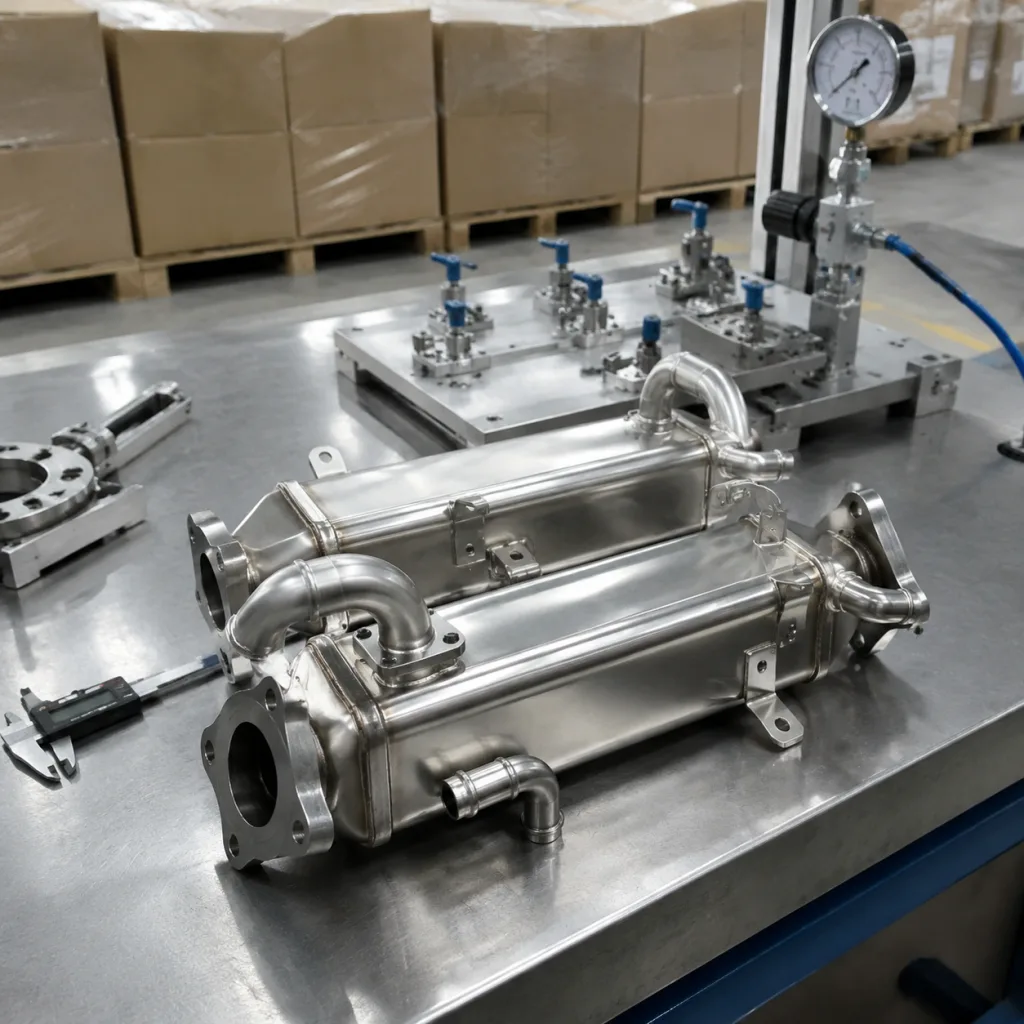
EGR valves are compact emission-control components, but their specification has a direct effect on NOx reduction, idle stability, turbocharger response, drivability and OBD readiness. For procurement and engineering teams, the sourcing risk is rarely price alone. Problems usually come from incomplete control of the part definition: flange geometry, actuator calibration, valve-seat leakage, connector pin-out, feedback signal, gasket interface and corrosion protection must all match the target engine application.
This guide outlines practical egr valve specifications used in supplier qualification, RFQ comparison, incoming inspection and production release for aftermarket distributors, OEM service programmes and repair-chain supply contracts. It focuses on measurable dimensional, material, electrical and validation requirements rather than consumer-level troubleshooting.
Driventus manufactures engine and powertrain components in Taizhou, Zhejiang under IATF 16949:2016 and ISO 9001:2015 systems, with export supply to more than 60 countries. Driventus is an independent aftermarket manufacturer; brand names are referenced for fitment identification only.
Core specification fields for an EGR valve RFQ
A complete RFQ should define the valve type, mating interface, actuation method, calibration requirements and expected duty cycle. The same vehicle platform may use different EGR designs by engine code, fuel type, emission level or model year, including vacuum-operated valves, DC motor valves, stepper-motor valves and integrated electronic EGR assemblies. Samples approved from photographs or catalogue appearance alone create a high risk of fitment, leakage or diagnostic faults.
Key fields to request from a supplier include:
Application data: engine displacement, fuel type, emission level, engine code and model year range.
OE part-number cross-reference where applicable, for example OE 06A… or OE 11251… conventions when supplied by the buyer.
Valve type: linear poppet, rotary, vacuum diaphragm, electronic motorised or cooler-bypass integrated design.
Flange interface: bolt hole spacing, locating diameter, gasket land width, port geometry and flange thickness.
Actuation method: vacuum diaphragm, solenoid, DC motor, stepper motor or integrated actuator module.
Sensor feedback: potentiometer, Hall-effect sensor or position switch, if fitted.
Operating temperature range: normally specified separately for gas-side body, actuator and connector.
Leakage limit: defined at a stated pressure differential, valve position and test temperature.
Surface protection: coating type, passivation requirement or corrosion-resistance expectation.
Packaging method: corrosion protection, cap protection for ports and connector shielding.
For catalogue-level selection, buyers can compare part families through our catalog, but engineering release should always rely on controlled drawings, inspection reports, approved samples and agreed validation criteria.
Typical dimensional and material parameters
Dimensional conformity is critical because an EGR valve sits between the exhaust gas path and the intake system. Small errors in flange flatness, gasket compression, port alignment or valve stroke can lead to exhaust leakage, intake contamination, sticking, unstable flow control or diagnostic trouble codes. The table below lists common specification fields used for incoming inspection, supplier development and PPAP-style review. Actual limits must always be confirmed against the controlled drawing for the target part number.
Specification area
Typical control item
Procurement note
Flange flatness
0.05-0.15 mm, part dependent
Measure after machining and, where required, after thermal cycling
Bolt hole positional tolerance
Often controlled within ±0.10-0.20 mm
Use CMM or a dedicated gauge for volume inspection
Port alignment
Drawing-controlled
Check against the gasket and mating manifold to prevent flow restriction
Valve seat runout
Drawing-controlled
Directly affects leakage, repeatable closing and carbon build-up tendency
Valve stroke
Part-specific linear or angular range
Must match ECU calibration and feedback signal expectations
Shaft/bushing clearance
Drawing-controlled fit
Excess clearance can raise leakage; insufficient clearance increases sticking risk
Flange roughness
Drawing-controlled
Important for gasket sealing and repeatable clamping load
Gas-side body material
Cast iron, stainless steel or aluminium alloy depending on location
Confirm exhaust temperature exposure, thermal expansion and corrosion environment
Valve head/shaft material
Stainless steel or heat-resistant alloy
Specify resistance to oxidation, hot gas erosion and carbon abrasion
Gasket interface
Metal, graphite-coated or composite gasket compatible
Avoid unvalidated gasket substitution, especially on high-temperature applications
Connector terminal finish
Tin or other drawing-specified plating
Check fretting corrosion, insertion force and mating compatibility
</tr></thead><tbody> </tbody></table>Material declarations should also address REACH (EC) No 1907/2006 for EU-market supply. For customers in the UK, EU, US, Canada, Australia and Brazil, Driventus can provide material data sheets, controlled drawings and inspection reports according to the agreed purchasing file.
Electrical and calibration requirements
Electronic EGR valves require tighter control than vacuum-operated valves because the ECU monitors commanded position, actual position, current draw and response time. A valve that fits mechanically may still fail in service if the feedback signal slope, closed-position voltage, end-stop range, motor resistance or response curve is outside the expected diagnostic window.
Common electrical checks include:
Coil or motor resistance at 20 °C, with upper and lower tolerance limits.
Insulation resistance between terminals and housing.
Connector pin continuity, pin assignment and terminal retention force.
Position sensor output at closed, mid-stroke and fully open positions.
Feedback linearity or defined sensor curve across the working stroke.
Hysteresis between opening and closing movement.
Response time under a defined voltage, temperature and load condition.
Current draw at start, running and end-stop positions.
End-stop detection and learned-position behaviour where required by the application.
Diagnostic behaviour under short-circuit, open-circuit and low-voltage test conditions where specified by the customer.
Electronic versus vacuum valve sourcing points
Feature
Electronic EGR valve
Vacuum EGR valve
Control method
ECU-controlled motor or solenoid
Vacuum signal through diaphragm
Main inspection risk
Sensor calibration, connector match, response time and current draw
Diaphragm sealing, spring force, vacuum leakage and stem movement
Validation focus
Electrical endurance, thermal cycling and environmental exposure
Vacuum decay, mechanical fatigue and diaphragm ageing
Procurement documentation
Pin-out, resistance, sensor curve, response limit and software-related limits
Vacuum-pressure curve, spring rate, leakage test and stroke data
</tr></thead><tbody> </tbody></table>For programme-specific needs, Driventus supports custom manufacturing for connector variants, casting revisions, machining fixtures and validation plans agreed before tooling release.
Test methods and validation evidence to request
A sourcing file should include evidence that the EGR valve has been tested under conditions relevant to hot exhaust gas, vibration, thermal shock, moisture, road salt, chemical exposure and soot contamination. Published management-system standards such as IATF 16949:2016 and ISO 9001:2015 do not by themselves prove product performance; they show that process control, traceability and corrective action systems are in place. Product validation must be reviewed separately for each part family and application.
Useful validation records include:
Dimensional inspection report with critical characteristics clearly identified.
Leakage test result at defined pressure, temperature and valve position.
Flow or stroke verification where the application requires controlled exhaust gas recirculation rate.
Actuator endurance test with cycle count, duty profile and post-test leakage.
Thermal cycling between low-temperature soak and high gas-side temperature exposure.
Thermal shock data where rapid exhaust temperature change is relevant.
Salt spray or corrosion-resistance data for external surfaces where required.
Vibration test data for connector, actuator and mounting flange stability.
Carbon fouling or contaminated-flow test where the application is sensitive to soot build-up.
Electrical performance report before and after environmental conditioning.
Packaging drop or transport simulation for export cartons.
For emission-related applications, procurement teams may also need to consider vehicle-level regulatory contexts such as ECE R-83 for emissions of passenger cars, depending on market and programme responsibility. The component supplier should not claim vehicle compliance unless that claim is supported by the vehicle approval holder. Driventus supplies components; it does not claim approval or endorsement by any vehicle manufacturer.
Quality controls for repeatable production
Stable production depends on controlled machining, reliable actuator assembly, repeatable calibration and final functional testing. Buyers should check whether the supplier manages the full route from casting or housing preparation through machining, cleaning, assembly, calibration and end-of-line inspection. Outsourced sub-processes can be acceptable, but they need documented control plans, supplier monitoring and traceability.
Driventus operates a quality system aligned with IATF 16949:2016 and ISO 9001:2015. For EGR valve programmes, typical control points include incoming material verification, CNC machining inspection, valve-seat measurement, cleaning control, actuator assembly torque control, leak testing, sensor calibration, connector inspection and final barcode traceability.
Recommended audit questions:
Are critical dimensions linked to a control plan and reaction plan?
Is every electronic valve tested for leakage and signal output, or only sampled?
Are calibration masters controlled, protected and periodically verified?
Can batches be traced to casting lot, actuator lot, gasket lot and assembly date?
How are machining tool wear and seat-surface variation monitored?
How are customer complaints analysed: 8D, returned-part teardown, warranty trend review or field data review?
Are engineering changes communicated and approved before shipment?
Are packaging materials validated for export transport and warehouse storage?
For high-volume distributors and repair chains, lot consistency matters as much as first-sample approval. A low defect rate on the first shipment has limited value if tooling wear, supplier substitution, cleaning variation or calibration drift is not controlled during repeat orders.
Commercial documentation and fitment control
Fitment data should be treated as controlled technical information. Brand names and model names can help identify an application, but they do not replace drawings, verified cross-references or sample approval. Driventus is an independent aftermarket manufacturer; brand names are referenced for fitment identification only.
For importers and category managers, the purchasing file should normally include:
Final drawing or customer-approved specification sheet.
Application list with engine code, fuel type and emission level where available.
OE cross-reference format supplied by the buyer, such as OE 06A… when relevant.
Sample approval record and test report.
Material declaration and REACH (EC) No 1907/2006 status for EU supply.
Carton label, barcode, private-label artwork and country-specific packaging requirements.
Agreed inspection level, AQL if used and non-conformance handling process.
Incoterms, minimum order quantity, lead time, spare packaging percentage and after-sales support process.
Engineering change notification procedure for connector, casting, coating, gasket or calibration updates.
The most reliable egr valve specifications are connected to measurable acceptance criteria. Phrases such as “OE quality” are not enough for purchasing control. Define the dimension, tolerance, test condition, sampling method, record format and document owner before issuing a purchase order. To discuss part families, drawings or an RFQ package, buyers can request a quote.
Frequently asked questions
The key items are flange geometry, valve stroke, leakage limit, actuator type, connector pin-out, feedback signal range, material grade, gasket interface and validation test conditions. These should be controlled by drawing and verified through inspection or functional testing.
Sometimes, but only when the mechanical interface, electrical behaviour, calibration range and emission application match. Cross-references should be validated against drawings, samples and test data, not only catalogue listings. Driventus does not claim approval by any vehicle manufacturer.
Request drawings, dimensional reports, leakage and electrical test data, material declarations, quality certificates, packaging specifications and fitment cross-reference files. For EU supply, REACH (EC) No 1907/2006 status is also commonly required.
If you are preparing an EGR valve sourcing file, Driventus can review drawings, cross-references and validation requirements for quotation. Send your part list or sample details through /contact.html