EGR Valve Citroen Manufacturer China for B2B Buyers
Finding a reliable **egr valve citroen manufacturer china** source is less about chasing the lowest list price and more about getting the application right, checking the evidence behind the product, and making sure export execution is dependable. Aftermarket and service-channel buyers usually need stable interchange across PSA engine codes, connector variants, cooler layouts, and emissions calibrations that shifted over different model years. A China factory can be commercially attractive, but only if it can show documented process control, repeatable leak and flow testing, disciplined change management, and lot-level traceability that holds up in a customer audit.
For distributors, repair-chain buyers, wholesalers, and OEM service programmes, the core sourcing questions are usually the same: which Citroen and PSA references are already in serial production, what is the opening MOQ, how long is the production cycle, what testing is done on every lot, and which documents support import and downstream compliance in the EU, UK, Middle East, Latin America, and other regulated destinations? This guide shows how B2B procurement teams can qualify an egr valve citroen manufacturer china partner, from application mapping and factory audit points to validation data, packaging, logistics planning, and custom manufacturing scope.
Start with application control, not price
Price comparisons only mean something once the application file is clean. For Citroen-fitment EGR valves, buyers should first confirm the exact engine code, fuel type, emissions standard, cooling configuration, valve actuation method, electrical connector form, gasket interface, and any integrated sensor, bypass, or cooler relationship.
This matters especially on PSA platforms, where visually similar references are often treated as interchangeable when they are not. Mounting faces may look the same, yet connector clocking, internal motor travel, commanded opening range, coolant passage geometry, or feedback-sensor logic can differ. In practice, that creates a part that installs physically but still triggers DTCs, unstable idle, limp-home mode, excessive soot loading, or repeat warranty returns. In a B2B programme, that quickly turns into a margin and reputation problem.
A disciplined sourcing process should begin with an application matrix linking each SKU to:
OE and aftermarket cross-references
Citroen model and platform
PSA engine code and displacement
Power output in kW/PS
Euro emissions level and production year range
Connector type, keyway and pin count
Cooled or non-cooled EGR layout
Gasket, fastener, and mating-pipe requirements
Before issuing an RFQ, ask the supplier to show that its engineering team and sales team are quoting the same product definition. Useful pre-quote documents include:
A cross-reference list by engine code, model year, and power output
Housing, connector, and flange drawings with revision status
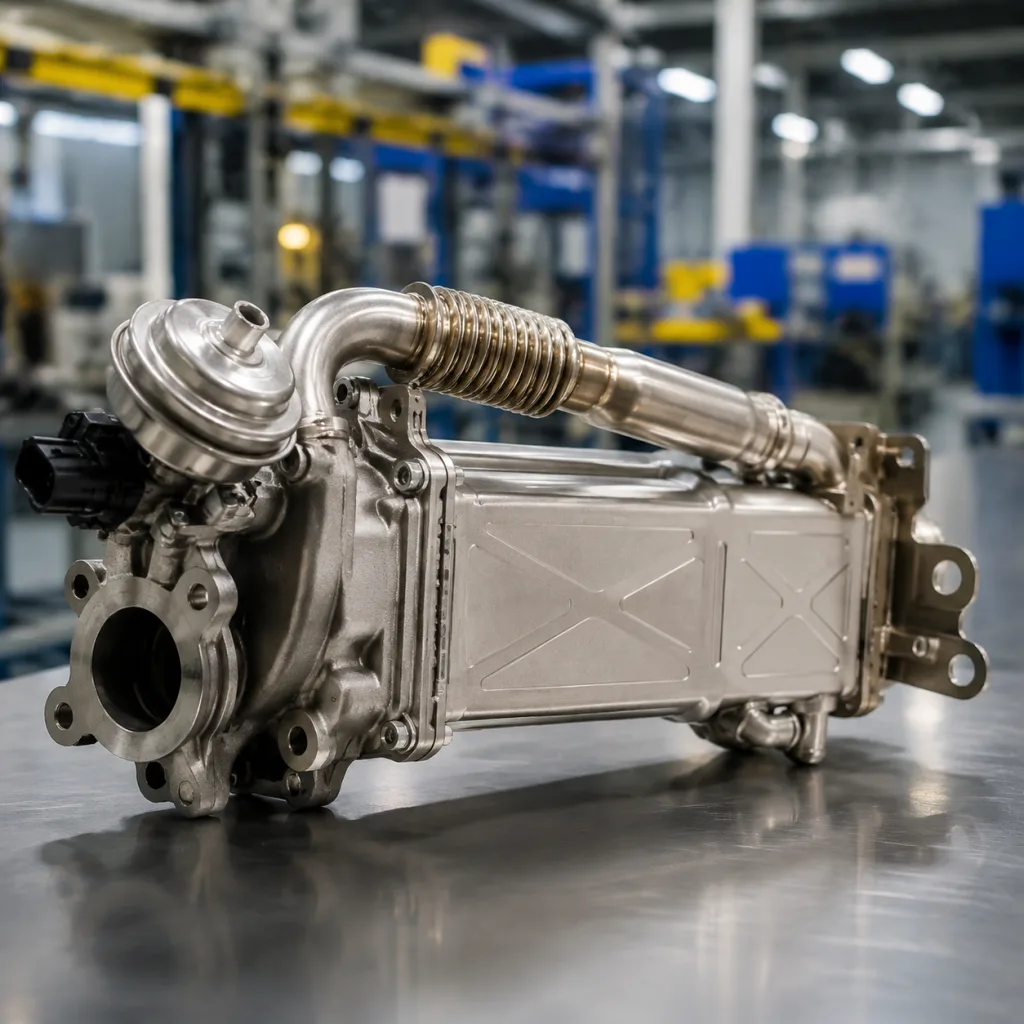
Photos of the finished valve from multiple angles, including connector orientation
Sample inspection records from a production lot rather than hand-built prototypes
BOM-level notes on key seals, actuator type, housing alloy, and surface finish
Packing details, carton quantity, and barcode format for each SKU
It is also sensible to ask how the factory handles supersessions. Some Citroen-fitment EGR valves move through OE number updates, software-related fitment notes, or production revisions that change interchange. If the supplier cannot explain clearly which references have been replaced, merged, or split by application, the buyer is left exposed to catalog ambiguity.
For more accurate quoting, request dimensional controls on the interfaces that most often drive misfit or leakage, such as flange flatness, bolt-hole position, connector clocking angle, and actuator stroke window. On this product family, even small deviations at the sealing face or connector orientation can create installation issues despite a housing that looks correct.
If you are screening reference coverage first, our catalog is the sensible starting point.
Factory audit points for a China EGR valve supplier
When evaluating an egr valve citroen manufacturer china partner, the audit should focus on process capability rather than brochure claims. EGR valves are emissions-related components that operate in a harsh environment of exhaust heat, soot, acidic condensate, and vehicle vibration. A credible supplier needs more than a current certificate on the wall. It needs controlled incoming materials, stable assembly processes, calibrated test equipment, defined reaction plans for defects, and traceability that links finished cartons back to key components and process records.
At minimum, buyers should assess the factory across the following control areas:
Audit item
What to verify
Evidence to request
Quality certification
Valid certification to IATF 16949:2016 or ISO 9001:2015
Current certificate, scope, issuing body
Incoming control
Inspection of castings, shafts, springs, seals, motors, PCBs, and connectors
IQC records, supplier scorecards, AQL criteria
Process control
Defined control plan for assembly, torque, calibration, leak test, and EOL electrical check
PFMEA summary, control plan, work instructions
Traceability
Batch or serial traceability from key components to finished cartons
Lot coding example, MES or batch records
Compliance
Substance declarations for EU import
REACH (EC) No 1907/2006 declaration, material statements
Test capability
Functional coverage for leakage, actuation, feedback signal, and electrical load
Test equipment list, MSA or calibration records
</tr></thead><tbody> </tbody></table>During an on-site or remote audit, go beyond the paperwork and ask practical questions such as:
Are cast housings, motors, seals, springs, and connectors sourced from approved vendors with documented PPAP or equivalent approval history?
How are torque values controlled during assembly, and what happens if a station records an out-of-limit result?
Is every valve 100% leak-tested, or is testing based on sampling? If sampled, what is the sampling plan?
Are electrical parameters such as operating current, supply voltage window, feedback output, and end-stop response checked at end-of-line?
Are test results stored by serial number, date code, or only by production batch?
How are non-conforming parts physically segregated to prevent accidental shipment?
What is the formal process for engineering change approval and customer notification?
A strong supplier should also show discipline in sub-supplier management. Many apparent quality issues with EGR valves start upstream: porosity in castings, unstable actuator electronics, poor elastomer compression set, or connector dimensional drift. Ask for approved vendor lists, incoming defect ppm trends, and examples of 8D or corrective action reports issued to sub-suppliers.
Packaging control is another area buyers often overlook. If parts are not protected from moisture, connector damage, or handling shock, a technically sound product can still arrive in unsellable condition. Verify inner tray design, anti-abrasion protection on flanges, desiccant or bagging where needed, carton burst or edge-crush suitability, pallet configuration, and label readability after transit.
A buyer should also review the supplier's quality system, change-control method, and non-conformance handling. If engineering changes are not version-controlled and documented against customer-approved references, forecast stability, catalog accuracy, and field quality start to deteriorate quickly.
Validation data buyers should request before SOP
An EGR valve works within the engine's wider emissions strategy, so a dimensional match on its own is not enough. Before start of production, buyers should request a data pack showing that the part opens, closes, seals, responds electrically, and survives thermal and contamination exposure within the intended duty cycle. This is even more important on Citroen applications using cooled EGR modules, where soot loading, condensate, and temperature cycling can create sticking or leakage risks over time.
The supplier's validation package should make clear that the part was tested as a production-intent assembly rather than as an engineering sample built outside normal process conditions. Production-lot samples give a much better view of repeatability because they reflect actual tooling, actual operators, actual materials, and actual end-of-line controls.
Minimum data pack
Dimensional report against drawing features, including flange flatness, shaft play, bolt-hole position, and connector position
Leak-test result with stated medium, pressure, dwell time, and acceptance limit
Actuator current, travel, end-stop position, and response-time report across temperature points
Flow or opening-characteristic verification where the design requires calibrated movement rather than simple open/close confirmation
Cycle durability summary with sample quantity, cycle count, and pass/fail criteria
Corrosion test summary, commonly aligned to ISO 9227 where external salt exposure is relevant
Sample fitment record on the target engine family or equivalent fixture
For higher-confidence sourcing decisions, buyers should also consider asking for:
Material declarations for seals, housings, shafts, and key internal components
PPAP-style elements where applicable, such as ballooned drawings, capability summaries, and approved appearance or labeling samples
Test method descriptions, including equipment used and acceptance thresholds
Thermal shock or high-temperature endurance data
Vibration or mechanical robustness results for connector retention and housing integrity
Comparative data against OE samples where available
Validation should cover both function and consistency. One valve meeting the leak limit in a lab is far less useful than evidence that multiple samples across a lot stay within a defined range for leakage, response time, and dimensional stability. If the supplier offers only a generic pass statement with no conditions, test quantities, or measured values, the package is not yet strong enough for commercial approval.
From a technical standpoint, buyers should look for measured outputs rather than marketing language. Typical examples include leak-rate limits at a defined test pressure, actuator response measured in milliseconds, current draw under nominal voltage, and endurance testing over a stated number of opening and closing cycles. The exact limits vary by design, but the supplier should always state the test condition, equipment, sample count, and acceptance criterion.
Buyers should also align validation with the failure modes they actually see in the market. If your channel has experienced carbon sticking, spindle wear, electrical intermittence, or flange sealing problems, request test evidence that addresses those risks directly. That turns supplier qualification from a paperwork exercise into a practical field-risk reduction exercise.
Where the buyer's programme has emissions sensitivity, request evidence that the supplier understands the vehicle-level context of standards such as ECE R-83. That does not mean the valve itself is 'approved' under ECE R-83; it means the supplier can support the technical and traceability data needed for downstream validation, importer records, and customer audit review.
MOQ, lead time and logistics planning
Commercial planning should be handled with the same discipline as technical validation. For an egr valve citroen manufacturer china programme, the buyer needs to understand not only unit price but also MOQ structure, stock status, material readiness, production slotting, packaging lead time, and export documentation. Small misunderstandings at this stage are a common cause of avoidable first-order delays.
For stocked or regularly produced references, opening MOQs of 300 to 500 pieces per SKU are common, provided the buyer accepts standard carton quantities, standard labels, and shared production scheduling. If the project includes private packaging, custom barcodes, destination-language labels, laser-marking changes, bundled gaskets, or customer-specific inspection reports, the practical MOQ often rises because print runs, line setup, and final verification workload increase.
Lead time depends on whether the reference is already mature in production:
Ready reference with qualified materials: often 30 to 45 days
Repeat order with forecast visibility: potentially shorter if stock is held or production is scheduled in advance
New packaging or branding only: may add 5 to 10 days for artwork confirmation and print approval
New tooling or new validation project: often 45 to 60 days or more before mass production
Buyers should ask the supplier to break lead time into stages instead of quoting a single number. A clearer schedule includes:
1. Technical confirmation of the reference 2. Sample preparation and approval 3. Packaging artwork confirmation 4. Material procurement 5. Assembly and end-of-line testing 6. Final inspection and document release 7. Export packing and shipment booking
This stage-based view helps procurement teams plan launch dates, warehouse intake, and customer commitments with fewer surprises.
For import programmes into the EU or UK, logistics details should be confirmed before the first order ships. Key checkpoints include:
Moisture protection and inner bagging where required
Carton compression strength for pallet stacking
Standard pallet dimensions and maximum pallet height
Gross and net weight per carton and per pallet
Label content, barcode symbology, and country-of-origin marking
Commercial invoice, packing list, HS code, and origin documentation
A good RFQ should separate all cost components so landed-cost analysis is realistic. Ask for a quote that itemises:
Unit price
Tooling cost, if any
Packaging cost
Label or barcode setup charges
Validation or reporting charges
Sample cost and courier terms
Incoterm basis such as EXW, FOB, or CIF
It is also sensible to confirm shipment consolidation rules, safety-stock options, and whether the supplier can hold finished goods after final inspection. For importers running multi-SKU replenishment, a small holding agreement can reduce partial-container inefficiency and smooth monthly supply.
This makes supplier comparison cleaner and prevents hidden assumptions from appearing after approval. When you are ready to benchmark landed cost and service terms, use request a quote.
When custom manufacturing makes sense
Custom manufacturing is not necessary for every sourcing programme, but it can add real value when the buyer needs more than a standard off-the-shelf replacement range. For Citroen-fitment EGR valves, custom work is often justified when a distributor wants a private-label line, a repair-chain buyer needs packaging aligned to internal replenishment systems, or a regional market requires specific label language, bundled accessories, or fitment notes.
It can also make technical sense when the target application has recurring field issues. If previous supply history shows failures linked to seal material, spindle wear, contamination resistance, connector fragility, or inconsistent actuator performance, a custom development path may allow the buyer and factory to define a stronger specification than the market baseline.
Typical customisation areas include:
Private-label carton, sticker, and barcode systems
Laser marking with customer SKU or batch format
Bundled gasket sets or mounting hardware
Revised connector orientation or harness interface where feasible
Upgraded seal or bearing material subject to validation
Reinforced packaging for e-commerce or export rehandling
Customer-specific inspection reports and traceability labels
However, buyers should clearly separate cosmetic changes from functional ones. Packaging and branding modifications are generally straightforward. Changes to connector geometry, internal materials, actuator calibration, spring rate, or housing features may require renewed validation, tooling updates, fitment checks, and formal approval samples.
Through custom manufacturing, buyers should expect a documented development path with defined deliverables such as:
Drawing and application review
Feasibility confirmation
Sample timing plan
Validation and test plan
Packaging specification
Labelling and traceability format
Change approval procedure for future revisions
A capable factory will explain what can be changed without requalification and what requires a new validation loop. That distinction protects both sides. It prevents the buyer from treating a small modification as low-risk when it may affect sealing, electrical behaviour, flow rate, or interchange.
For long-term B2B programmes, custom manufacturing can also improve commercial stability. A buyer with exclusive packaging, proprietary SKU control, and agreed application mapping is less exposed to channel confusion and direct product comparison. The result is not only stronger market differentiation, but also cleaner inventory management and lower return risk.
Driventus is an independent aftermarket manufacturer; brand names are referenced for fitment only. That distinction matters for compliance, labelling, catalog presentation, and buyer due diligence when building a private-label or importer programme.
Frequently asked questions
Start with IATF 16949:2016 or ISO 9001:2015, then verify that the certificate covers the actual production site and product scope. For EU distribution, also ask for REACH (EC) No 1907/2006 material declarations, calibration records for leak, electrical and dimensional test equipment, and retained traceability records linking shipped lots to production and inspection data.
For established references, 300 to 500 pieces per SKU is a common opening range. The exact MOQ depends on actuator sourcing, packaging format, label variation, whether the supplier is producing standard stock or a private-label programme, and whether custom reporting, bundled accessories, or dedicated end-of-line data retention are required.
Use a pilot lot rather than prototype-only samples. Confirm engine-code mapping, connector geometry, flange dimensions, leak-test data, actuator response, electrical values, and carton labels. For emissions-sensitive applications, add fixture or vehicle-based fitment checks, review measured validation values instead of pass-only statements, and approve the exact packaging and labeling format before mass shipment release.
Send the target applications, annual volume, destination market, and packaging requirements for a practical sourcing review from an experienced **egr valve citroen manufacturer china** team. Procurement groups can [request a quote](/contact.html).