Clutch Kit Cadillac Wholesale: Buyer Checks for Stable Supply
Clutch kit Cadillac wholesale demand is usually narrower and more technical than a keyword report might imply. Most programmes are not built around high-turn retail volume. Instead, they serve low-parc manual-transmission applications, export markets, restoration channels, and GM platform overlap, where a single dimensional mismatch can leave you sitting on a container of slow-moving stock. For procurement teams, that shifts the buying criteria. Catalogue breadth still matters, but traceability, sample validation, kit completeness, and commercial discipline matter more because reorder cycles are slower and the cost of a wrong fitment is higher.
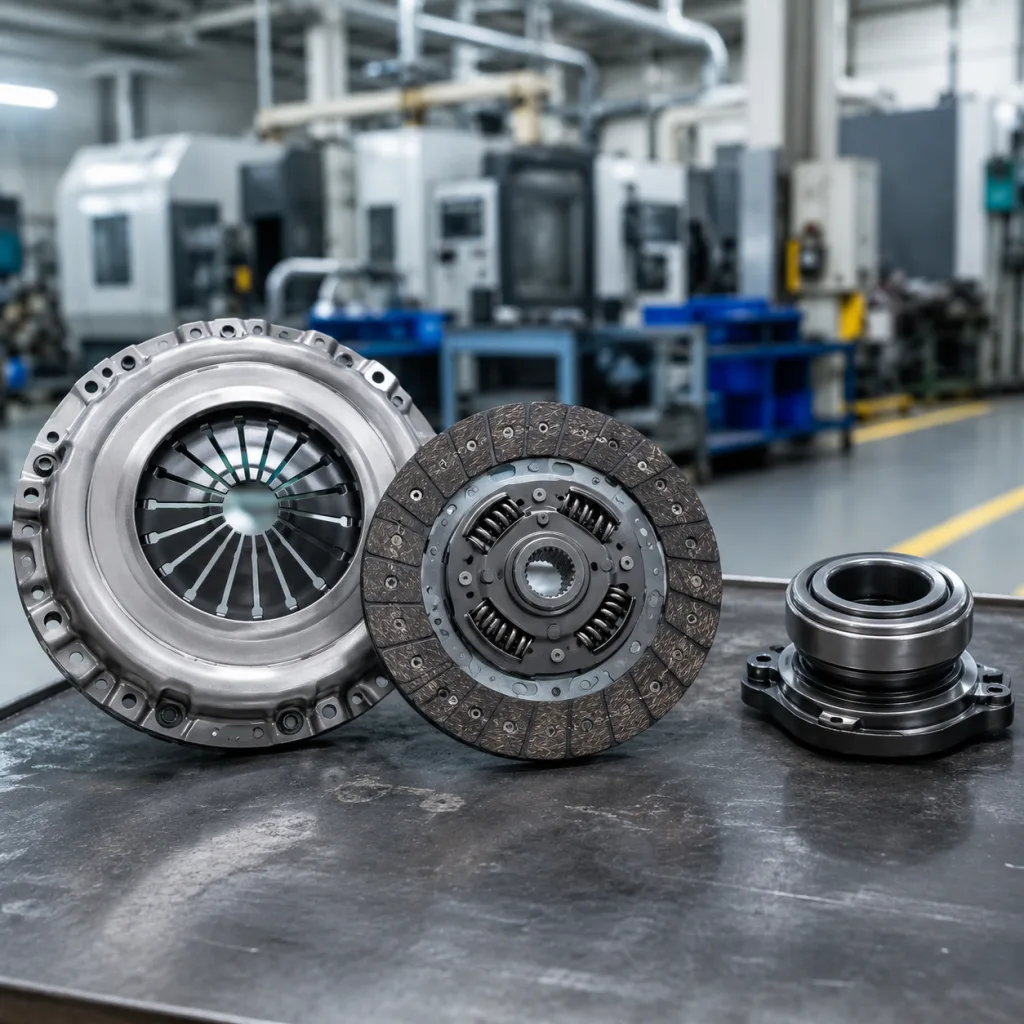
A credible source should be able to explain how the cover assembly, driven plate, release bearing, and any pilot component are matched, measured, tested, and packed before release. It should also be able to document management-system certification, material compliance, lot control, and corrective-action handling in a format an importer, distributor, or tier supplier can audit. The sections below cover the practical checks buyers use when assessing a clutch kit Cadillac wholesale programme for Cadillac applications, from SKU control and MOQ planning to validation and claim prevention.
Why Cadillac Applications Need Tighter SKU Control
Cadillac clutch demand rarely follows the same inventory pattern as high-volume compact cars. In many markets, the job is not to keep one universal fast mover on the shelf. It is to support a narrow set of manual-transmission applications, legacy rear-wheel-drive platforms, performance trims, or export catalogues that share GM driveline components across different nameplates. In that environment, the bigger risk often sits in cross-reference accuracy rather than unit price. A clutch disc with the right outside diameter but the wrong spline count, spline major/minor diameter, hub offset, marcel height, or damper calibration is not a close call. It becomes a full return, a workshop complaint, and often a stock write-down if the same error runs across the whole lot.
Before onboarding any supplier, review our catalog at kit level, not title level. Confirm the content of each SKU, the transmission family, the release system type, and whether the box includes the bearing, pilot component, bolts, and alignment tool where your market expects them. On niche lines, one bad cross-reference can tie up working capital for a full season, so the supplier should show a clear supersession history backed by drawings, OE references, or validated interchange logic rather than a long keyword list.
SKU Points That Should Be Locked Before Purchase Order
Wrong fit, clutch drag, noise, or immediate return
Cover assembly
Bolt pattern/PCD, dowel location, diaphragm finger height, installed height, clamp-load target, and dynamic balancing status
Pedal-force complaints, slip, release issues, or premature wear
Release components
Bearing type, contact-face geometry, carrier dimensions, and hydraulic or mechanical release compatibility
Incomplete kit or disengagement complaint
Pilot part
Bearing or bushing included, ID/OD/length, and material
Installation delay and uncontrolled field substitution
Flywheel notes
Step height assumptions, resurfacing warning, and dual-mass versus solid-flywheel conversion notes
Repeated warranty claims caused by installation mismatch
Packing configuration
VCI bag or rust inhibitor, separator/protective inserts, label content, and batch code
Transit damage, mixed lots, and weak traceability
</tr></thead><tbody> </tbody></table>Low-volume programmes usually reward mixed-SKU planning and accurate supersession control more than aggressive single-line pricing. Buyers should ask how the supplier manages obsolete references, overlapping GM applications, and local-market naming differences. If the answer relies only on catalogue text, rather than retained drawings, OE samples, or validated cross-reference logic, the risk stays with the importer. In a clutch kit Cadillac wholesale programme, disciplined SKU control is what keeps a narrow range saleable over time.
Supplier Checks Before Placing a Wholesale Programme
A supplier page on its own is not enough. Buyers should audit the quality system against the way lots are released, how nonconforming parts are quarantined, and whether inspection records can be traced back to a finished carton. The most useful review has three layers: a document check before quotation approval, a process walk before nomination, and a trace-back test in which the supplier shows how one shipped box links to incoming material, in-process records, and final inspection.
Audit point
What to verify
Why it matters
Certification
Current IATF 16949:2016 and/or ISO 9001:2015 scope, legal entity, manufacturing address, and expiry dates
Confirms the site operates under an auditable management system
Material compliance
REACH (EC) No 1907/2006 declaration, SVHC status, and any requested RoHS statement for plated/electrical subcomponents if applicable
Reduces customs and customer compliance risk
Process control
Control plan, PFMEA, incoming inspection standards, heat-treatment records, balancing records, and reaction plan for out-of-spec results
Lot code structure from raw material or key subcomponent to carton label, including date/shift/line
Speeds containment if a field claim occurs
Gauge control
Calibration status for load cells, height gauges, dial indicators, spline gauges, and torque tools
Prevents false acceptance of out-of-tolerance parts
Nonconformance handling
Segregation area, red-tag process, rework approval, and corrective-action workflow
Prevents suspect parts from re-entering good stock
Packaging control
Approved inner pack, corrosion protection, barcode content, and final label verification
Avoids mixed lots and receiving errors
</tr></thead><tbody> </tbody></table>If the supplier cannot produce these documents quickly, that already tells you something about the commercial risk. During a factory audit, ask to see how suspect lots are identified on the floor, who signs first-article release, how often gauges are calibrated, and whether the finished carton code appears on inspection records. Those details often reveal more than a polished quality manual, because they show whether the clutch kit Cadillac wholesale programme is controlled in day-to-day practice rather than only in presentation.
MOQ, Lead Time and Consolidation Strategy
MOQ on clutch kits is usually driven by the least flexible component in the set, not by master-carton quantity. Cover assemblies require stamping, machining where applicable, diaphragm spring control, and balancing time. Driven plates need hub broaching, cushion segment control, damper-component planning, and friction-material allocation. That is why small annual volumes need to be quoted realistically. If a supplier promises niche Cadillac coverage with almost no MOQ, ask whether the offer is based on existing stock, a shared subassembly family, or a one-off production slot. The answer will tell you whether the quoted price and lead time are repeatable.
Typical wholesale programmes for low-parc North American applications start around 100-300 kits per SKU for made-to-order supply, or a mixed monthly build schedule using several related GM fitments. First-order lead time is commonly 45-60 days after sample approval and artwork sign-off. Repeat orders often shorten to 30-45 days when friction material, springs, bearings, packaging, and capacity reservations are already in place. For private-label programmes with new carton tooling or printed inserts, add roughly 7-15 days depending on approval cycles and print method.
Commercial Points to Settle Early
Topic
What to agree
Why it protects the buyer
Forecast window
A 90-day rolling forecast with at least 30 days firm
Lets the factory reserve friction material, springs, bearings, and machining capacity
Consolidation
Mixed-SKU build across related GM fitments or other driveline lines
Reduces effective MOQ on slow movers
Safety stock
Whether any agreed finished-goods or component buffer will be held, and by whom
Improves fill rate without overbuying every SKU
Packaging
Inner bag, VCI/rust inhibitor, barcode symbology, pallet pattern, and country-of-origin mark
Prevents relabelling errors and warehouse damage
Artwork approval
Final proof sign-off for labels, inserts, and master cartons before production
Avoids carton scrap and customs delays
Claims process
Return-analysis flow, response time, debit-note rules, and sample-retention period
Stops disputes from dragging across multiple shipments
Payment and Incoterms
Deposit terms, balance trigger, FOB, CIF, EXW, or other Incoterms 2020 basis, and partial-shipment rules
Aligns cash exposure with production status
Private label
Decide whether the factory or importer applies final market labels
custom manufacturing is usually cheaper and easier to audit than local repacking
</tr></thead><tbody> </tbody></table>For buyers building a clutch kit Cadillac wholesale line, stable replenishment usually comes from forecast discipline and consolidation, not from forcing retail-style MOQ expectations onto a niche application. A disciplined mixed-SKU programme also makes it easier to hold service stock without carrying dead inventory one reference at a time.
Technical Validation for OE-Equivalent Fit and Field Life
Technical validation should start with dimensions and end with vehicle testing. Cadillac fitment data can look straightforward in catalogues, but disengagement problems usually come from stack height, hub offset, spline fit, release bearing geometry, pilot fit, or flywheel assumptions. For import programmes, ask for pre-shipment sample reports against the supplier drawing, retained OE sample, or approved golden sample, then confirm with bench and vehicle checks on the target transmission.
Validation Sequence Buyers Commonly Use
1. Drawing review: confirm critical dimensions, kit content, material notes, and supersession status before samples are dispatched. 2. Bench inspection: measure cover height, disc assembled thickness, hub projection, spline fit, axial runout, and bearing geometry against drawing or golden sample. 3. Vehicle fitment: check installation effort, pedal force, release point, idle noise, gear engagement, take-up smoothness, and slip under load. 4. Pilot lot approval: release mass production only after the approved sample, packaging proof, and lot definition are linked to the same production standard.
Tolerance targets should follow the approved drawing or retained OE-equivalent sample; the figures below are common aftermarket screening bands, not universal engineering limits.
Measurements Buyers Commonly Request
Characteristic
Typical check
Why it matters
Cover assembled height and installed height
Measured to drawing or retained sample, typically in mm with defined datum points
Controls release position and clamp relationship
Clamp load at test height
Common buyer screening band of approximately ±5% to ±8% versus approved value, subject to drawing
Too low can slip; too high can alter pedal effort and release behaviour
Driven plate axial runout
Common screening limit around 0.5-0.8 mm unless application requires tighter control
Excess runout can cause chatter, drag, or noise
Friction lining thickness and marcel height
Measured per drawing at specified points around the disc
Affects stack height, engagement smoothness, and wear reserve
Hub spline dimensions
Major/minor diameter, tooth profile gauge, and go/no-go fit
Prevents installation damage and input-shaft mismatch
Damper function
Spring retention, angular free play, rivet integrity, and torsional movement
Reduces rattle and premature hub failure
Release bearing test
Rotational noise, smoothness, grease retention, and endurance check
Small bearing defects quickly become field claims
Balance status
Cover or disc residual imbalance per supplier standard or drawing
Helps prevent NVH complaints at operating speed
</tr></thead><tbody> </tbody></table>There is no shortcut here: catalogue cross-reference should support the drawing, not replace it. Buyers with recurring demand should retain golden samples, lock a first-article inspection report to the approved SKU, and require the supplier to notify them before any material, tooling, friction formulation, or sub-supplier change. In a clutch kit Cadillac wholesale programme, those controls are what separate OE-equivalent supply from a one-time fitment guess.
Documentation and Commercial Terms That Reduce Claims
Strong aftermarket supply is not only about the part itself. It is also about the document trail that lets an importer defend a claim, quarantine stock, and reorder with confidence. A quotation pack should show application mapping, kit contents, MOQ, net weight, carton quantity, Incoterms 2020 basis, lead time, inspection method, and warranty terms. For private-label business, ask for barcode rules, packaging proofs, master-carton marks, and batch-coding logic before mass production so the approved artwork and approved product stay linked.
Documents That Should Be Agreed Before Shipment
Document or term
What it should include
Claim-reduction value
Proforma or quotation pack
SKU list, fitment mapping, kit content, MOQ, lead time, and price basis
Stops ambiguity before deposit is paid
Sample approval record
Part photos, critical dimensions, test results, and approved packaging proof
Links commercial approval to technical approval
Batch traceability rule
Carton code format, production date, shift/line reference, and key subcomponent lot if available
Makes targeted containment possible
Pre-shipment inspection standard
AQL level or buyer checklist, sample size, defect classification, and release responsibility
Prevents disputes over what was accepted
Shipping documentation
Packing list, gross/net weight, country of origin, HS code support where required, and product description
Reduces customs and warehouse receiving errors
Warranty and claim procedure
Time window, evidence required, return authorisation, and corrective-action format such as 8D
Speeds closure and prevents repeated failures
</tr></thead><tbody> </tbody></table>For warranty submissions, define the evidence package in advance: carton photo, batch code, defect photos, mileage or service hours where relevant, installer report, and whether the returned part must be retained for teardown. Without that standard, claims quickly become anecdotal and root-cause work stalls.
If you want to compare programme structure across several part families, combine clutch kits with other driveline or engine parts in one sourcing review rather than buying line by line. That makes it easier to evaluate container utilisation, supplier responsiveness, and shared packaging rules at the same time. Use request a quote when you need a fitment check against target markets, annual volume, packaging format, or private-label requirements.
Driventus is an independent aftermarket manufacturer; brand names are referenced for fitment only.
Frequently asked questions
For a low-volume clutch kit Cadillac wholesale order, 100-300 kits per SKU is common for made-to-order production. Some suppliers can reduce the effective MOQ by consolidating related GM fitments, using blanket orders with scheduled releases, or combining clutch kits with other driveline parts in the same shipment. The real constraint is usually cover and disc production planning, not the printed box count, so buyers should confirm whether the quoted MOQ is repeatable production MOQ or only available from existing stock.
Ask for current IATF 16949:2016 and/or ISO 9001:2015 certificates, REACH declarations, sample inspection reports, a full kit content list, traceability format, packaging specification, and a written warranty procedure. For niche Cadillac applications, request drawing-based dimensional checks, retained-sample comparison, and evidence of clamp-load, runout, spline, and bearing testing instead of relying on catalogue text alone.
Yes. Private-label clutch kits can be packed for different export markets if the supplier controls artwork approval, barcode format, origin marking, language requirements, and batch traceability at carton level. In most cases, one controlled production lot with market-specific labels is more economical and easier to audit than uncontrolled repacking after import, especially when customs or distributor label rules differ by country.
If you are reviewing clutch kit Cadillac wholesale supply for Cadillac applications, send the model list, transmission code, annual demand, target Incoterm, and label requirements; Driventus can reply with MOQ, validation scope, packaging format, and shipping terms via [request a quote](/contact.html).