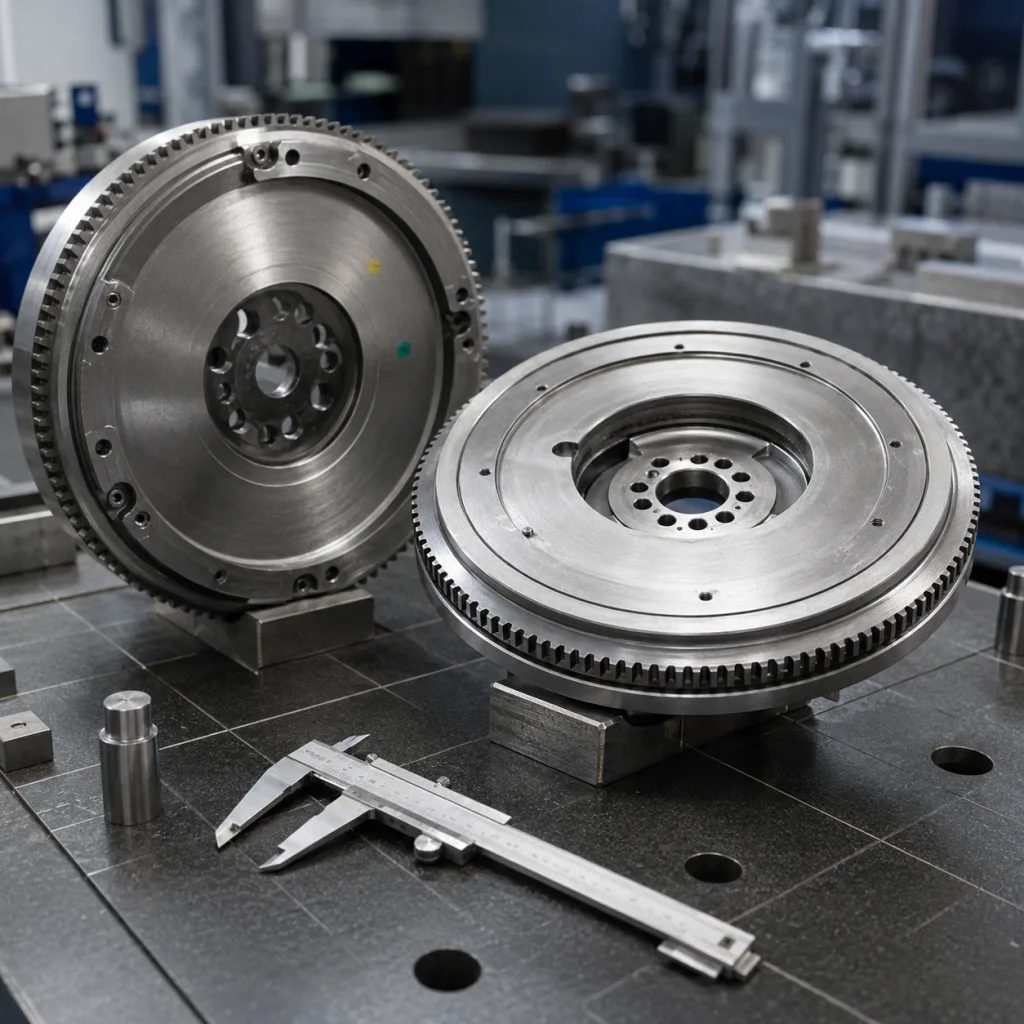
Dual mass flywheel symptoms of failure usually appear first as driver or technician complaints: idle rattle, start-stop knock, launch judder, vibration at low rpm or poor shift quality. For distributors, repair-chain buyers and sourcing engineers, the commercial impact often arrives later through warranty returns, clutch kit disputes, repeat labour claims and inconsistent workshop diagnosis.
The core task is to separate normal wear from a flywheel that can no longer control torsional vibration within the driveline. A dual mass flywheel is a tuned component, not just a heavy rotating plate. It uses primary and secondary masses, arc springs, friction control and damping grease to isolate crankshaft pulses before they reach the clutch and gearbox. Once wear exceeds the functional range, the same complaint may be blamed on clutch slip, engine misfire, mount failure or gearbox noise.
This guide sets out a practical diagnostic path from symptom to cause, the inspection evidence to request before authorising replacement, and the procurement controls that matter when sourcing aftermarket dual mass flywheels for diesel and petrol applications.
Primary Symptoms Seen in Workshops and Warranty Claims
The most common field reports involve noise, vibration and clutch engagement. One complaint rarely proves that the flywheel is defective, but repeated patterns across the same application can point to damping wear, spring fatigue, heat damage or excessive rotational free play.
Typical symptoms include:
Reported symptom
Likely flywheel-related cause
Checks before replacement
Rattle at idle that changes when the clutch pedal is pressed
Excessive angular play, worn internal stops or reduced damping control
Compare free play with the application limit; confirm idle speed stability
Knock during engine start or shut-down
Weak arc springs, failed internal damping or stop-surface impact
Inspect starter ring, engine mounts and engine stop behaviour
Vibration through body, pedals or gear lever at low rpm
Reduced torsional damping capacity
Check misfire data, injector correction, compression balance and mounts first
Judder during clutch take-up
Hot spots, uneven friction surface, grease leakage or clutch interface distortion
Inspect clutch disc, pressure plate, release system and friction surface condition
Difficulty shifting at low speed
Clutch drag or unstable movement at the flywheel-clutch interface
Verify hydraulic travel, release bearing, pilot support and gearbox input shaft condition
Burning smell or blue heat marks
Overheating caused by clutch slip, overload or severe launch duty
</tr></thead><tbody> </tbody></table>For fleet and repair-chain data, separate first-fit replacement mileage from repeat failures within 12 months. Early repeat failures often point to installation errors, incompatible clutch kits, oil contamination, unresolved engine vibration or aggressive duty cycles rather than the flywheel alone. This distinction helps buyers avoid rejecting good stock when the real issue is application control or workshop process.
Symptom to Cause: Diagnostic Sequence
A reliable diagnosis starts with the operating condition. Noise only during start-up, for example, has a different cause profile from vibration under load at 1,200–1,800 rpm. The aim is to confirm whether the dual mass flywheel is the source of the complaint or only the component making another driveline issue more noticeable.
1. Confirm the complaint under controlled conditions. Record engine speed, gear, load, clutch position, vehicle temperature and whether the noise appears at idle, launch, deceleration, start-up or shut-down. A light cold-start rattle may be acceptable on some high-mileage applications; a heavy metallic knock is not. 2. Check engine stability before condemning the flywheel. A dual mass flywheel cannot compensate for severe combustion imbalance. Review misfire counts, injector correction values, compression balance, idle control and engine mounts, especially on diesel applications with high low-speed torque. 3. Inspect the clutch and release system. Clutch drag, incorrect release bearing preload, distorted pressure plates, worn pilot support and contaminated friction material can create symptoms that look like flywheel failure. If the clutch does not release cleanly, gear selection complaints may continue after flywheel replacement. 4. Measure flywheel movement. Angular free play, axial rock and return behaviour are more reliable than sound alone. The secondary mass should move within the specified range and return smoothly, without binding, scraping or metallic impact at the end stops. 5. Inspect thermal and leakage evidence. Heat cracks, bluing, grease expulsion, scoring and friction transfer indicate overload or internal deterioration. These signs should be assessed together with clutch condition because overheating is often a system failure, not an isolated flywheel defect.
Driventus recommends that distributors provide workshops with application-specific measurement limits where available. Generic pass/fail rules are useful for screening, but final judgement should consider the vehicle application, engine torque, idle speed range and clutch kit design.
Inspection Points Before Authorising Replacement
Procurement teams reviewing warranty claims should ask for measurable evidence, not only photos. Images may show heat damage, grease leakage or broken friction surfaces, but they rarely prove excessive damping wear by themselves. A structured evidence set also makes it easier to identify whether a claim is a part issue, installation issue or operating-condition issue.
Useful inspection records include:
Vehicle mileage, engine code, gearbox type, VIN where available and duty cycle.
Complaint condition: idle, start-up, shut-down, launch, deceleration, cruising or load.
Angular free play measurement using a protractor or calibrated flywheel tool.
Axial movement and secondary mass rock check against the relevant limit.
Return behaviour of the secondary mass after rotation in both directions.
Surface condition: cracks, scoring, blue heat marks, hot spots and friction transfer.
Evidence of grease leakage from the internal damping cavity.
Confirmation that the crankshaft rear main seal and gearbox input shaft seal are dry.
Installation details, including new bolt use, tightening sequence and torque procedure.
When replacement is justified
Replacement is normally justified when the flywheel has excessive angular travel, rough or non-returning spring action, visible grease loss, cracked friction surfaces, severe heat checking, damaged ring gear teeth or metallic impact at the end stops. It is also justified when overheating from clutch slip has compromised surface hardness, flatness or the clutch height relationship.
When the root cause may be elsewhere
If vibration occurs only under acceleration and flywheel measurements remain within limit, inspect engine mounts, driveshafts, injectors, compression balance and gearbox bearings. If gear selection is poor but there is no noise or abnormal flywheel travel, focus on the release bearing, hydraulic cylinder, clutch fork, pilot support and clutch disc movement. This prevents unnecessary returns and reduces the risk of replacing the flywheel while leaving the real fault in service.
Replacement Criteria and OE-Equivalent Fitment Control
A replacement dual mass flywheel must match the vehicle application, torque capacity, clutch interface, starter ring geometry and balance requirements. Small dimensional errors can cause starter noise, clutch drag, vibration or premature clutch wear, even when the part appears visually similar to the original.
For aftermarket programmes, buyers should verify:
Ring gear tooth count, chamfer direction, tooth profile and hardness.
Crankshaft bolt pattern, pilot diameter, mounting face runout and bolt seating design.
Clutch cover dowel position, bolt circle diameter and friction surface height.
Friction surface flatness, finish and cleanliness after final machining.
Dynamic balance method and residual unbalance target by part number.
Damping curve suitability for engine torque, idle speed range and gearbox design.
Compatibility with approved clutch disc, pressure plate and release bearing references.
Packaging protection for the secondary mass, ring gear and friction face.
Dual mass flywheels are not normally resurfaced like solid flywheels because machining can disturb the internal damping system, friction control and surface-height relationship. Resurfacing also cannot restore worn arc springs, degraded damping grease or damaged internal stop surfaces. If a workshop reports repeated machining requests, it is usually a sign that application education, warranty guidance or clutch kit matching needs to improve.
Driventus supplies engine and powertrain components through our catalog and can support programme-level fitment review for distributors managing multiple clutch and flywheel references. Driventus is an independent aftermarket manufacturer; brand names are referenced for fitment only.
Quality, Materials and Compliance Considerations
Dual mass flywheel sourcing should be managed as a safety- and durability-relevant driveline programme, not as a commodity casting purchase. The product combines metallurgy, spring design, precision machining, friction control, grease management and balance control. Weakness in any one area can become an NVH complaint, starter engagement issue, clutch dispute or early-life warranty claim.
Typical production controls include:
Control item
Procurement relevance
Verification method
Cast or forged mass material
Fatigue resistance, machinability and burst-strength margin
Material certificate and batch traceability
Arc spring specification
Torsional damping, torque capacity and service life
Supplier drawing, validation record and functional test data
Friction washer system
Smooth damping, controlled slip and return behaviour
Functional torque curve test
Ring gear hardness
Starter engagement durability and tooth wear resistance
Hardness testing and tooth profile inspection
Dynamic balance
NVH control and gearbox input protection
Balance report by part number batch
Grease fill control
Heat resistance and damping stability over service life
Process control record and audit evidence
Final dimensional inspection
Fitment accuracy at crankshaft, clutch and starter interfaces
CMM report or controlled inspection plan
</tr></thead><tbody> </tbody></table>Relevant management and compliance references include IATF 16949:2016 for automotive quality management, ISO 9001:2015 for quality management systems, and REACH (EC) No 1907/2006 for chemical substance obligations in the EU supply chain. Depending on market and customer requirements, material declarations, PPAP-style documentation, IMDS data, restricted substance checks and batch-level inspection reports may be requested.
Driventus manufactures under an IATF 16949:2016 and ISO 9001:2015 certified quality system. For private-label, application expansion or design-to-sample programmes, buyers can discuss custom manufacturing with engineering and export teams.
Procurement Actions to Reduce Returns
Many dual mass flywheel returns are preventable through better application control, clearer installation guidance and more disciplined warranty evidence. The strongest return-reduction measures are operational: they help workshops fit the correct part, prove the fault accurately and avoid replacing the flywheel when another system is responsible.
Recommended controls for distributors and repair-chain buyers:
Require VIN, engine-code or OE-reference validation before shipment for high-return applications.
Pair flywheel references with approved clutch kit, release bearing and bolt set combinations.
Include installation notes covering bolt replacement, tightening sequence, torque angle and contamination checks.
Record measured angular play, axial movement and return behaviour on warranty claims.
Track returns by application, installer, mileage, driving duty and clutch kit brand reference.
Audit packaging damage for heavy flywheels shipped through parcel or mixed-load networks.
Retain sample parts from repeated claims for dimensional, metallurgical or destructive inspection when volumes justify it.
Feed confirmed field issues back into catalog notes, installer bulletins and supplier corrective action requests.
A dual mass flywheel that is incorrectly matched, mishandled during shipment or installed with a worn clutch release system can fail early even if the part was built correctly. For importers, the purchasing specification should therefore include dimensional data, damping and balance expectations, batch traceability, packaging standards and warranty evidence requirements.
If your team is comparing dual mass flywheel suppliers or consolidating clutch programme sourcing, Driventus can review drawings, samples, target references and annual demand forecasts before quotation. To start an application review, request a quote.
Frequently asked questions
A heavy rattle or knock at idle, start-up or shut-down combined with excessive angular free play is a strong indicator. Diagnosis should still include engine mounts, misfire data, clutch condition and release system checks before replacement is authorised.
In most aftermarket service cases, resurfacing is not recommended. Machining can change the clutch height relationship and does not restore worn internal springs, friction washers or damping grease. Replacement is normally preferred when wear limits are exceeded.
Request application coverage, dimensional drawings, material and hardness controls, balance method, functional damping checks, batch traceability, packaging details and quality certificates such as IATF 16949:2016 and ISO 9001:2015.
For application matching, batch documentation or dual mass flywheel sourcing discussions, contact Driventus with target references, annual volumes and market requirements at /contact.html