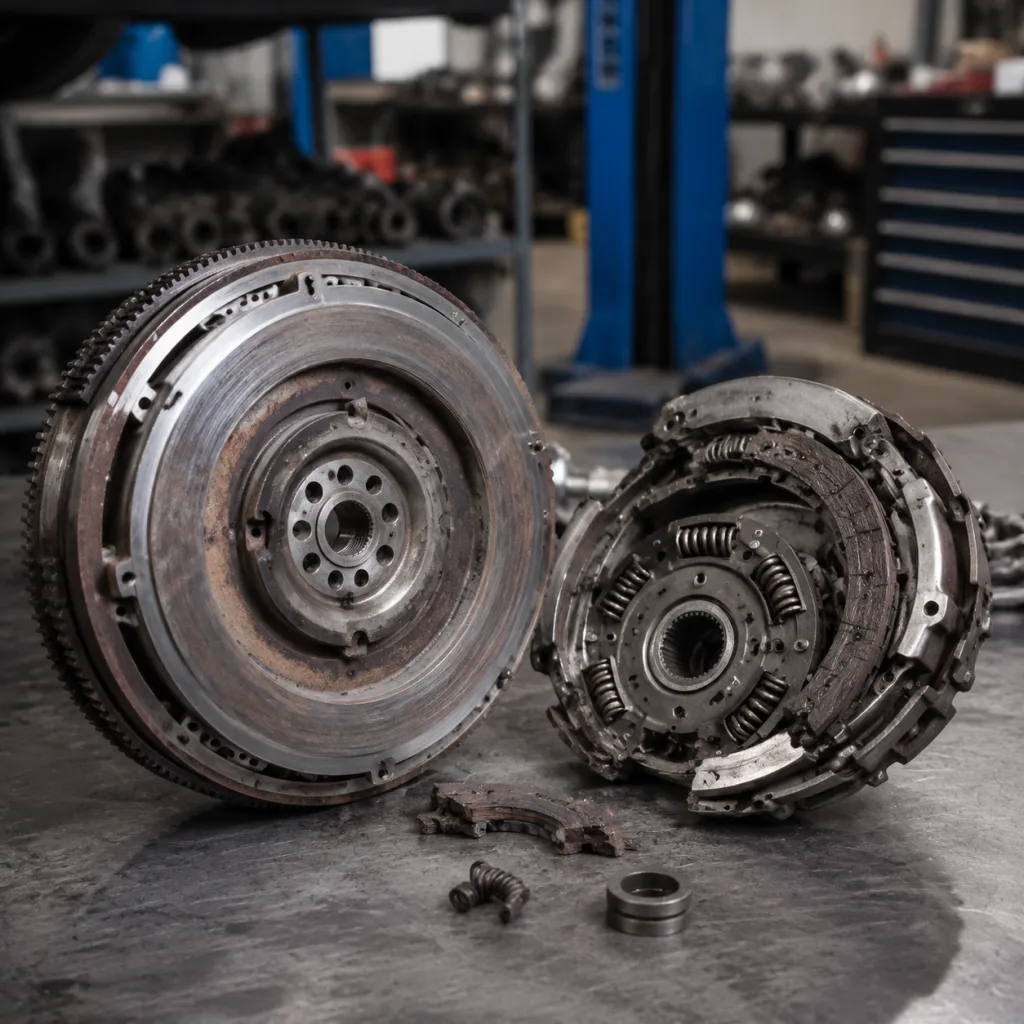
Selecting a dual mass flywheel supplier is a procurement decision, not just a parts-buying task. The part directly affects torsional vibration control, idle quality, gearbox protection, clutch life, and long-term drivability, so buyers should evaluate it with the same discipline used for other safety-relevant powertrain components. For B2B buyers, the core questions are consistency, validation, and supply continuity.
A supplier should be able to define the mass split, spring-pack behaviour, rotational backlash, thermal limits, and inspection method for each application, then hold those controls across repeat orders. For an aftermarket programme, the practical sourcing baseline usually starts with OE cross-reference, confirmed fitment dimensions, a documented spin-balance limit, and a stable release process. Driventus supplies powertrain components from Taizhou, Zhejiang, with IATF 16949:2016 and ISO 9001:2015 systems in place. Driventus is an independent aftermarket manufacturer; brand names are referenced for fitment only.
For buyers in the EU, UK, US, Canada, Australia, and Brazil, the practical checks are the same: OE cross-reference, dimensional match, batch traceability, packaging standard, and lead-time stability. If your team is comparing options, this article sets out what to verify before you place a trial order.
What to verify before you shortlist a supplier
A dual mass flywheel is not a commodity casting. Before approving a dual mass flywheel supplier, confirm the following:
OE cross-reference coverage for the target vehicle range
Rotational backlash and damping performance at the specified torque window
Hub spline, ring gear, and bolt-circle dimensions against the application drawing
Runout, balance, and face-parallelism limits on finished parts
Material and heat-treatment control for the mass bodies and spring carrier
Batch traceability, serial or lot marking, and inspection records
For suppliers serving aftermarket, OEM, and Tier-1 channels, document control matters as much as machining accuracy. Ask for PPAP-style data where available, even when the order is aftermarket. A practical request package should include the application number, sample photo set, OE reference, target annual volume, and the acceptance criteria you will use for first-article sign-off.
A stable supplier should also define packaging to prevent grease loss, corrosion, and transit damage during export, including VCI protection, partitioned cartons, and pallet-loading limits. For high-volume programmes, ask for a stated inspection plan with critical-to-quality characteristics, sample frequency, and a clear disposition rule for nonconforming batches.
Where fitment goes wrong
The main sourcing failure is assuming visible geometry is enough. Two parts can share the same outside diameter and still behave differently on the vehicle.
Check point
Why it matters
Typical buyer request
Installed height
Affects clutch stack-up and release travel
Compare against OE or approved sample
Starter ring gear tooth form
Impacts engagement and noise
Match tooth count and pitch profile
Inertia and damping curve
Affects vibration control
Supplier test report by application
Axial and radial runout
Influences smoothness and clutch wear
Inspection record with stated limit
Fastener specification
Protects clamp load and service safety
Torque and thread standard confirmation
</tr></thead><tbody> </tbody></table>Ask for numbers instead of generalities. Common buyer-side tolerances to confirm include radial runout, axial runout, backlash, and rotational resistance at the defined test torque. If the supplier cannot state the limit in microns, millimetres, or Newton-metres, the part is not ready for controlled procurement.
A workable comparison set should also include outer diameter, height, starter ring gear tooth count, spline count, and mounting pattern, because a mismatch in any one of those values can stop fitment even when the part looks correct in photos. If the application is sensitive to vibration or stop-start duty, ask for test evidence aligned to published methods such as SAE J2527 for durability-style evaluation where relevant, and confirm any regional compliance needs tied to REACH (EC) No 1907/2006 for material reporting. Where the buyer has a technical drawing, ask the supplier to confirm the critical dimensions against that drawing before sample release, rather than after production has started.
How to compare suppliers without getting misled by price
A fair comparison needs the same data from every bidder. Do not compare only unit price. Compare the full landed and operational cost.
Comparison checklist
Same OE application or documented equivalence
Same warranty terms and complaint-response window
Same packing specification and export documentation
Same test basis for damping, balance, and runout
Same MOQ, lead time, and production flexibility
Same traceability and label format
To make the comparison actionable, ask every bidder for a line-item quotation that separates unit price, tooling if any, sample cost, carton specification, pallet cost, and freight basis. Also ask whether the quoted price changes by volume band, since a real programme may move from 20 units for validation to 200 units for launch and then to monthly replenishment.
A lower-priced supplier can cost more if the assembly drifts out of balance, wears the clutch prematurely, or arrives without usable batch data. For import managers, that turns into returns, delayed fitting, and lost distributor confidence. If you need a source review or a replacement programme quotation, the cleanest next step is to request a quote.
A practical sourcing sequence for trial orders
For procurement teams, supply terms often decide the shortlist. A credible supplier should state MOQ by part family, not give a generic answer. Dual mass flywheels usually require more controlled inventory than a standard flywheel because the assembly contains springs, friction elements, and a balanced rotating structure.
Typical questions to raise during sourcing:
What is the MOQ for first production and repeat orders?
What is the standard lead time after sample approval?
Which parts are held in finished-goods stock versus made to order?
Can the factory support phased releases for distributor programmes?
What is the failure-analysis process if a field complaint is raised?
A practical MOQ framework is usually split into three stages: sample quantity for validation, pilot quantity for first market release, and production MOQ for replenishment. Sample lots should be small enough for fitment and bench checks, pilot lots should cover installer feedback, and repeat orders should align with carton or pallet economics.
Lead time should also be separated into sample lead time, tooling or setup lead time, and mass-production lead time, because those are often different. For large distributors and repair-chain buyers, continuity is often more valuable than the lowest unit price. A supplier with stable machining, controlled welding, and documented inspection can reduce claim rates and shortage risk. If your programme includes multiple vehicle platforms, ask whether the factory can consolidate related references under one sourcing plan through our catalog and custom manufacturing.
What a factory audit should actually cover
A factory audit for this product should focus on process control, not only on certificates on the wall. At minimum, review the following:
1. Incoming material verification for castings, forgings, springs, and friction surfaces. 2. CNC process capability for critical dimensions and bore concentricity. 3. Balance-correction method and final spin-test procedure. 4. Assembly traceability for lubrication, fasteners, and locking features. 5. Final inspection records and non-conformance containment.
For a real audit, ask to see the process route from incoming material to finished packing. That route should show where the supplier controls hardness, concentricity, runout, balance correction, torque retention, and final cleaning. A buyer can also request capability evidence such as first-article dimensions, in-process check sheets, gauge calibration records, and a defined reaction plan if a critical dimension drifts out of spec.
Driventus operates under quality system controls aligned to IATF 16949:2016 and ISO 9001:2015. For buyers in regulated supply chains, this supports audit readiness and repeatable release documentation. If your team needs a drawing-based part developed to your own programme, custom manufacturing is the right route for sample approval and serial production planning. For export programmes, confirm whether the supplier can supply part labels, carton marks, and inspection paperwork in the format required by your warehouse or distributor network.
Frequently asked questions
Yes. We support OE cross-reference sourcing by application and fitment data. We do not claim vehicle-maker approval. Brand names are used for fitment only, and final suitability should be confirmed against the buyer’s drawing or sample.
Typical documents include commercial invoice, packing list, certificate of origin where required, and inspection records. For controlled programmes, we can also provide batch traceability, carton labels, and quality documentation linked to the supplied part number.
Yes. Trial orders are commonly used for validation before a wider release. MOQ, lead time, and packaging format depend on the application and production route, so we confirm those details at quotation stage. In practice, buyers often start with a small validation lot, then release a pilot lot after fitment and road-use checks, then move to repeat replenishment once the acceptance criteria are closed.
If you are building a sourcing list for a dual mass flywheel programme, send your application details and target volume. Start here: /contact.html