Dual Mass Flywheel Specifications for Procurement Teams
Dual mass flywheel specifications need to turn fitment, torsional damping, durability, and supply repeatability into measurable requirements. For procurement teams, the question is not simply whether a DMF fits the transmission bell housing. The full stack of dimensions, inertia, spring behavior, balance, surface condition, and traceability has to stay controlled to the same approved drawing from batch to batch. A clear specification reduces wrong-part returns, shortens PPAP-style validation, and makes OE cross-reference work more dependable. It also gives purchasing, quality, engineering, and aftersales teams a shared acceptance language when they review a sample, inspect an incoming lot, or investigate a warranty return. Driventus is an independent aftermarket manufacturer; brand names are referenced for fitment only. The guidance below is for buyers sourcing replacement or private-label dual mass flywheels from a controlled manufacturing base. It covers the measurements that matter, the documents to request, the tests that should appear on the inspection record, and the standards that support a defensible supplier file.
1. What belongs on a DMF specification
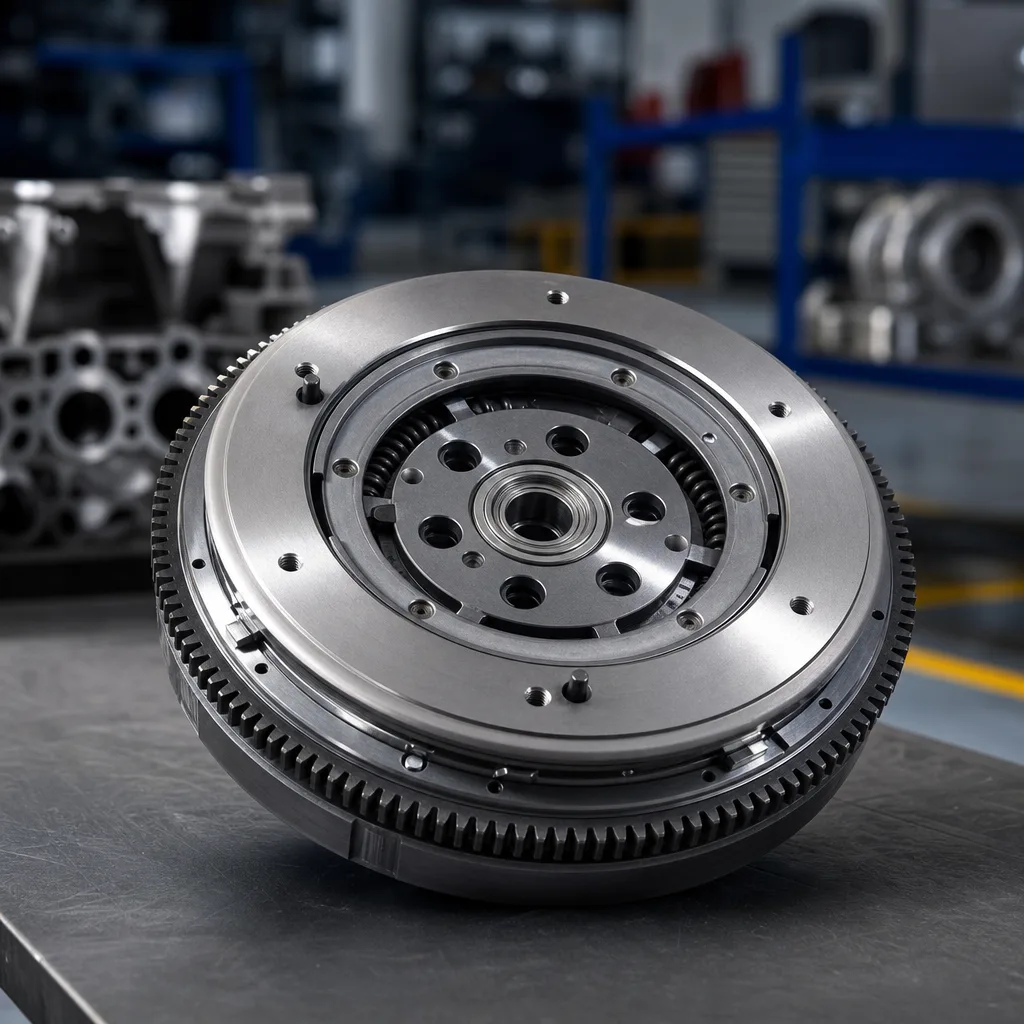
A useful spec sheet defines fit, function, and acceptance criteria. For a dual mass flywheel, start with application data, then move into the dimensional and performance items that control interchangeability. Do not approve a quote from OE cross-reference alone. Ask for the drawing revision, finished mass, overall height, ring gear tooth count, pilot features, bolt pattern, starter interface, and installation constraints such as single-use bolts, required tightening sequence, or clutch-kit pairing.
A strong DMF specification should also say what the part is being matched against. A replacement part may be matched to an OE drawing, an approved aftermarket drawing, a reverse-engineered master sample, or a customer-owned private-label design. Those routes can lead to similar catalog references but different acceptance files. Record the evidence source and revision level so later changes in spring pack, grease, coating, or machining route are not treated as invisible substitutions.
At minimum, capture:
Engine code, transmission code, clutch diameter, and torque rating where known
Vehicle application range, model-year coverage, and market restrictions
Drawing number, revision, approval date, and sample reference
Outer diameter, overall stack height, and datum scheme
Crankshaft bolt circle, hole count, hole diameter, and thread class where applicable
Ring gear tooth count, module or pitch, chamfer direction, hardness zone, and starter engagement face
Pilot bore or locating spigot diameter, depth, lead-in chamfer, and concentricity
Finished mass and rotational inertia, with measurement method stated
Angular free play, damper travel, return behaviour, and measurement torque
Axial clearance, secondary-mass tilt, and end-stop behaviour where applicable
Face runout, bore runout, parallelism, flatness, and surface finish limits
Friction face hardness, roughness, usable contact width, and corrosion-protected masking areas
Packing method, label content, barcode format, and traceability format
For dual mass flywheel specifications, separate critical characteristics from reference characteristics. Critical items are acceptance points that can reject a shipment, such as bolt pattern, ring gear concentricity, balance, stack height, or angular free play outside the approved range. Reference items help identify the part, but they may not be practical receiving-inspection criteria for every lot. This distinction keeps a supplier from treating a critical fit dimension as informational, and it keeps internal inspection teams from overchecking features that do not control field performance.
If the part belongs to a larger rotating assembly, keep the same datum system across related engine components. That way, a clutch, starter, spacer, crankshaft interface, or release system change does not shift the fit stack. This is where an organised catalogue helps, including our catalog and the broader engine components range. When the same vehicle platform has multiple engine codes, gearbox codes, starter types, or clutch diameters, add those identifiers directly to the specification instead of relying on sales notes or catalog comments.
2. Dimensional items buyers should lock down
The fastest way to reduce sourcing mistakes is to define the measurement method before the first sample ships. Specify which face, bore, or edge is the datum, what temperature the inspection uses, and whether the values apply to the finished assembly or a subcomponent. Standard room-temperature inspection at 20 C is common, but the drawing should state it when tight tolerances are being compared across suppliers. The same name on a quote can hide different designs if the drawing is loose.
Dimensional control should follow how the part works in the vehicle. The crankshaft mounting face, pilot bore or spigot, ring gear, clutch friction face, and transmission clearance envelope all interact. A stack-height difference of 0.3-0.5 mm can be enough to affect clutch release margin on some applications. Poor concentricity at the pilot feature may show up as vibration, starter noise, or uneven friction wear. For that reason, the drawing should define both nominal dimensions and geometric controls such as runout, flatness, parallelism, and concentricity.
Parameter
What to define
Procurement note
Outer diameter
Nominal diameter, tolerance, chamfer, and clearance envelope
Must clear the bell housing and starter path
Overall height
Stack height from the agreed datum, usually crank face to clutch face
Controls clutch alignment and release travel
Primary mounting face
Datum surface, flatness, seating width, and coating mask
Bore or locating spigot diameter, depth, chamfer, and concentricity
Protects concentricity at installation
Ring gear
Tooth count, pitch or module, chamfer, hardness zone, axial position, and concentricity
Directly affects starter engagement
Friction face
Contact diameter, width, flatness, runout, roughness, and hardness
Affects clutch bedding, noise, and heat behaviour
Free play
Angular travel between masses, torque applied, direction, and return limit
Main indicator of torsional damping behaviour
Axial clearance
End play between primary and secondary masses and gauge load
Helps identify internal wear or assembly variation
Runout
Face and bore runout on the finished unit, measured on fixture datums
Impacts noise, vibration, and clutch life
Mass properties
Finished mass, centre of gravity where required, and rotational inertia
Affects engine response and damping match
</tr></thead><tbody> </tbody></table>If the platform has a known OE benchmark, keep the same measurement references used by the original drawing or master sample. That makes first-article inspection and incoming checks easier to compare across suppliers. A dimensional report should show the actual value, tolerance, instrument used, inspection fixture or datum, and acceptance decision on the same line. For high-volume programs, ask the supplier to identify key characteristics on the drawing and provide capability data for the features most likely to drift during machining or assembly, including stack height, ring gear concentricity, bolt-hole position, and friction-face runout.
Define sample selection as well. One golden sample is useful for visual comparison, but it does not prove lot stability. A stronger approach is to inspect multiple pieces from the first production batch, such as 3-5 pieces across the run where volume allows, then confirm the most critical dimensions on later lots. When a supplier proposes a change to tooling, ring gear source, machining fixture, spring supplier, grease, or assembly line, repeat the relevant measurements against the approved dual mass flywheel specifications before allowing mixed inventory into the channel.
3. Materials, heat treatment, and balance
Material control matters because the DMF sees cyclic torque, clutch heat, starter impact, and repeated engagement loads. The purchase order should state the base material, whether the primary and secondary masses are cast or forged, the heat-treatment target, and any surface hardness requirement on the friction face. Typical drawings identify grey cast iron, ductile iron, or steel grades by recognized standards, but the exact grade and process route should still be approved. If the supplier changes the route from cast to forged, inertia, machining allowance, thermal response, and damping behaviour can shift even when the outside dimensions stay the same.
A dual mass flywheel is more than a machined wheel. It is an assembly of masses, arc springs, friction elements, retainers, seals, grease, and ring gear features that must keep working after repeated start-stop cycles and clutch engagements. The specification should identify the material and process requirements for each functional area, not just the visible casting or forging. The friction surface, for example, needs stable hardness and roughness. The internal damper package needs spring fatigue resistance, controlled lubrication, and protection against dust, water, and grease leakage.
The spec should also cover the internal damper package:
Spring wire grade, shot-peening requirement where used, preload target, and fatigue-life validation basis
Spring rate, angular range, progressive damping stages, and mechanical stop position where controlled
Grease type, drop point or operating temperature range, compatibility with seals, and fill quantity by weight
Seal design, retention method, grease-leak criteria, and contamination controls during assembly
Wear plate or friction washer material, thickness, hardness, and coefficient-of-friction target where specified
Surface roughness on mating ring faces and spring contact tracks
Rivet, fastener, staking, or welding method for retained components
Ring gear material, tooth hardness, attachment method, and heat-affected-zone limits if welded or shrink-fitted
Heat-treatment records should connect to the supplied batch, not only to a generic process sheet. Request evidence of hardness testing at the friction face and any other hardened contact zones, with the test method, load, and location stated. If the product uses different material grades across variants, those grades should be visible in the drawing or bill of materials so a quotation for one engine family is not accidentally applied to another.
Balance control
Dynamic balance should be checked after final machining and before packing, using the assembly condition defined by the drawing. Ask for the balancing grade or residual unbalance limit, test speed, correction method, fixture reference, and residual unbalance record. Many aftermarket buyers specify acceptance in g-mm per plane or by ISO 21940 balance grade, but the limit must be tied to the flywheel mass, operating speed range, and customer requirement. Traceability is the key point: a pass/fail stamp is not enough if the supplier cannot show where the correction was made.
Balance requirements should state whether the part is balanced as a standalone flywheel or as part of a matched clutch assembly. If correction drilling, milling, or weight addition is allowed, the drawing should define acceptable correction zones, maximum correction depth, minimum wall or web thickness, and coating repair requirements. Receiving teams should compare balance records with serial, batch, or production-date codes so warranty analysis can connect field claims back to the actual production lot.
If a coating is specified, define thickness, adhesion, salt-spray or corrosion test method, masking areas, and appearance limits after handling. Coating build-up on a locating face, bolt seat, pilot bore, or ring gear interface can create installation problems even when corrosion protection is adequate. For chemical compliance, the file should carry a REACH (EC) No 1907/2006 declaration for substances of concern, and private-label buyers should confirm whether any market-specific material restrictions apply to their destination countries.
4. Validation and documentation
Treat validation as part of the specification, not as an optional attachment. For a controlled supply chain, the factory should operate under IATF 16949:2016 and ISO 9001:2015, with calibrated gauges, retained inspection records, defined change control, and a reaction plan for nonconforming parts. That does not replace product approval, but it gives the buyer a structured way to audit process stability.
The validation file should answer three questions: does the part match the approved design, can the process repeat it, and can the supplier prove what was shipped if there is a field issue? A drawing without test records is difficult to defend. Test records without drawing revision control can point to the wrong product. Keep the document pack tied to the same part number, revision, production date, batch identification, and label code used on the carton.
Request a file that includes:
Approved drawing or specification with revision history and critical-characteristic marking
Dimensional report on the finished assembly, including actual readings and gauge IDs
Material certificate and heat-treatment record tied to the production batch
Hardness and surface roughness evidence for the friction face and other controlled zones
Balance report with test speed, fixture, correction method, and residual unbalance stated
Angular free-play, axial-clearance, tilt, and functional damping checks where applicable
Traceability to batch or serial number, including subcomponent lot traceability for springs, grease, ring gear, and castings where required
Gauge calibration status for critical measurements
REACH declaration and packaging specification
Photos or drawings that show the exact revision supplied
Control plan or inspection plan for recurring production
Change-notification process for material, tooling, fixture, sub-supplier, coating, and packaging changes
If a supplier claims OE equivalence, the test evidence should show what was measured, at what speed, under what torque or temperature condition, and on what fixture. Keep vehicle claims separate from part claims. Do not allow implied approval by a vehicle manufacturer unless you have written evidence for that programme. For coating or weathering claims, some buyers also reference SAE J2527, ISO 9227, or internal salt-spray methods, but the method must match the actual finish and use case.
For higher-risk or new-source programs, request a first-article inspection report before commercial approval. The first article should come from the intended production process, not from a hand-finished prototype. If endurance, thermal cycling, overspeed, burst-risk assessment, or torsional vibration testing is part of the program, define the load profile, temperature range, number of cycles, acceptance criteria, and post-test inspection requirements before the test begins. Useful post-test checks include grease leakage, spring pocket wear, free-play change, crack inspection, ring gear movement, friction-face condition, and balance shift.
Packaging belongs in the documentation set because transit damage often looks like a manufacturing defect at the receiving dock. The specification should define rust prevention, protective caps or covers, carton strength, pallet layout, label content, barcode format, and whether installation notes are included. For distributors and repair chains, consistent labeling also prevents an approved DMF from being confused with a visually similar but incompatible variant.
5. Sourcing, lead time, and private-label control
Buying on specification is easier when the supplier can show process control, commercial terms, and variant management together. Use our catalog to check coverage, our quality system to review controls, and custom manufacturing if the application needs a non-catalogue geometry or private-label pack. If you need a broader view of the family, start with engine components.
For quote comparison, align these items before evaluating price:
MOQ, sample quantity, and sample lead time
Mass-production lead time and capacity by month
First-article, in-process, and pre-shipment inspection requirements
AQL level or sampling plan for visual, dimensional, and packaging checks
Document pack included with each lot and document retention period
Tooling, engineering, reverse-engineering, or fixture charges
Labelling, barcode, carton, insert, and electronic catalog data requirements
Warranty handling, teardown procedure, and claim-analysis response time
Forecast window, safety stock, and engineering change notice timing
A good quotation should state whether the part is matched by dimension, by vehicle application, by OE reference used for identification, or by drawing revision. Those are not the same purchasing basis. A vehicle-application match may be suitable for catalog coverage, but a private-label or fleet program usually needs a controlled drawing and documented acceptance criteria. When the application has several supersessions, engine codes, gearbox codes, starter variants, or clutch kit pairings, ask the supplier to map each reference number to one approved specification instead of combining similar-looking variants into a single line.
Review lead time by stage: sample build, validation, tooling or fixture adjustment, casting or forging supply, machining, spring and ring gear procurement, assembly, balance, inspection, packing, and freight. DMF sourcing often involves machined masses, bought-in spring or ring gear components, grease and seal materials, and final balance operations. A delay in any one of those inputs can affect shipment timing, so procurement should confirm which items are made in-house, which depend on approved sub-suppliers, and which have minimum order constraints. For annual programs, reserve capacity against forecast and define how revision changes will be communicated before production material is purchased.
Private-label control should cover more than the box design. Confirm whether the product marking, carton label, installation sheet, pallet label, warranty language, and electronic catalog data all use the buyer's part number and approved fitment language. The supplier should also define how obsolete labels, old revisions, mixed-language inserts, and superseded application data are segregated after a packaging change. These details matter because a correct flywheel can still create a channel problem if it arrives under the wrong reference or with unclear application data.
Driventus is an independent aftermarket manufacturer; brand names are referenced for fitment only. That wording matters in distributor, wholesaler, and repair-chain channels because it keeps the file accurate without implying manufacturer endorsement. For a practical RFQ, send the drawing pack, OE or aftermarket references used only for identification, target markets, annual volume, packaging requirements, inspection requirements, and any required dual mass flywheel specifications so engineering and commercial review can happen from the same source file.
Frequently asked questions
It should include application data, drawing revision, dimensions, datums, mass, inertia, angular free play, axial clearance, runout, ring gear details, materials, heat treatment, balance limits, traceability requirements, and the acceptance limit for each critical feature.
Match the drawing revision, measurement datums, starter interface, clutch stack height, ring gear details, pilot feature, bolt pattern, and transmission family. Use a dimensional report and first-article sample, not the name on the box.
Ask for a dimensional report, material and hardness evidence, balance record, traceability, packaging specification, and REACH declaration. For controlled supply, request IATF 16949:2016 and ISO 9001:2015 evidence.
Send the drawing pack, application data, target markets, packaging requirements, inspection requirements, and target annual volume for a quote review, then [request a quote](/contact.html).