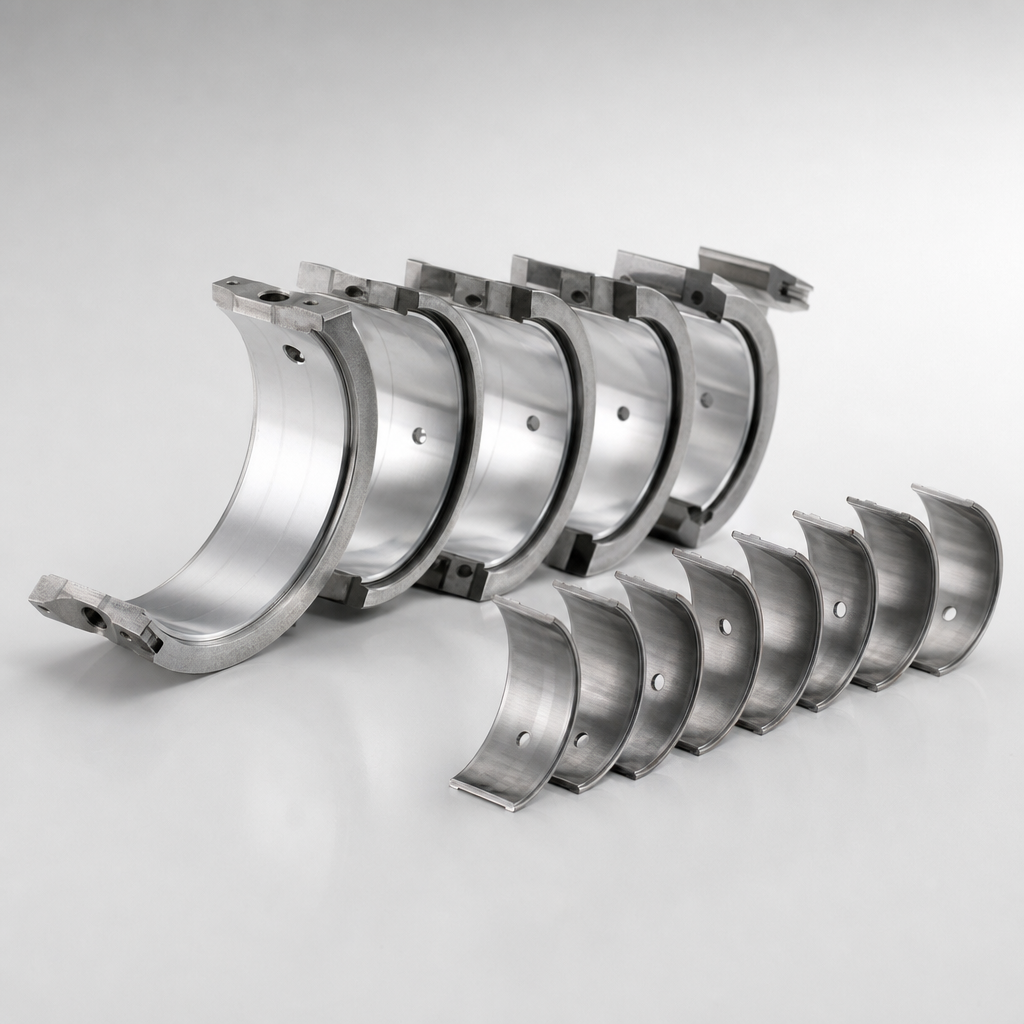
Dual Mass Flywheel Seat Manufacturer China: How Buyers Should Qualify Supply
For buyers screening a **dual mass flywheel seat manufacturer China** can be a strong sourcing base, but only if the evaluation goes past catalogue claims and unit price. The real question is simpler: can this supplier hold the drawing, control the process, and prove it repeatedly from lot to lot?
A flywheel seat used within a dual mass flywheel assembly works under cyclic torsional loading, clutch engagement shock, and thermal variation. Small errors in machining, hardness, cleaning, or traceability can turn into noise, fitment issues, or early field failures. That is why experienced buyers focus on process discipline first.
In practice, qualification usually comes down to a few measurable points: critical concentricity and face-runout checks often in the 0.03-0.08 mm range depending on print, mating-face flatness commonly around 0.02-0.05 mm, and contact-face roughness often near Ra 1.6-3.2 um where assembly stability matters. Material may be forged or bar-machined medium-carbon or alloy steel, with hardness defined by drawing and application, not by a generic product sheet.
This article breaks the sourcing decision into the questions that actually matter: what to verify first, where supplier failure modes usually appear, how to compare quotations fairly, and what technical evidence should be in the approval file. Driventus is an independent aftermarket manufacturer; any brand names are referenced for fitment only.
Start With the Decision Gate, Not the Brochure
When assessing a dual mass flywheel seat manufacturer China buyers should open with one filter: is this a real process owner or simply a coordinator of outside workshops? That single distinction affects traceability, response speed, consistency, and claim handling later.
Before going deep, verify these points:
Manufacturing scope: confirm whether turning, drilling, broaching, grinding, washing, and final inspection are performed in-house or split across subcontractors.
Legal entity and certificate match: check that the company issuing the quote is the same entity named on IATF 16949:2016 and ISO 9001:2015 certificates, or clearly identify the actual production site.
Material traceability: ask whether a raw-material heat number can be linked to machining lot, inspection record, and shipment label quickly and reliably.
Drawing revision control: confirm how print changes reach operators, fixtures, CMM programs, and inspection plans.
Inspection capability: verify access to CMM measurement, hardness testing, roughness testing, and runout checks. A typical machining supplier may have a CMM with 2-5 um accuracy, hardness tester, roughness tester, and dedicated dial-indicator fixtures.
Capability evidence: request Cp/Cpk data or at least trend charts for critical dimensions. Many buyers use Cpk >= 1.33 for important features and >= 1.67 for special characteristics before launch.
Export execution: confirm rust prevention, carton limits, pallet standard, label format, and shipping document accuracy.
Compliance support: where needed, request declarations aligned with REACH (EC) No 1907/2006 and any customer-specific substance restrictions.
This first screen saves time. If a supplier cannot answer these items clearly, the problem is usually not communication style. It is lack of control.
For distributor programmes, also check application coverage, cross-reference discipline, and whether the supplier can support OE number and aftermarket reference mapping inside your ERP. If you need a broader driveline or engine sourcing package, review our catalog.
Where Qualification Usually Fails During the Factory Audit
A factory audit for this part should follow the real process path, not the presentation deck. Most sourcing failures show up in ordinary places: raw material identification, fixture control, operator discipline, cleaning, and release inspection.
Audit the line in sequence
1. Incoming material - Heat-number marking on forgings or steel stock - Material certificate storage and retrieval - Segregation of accepted, pending, and quarantined material - FIFO discipline where shelf life or coating condition matters - Incoming checks against purchase spec, including chemistry, hardness, or ultrasonic review when required
2. Machining process - Machine suitability for bore control, concentric turning, and datum stability - Fixture condition and setup repeatability - Tool-life control and replacement triggers - First-off, in-process, and last-off inspection practice - Error prevention for orientation, bolt-hole pattern, and wrong-program selection
3. Measurement room - Calibration status of gauges and masters - Revision control for CMM programs - SPC charts, trend reports, or capability records on critical dimensions - Reaction plan when results drift toward tolerance limits - Operator reference standards for edge condition and appearance
4. Cleaning and preservation - Washing-process control - Drying method and corrosion prevention - Preservation method such as rust-preventive oil or VCI - Cleanliness verification by wipe test, gravimetric method, or defined particle limit
5. Packing and dispatch - Lot coding and part identification - Carton strength and anti-damage protection - Pallet stability for export handling - FIFO control between final inspection, warehouse, and shipment
Documents worth requesting on site
Process flow chart
PFMEA or equivalent risk analysis
Control plan
Inspection standard with critical characteristics marked
Material certificates
Calibration records for key gauges
Non-conformance and corrective-action examples
Packaging specification
Sample dimensional report ballooned to drawing
Capability data from an active serial part in a similar family
A useful audit test is simple: ask the supplier to walk one actual batch from raw material receipt to shipment label. If they can show, for example, how lot 240315-A moved through machining, washing, inspection, and packing with machine ID, operator ID, and timestamp, traceability is probably real. If the trail breaks, the certificate tells you less than it appears to.
If the supplier offers private-label supply or application-specific adaptation, ask how engineering changes move from commercial approval to production release through custom manufacturing. For ongoing vendor approval, review whether the supplier's quality system includes layered audits, containment, traceability, and corrective-action follow-up.
Compare Quotes by Assumption, or the Numbers Mean Very Little
Many RFQs look comparable and are not. One supplier prices a forged route, another bar stock. One includes export packing, another does not. One assumes sampling and full reports, another assumes visual release only. The unit price alone tells you almost nothing.
Item
What to confirm
Why it changes the deal
MOQ
Pieces per SKU and mixed-load options
Drives stock risk on slow movers
Lead time
First order vs repeat order
Affects launch timing and buffer stock
Tooling
Soft tooling, hard tooling, or fixture cost
Changes upfront cash and ownership terms
Sampling
Sample count and approval method
Impacts validation schedule
Packaging
Carton quantity, VCI, pallet pattern
Alters damage rate and warehouse handling
Incoterms
FOB, CFR, CIF, or DDP
Changes true lane cost
Warranty
Scope, exclusions, and claim evidence
Affects aftermarket exposure
</tr></thead><tbody> </tbody></table>Typical ranges buyers may see:
MOQ for active standard references: often 100-300 pcs per SKU
MOQ for slower-moving references: often 300-800 pcs per SKU
MOQ for dedicated fixtures or special setups: often tied to 500-1,000 pcs or a minimum order value
Sample quantity: usually 3-10 pcs for dimensional approval, more if bench or fitment testing is required
First-order lead time: often 35-50 days after drawing approval and deposit
Repeat-order lead time: commonly 20-35 days once material route and fixtures are established
Tooling lead time: add 2-5 weeks if new fixtures or gauges are needed
When one quote comes in far below the market cluster, push for the reason. In this product family, the answer is usually one of four things:
Larger MOQ
Looser tolerance route
Reduced inspection content
More outsourced process steps
Ask every supplier to break the quote into the same structure:
Unit price
Tooling or fixture cost
Sample cost
Test cost, if any
Packaging upgrade cost
Freight basis
Payment terms
Then request at least three volume breaks, such as 200 pcs / 500 pcs / 1,000 pcs. Real manufacturers usually show a cost curve. Flat numbers across all breaks often mean the quotation was built too loosely to support a disciplined sourcing decision.
The Technical Checks That Actually Protect Your Warranty Budget
This component does not need dramatic language. It needs controlled release criteria. Most warranty problems start with small, ordinary shifts that were never defined well enough to catch.
Buyers should lock down these controls in writing:
Dimensional conformity to the approved drawing revision
Face runout and concentricity on key datums, often around 0.03-0.08 mm depending on design and gauge method
Bore and pilot feature tolerance for assembly fit, often H7/H8 class or explicit limits such as +0.015 / 0 mm
Surface roughness on mating faces, frequently Ra 1.6-3.2 um where contact stability matters
Hardness range after heat treatment where specified, for example HB 180-240 or equivalent per print
Residual contamination after washing, checked by a defined cleanliness method rather than visual judgement alone
Lot traceability from material batch to shipping label
Deburring and edge condition on holes, pilots, and contact edges
Be careful with generic testing claims. A supplier should explain exactly what was tested, on what sample condition, to which method, and against what acceptance criteria. Broad references to unrelated standards are not evidence. For example, SAE J2527 is commonly associated with brake dynamometer testing, not flywheel-seat validation.
A practical sample-release file often includes:
Ballooned drawing + full dimensional report on 3-5 sample pcs
Material certificate tied to the exact sample lot
Hardness report and heat-treatment record where applicable
Runout/concentricity report for every sample piece
Appearance and cleanliness standard with accept/reject photos
Packaging approval based on an actual export pack trial
One more point matters and is often missed: define inspection frequency, not just the target. A requirement such as runout within 0.05 mm is incomplete unless the supplier also states whether that feature is checked 100%, hourly, per shift, or per batch.
Where a reference is sold against an OE number provided by the buyer, it should be quoted in approved format, such as OE 06A107065, without implying vehicle-maker authorization or endorsement.
A Like-for-Like Supplier Comparison Model for China Sourcing
Once technical and commercial assumptions are aligned, compare suppliers with a scorecard. That forces the decision away from anecdotes and toward landed-cost reality.
Suggested scoring framework
Quality system and audit result: 25%
Process capability and technical evidence: 20%
Commercial terms and MOQ flexibility: 15%
Lead time and capacity security: 15%
Packaging and export execution: 10%
Claim response and warranty handling: 10%
Communication quality during RFQ: 5%
Within that model, score each supplier on measurable criteria:
Certification status: valid IATF 16949:2016 and ISO 9001:2015
Audit result: pass, conditional pass, or development required
Process ownership: in-house machining versus reliance on subcontractors
Traceability depth: full lot traceability versus carton-level only
Inspection frequency: 100% on key dimensions or sampling only
PPM history: documented internal defects and complaint records
Change control: written notification period for source, process, or material changes
Capacity: monthly output by family and peak-load flexibility
Export experience: destination markets, documentation accuracy, and claim handling
Also score RFQ behavior. Suppliers that answer technical questions clearly, mark drawings, flag risks early, and document assumptions usually perform better after SOP than those that send only a price table.
When calculating total landed cost, include the hidden items buyers often forget:
Sorting or incoming inspection labor at destination
Repacking cost from incorrect carton count, labels, or pallet height
Airfreight exposure if vessel cut-off is missed
Dead stock created by excessive MOQ
Warranty reserve when defect history is unclear
Working-capital cost from long lead times and deposit terms
A sensible sourcing structure is two approved manufacturers plus one backup supplier. Run first-article approval and commercial negotiation in parallel. It reduces launch risk and gives you leverage if one vendor fails validation or loses capacity.
Driventus supports B2B sourcing with documented manufacturing controls, export packaging, and application-based supply planning. You can review relevant capability through our catalog and quality system pages.
When Driventus Fits the Programme
Driventus is built for buyers who need a manufacturing partner with documentation discipline, not a catalogue relay point. We supply engine and powertrain components to importers, distributors, and industrial customers across multiple regions, with production controls aligned to IATF 16949:2016 and ISO 9001:2015 requirements.
We are usually a strong fit when the programme calls for:
Stable batch production for aftermarket or OE-service channels
Drawing-based review and manufacturability feedback
Lot traceability and inspection records
Export documentation for EU, UK, US, Canada, Australia, or Brazil
Flexible packing for distributor or private-label supply
Multi-part sourcing beyond a single driveline reference
From a buyer's side, that typically means support across the full sequence: drawing review, manufacturability check, sample planning, dimensional reporting, packaging confirmation, and serial-order scheduling. Where volume justifies it, commercial discussions can also cover annual forecast logic, safety stock, mixed-SKU loading, and phased release by market.
If your programme needs tailored dimensions, packaging, marking, or a staged market rollout, our team can discuss custom manufacturing options. For direct RFQ handling, commercial terms, and sample planning, use request a quote.
Driventus is an independent aftermarket manufacturer; brand names are referenced for fitment only.
Frequently asked questions
It depends on whether the part is an active standard reference, a low-volume item, or a part that needs dedicated setup or fixtures. A common working range is **100-300 pcs per SKU** for regularly produced references, **300-800 pcs** for slower-moving items, and **500-1,000 pcs** where setup cost must be absorbed. Buyers should also confirm mixed-load options, sample policy, and whether a pilot order can be approved before full production release.
For automotive-related sourcing, current **IATF 16949:2016** and **ISO 9001:2015** certificates are the usual baseline. Buyers should still verify the certificate scope, legal entity name, calibration control, traceability records, and, where relevant, **REACH (EC) No 1907/2006** declarations. The stronger signal is not the certificate alone but the supporting evidence: control plans, PFMEA, dimensional reports, gauge calibration, and corrective-action records.
Use a drawing-based release process. Request samples, material certificates, dimensional reports, hardness data where specified, and written change-control commitments. A factory audit, first-article approval, and defined release criteria are much more reliable than catalogue descriptions. In practice, buyers should agree tolerances, inspection frequency, sample size, packaging approval, and claim-response expectations before the first production PO is issued.
If you are qualifying a Chinese source for dual mass flywheel seat supply, we can review your drawings, target volumes, and quality requirements. Contact the Driventus team to discuss the project at /contact.html