Dual Mass Flywheel Infiniti Supplier Guide for Buyers
Procurement teams sourcing a dual mass flywheel Infiniti programme need three things before placing volume orders: dimensional match, consistent damping performance, and a supplier that can support repeat supply. Driventus is an independent aftermarket manufacturer; brand names are referenced for fitment only. For Infiniti applications, the buying decision usually turns on OE cross-reference accuracy, material control, balancing, and traceability across batches. That is especially important where the flywheel must work with clutch assemblies, starter engagement, and driveline NVH targets. Driventus manufactures engine and powertrain components in Taizhou, Zhejiang, and exports to more than 60 countries. We support B2B buyers with IATF 16949:2016 and ISO 9001:2015 systems, documented inspection, and export-ready packing. If you are building a private label, wholesale, or OE-service programme, the points below explain what to verify before you issue an RFQ or approve first article samples.
What buyers should verify before sourcing
For a dual mass flywheel Infiniti supplier search, the first filter is fitment discipline. Ask for OE part-number cross-references in the format used by your catalogue, for example OE 06A107065 when a valid cross-reference exists in the programme data. Do not accept vague “fits many models” claims without application mapping.
Check these points before quotation:
Engine code and transmission family
Bolt pattern, offset, and register diameter
Ring gear tooth count and starter engagement depth
Unit mass and rotational inertia window
Secondary mass spring pack specification
Surface finish at clutch contact face
Balancing method and residual unbalance limits
For buyers serving repair chains or distributors, the objective is repeatability across reorders. A correct sample that cannot be repeated at scale is a supply risk, not a solution.
Technical controls that affect service life
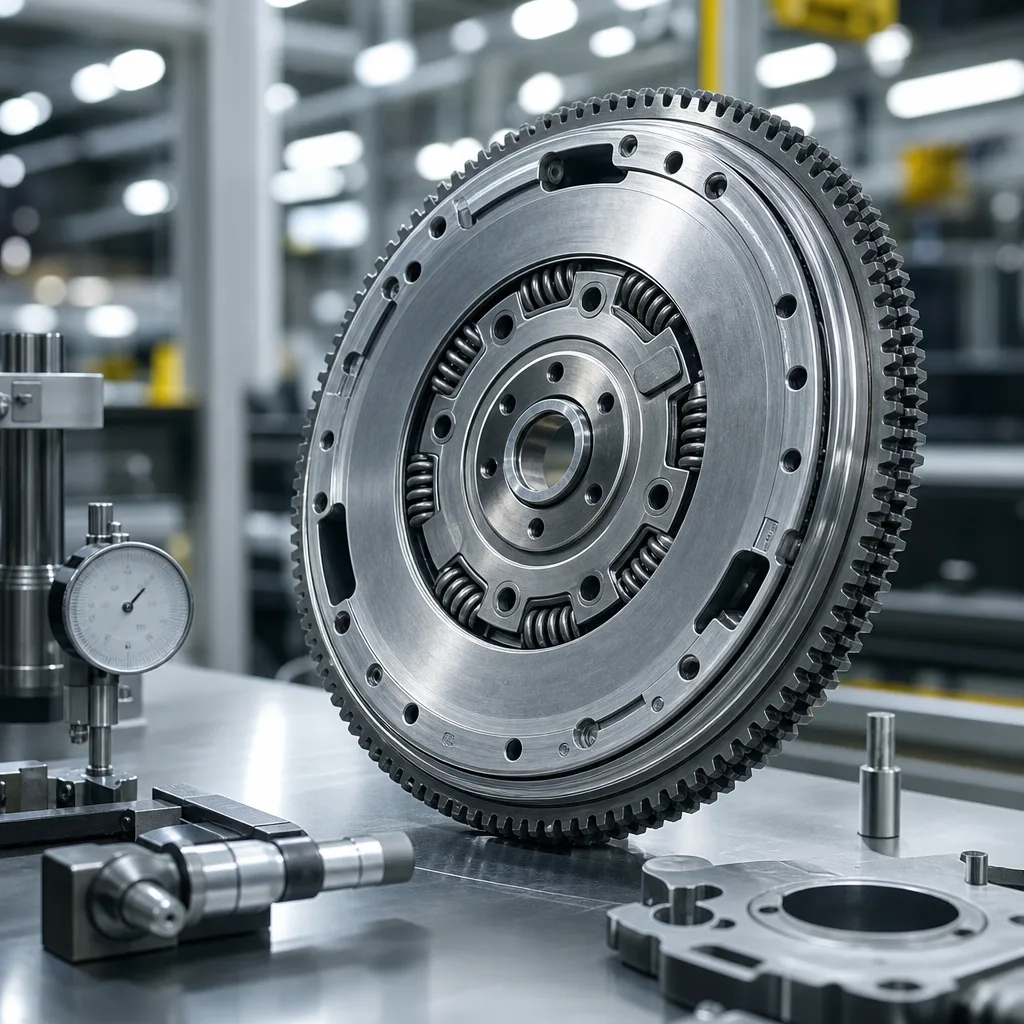
A dual mass flywheel is not just a machined steel disc. It is an energy-damping assembly that must manage torsional fluctuation under idle, tip-in, and gear change events. For Infiniti applications, the main failure drivers are heat load, spring fatigue, grease breakdown, and excessive angular free play.
Typical manufacturing and inspection controls
Control item
What to specify
Why it matters
Material grade
OE-matched cast iron or alloy steel, by application
Strength, machinability, thermal stability
Dynamic balancing
100% balance check on rotating assembly
Reduces vibration and clutch chatter
Angular free play
Defined by application drawing
Ensures damping function remains within target
Concentricity
Measured on critical datums
Protects starter engagement and clutch alignment
Surface hardness
Controlled by process route
Improves wear resistance at contact faces
Traceability
Batch and date code
Supports warranty and recall containment
</tr></thead><tbody> </tbody></table>Driventus production is controlled under IATF 16949:2016 and ISO 9001:2015. For European customers, compliance documentation may also reference REACH (EC) No 1907/2006 where material declarations are required.
Lead time, MOQ, and supply planning
Supplier selection is often decided by replenishment performance, not by sample quality alone. Buyers should ask for the minimum order quantity, standard lead time, and how the plant handles raw material allocation during peak demand.
A practical RFQ should request:
MOQ by part number and by programme
Sample lead time and mass-production lead time
Packing quantity per carton and pallet configuration
Incoterms supported for export
Documentation package: inspection report, material declaration, packing list, and commercial invoice format
Warranty scope and claim process
For distributors, stable lead time is especially important for high-turning references and regional stock programmes. For OEM and Tier-1 supply, the key requirement is whether the factory can support PPAP-style documentation, controlled changes, and long-term repeatability. If you need application-specific development, custom manufacturing can be used to align the flywheel to a defined drawing or sample.
Validation testing for aftermarket and OE-service supply
Before releasing inventory, validation should confirm both geometry and functional performance. A useful sample plan for this part family normally includes dimensional inspection, balance verification, hardness testing, and thermal cycling review. Where customer demand is high, buyers may also request endurance evidence for repeated start-stop duty.
Common validation checks
1. Dimensional inspection against the agreed drawing or OE cross-reference data 2. Runout and concentricity measurement at critical faces 3. Balance confirmation on the complete assembly 4. Angular movement and damping check within the approved window 5. Visual inspection for cracks, casting defects, and machining burrs 6. Packaging drop and corrosion protection review for export lanes
For specific market programmes, published test methods such as SAE J2527 may be referenced where relevant to durability or environmental exposure, while vehicle-level calibration requirements should be confirmed by the buyer. Driventus does not claim manufacturer endorsement or vehicle approval; it supplies independently manufactured aftermarket components only.
Why buyers audit the factory, not just the sample
A sample can be correct even when the plant is not ready for scale. Procurement teams should assess the factory’s process control, inspection records, and corrective action discipline. That is where a quality system review becomes more useful than a one-off visual inspection.
What an audit should confirm:
Incoming material inspection and supplier qualification
Process flow for casting, machining, assembly, and balancing
Measurement equipment calibration status
Non-conformance segregation and rework control
Traceability from batch to finished carton
Change-control approval before tooling or process updates
If your business model depends on catalogue breadth, you may also want a supplier that can support adjacent engine and powertrain parts through a single sourcing channel. Review our catalog and, where relevant, engine components to consolidate procurement and reduce vendor count.
How Driventus supports Infiniti fitment programmes
Driventus supplies dual mass flywheel programmes for aftermarket distribution, multi-location repair chains, and selected OEM or Tier-1 projects where the buyer provides the technical specification. We work from drawings, samples, or OE cross-reference data, then confirm manufacturability before quotation.
Typical buyer requirements we support:
Private label packaging
Batch traceability and inspection records
Stable MOQ for regional stocking
Export documentation for EU, UK, US, Canada, Australia, and Brazil
Drawing-based revisions for application-specific fitment
Because Infiniti applications can vary by engine, transmission, and market, buyers should confirm the exact reference before order placement. If you are evaluating a dual mass flywheel Infiniti supplier for repeat supply, submit your reference list, annual volumes, and target delivery window. We can then confirm availability, lead time, and testing scope before production starts.
Frequently asked questions
We supply independent aftermarket programmes for Infiniti fitment where the buyer provides the required reference data. We do not claim manufacturer approval or endorsement. Brand names are used for fitment identification only.
Typical documents include commercial invoice, packing list, batch traceability data, and inspection records. For regulated markets, material declarations or compliance statements may be included where applicable.
Yes. We support drawing-based or sample-based development, private label packing, and volume planning under controlled manufacturing. Share your target application and annual demand for a formal quotation.
If you are qualifying a dual mass flywheel supply source, send your reference list, target volume, and required documentation. Request a quote at /contact.html