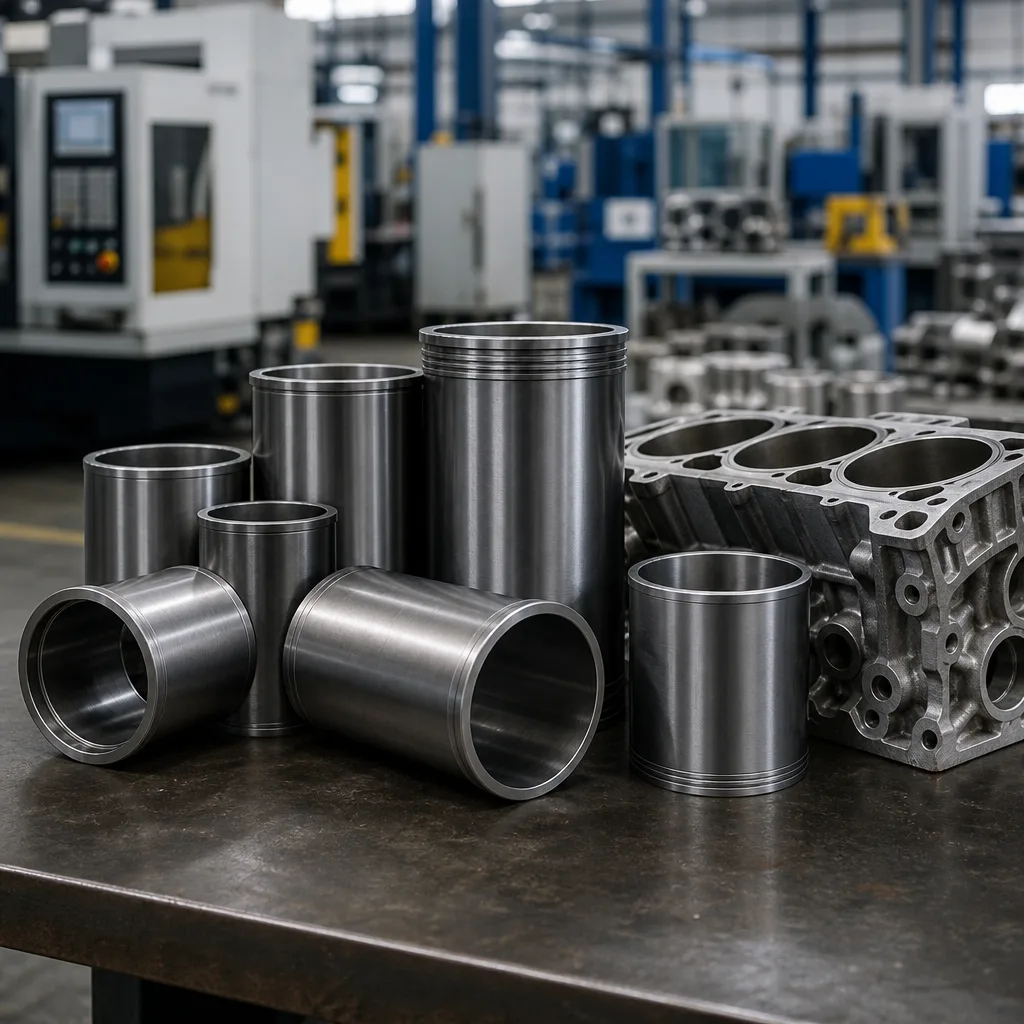
For cylinder sleeve wholesale buyers, a dependable sourcing decision comes down to more than unit price. The sleeve has to match the target engine platform, install correctly in the block, stay dimensionally stable after boring and honing, and arrive with documentation that supports receiving inspection and repeat replenishment. Small differences in wall thickness, bore finish, flange height, or interference fit can lead to difficult installation, coolant leakage, oil consumption, piston-ring wear, localized hot spots, or early engine failure.
The procurement task is therefore twofold: confirm that the product is technically correct, and confirm that the supplier can reproduce the same result across batches. That means reviewing drawings, OE cross-references, material grade, heat treatment or stress-relief requirements where specified, machining tolerances, inspection records, packaging, corrosion protection, and export paperwork before placing a larger purchase order.
Driventus supplies engine and powertrain components for B2B buyers who need controlled manufacturing, export documentation, traceable lots, and parts that can be matched to OE references where required. Driventus is an independent aftermarket manufacturer; brand names are referenced for fitment only. The sections below explain what to verify before placing a cylinder sleeve wholesale order, how sleeve type affects sourcing, and what a qualified factory should provide before shipment.
What wholesale buyers should verify first
For a sleeve programme, the first screen is fitment control. Before comparing prices, confirm the engine family, cylinder count, nominal bore, finished bore, sleeve type, block condition, and whether the part is intended for repair, remanufacture, service replacement, or production supply. A sleeve used for machine-shop repair may need 0.20-0.50 mm of finishing allowance, while a finished service sleeve may be expected to meet final bore and surface-finish requirements at receipt.
If the application uses an OE cross-reference, record it exactly as specified, for example OE 06A107065, and confirm the revision level before ordering. Many sourcing issues start with the assumption that two references are equivalent, even though the flange, height, coolant-side seal, or finish requirement has changed. When possible, provide the drawing, sample, engine code, block casting number, and installation notes together so the supplier can check the full fitment context.
A practical buyer checklist:
Nominal bore, supplied ID, and finished bore tolerance
Outer diameter and required interference or clearance fit
Sleeve height, flange geometry, chamfer, and deck projection
Wall thickness at top, middle, and lower measurement zones
Material grade, hardness range, and microstructure requirement
Machining allowance for boring and honing, where applicable
Surface finish requirements before and after honing
Whether the sleeve is raw-machined, semi-finished, pre-honed, or fully finished
Packaging, corrosion protection, part label, and lot marking
Required documents: inspection report, material certificate, conformity statement, and origin statement
For cylinder sleeve wholesale procurement, the goal is to remove ambiguity before production starts. A quotation that leaves out material, dimensional status, inspection scope, or packing method is difficult to compare against another supplier's offer. Ask each factory to quote against the same technical file and to state any assumptions in writing, including whether tolerances are drawing-defined, ISO general tolerances, or factory internal limits.
If the project needs technical alignment across drawings, samples, and packaging, start with our catalog and then narrow the scope through custom manufacturing.
Dry sleeve and wet sleeve sourcing
Dry and wet sleeves solve different engineering problems, so they should not be treated as interchangeable stock items. Dry sleeves are typically used as a repair or reinforcement element pressed into an existing block. They rely on correct outside diameter, roundness, cylindricity, and interference fit to transfer heat through the block wall. Depending on block material and sleeve diameter, the specified interference is often in the hundredths of a millimetre range and must follow the drawing or engine-rebuilder specification. If the fit is too tight, installation can distort the bore or damage the block. If it is too loose, heat transfer and sleeve stability may be compromised.
Wet sleeves transfer heat directly to coolant, which makes sealing and block-interface control especially important. In addition to bore and wall dimensions, buyers should review flange geometry, O-ring groove width and depth, sealing land finish, coolant-side surface condition, and any pressure-test requirement. A wet sleeve with incorrect flange height or seal geometry can create coolant leakage, cavitation erosion, fretting at the flange, or liner movement under load.
Feature
Dry sleeve
Wet sleeve
Cooling contact
Indirect through the engine block
Direct coolant contact
Installation
Press fit or machined fit into the block
Installed with seal control, flange seating, and coolant-side integrity
Common use
Reconditioning, rebuilds, and block repair
Heavy-duty engines, commercial vehicles, agricultural equipment, and some OE designs
Risk focus
Interference fit, roundness, taper, cylindricity, and heat transfer
Leakage, cavitation, seal integrity, flange height, wall integrity, and liner protrusion
Inspection focus
OD, ID, concentricity, straightness, finish
Flange geometry, O-ring groove, sealing lands, pressure or leak test
</tr></thead><tbody> </tbody></table>For buyers, the key sourcing point is whether the supplier can hold the same geometry across repeated lots. This becomes critical when a distributor is stocking sleeves for multiple engine families or when a remanufacturer needs predictable machining allowance. A low-cost sleeve that varies from batch to batch can create hidden labour cost through sorting, measuring, rework, scrap, delayed engine builds, and customer returns.
If a programme needs a different flange profile, finish requirement, wall thickness, or packing method, put it through custom manufacturing rather than trying to adapt a generic stock item. For broader engine line coverage, see our catalog and engine components.
Materials, tolerances, and finish control
Most cylinder sleeves use cast iron-based material systems because their wear behaviour, machinability, damping, and thermal response are proven in engine rebuild work. Depending on the application, buyers may specify grey cast iron, alloyed cast iron, or a material grade defined by the drawing. Common controls include hardness range, graphite form, pearlitic matrix percentage, carbide control, and absence of harmful porosity or shrinkage. The exact alloy, hardness range, microstructure, and machining allowance should follow the buyer's technical specification rather than a generic catalogue description.
Material control matters because the sleeve must resist wear while staying machinable for final boring and honing where required. Excessive hardness variation can increase tool wear or create inconsistent bore finish. Poor casting control can produce porosity, inclusions, hard spots, or local weak areas that only become visible after machining. For wholesale programmes, these risks should be controlled before shipment through melt control, casting inspection, machining-process control, and final dimensional verification.
The supplier should state the applied tolerance scheme on the inspection report and distinguish clearly between raw casting dimensions, rough-machined dimensions, semi-finished dimensions, and finished dimensions. This distinction is critical. A buyer expecting a ready-to-install sleeve may reject a semi-finished part, while a machine shop expecting honing allowance may not want a fully finished bore. Where GD&T is used, the report should identify the datum structure and the measured characteristics rather than only listing nominal sizes.
Useful controls to request:
OD and ID measurements at multiple clock positions and heights
Roundness, taper, cylindricity, and straightness data where specified
Concentricity or total indicated runout between inner and outer surfaces
Sleeve height, deck height, flange height, or liner protrusion where applicable
Wall thickness checks at defined top, middle, and lower locations
Surface roughness on the finished bore, sealing land, or machining surface
Hardness verification with method and test location when specified
Visual check for porosity, cracks, dents, burrs, corrosion, and sharp edges
Confirmation of chamfer, radius, oil passage, and coolant passage features if present
Surface finish deserves particular attention. The bore finish must support oil retention, piston-ring seating, and stable wear behaviour. Finished cylinder bores are often controlled by Ra, Rz, Rpk, Rk, and Rvk parameters after plateau honing, not by Ra alone. If the sleeve will be honed after installation, confirm the pre-machining allowance and whether the supplied surface is intended only for further machining. If the sleeve is supplied as finished, request the surface requirement used for inspection and the measuring method.
If a supplier cannot explain the difference between raw and finished dimensions, the risk is usually in machining control, not freight. For technical programmes, ask for a drawing review before first production. That reduces the chance of receiving parts that are nominally correct but not installable in the target block.
Quality system and inspection evidence
Wholesale buyers should treat quality evidence as part of the commercial offer. A supplier that sells sleeves without traceability or measurement records increases receiving risk for distributors, importers, remanufacturers, and repair-chain warehouses. At minimum, ask for first article or sample approval, in-process inspection data, and final inspection records tied to the batch being shipped.
A strong quality package should show what was checked, how it was checked, which standard or drawing requirement was used, which gauge or test method was applied, and which batch the result belongs to. Generic statements such as "quality approved" are not enough for cylinder sleeve wholesale supply because the most important risks are dimensional and application-specific. Buyers should request actual readings for critical characteristics, not only pass/fail marks.
Driventus documents production through a controlled quality system and can support export-oriented buyers with lot identification, inspection records, and packaging control. For larger programmes, ask whether the supplier can support incoming audit questions on process flow, control plan, gauge calibration, nonconformance handling, inspection frequency, containment action, and corrective-action response.
The best sign of maturity is consistency in documentation. If the paperwork changes from batch to batch, the process is probably not stable enough for planned replenishment. For audited programmes, request:
Material certificate tied to heat, melt, or batch reference
Dimensional report with actual readings for agreed critical dimensions
First article inspection or sample approval record before mass shipment
In-process inspection plan for casting, rough machining, finishing, and final cleaning
Gauge list and calibration status for micrometers, bore gauges, height gauges, and roughness testers
Final visual inspection standard for burrs, cracks, dents, porosity, and corrosion
Packaging specification and corrosion-protection method
Lot label format and carton/pallet identification method
Corrective-action response time for claims or repeated defects
This is especially important for importers supplying multiple warehouses, where a single mismatch can affect several downstream orders at once. Clear lot traceability allows the buyer to isolate affected stock, investigate root cause, and avoid unnecessary recall of unaffected batches.
MOQ, lead time, and export supply terms
For cylinder sleeve wholesale orders, commercial terms matter because the part is usually bought as part of a recurring service line, not a one-off repair. Ask for MOQ by part number, not a generic factory minimum. A serious supplier should also state sample lead time, pilot-run timing, mass-production lead time, packing configuration, and whether the quoted price assumes standard stock, semi-finished inventory, or made-to-order production.
MOQ can vary by sleeve size, material, tooling requirement, casting pattern, machining workload, and inspection scope. A common sleeve with existing tooling may support a lower order quantity, while a special flange, uncommon bore, revised wall thickness, or dedicated packaging may require a larger run. If you are consolidating several engine parts into one shipment, ask whether mixed-SKU cartons or mixed-SKU pallets are available and how each item will be labelled for warehouse receiving.
Typical questions for procurement:
What is the MOQ by part number and by production batch?
Can the supplier support mixed-SKU cartons for distributor replenishment?
Is there stable monthly capacity, or only spot production?
What are the sample, pilot-run, and mass-production lead times?
Are private-label cartons, barcode labels, and pallet marks available?
Can the factory hold finished-goods stock for repeat call-offs?
What corrosion protection is used for sea freight and long storage?
What is the procedure for dimensional change control?
How are engineering revisions communicated before production?
For buyers in the EU, UK, US, Canada, Australia, and Brazil, export readiness matters as much as unit cost. Customs delays often come from incomplete paperwork rather than product defects. Ask for commercial invoice details, packing list format, HS code alignment, carton count, gross and net weights, pallet dimensions, country-of-origin statement, and any preferential-origin documentation before confirming release.
Packaging should be discussed early. Cylinder sleeves are heavy precision parts, and impact damage, corrosion, or mixed labels can create avoidable receiving problems. For export, confirm whether each sleeve is individually wrapped, oiled or VCI-protected, separated inside the carton with dividers or foam, and packed on a pallet suitable for forklift handling. If the parts will move through several warehouses, barcode and lot labels should remain readable after transport and humidity exposure.
If you need a quotation with part matching, drawing review, or a custom pack spec, use request a quote.
How Driventus supports wholesale buyers
Driventus is set up for B2B sourcing, not retail drop shipping. That matters because wholesale buyers need repeatable dimensions, stable packaging, clear documentation, and a supplier that can respond to audit questions without delay. The factory supports engine and powertrain parts for aftermarket distributors, OEM and Tier-1 supply chains, remanufacturers, and multi-location repair networks.
For cylinder sleeve wholesale programmes, Driventus can help buyers move from a part reference or drawing to a controlled sourcing plan. This may include fitment review, technical comparison against a supplied sample, confirmation of critical dimensions, machining allowance review, packaging planning, and export documentation. The objective is to reduce uncertainty before production and make repeat orders easier to manage.
What buyers typically use us for:
Engine component replenishment across multiple part numbers
Drawing-based customization for non-standard sleeve geometry
OE reference matching for fitment identification without brand claims
Dry sleeve and wet sleeve sourcing support by application
Semi-finished or finished sleeve supply depending on the machining route
Export packing, lot labelling, and batch traceability
Sample review before larger purchase orders
Replacement programmes for distributors and repair networks
If your programme needs dimensional adaptation, revised wall thickness, a different flange profile, a specific bore finish, or private-label export packaging, custom manufacturing is the correct route. If you are building a broader sourcing list, start with our catalog and then narrow to the sleeve family that matches your engine platform.
Driventus is an independent aftermarket manufacturer; brand names are referenced for fitment only.
Frequently asked questions
Send the engine family, sleeve type, dimensions, drawing if available, target quantity, and any OE cross-reference. Include nominal bore, OD, sleeve height, flange details, finish status, and required machining allowance. If you need custom packing, surface finish, material, or inspection requirements, include those at the start.
Yes. Wholesale programmes should request lot marking, material traceability, and an inspection record tied to the shipment. That reduces receiving risk, supports claims handling, and helps isolate stock if a batch review is needed.
Yes. Packaging can be adjusted for distributor cartons, barcode labels, corrosion protection, and pallet configuration, subject to the agreed specification and order volume.
If you are comparing suppliers for an upcoming sleeve programme, send the drawing, target quantity, and part reference so we can review fitment, QA requirements, packaging, and commercial terms. Start here: [request a quote](/contact.html).