cylinder sleeve · 2026-06-07

Cylinder Sleeve Volvo Wholesale: Sourcing Guide for Buyers

Buying cylinder sleeve Volvo wholesale is a technical sourcing decision, not a simple commodity purchase. The lowest unit price can become expensive if bore dimensions, flange geometry, material quality, or packaging standards are inconsistent. For Volvo engine applications, buyers should confirm the sleeve specification against bore diameter, wall thickness, flange seat, interference fit, surface finish, and the intended installation process before comparing quotations.

Driventus is an independent aftermarket manufacturer; Volvo and other brand names are referenced only to identify fitment. Our work is focused on repeatable production for distributors, wholesalers, OEM and Tier-1 supply chains, and multi-location repair networks. That requires controlled metallurgy, traceable batches, documented inspection, and export-ready packaging.

If your team is qualifying a replacement programme, begin with the application list, drawings, physical samples where available, and an agreed testing plan. The goal is straightforward: reduce mismatch risk, protect rebuild labour, and keep stock usable across the markets and engine variants you serve.

What buyers should verify before placing a wholesale order

For a cylinder sleeve Volvo wholesale programme, fitment is the first filter. Price should only be compared after the buyer has confirmed the engine family, cylinder bore, sleeve design, and whether the application uses a dry sleeve, wet sleeve, or parent-bore repair sleeve. If the cross-reference is incomplete or the engine code has multiple variants, request drawings and complete sample validation before committing to volume.

Key checks for procurement teams:

  • Bore diameter, outer diameter, and overall length
  • Flange height, flange width, and seat geometry
  • Wall thickness and coolant-side profile where applicable
  • Interference fit range and recommended installation method
  • Material grade, hardness, and post-machining stability
  • Surface finish on combustion, seating, and coolant interfaces
  • Packaging standard for export, warehouse handling, and branch distribution

For distributors, the practical question is whether the part can be stocked across multiple branches without sortation errors or excessive returns. For workshops and rebuilders, the question is whether the sleeve installs consistently without rework, distortion, or sealing problems. Those two goals should be written into the supplier specification from the start.

A useful approval process also includes confirming how each part number will be labelled, how mixed pallets will be separated, and how nonconforming dimensions will be reported. These details look administrative, but they directly affect stock accuracy and field reliability when orders scale beyond the first shipment.

Technical specification and fitment controls

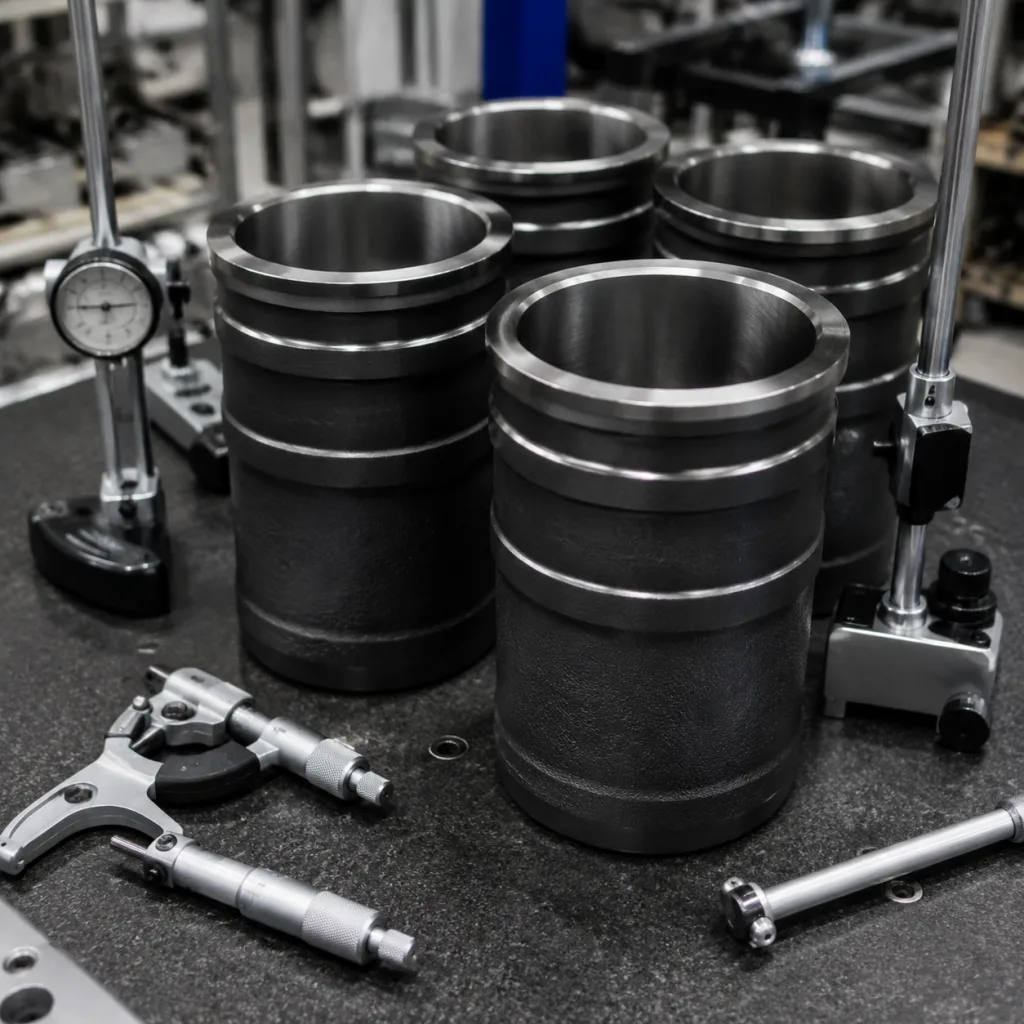
Volvo engine sleeves used in wholesale supply chains typically require stable machining tolerances and a defined inspection plan. Exact values depend on the engine code, sleeve type, and repair standard, but a qualified supplier should be able to document nominal dimensions, tolerance bands, measuring equipment, inspection frequency, and acceptance rules.

</tr></thead><tbody> </tbody></table>If you are comparing several suppliers, ask each one to quote against the same drawing revision and measurement method. A tolerance stated without gauge type, sample size, inspection stage, and acceptance rule is difficult to enforce. It can also create disputes if the factory, importer, and workshop use different measuring practices.

For catalogue browsing, see our catalog and the engine component range at [/products/engine-components.html]. For final approval, however, catalogue references should be supported by drawings, samples, and an agreed inspection checklist.

Manufacturing controls that reduce risk in rebuild supply

Wholesale buyers should look for a process built around repeatability, not just production output. Cylinder sleeves must remain dimensionally stable through material preparation, machining, finishing, inspection, corrosion protection, and packing. A strong unit price is of limited value if the first shipment passes but repeat orders drift outside the approved range.

At Driventus, production is aligned with quality system requirements under IATF 16949:2016 and ISO 9001:2015, with batch traceability and documented inspection records. Depending on the product specification, controls may include verified material sourcing, controlled machining steps, in-process dimensional checks, final inspection, and packaging review before export.

Inspection and compliance points commonly requested by buyers include:

  • Incoming material verification
  • Dimensional checks at rough machining and finish machining stages
  • Hardness and surface-finish confirmation where specified
  • Batch traceability through machining, inspection, and packing
  • Corrosion protection for sea freight and warehouse storage
  • Packaging validation for cartons, pallets, and mixed shipments
  • Export documentation for customs clearance and customer receiving checks

Relevant regulatory and testing references may include REACH (EC) No 1907/2006 for substance compliance. Customer-specific durability, corrosion, or environmental exposure methods, including SAE J2527 where requested, can be discussed as part of the approval plan. If your programme needs a non-standard sleeve geometry, custom manufacturing is the correct route for drawing review, tooling assessment, sample production, and approval.

The lower the variation at source, the less rework is absorbed downstream. For rebuild networks, that means fewer installation delays. For distributors, it means fewer technical claims and more predictable replenishment.

Wholesale terms that matter to distributors and repair networks

Price only becomes meaningful after lead time, MOQ, quality requirements, and service level are defined. In wholesale supply, a low unit price can still create a higher landed cost if the supplier cannot maintain packing consistency, provide stable repeat orders, or support documentation for incoming inspection.

Typical commercial points to confirm:

  • MOQ by part number and by mixed order
  • Standard lead time for first orders and repeat-order lead time
  • Carton quantity, inner protection, and pallet configuration
  • Label format for warehouse scanning and customer relabelling
  • Reserved stock policy for recurring programmes
  • Forecast window and adjustment rules
  • Incoterms, export documentation, and consolidation options
  • Claim handling for dimensional nonconformance or transit damage

For regional wholesalers, the best result is often a two-tier stocking model: one fast-moving inventory set for common applications and one replenishment set for slower lines. This reduces obsolescence while keeping service levels stable for workshops. It also helps purchasing teams avoid tying too much cash to low-rotation engine variants.

If your team is consolidating suppliers, ask for a single export pack standard across the range so inbound handling remains consistent from port to branch warehouse. Consistent carton sizes, readable labels, batch references, and moisture protection can save time long after the purchase order is placed.

How Driventus supports cylinder sleeve programmes

Driventus supplies engine and powertrain components from Taizhou, Zhejiang, with export experience in more than 60 countries. For cylinder sleeve Volvo wholesale supply, the practical value is in documentation, repeatability, and fitment discipline rather than broad catalogue claims.

We support buyers with:

  • Drawing-based quotation and sample review
  • Application and cross-reference checks for target markets
  • Batch traceability and inspection records
  • Packaging suited to distributor, wholesaler, and workshop channels
  • Support for private label and OEM-style programmes
  • Export coordination for multi-market rollouts
  • Custom manufacturing review when standard items are not suitable

If your team is validating a new source, start with a technical pack: application list, engine family, target annual volume, sample part or drawing, packaging needs, and inspection criteria. That allows the quotation to reflect real production risk instead of a generic catalogue estimate.

For direct enquiries, use request a quote and include the engine family, sleeve type, target market, and any customer-specific inspection requirements. Clear inputs shorten the approval cycle, reduce back-and-forth on fitment, and help both sides define a supply programme that can be repeated consistently.

Frequently asked questions

Yes. We support wholesale programmes for Volvo engine applications with drawing review, batch traceability, inspection records, and export-ready packing. Brand names are referenced for fitment identification only.

Request dimensional drawings, inspection criteria, material specification, batch traceability details, packaging information, and compliance references such as IATF 16949:2016, ISO 9001:2015, and REACH where applicable.

Yes. If a standard catalogue item does not match the target engine code, geometry, or tolerance requirement, we can review drawings and support custom manufacturing for OEM or aftermarket programmes.

If you are sourcing cylinder sleeves for Volvo applications, send the engine code, sleeve type, target volume, and required inspection scope. We will respond with a technical and commercial quotation via /contact.html.

Request a Quote
Control item What to confirm Why it matters
MaterialAlloy cast iron or specified sleeve gradeSupports wear resistance and thermal stability
HardnessMeasured after heat treatment or finishingHelps predict machining behaviour and service life
ConcentricityBore-to-OD alignmentReduces uneven ring wear and sealing issues
RoundnessPost-machining roundness limitPrevents installation mismatch and distortion risk
Surface finishCombustion, seating, and coolant facesAffects sealing, lubrication, and heat transfer
Flange geometryHeight, width, flatness, and seating angleEnsures correct deck position and sealing load
IdentificationPart number, batch, and label formatImproves traceability and warehouse control