Cylinder Liner vs King Alternative: Procurement Comparison
A cylinder liner vs King alternative comparison is usually a procurement and engineering decision, not a simple price check. Buyers need to confirm that a substitute liner matches the approved part in bore diameter, wall thickness, flange geometry, seal-groove design, surface finish, and supplied installation condition, while also suiting the engine's wet or dry liner architecture. If the part is meant to replace an existing build, the real question is not whether it looks interchangeable in a catalog. It is whether it holds the same dimensional envelope, metallurgical condition, and sealing behavior under operating temperature, cylinder-head clamp load, coolant exposure, and ring contact. Driventus is an independent aftermarket manufacturer; brand names are referenced for fitment only. For buyers in the EU, UK, US, Canada, Australia, and Brazil, the practical purchasing standard is to require traceable inspection data, controlled cross-reference management, and documentation aligned with IATF 16949:2016, ISO 9001:2015, and REACH (EC) No 1907/2006 before any release to stock or production.
What the comparison really means
In practice, a cylinder liner vs King alternative review is not a comparison between two random metal sleeves. It is a comparison between two supply routes for the same engine family. One route follows an approved drawing, revision, and installation method. The other claims to be a substitute that will perform the same job. Procurement should treat those as different risk profiles until dimensional and material equivalence are proven.
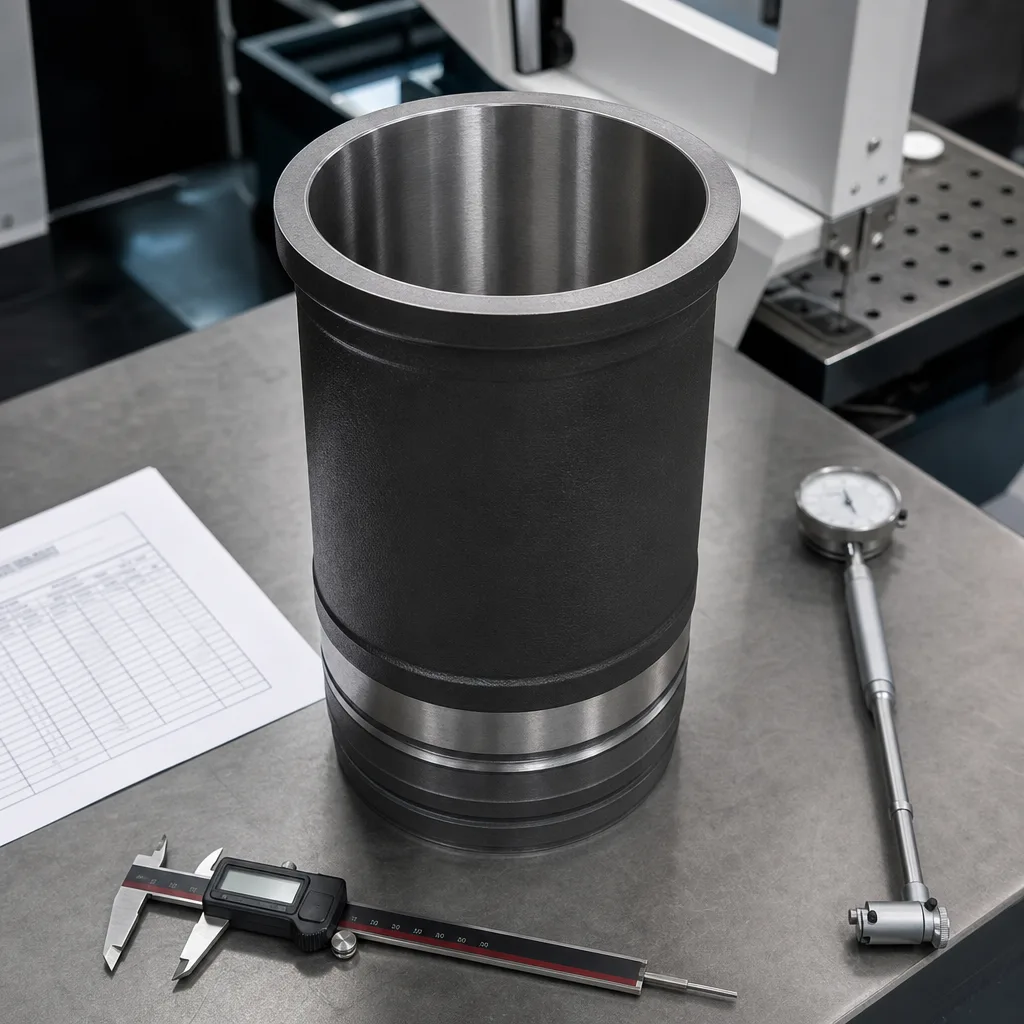
Start by classifying the liner correctly. Wet liners run in direct contact with coolant on the outer wall and depend heavily on lower seal-ring grooves, counterbore condition, flange support, and protrusion above the block deck. Dry liners depend more on outside-diameter interference, bore finish, heat transfer into the parent block, and whether final boring or honing is required after installation. A catalog listing that says "fits engine X" is not enough if the approved build expects a different liner type, flange form, outside-diameter fit, or finish condition.
Buyers should also separate standard replacement parts from repair liners and oversize variants. A substitute may match the nominal engine code while still differing in wall thickness, inside-diameter machining allowance, outside-diameter repair size, or deck stand-proud requirement. Those differences can move work to the rebuilder or assembly line. That means the real comparison is not unit price against unit price, but approved installation cost against downstream correction cost.
A useful screening logic is simple:
- Same engine application and cross-reference scope
- Same drawing revision or a validated interchange revision
- Same wet or dry liner architecture
- Same outside-diameter fit class and supplied installation condition
- Same sealing, protrusion, and post-install machining expectations
- Same packaging, labeling, and lot traceability rules for the destination market
If any of those items are unclear, the part is not yet a true substitute. It is only a candidate that still needs technical approval.
Material and process control
Material and process control usually decide whether an alternative liner lasts beyond initial fitment. A liner can look acceptable on arrival and still fail in service if the chemistry, microstructure, hardness profile, or residual stress condition does not match the application. For many engines, the approved material route is as important as the dimensions because ring wear, oil retention, thermal stability, cavitation resistance, and crack resistance are all shaped by how the liner is made.
Procurement should ask for more than a generic material name. A useful supplier file identifies the alloy family, casting route, heat treatment state, hardness test method, finish condition, and lot traceability. Common liner materials include pearlitic gray cast iron, alloyed gray iron, and ductile iron for selected heavy-duty applications, but the accepted grade must follow the drawing or agreed control specification. If the supplier cannot state whether the part is centrifugally cast, sand cast, or machined from tube stock, the buyer cannot properly assess porosity risk, wall-density consistency, or expected wear behavior. Centrifugal casting is often preferred for cylinder liners because it can provide a denser bore-facing structure and more consistent wall properties, but the approved route must still match the engine program and drawing requirements.
The microstructure behind the hardness number matters as well. Two liners may show similar bulk hardness and still behave differently because of graphite distribution, pearlite percentage, carbide content, chill depth, phosphide network, or local variation through the wall. That is why high-control buyers ask for heat number traceability, chemical composition evidence, hardness by lot, and microstructure records when the application is warranty-sensitive or production-controlled. Where the drawing defines hardness, it should also define the scale and location, such as HBW on the running surface or flange zone, rather than a single unsupported range.
Coatings and preservation claims deserve the same discipline. If a supplier states that the liner has anti-corrosion protection, phosphate treatment, rust preventive oil, VCI packaging, or another storage coating, ask for the exact process, shelf-life expectation, and test method used to support the claim. For export programs or humid storage environments, it is reasonable to request neutral salt-spray or storage validation data, packaging compatibility, and confirmation that the protective layer does not interfere with O-ring installation, seal compression, or bore cleaning.
From a systems standpoint, the supplier's manufacturing controls matter because liners are sensitive to lot variation. Driventus aligns its production system with IATF 16949:2016 and ISO 9001:2015, while material declarations should support REACH (EC) No 1907/2006 where required by the destination market. For procurement teams, the key point is straightforward: do not accept "equivalent material" as a complete answer unless the supplier can show how that equivalence was defined, measured, and released by lot.
Fit, dimensions, and installation checks
Dimensional equivalence is where many alternatives fail, especially when the catalog description focuses only on nominal bore diameter. A liner has to fit the block, support the ring pack, manage heat, and maintain sealing under real clamp load. A few hundredths of a millimetre in the wrong place can change interference, protrusion, gasket loading, coolant sealing, or the amount of finish machining required.
For that reason, buyers should verify the complete dimensional envelope, not just one headline dimension. A serious inspection plan usually covers:
- Inside diameter in the supplied condition, including whether the bore is finished, semi-finished, or supplied with stock allowance for final honing
- Outside diameter at multiple heights, including ovality and taper, because interference fit is created by the actual profile rather than a single average number
- Overall length, flange thickness, flange outside diameter, register diameters, and counterbore interface geometry
- Wall thickness and concentricity between ID and OD, which influence heat transfer and bore stability in service
- Seal-groove width, depth, position, and edge radii for wet-liner designs
- Liner protrusion or stand-proud above the block deck where the engine specification requires it, often controlled in hundredths of a millimetre by engine family
- Chamfers, lead-ins, and edge condition at the top and bottom of the liner to prevent seal damage during installation and ring damage during assembly
- Bore roundness, cylindricity, surface roughness, and honing pattern in the final running surface
Installation condition must be checked just as carefully as raw dimensions. Some dry liners are intended to be pressed in and then bored or honed to final size in the block. Some wet liners are supplied ready to install and must hold protrusion and bore finish without additional machining. If procurement buys the wrong condition, the part may still be technically usable, but only after extra shop work that erases the price advantage.
Ask for evidence that matches the way the part will be used. A first-article inspection report, ballooned drawing, and measurement records from appropriate equipment such as bore gauges, air gauges, surface roughness testers, profile gauges, or CMMs are far more useful than a basic certificate of analysis. For production engines or warranty-sensitive rebuild programs, it is also sensible to request a sample installation check so that protrusion, seal fit, press load where applicable, and post-fit bore condition are verified before volume release.
Side-by-side sourcing table
Comparison table
| Item | OE-matched liner | King alternative / substitute source | Procurement note |
|---|---|---|---|
| Application scope | Controlled to a specific engine code, drawing, and revision | May be listed by broad interchange or catalog cross-reference | Confirm the exact engine family, displacement, variant, and revision status |
| Geometry | Critical dimensions controlled to the approved drawing | Nominal match can hide deltas in flange form, seal grooves, chamfers, or wall thickness | Request CMM, gauge, or first-article evidence against critical-to-function dimensions |
| Liner type | Wet or dry architecture clearly defined | Catalog language may not fully describe installation condition | Verify whether the liner is wet, dry, repair, oversize, finished, or semi-finished |
| Material and microstructure | Chemistry, casting route, hardness state, and microstructure are specified | Material may be described as equivalent without full process detail | Ask for heat number traceability, chemistry, hardness data, and process route |
| Bore finish | Honed surface and final finish requirement documented | Bore may need re-honing or final machining after install | Confirm roughness, plateau-hone or cross-hatch requirement, stock allowance, and final machining responsibility |
| Sealing interface | Counterbore, flange, and O-ring groove geometry are controlled | Small groove or chamfer differences can affect seal compression | Check groove width, depth, edge radius, and approved seal material compatibility |
| Corrosion protection | Storage coating and packaging are usually defined | Protection level may depend on supplier standard packaging | Check preservative method, VCI use, shelf-life, and export packaging suitability |
| Validation | Often backed by approved drawing history or application validation | Frequently supported only by supplier dimensional inspection | Ask what testing, field history, or installation validation supports the interchange |
| Traceability | Lot control is normally structured around the approved part | Traceability depth varies widely by supplier | Define required lot, heat, label, and document retention rules before order placement |
| Commercial profile | Lower engineering uncertainty, often higher purchase price | Lower quoted price, but qualification and correction costs can rise | Compare total landed cost, not list price alone |