Cylinder Liner Volvo Supplier: Sourcing Guide for Buyers
Buyers searching for a cylinder liner Volvo supplier need more than a price list. They need confidence that each liner matches the intended engine family, holds bore geometry under load, seals correctly at the deck or flange, and arrives with documentation that supports internal quality review. In practice, that means controlled metallurgy, repeatable machining, verified honing, corrosion protection, and export packaging that protects the parts through sea freight, warehousing, and regional distribution.
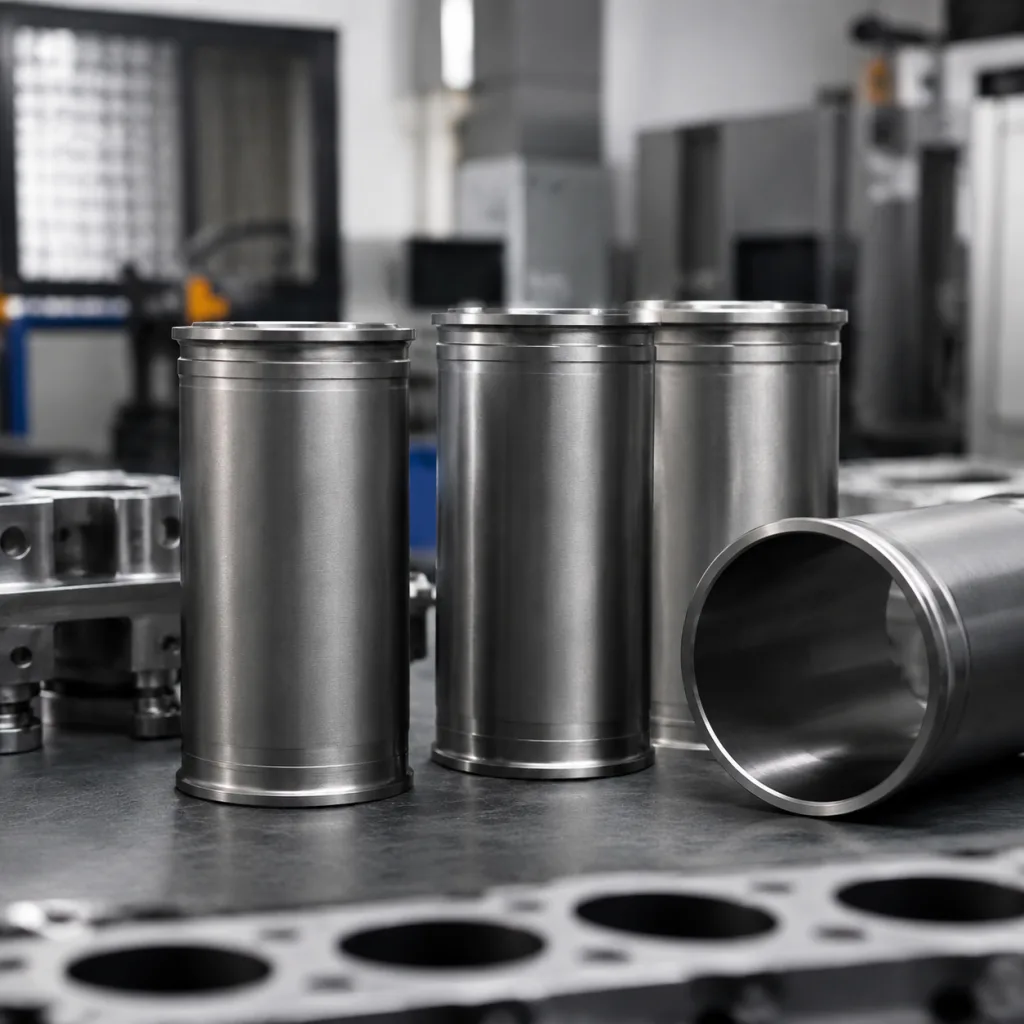
Driventus manufactures engine and powertrain components in Taizhou, Zhejiang, and serves aftermarket distributors, OEM and Tier-1 channels, repair networks, and industrial buyers in more than 60 countries. Our scope includes wet and dry liners for diesel and gasoline applications, supplied with dimensional checks, traceability records, and packaging suitable for international transport. We support sourcing teams that need sample matching, drawing review, OE cross-reference confirmation, private-label packing, and repeat-order planning.
Driventus is an independent aftermarket manufacturer; brand names are referenced for fitment only. This guide explains what procurement teams should verify before placing a purchase order, including technical data, standards alignment, quality controls, lead-time planning, documentation, and the questions that reduce mismatch risk when sourcing replacement parts or building a long-term supplier list.
What procurement teams should verify first
For Volvo engine programmes, fitment comes before price. Cylinder liners are tightly controlled machined parts, and even a small error in bore diameter, flange height, outside diameter, wall thickness, or liner length can lead to poor heat transfer, sealing loss, coolant leakage, piston scuffing, excessive oil consumption, or early failure after installation. Before comparing quotations, buyers should make sure every supplier is working from the same technical definition.
A reliable RFQ should identify the engine family, application, liner type, and critical dimensions. Wet liners need special attention to sealing grooves, flange geometry, coolant-side corrosion protection, and O-ring compatibility. Dry liners call for tight control of press-fit dimensions, wall thickness, and finished bore condition after installation. For either type, procurement should confirm whether the requested part is supplied semi-finished, fully finished, or intended for final machining by the customer.
Key data to request from any cylinder liner Volvo supplier:
Engine family and application coverage
Wet or dry liner type
Nominal bore diameter and tolerance
Outside diameter, flange OD, and flange thickness
Overall length, flange height, and deck protrusion requirement
Wall thickness and any sealing-groove dimensions
Material grade and heat-treatment route
Bore finish, honing pattern, and roughness range
Hardness range and microstructure control method
Coating, oiling, or corrosion-protection method
Packaging method for cartons, pallets, and export handling
Inspection records, lot traceability, and document retention period
For cross-reference work, use OE data only for fitment validation. A request may reference an OE 06A107065-style pattern when the internal catalogue uses generic numbering, but the supplier should still confirm dimensions against a measured sample, drawing, or approved specification. Cross-reference tables help speed up quotation, but they should not replace engineering confirmation.
If your buying process includes vendor onboarding, ask for PPAP-style documentation even when full automotive approval is not required. A dimensional report, material certificate, control plan, packing specification, and sample approval record make it easier to compare factories on the same technical basis. They also give your incoming inspection team a clear baseline before the first shipment arrives.
Why material and process control matter
Cylinder liners operate under repeated thermal cycling, pressure loading, lubricant exposure, and piston-ring contact. The liner must resist wear while maintaining roundness, taper, and surface integrity across a wide operating range. Material and process control determine whether the part stays stable after machining, installation, and real engine service.
Driventus manufactures liners using controlled iron-based metallurgy selected for wear resistance, machinability, and thermal stability. For buyers, the important issue is not only the nominal material grade, but how consistently the supplier controls casting, heat treatment, machining, honing, cleaning, and preservation. A liner can look correct visually and still fail if the microstructure, hardness, or bore finish is outside the required range.
For procurement, the relevant questions are:
1. Is the liner centrifugally cast, cast in sand, or machined from tube stock? 2. What material grade, alloying elements, and hardness range are controlled? 3. Is heat treatment performed before final machining and honing? 4. Is the bore honed after heat treatment, not before? 5. Are roundness, taper, flange flatness, and surface roughness recorded by batch? 6. Are hardness and microstructure checked on each batch or according to a defined sampling plan? 7. Is the coating, oiling, or anti-corrosion layer compatible with the expected storage and shipping time? 8. How are nonconforming liners segregated, reviewed, and prevented from re-entering finished stock?
Published standards are useful as a reference point for supplier qualification. Many buyers align internal requirements with IATF 16949:2016 and ISO 9001:2015 for process control, while export compliance may require REACH (EC) No 1907/2006 review for restricted substances. For testing and durability comparisons, buyers may also ask suppliers to reference SAE J2527 where applicable to surface durability protocols, although this is not a liner-specific approval standard.
A qualified supplier should be able to explain how each process step affects roundness, taper, hardness, flange seating, and bore surface integrity. For example, poor casting control can create inconsistent hardness; weak machining control can create taper or ovality; and improper honing can prevent oil retention or accelerate ring wear. If the technical explanation is vague, the commercial quote is incomplete.
Comparison table: supplier capability versus buying risk
Choosing a cylinder liner supplier is not just a purchasing decision; it affects warranty exposure, warehouse claims, installer confidence, and the workload of the receiving inspection team. The table below shows how supplier capability changes practical buying risk.
Procurement item
Low-control supplier
Qualified cylinder liner supplier
Dimensional evidence
Basic visual check only
Full gauge report with critical dimensions
Material traceability
Batch number only
Heat/lot traceability to raw material record
Bore geometry
Not measured consistently
Roundness, taper, and bore size controlled
Surface quality
Not stated
Bore finish, honing pattern, and roughness recorded
Hardness control
Informal spot check
Defined hardness range and batch verification
Packaging
Generic carton
Rust prevention, separators, export-grade packing
Audit support
Limited documents
Factory audit files and QA procedures
Change control
Informal
Written notice for tooling, material, or process changes
Lead-time reliability
Variable
Forecast-based production planning
Claim handling
Case-by-case negotiation
Traceable review with corrective-action process
</tr></thead><tbody> </tbody></table>This is the practical difference between buying a part and building a supply base. If your sourcing team handles annual tenders, the qualified-supplier model lowers incoming inspection cost, reduces installation complaints, and gives your quality team evidence when investigating a field issue. It also makes repeat orders more predictable because the approved specification is tied to controlled production records rather than memory or informal sample matching.
For buyers who need adjacent engine parts in one shipment, review our catalog and the broader engine components range to combine freight, simplify supplier management, and keep related engine hard parts under one quality framework.
MOQ, lead time, and export supply planning
MOQ should be evaluated against annual usage, warehouse rotation, and landed cost, not only the quoted unit price. A lower price on a small trial lot can disappear once air freight, inspection time, import handling, and urgent reordering are added. A larger order can also create problems if demand is uncertain, the shelf life of protective oil is limited, or the packaging format does not fit your distribution network.
Typical procurement questions include:
What is the minimum order quantity per part number, bore size, or engine family?
Can the factory support mixed-line packing by application family?
What is the standard production lead time after drawing, sample, or specification approval?
Are sample runs available before mass production?
Can shipments be consolidated with gaskets, pistons, water pump kits, or other engine components?
Can the supplier support forecast orders, blanket orders, or scheduled releases?
What packing format is used for individual liners, inner cartons, master cartons, and pallets?
Are barcode labels, customer part numbers, and private-label cartons available after approval?
For export buyers, documentation matters as much as production capacity. Commercial invoice details, packing list consistency, HS classification support, carton markings, country-of-origin requirements, fumigation or pallet compliance, and pallet specification should be confirmed before the first shipment. A supplier with stable export experience should also be able to manage barcode labelling, carton count control, photo confirmation before dispatch, and packing records that match the purchase order.
When lead time is sensitive, ask whether raw material and semi-finished blanks are held in stock or sourced to order. That single point often determines whether a programme can recover after a demand spike. Buyers should also ask how the supplier handles capacity during peak seasons, whether tooling is dedicated or shared, and how quickly repeat orders can move once the first article or sample approval is complete.
For regional distributors, the best supply plan often combines a small technical approval order with a forecast for fast-moving references. That allows the buyer to verify fitment, packaging, and documentation before scaling to container or consolidated sea-freight shipments.
Audit-ready quality and custom manufacturing support
A strong supplier should be able to pass a factory audit without preparing special samples for the visit. Procurement teams should look for documented incoming inspection, in-process gauging, final inspection, calibration control, nonconformance handling, and corrective-action records. The goal is to confirm that production quality is built into the normal workflow, not added at the end to satisfy one shipment.
Driventus operates under an established quality system aligned with IATF 16949:2016 and ISO 9001:2015. For customers with special packaging, machining, surface finish, application coverage, or branding requirements, custom manufacturing is available for approved specifications. Custom work may begin from drawings, measured samples, customer specifications, or validated cross-reference data, depending on the programme.
What to verify during supplier evaluation:
CMM or gauge calibration status
Control plan for bore, ovality, taper, flange dimensions, and length
Incoming inspection for castings, blanks, or raw material
In-process inspection frequency during turning, grinding, and honing
Final inspection report format and acceptance criteria
Corrective action process for rejected lots
Traceability format by part number, carton, pallet, lot, and production date
Document retention period for inspection and material records
Sample retention policy and approval-sample labelling
Packaging validation for corrosion protection and export transport
If you are sourcing for a regional distribution network, ask for a written change-control agreement. That helps prevent silent tooling revisions, material substitutions, coating changes, or packaging changes, which are common reasons for field complaints in engine parts. The agreement should define when the supplier must notify the buyer, what evidence is required, and whether re-approval samples are needed before shipment.
Custom manufacturing support is most effective when the buyer supplies complete technical data early. Bore size alone is not enough. The supplier also needs application context, mating parts, required finish level, installation method, annual volume, tolerance priorities, and any market-specific packaging or labelling requirements. Clear input reduces sample cycles and makes quotation more accurate.
How Driventus supports Volvo-line sourcing
Driventus supports Volvo-line sourcing for aftermarket and industrial engine channels with a focus on repeatable dimensions, controlled production, export packaging, and buyer documentation. As a cylinder liner Volvo supplier, we help purchasing teams move from uncertain cross-reference lists to confirmed part data, inspected samples, and repeatable supply programmes.
We support part matching using sample measurement, drawings, or OE cross-reference data provided by the customer. When a buyer submits a part number, engine family, sample, or drawing, our team reviews the technical requirement before quotation so that price, MOQ, lead time, and inspection scope reflect the real application. For repeat orders, we can align production scheduling with forecast demand and agreed packing formats.
Typical support package includes:
Technical confirmation before quotation
Sample, drawing, or cross-reference review
Dimensional inspection for critical features
Batch inspection records and traceability details
Material and hardness information when required
Export carton and pallet planning
Corrosion protection for international transport
Stable repeat order scheduling
Private-label packaging where agreed
Consolidation with related engine component orders when practical
We do not claim vehicle manufacturer approval or endorsement. Driventus is an independent aftermarket manufacturer; brand names are referenced for fitment only. Our role is to manufacture and supply replacement engine components according to confirmed specifications, buyer requirements, and agreed quality documentation.
For sourcing teams that need a single point of contact for multiple engine part families, start with our catalog, review our quality system, and then use request a quote to submit your part numbers, drawings, or samples. The more complete the technical input, the faster we can confirm feasibility, prepare a quotation, and define the right sample or production route.
If your programme includes other engine hard parts, you can also reference the wider engine components portfolio to reduce supplier count, combine shipments, and simplify inbound logistics across related product families.
Frequently asked questions
Send the OE reference if you have it, plus bore size, engine family, drawings, photos, or a physical sample. Include annual volume, target Incoterms, destination market, documentation requirements, and packaging needs so the offer reflects real landed cost.
Yes, if the requirement is technically clear and volume is suitable. Custom manufacturing can cover dimensional changes, surface requirements, finish level, packaging specifications, and marking requirements after drawing or sample review.
Yes. Buyers can request inspection records, traceability details, material or hardness information where applicable, and process documentation. Our quality framework is aligned with IATF 16949:2016 and ISO 9001:2015.
If you need a qualified sourcing partner for liner supply, send your part data, target volume, documentation needs, and delivery terms to /contact.html for a direct quotation.