Connecting Rod for Isuzu MU-X Replacement: OE Fitment
A connecting rod for Isuzu MU-X replacement needs to match far more than the vehicle nameplate. Procurement teams should verify the engine code, model year range, centre-to-centre length, big-end and small-end geometry, rod bolt specification, mass class, and the material and heat-treatment route used in production. When one of those variables is wrong, the result can be bearing distress, piston contact, abnormal vibration, or premature fatigue failure after assembly.
Driventus supplies engine and powertrain components for B2B buyers that need repeatable fitment, lot-level traceability, and documented inspection. Production is managed under IATF 16949:2016 and ISO 9001:2015, with controlled material and process records aligned to export requirements. Driventus is an independent aftermarket manufacturer; brand names are referenced for fitment only. For OE cross-reference sourcing, the safest route is to confirm the engine code, year range, measured dimensions, and any prior rebuild changes before release. This helps reduce installation risk while preserving bearing alignment, piston height, and long-term durability in service.
What a replacement connecting rod must match
For replacement use, the rod has to match the engine's mechanical envelope, not just the badge on the vehicle. For the Isuzu MU-X, buyers should begin with the engine variant, because diesel and emission updates can alter rod geometry, bolt specification, small-end bushing design, or machining details even when the model name remains unchanged.
Before ordering, confirm the following against the original part, service data, or a controlled sample:
- Centre-to-centre length
- Big-end bore diameter after torquing the cap
- Small-end bore diameter and bushing condition
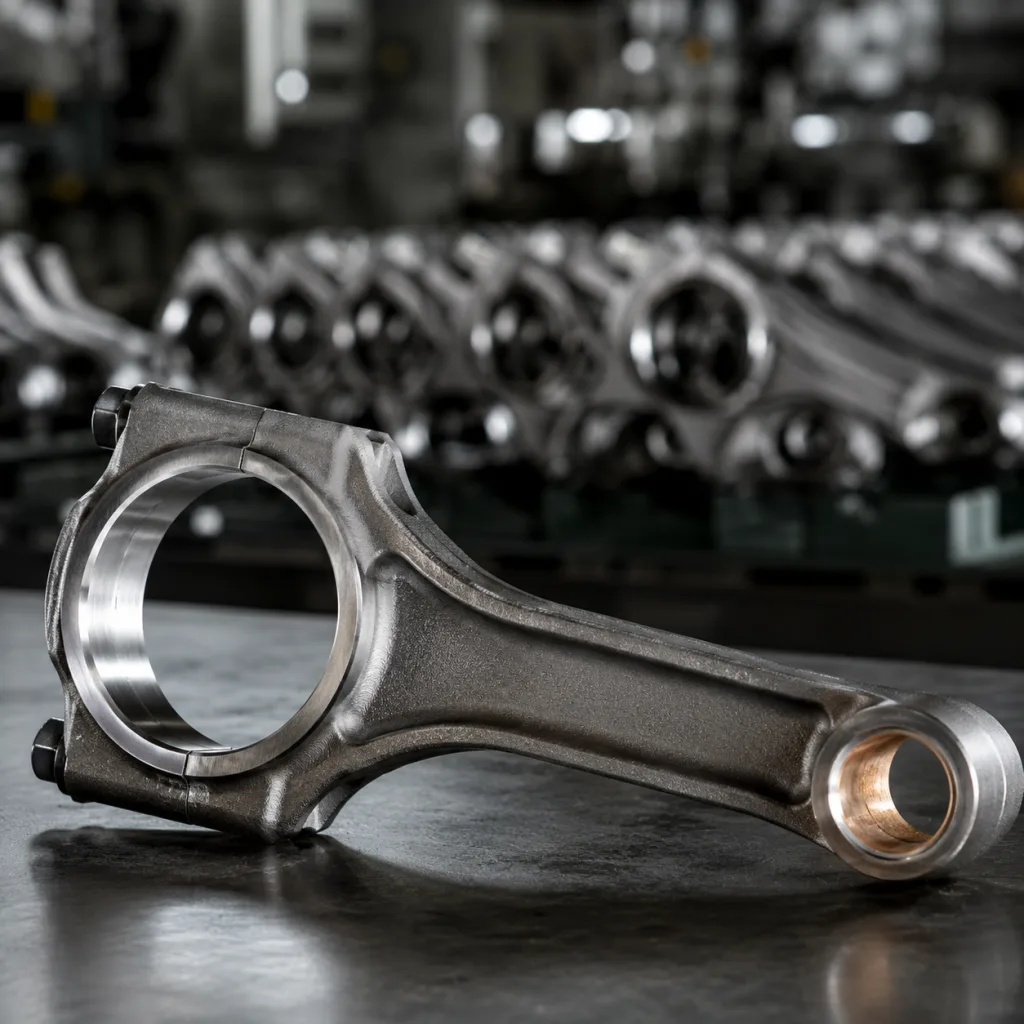
- Beam profile and clearance to the block and crankshaft
- Rod bolt grade, thread form, and tightening method
- Total mass and end-to-end balance within the approved assembly window
- Surface finish, roundness, and parting-line condition at both bearing interfaces
A correct connecting rod for Isuzu MU-X replacement should install without forcing, maintain bearing alignment, and keep piston deck height within the original build window. If you are matching by OE number, use the exact cross-reference from the engine bill of materials, service documentation, or a verified sample. Do not assume all MU-X diesel variants use the same rod design, even when the external model designation looks identical.
For procurement teams supporting multiple branches or markets, it is practical to treat the rod as a controlled dimensional component. The approved reference should include measured values, tolerance limits, mass class, and bolt data, not only a part name. Driventus can support part matching through drawing review, sample comparison, and dimensional confirmation before bulk release.
Technical checkpoints procurement teams should verify
Before approving a supplier sample, ask for measured data, not just a compatibility statement. A visual match is not enough for an engine component that works under repeated tensile and compressive loading at high temperature.
| Checkpoint | What to confirm | Why it matters |
|---|---|---|
| Centre distance | Measured from cap face to small-end centre | Affects piston position and compression height |
| Big-end bore | Nominal size, roundness, and surface finish after cap torque | Controls bearing fit and oil clearance |
| Small-end bore | Bushing ID and press fit | Prevents wrist pin wear and seizure |
| Beam profile | Overall section shape and clearance envelope | Prevents interference with crankshaft and block internals |
| Bolt specification | Material grade, preload method, and reuse policy | Directly affects cap retention under load |
| Weight class | Individual and matched-set mass | Reduces vibration and imbalance |
| Material report | Forging alloy and heat-treatment record | Supports fatigue resistance |
| Straightness/runout | Measured across the sampled lot | Confirms the rod remains aligned under load |