Cylinder Liner Jeep Manufacturer China Sourcing Guide
For importers, distributors and engine component buyers, choosing a cylinder liner Jeep manufacturer China partner is a decision that affects warranty exposure, machining cost, stock availability and customer confidence. Jeep-compatible cylinder liners for engine rebuild programmes must hold bore geometry, flange height, wall thickness, surface finish and material consistency across repeat batches—not simply match a sample once.
Driventus Auto Parts manufactures wet and dry cylinder liners in Taizhou, Zhejiang for B2B aftermarket distributors, wholesalers, OEM/Tier-1 supply projects and repair chain programmes. Production is managed under IATF 16949:2016 and ISO 9001:2015, supported by dimensional inspection, material verification, batch traceability and controlled process records.
Driventus is an independent aftermarket manufacturer; brand names are referenced for fitment identification only. This guide explains what procurement teams should define, verify and audit before approving a Chinese supplier for Jeep-compatible cylinder liner applications.
What Procurement Teams Should Specify
A Jeep-fit cylinder liner sourcing project should begin with a controlled technical file. Samples can be useful, but visual comparison is not enough. Liners that look identical may differ in interference fit, flange seating, wall thickness, bore allowance or inner diameter after honing. Those differences directly affect sealing, heat transfer, oil control and rebuild consistency.
For a clear RFQ, provide the supplier with:
Engine application and displacement family, stated as fitment reference only
Liner type: wet, dry, flanged or non-flanged
Finished or semi-finished bore requirement
Outside diameter, inside diameter, length and flange dimensions
Required machining allowance before final honing
Material grade, hardness range and any microstructure requirement
Surface roughness target after machining or honing
Sealing groove dimensions for wet liners, where applicable
Packing quantity, corrosion protection and labelling requirement
Annual volume, first-order quantity and quarterly forecast
Destination market and required import documentation
When cross-referencing part numbers, use generic OE-style references only where available, such as OE 06A… or OE 11251…, and avoid treating those references as brand approval. A capable Chinese manufacturer should confirm dimensional interchangeability, material specification and validation records instead of relying on catalogue equivalence alone.
Buyers should also clarify whether the liner will be supplied ready for installation, semi-finished for local machining, or supplied with extra allowance for a specific rebuild process. That single point can change the quote, inspection method, lead time and packaging requirement.
Driventus maintains cylinder liner coverage within our catalog, including engine component lines relevant to aftermarket rebuild programmes.
Manufacturing Controls for Jeep-Compatible Liners
Cylinder liner production depends on stable control of casting, heat treatment, rough machining, precision turning, honing, cleaning, preservation and inspection. For Jeep-compatible rebuild demand, repeatability between production batches is often more important than an impressive first-article sample.
Typical control points include:
Control point
Procurement relevance
Typical verification
Material chemistry
Wear resistance and machinability
Spectrometer report per melt batch
Hardness
Bore durability and honing behaviour
Brinell or Rockwell testing by batch
Microstructure
Strength, wear pattern and casting quality
Metallographic review where required
OD and ID dimensions
Press fit, sealing and machining allowance
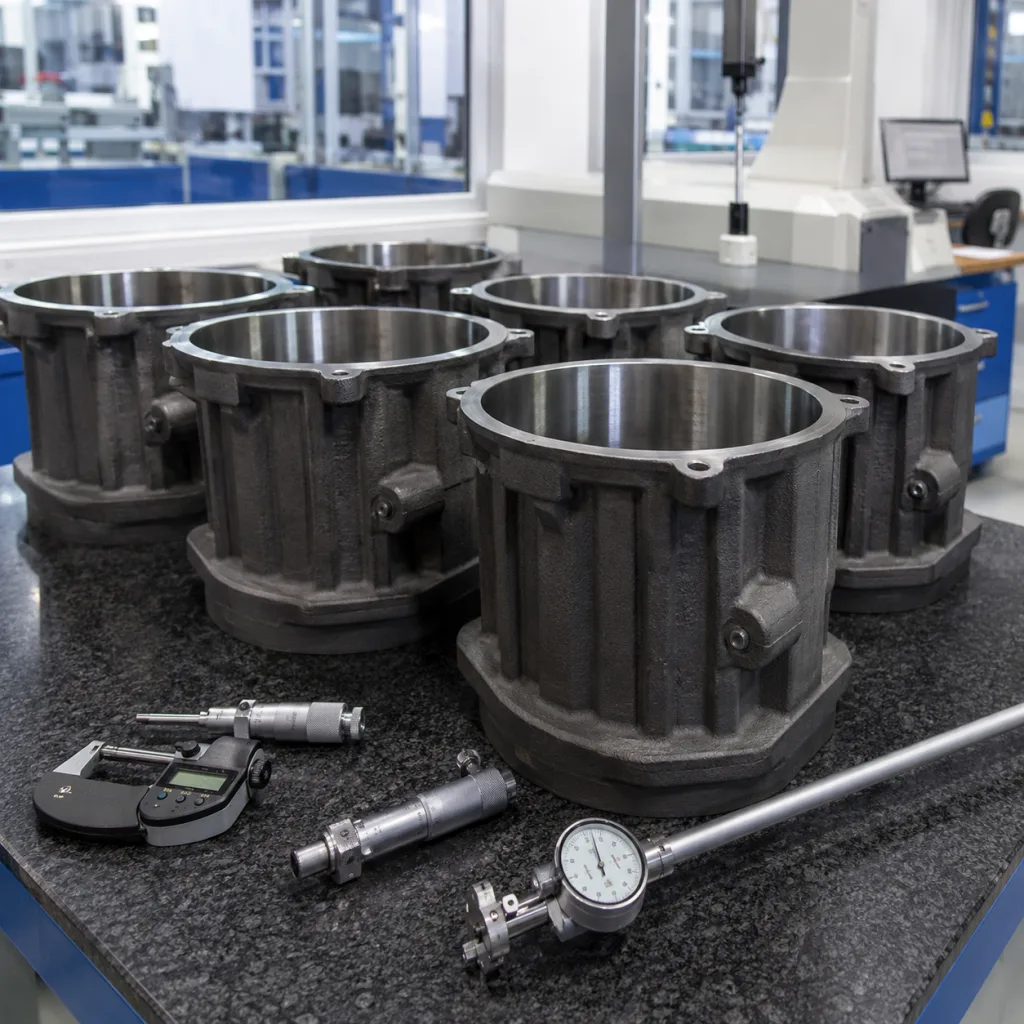
CMM, air gauge or calibrated bore gauge
Roundness and cylindricity
Bore stability after installation
Precision bore measurement and sampling plan
Flange height and parallelism
Head gasket loading and block seating
Height gauge and flatness inspection
Groove geometry
Wet liner sealing reliability
Profile and dimensional inspection
Surface finish
Oil retention and ring bedding
Roughness tester after honing
Visual integrity
Porosity, cracks and handling damage
Visual, magnetic particle or other inspection as applicable
Traceability
Warranty analysis and batch containment
Lot coding and inspection records
</tr></thead><tbody> </tbody></table>For wet liners, buyers should pay close attention to sealing groove geometry, flange seating, external surface condition and corrosion protection. Small defects around seal lands can create leakage risk even when bore dimensions are acceptable. For dry liners, outside diameter control, roundness and wall thickness are central because incorrect interference can distort the bore after installation.
Published management standards such as IATF 16949:2016 and ISO 9001:2015 do not define cylinder liner dimensions. Their value is in requiring disciplined process control, documented nonconformity handling, calibration management, corrective action and traceability. Driventus applies these principles through incoming inspection, in-process checks and final release records described in our quality system.
MOQ, Lead Time and Export Supply Planning
A practical supplier discussion should include commercial terms early, before sample approval consumes engineering time. Cylinder liner demand can be fragmented by engine family, bore size, repair habit and local market preference, so MOQ should be reviewed by part family and production route rather than by a single headline number.
Typical sourcing parameters for cylinder liner programmes include:
Sample order: available for drawing-confirmed or catalogue-confirmed items, subject to tooling and stock status
Trial order: commonly structured by mixed part numbers within one engine component shipment
Production MOQ: influenced by casting requirement, machining setup, finishing process and packaging format
Standard production lead time: often 30-60 days after deposit and specification confirmation
Repeat order lead time: shorter where semi-finished blanks, castings or regular part numbers are stocked
Export packaging: neutral cartons, palletised export cartons or buyer-specified labels
Corrosion protection: oiling, wrapping, VCI material or other agreed method based on shipment route
Documentation: commercial invoice, packing list, certificate of origin where required and inspection records by agreement
For EU and UK importers, material declarations may need to support REACH (EC) No 1907/2006 compliance. For North America, Australia and Brazil, buyers should also align marking, packaging strength, carton labelling and documentation with local customs rules and distributor intake requirements.
Forecast quality has a direct effect on cost and supply reliability. If a buyer can share expected quarterly demand, a manufacturer can plan castings, machining capacity and mixed shipments more accurately. This is especially useful for distributors carrying multiple engine component categories.
Driventus exports to more than 60 countries and can align mixed shipments across pistons, gaskets, water pumps, crankshafts and cylinder liners to improve container utilisation and reduce logistics cost per SKU.
Factory Audit Questions Before Supplier Approval
A remote or on-site audit should test whether the supplier can control repeat production, not only present clean samples. For a cylinder liner Jeep manufacturer China evaluation, buyers should request evidence that connects incoming material, casting control, machining, inspection, packaging and shipment.
Useful audit questions include:
Is production certified to IATF 16949:2016 and ISO 9001:2015, and are certificates current?
Are casting suppliers approved, monitored and periodically reviewed?
How is material chemistry verified before machining release?
What gauges are used for bore, OD, flange, groove and roundness inspection?
Are gauges calibrated with traceable records and defined intervals?
How are first-off, in-process and final inspections documented?
What sampling plan is used for critical dimensions?
Can lot numbers connect shipped liners to production, material and inspection records?
How are nonconforming liners identified, segregated and dispositioned?
What is the containment and corrective action process after a customer complaint?
Are packaging drop strength, corrosion protection and palletisation defined?
Can the supplier support PPAP-style documentation when requested by an OEM or Tier-1 customer?
Auditors should compare written procedures with actual production practice. For example, a supplier may list bore inspection as a final control point, but the buyer should confirm the gauge type, operator training, calibration status, inspection frequency and record retention period.
For higher-volume programmes, Driventus can support custom manufacturing based on buyer drawings, material specifications and validation plans. This may include adjusted bore allowance, private packaging, dedicated inspection reporting or application-specific process controls.
Validation and Fitment Risk Management
Cylinder liners are not regulated in the same way as emissions or braking systems, but the engine rebuild market still expects disciplined validation. Buyers should distinguish between catalogue fitment, dimensional verification and engine-level performance evidence. A listing that says a liner is Jeep-compatible is only the starting point; the part still needs to meet the buyer’s dimensional, material and installation requirements.
A suitable validation plan can include:
Drawing review and dimensional report for initial samples
Material chemistry and hardness report
Microstructure review where required for cast iron liners
Trial installation in representative blocks
Bore distortion check after fitting
Flange seating and protrusion verification where applicable
Honing response and ring seating assessment
Seal groove and leakage review for wet liners
Heat-cycle or durability testing by the buyer or approved lab
Packaging transport test for export lanes
Review of installation instructions or technical notes for rebuild customers
Standards such as ECE R-83 relate to vehicle emissions rather than cylinder liner approval, while SAE J2527 relates to brake dynamometer testing and is not a liner standard. Referencing unrelated standards can create false confidence and confusion during supplier approval. For engine components, procurement teams should focus instead on controlled drawings, material specifications, process capability, installation checks and traceable inspection.
Fitment risk also increases when buyers combine parts from multiple sources without checking the full rebuild stack-up, including pistons, rings, gaskets and machining practice. For this reason, the most reliable approval process includes both component-level inspection and practical rebuild evaluation.
Driventus is an independent aftermarket manufacturer; brand names are referenced for fitment only. We do not claim approval, sponsorship or endorsement by any vehicle manufacturer.
How Driventus Supports B2B Buyers
Driventus Auto Parts is a vertically integrated engine and powertrain component manufacturer based in Taizhou, Zhejiang. For buyers sourcing Jeep-compatible cylinder liners, the main value is not only part availability but also the ability to combine engineering review, controlled repeat production and export execution under one supplier relationship.
Support for distributors, importers and sourcing teams includes:
Catalogue matching for aftermarket cylinder liner demand
Drawing review for custom, finished or semi-finished liners
Mixed engine component shipments to reduce logistics cost per SKU
Inspection documentation agreed before production
Neutral or buyer-specified packaging
Batch traceability for warranty investigation
Export experience across EU, UK, US, Canada, Australia and Brazil markets
Coordination across related engine components such as pistons, gaskets, water pumps and crankshafts
For category managers comparing suppliers, the strongest RFQ package includes target annual volume, expected first order, market destination, drawing or sample availability, required documentation and packaging specification. That information allows the manufacturer to quote realistic MOQ, tooling status, lead time and inspection scope instead of offering a generic price that may change after approval.
A good sourcing process also defines responsibilities early: who confirms final fitment, who performs engine-level validation, what inspection reports are required with shipment and how warranty feedback will be handled. When those points are clear, buyers can move from price comparison to a more reliable supply plan for Jeep-compatible cylinder liners from China.
Frequently asked questions
Yes, where the sample is technically suitable. We normally prefer a drawing, but samples can support reverse measurement, material review and quotation. Buyers should confirm whether they need finished bore or semi-finished bore liners before sampling.
Request current IATF 16949:2016 and ISO 9001:2015 certificates, calibration records, material reports and dimensional inspection reports. For EU supply, REACH (EC) No 1907/2006 material compliance information may also be required.
No. Jeep-fit or Jeep-compatible means the part is referenced for application and dimensional fitment. Driventus is an independent aftermarket manufacturer; brand names are referenced for fitment only.
Share your drawings, samples, target MOQ and destination market, and Driventus will review feasibility, lead time and documentation requirements. To discuss a cylinder liner sourcing project, [request a quote](/contact.html)