Cylinder Liner Ford Manufacturer China: Sourcing Guide
Buyers searching for a cylinder liner Ford manufacturer China are usually balancing fitment risk, metallurgy, cost, and delivery reliability. For engine rebuilders, distributors, importers, and procurement teams, the purchase decision goes beyond unit price. A liner has to match the engine family, bore geometry, flange or shoulder design, protrusion target, wall thickness, surface finish, and material requirements expected in diesel or petrol service. Driventus supplies cylinder liners from Taizhou, Zhejiang, with production controls aligned to IATF 16949:2016 and ISO 9001:2015. We support B2B sourcing for aftermarket distributors, OEM and Tier-1 purchasing teams, and multi-location repair networks. Driventus is an independent aftermarket manufacturer; Ford and other brand names are used only to describe vehicle or engine fitment. This guide explains what to check before issuing a purchase order, how to compare materials and machining options, and which documents should be available for audits, sample approval, and incoming inspection.
What procurement teams should verify first
Start with dimensional compatibility, then confirm whether the liner suits the intended repair route. A cylinder liner can look correct by catalogue reference but still cause installation or durability problems if wall thickness, skirt length, flange height, counterbore fit, or interference fit falls outside the required range.
Core purchase checks
Bore diameter, tolerance band, and repair size
Outer diameter and interference-fit requirement
Flange or shoulder height and seating-face flatness
Overall length, skirt profile, and counterbore compatibility
Working-bore surface finish and honing allowance
Material grade, hardness range, and heat-treatment condition
Marking, packaging, and corrosion protection for export
If the project is tied to an OE reference, confirm the cross-reference format, such as OE 06A107065 where applicable, and match it against the engine code and dimensional data. Do not assume interchangeability across engine codes, casting revisions, emission generations, or oversize repair variants.
Cylinder liners are commonly supplied as dry or wet designs, depending on the block structure and cooling layout. The design affects installation method, sealing requirements, coolant exposure, and the machining controls needed before shipment.
Type
Typical use
Key sourcing point
Dry liner
Passenger car and light-duty engine blocks
Requires tight OD tolerance, stable wall thickness, and correct press-fit behaviour
Wet liner
Heavy-duty, commercial, and some industrial engines
Requires accurate seal-land geometry, coolant-side finish, and corrosion control
Centrifugally cast iron
Common aftermarket replacement liners
Offers consistent structure and wear resistance when casting and machining are controlled
Alloyed cast iron
Higher thermal-load applications
Improves heat and wear resistance; verify hardness, chemistry, and machinability
</tr></thead><tbody> </tbody></table>The question is not simply whether the liner is made from cast iron. Buyers should confirm whether the microstructure, hardness range, graphite distribution, and final machining quality support the duty cycle. For higher-load applications, poor material consistency can lead to premature wear, oil consumption, scoring, or distortion after installation.
For export programs, request material certificates, hardness reports, and dimensional records by lot. Where the application needs private label supply, a special repair size, or drawing-based production, use our custom manufacturing service to define the specification before samples are made.
Quality controls expected from a China supplier
A capable China supplier should provide traceability from raw material heat or casting batch through machining, inspection, packing, and shipment. For cylinder liner programmes, the baseline documentation should include lot identification, inspection records, sampling methods, and any customer-specific requirements agreed before production.
Driventus operates under IATF 16949:2016 and ISO 9001:2015. For procurement teams, these systems support process discipline, corrective action, change control, and repeatability across serial orders rather than relying only on final inspection.
Typical inspection points 1. Incoming material verification 2. Chemical composition or material-grade check 3. Rough machining dimensional control 4. Heat-treatment verification, when specified 5. Finish machining of bore, OD, flange, and sealing areas 6. Final checks for roundness, cylindricity, taper, and flange dimensions 7. Marking, corrosion protection, packing, and export-label audit
For regulated or export-sensitive programmes, buyers may also request compliance alignment for REACH (EC) No 1907/2006, especially where coatings, protective oils, labels, or packing materials are involved. If your team is auditing a source, review the quality system before requesting sample approval so the documentation package is aligned from the beginning.
Lead time, MOQ, and commercial planning
Cylinder liner procurement depends on forecast stability, tooling status, casting availability, machining capacity, and packing requirements. Before a supplier is shortlisted, buyers should confirm whether the part is a stocked aftermarket item, a repeat production part, or a made-to-order drawing project.
Commercial questions to settle early
What is the standard MOQ per part number, repair size, or drawing?
Is the item available from stock, repeat production, or new tooling?
What is the normal lead time after drawing confirmation or sample approval?
Can the factory support mixed-SKU consolidation for distributor orders?
Which Incoterms, payment terms, and export documents are available?
Are trial orders or pilot batches available for validation builds?
For distributors, the best commercial structure depends on SKU spread and demand predictability. A fast-moving catalogue liner may support smaller repeat orders, while a special repair size or private-label programme usually needs a larger production batch. Larger batches can reduce unit cost by spreading setup, inspection, and packaging work across more pieces, but they also require stronger forecast control.
If your team needs pricing, use request a quote and include the engine code, OE or aftermarket reference, drawing if available, quantity, target market, inspection requirements, and packaging format.
How to validate sample parts before release
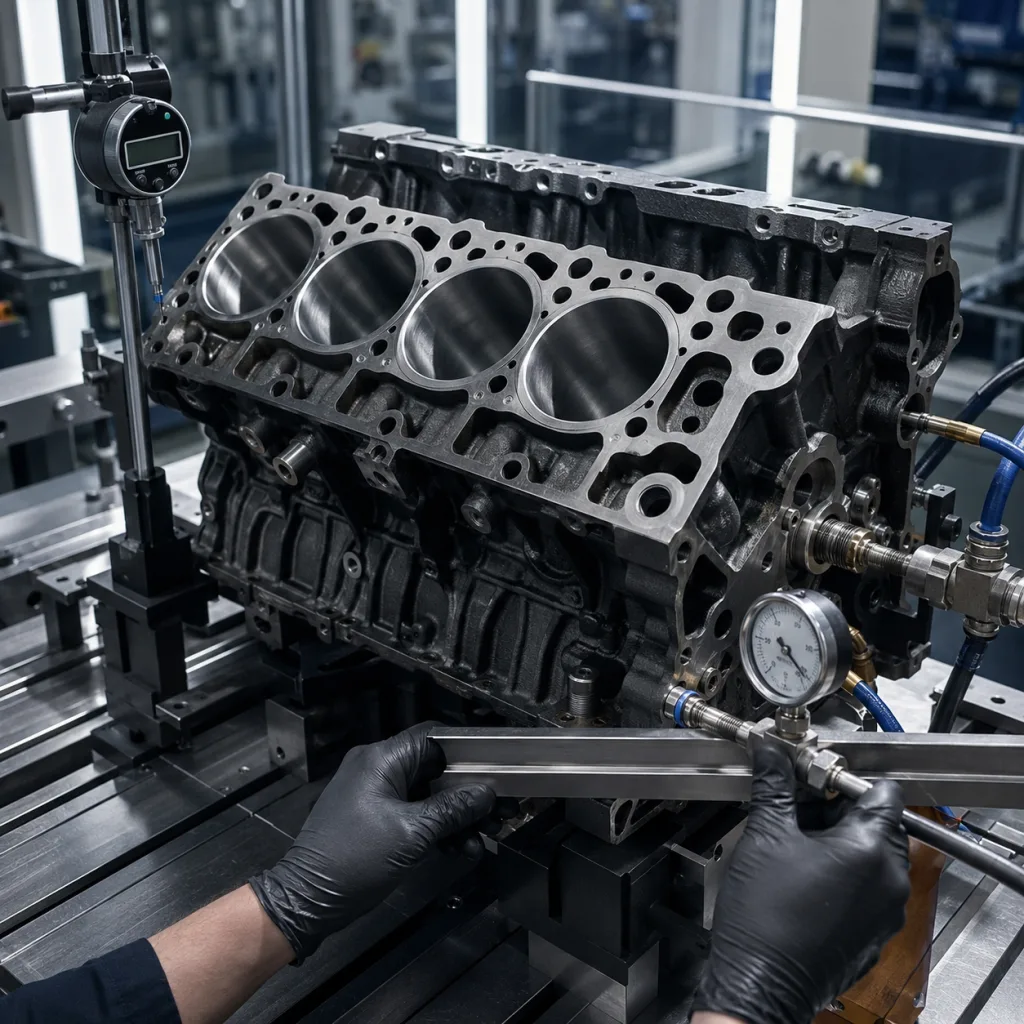
Sample approval should combine bench measurement, document review, and application-level fitment. A liner can pass a dimensional report yet still create problems if the block condition, interference fit, protrusion, or final honing process is not validated in the real repair environment.
Validation checklist
Measure bore, OD, wall thickness, and flange height with calibrated instruments
Confirm interference fit in the block or an approved test fixture
Check seating depth, counterbore contact, and protrusion where applicable
Inspect bore finish after honing or final machining
Review hardness, material, and heat-treatment records
Compare sample marking, labeling, and packaging against PO requirements
For rebuild networks and distributors, keep one approved master sample and one retained dimensional record for each released part number or repair size. This helps reduce disputes when later shipments are inspected by different warehouses, branches, or customers using different measuring routines.
Driventus can support drawing review, sample submission, inspection-standard alignment, and serial production once the fitment target and release criteria are agreed.
Why importers source from Taizhou suppliers
Taizhou, Zhejiang has a concentrated base of engine-component manufacturing, machining, inspection, and export support. For importers managing multiple powertrain parts, the sourcing advantage is not only local production capacity. It is the ability to coordinate related components, technical communication, packing, and freight through a more integrated export workflow.
For importers, the practical benefits are:
Shorter coordination path between casting, machining, inspection, and packing
Easier batch traceability across related engine components
Ability to combine liners, gaskets, pistons, and other parts for freight efficiency
Better support for private-label, mixed-SKU, and drawing-based requests
Driventus supplies cylinder liners as part of a broader engine component range, helping buyers reduce supplier count where technical fit and quality controls are already approved. If you are building a new sourcing lane for a cylinder liner Ford manufacturer China programme, begin with drawings or fitment data, define the sample approval standard, and share a realistic forecast. That approach reduces launch risk more effectively than negotiating on price alone.
Frequently asked questions
Yes, when the engine code and dimensional data are provided. We do not claim OEM approval, but we can support OE cross-reference checking such as OE 06A107065 where fitment data is available.
Ask for dimensional drawings, material specifications, inspection records, lot traceability, and packing details. For export programmes, confirm any compliance documents before sample approval.
Yes. Through drawing-based production and export packaging options, we can support custom manufacturing for verified applications after sample approval.
If you are qualifying a new source or comparing current suppliers, send your drawing, engine code, target quantity, and packaging requirements to our team. Start your enquiry here: /contact.html