Cylinder Head Porsche Supplier for B2B Sourcing
Choosing a cylinder head porsche supplier is not only a fitment call. It is also a decision about manufacturing control, traceability, and paperwork. The head must match the target engine family, of course, but buyers also need evidence that casting, heat treatment, CNC machining, leak testing, cleaning, and packing can be repeated consistently for distributors, repair networks, and export programmes. Before comparing unit prices, procurement teams should confirm combustion chamber volume, valve train geometry, port layout, coolant passages, oil galleries, deck finish, flange dimensions, threaded interfaces, and the exact assembly configuration.
For international sourcing teams, the practical questions go well beyond whether a head appears to fit. A qualified supplier should be able to quote by engine code, reference sample, OE-style reference number, or drawing. They should also explain datum selection and controlled machining dimensions, mark batches for traceability, and prepare documents that support customs clearance and incoming inspection. Driventus supports B2B procurement for distributors, repair groups, and OEM or Tier-1 programmes from Taizhou, Zhejiang. We operate under IATF 16949:2016 and ISO 9001:2015, and we can align materials and declarations with REACH (EC) No 1907/2006 where required. Driventus is an independent aftermarket manufacturer; brand names are referenced for fitment only.
What buyers should verify first
For a Porsche-fit cylinder head, start by locking the fitment basis. The supplier should make clear whether the order covers a bare casting, a semi-machined head, a fully machined head, or an assembled unit with valves, springs, guides, seats, seals, plugs, and related hardware. Each format puts responsibility in a different place, so procurement teams should define exactly what is included before sample approval or volume pricing begins.
Fitment confirmation usually begins with the engine code and application notes, then moves into the features that determine whether the head can seal, breathe, cool, and operate correctly under load. Combustion chamber volume, valve head diameter, stem diameter, valve angle, cam carrier or tappet layout, injector or spark plug position, intake and exhaust flange geometry, coolant jacket alignment, oil gallery routing, and gasket-face requirements all need to be checked against the buyer's reference. A typical approval pack also defines deck flatness, gasket-face roughness, guide bore size, valve-seat width, thread specification, and dowel-pin location. If the drawing pack is incomplete, ask the supplier to compare a physical sample, high-resolution photos, or a measured reference part before committing to tooling or production.
Before release, verify these items:
- Engine code, cylinder count, displacement range, aspiration type, and cam layout
- Bare, semi-machined, machined, or assembled supply configuration
- Combustion chamber volume, valve size, valve angle, and valve-stem specification
- Deck height, deck flatness target, and gasket-face surface finish requirement
- Intake and exhaust port geometry, bolt pattern, flange thickness, and manifold datum
- Coolant jacket alignment, oil gallery integrity, core-plug position, and drain-back paths
- Valve seat, guide, spring-seat, seal, tappet, and cam carrier specification
- Thread quality for studs, plugs, sensors, lifting eyes, and accessory mounting points
- Batch marking, carton label, pallet label, and traceability method
For trade buyers, a useful cylinder head porsche supplier is one that can explain what was measured, how it was measured, which tolerances apply, and how the batch can be identified if a field issue appears later. That early clarity reduces sample loops, prevents wrong-configuration shipments, and gives distributors a cleaner basis for warranty review.
How we control production and inspection
Cylinder head production is a chain of controlled operations, not one machining step. The main risk points include casting porosity, deck distortion, seat runout, poor guide-to-seat alignment, uneven gasket-face roughness, blocked coolant passages, thread damage, and mismatch between the machined head and the buyer's intended valve train package. At Driventus, process control is used to keep those variables stable across repeat orders and to make first-article approval easier to assess.
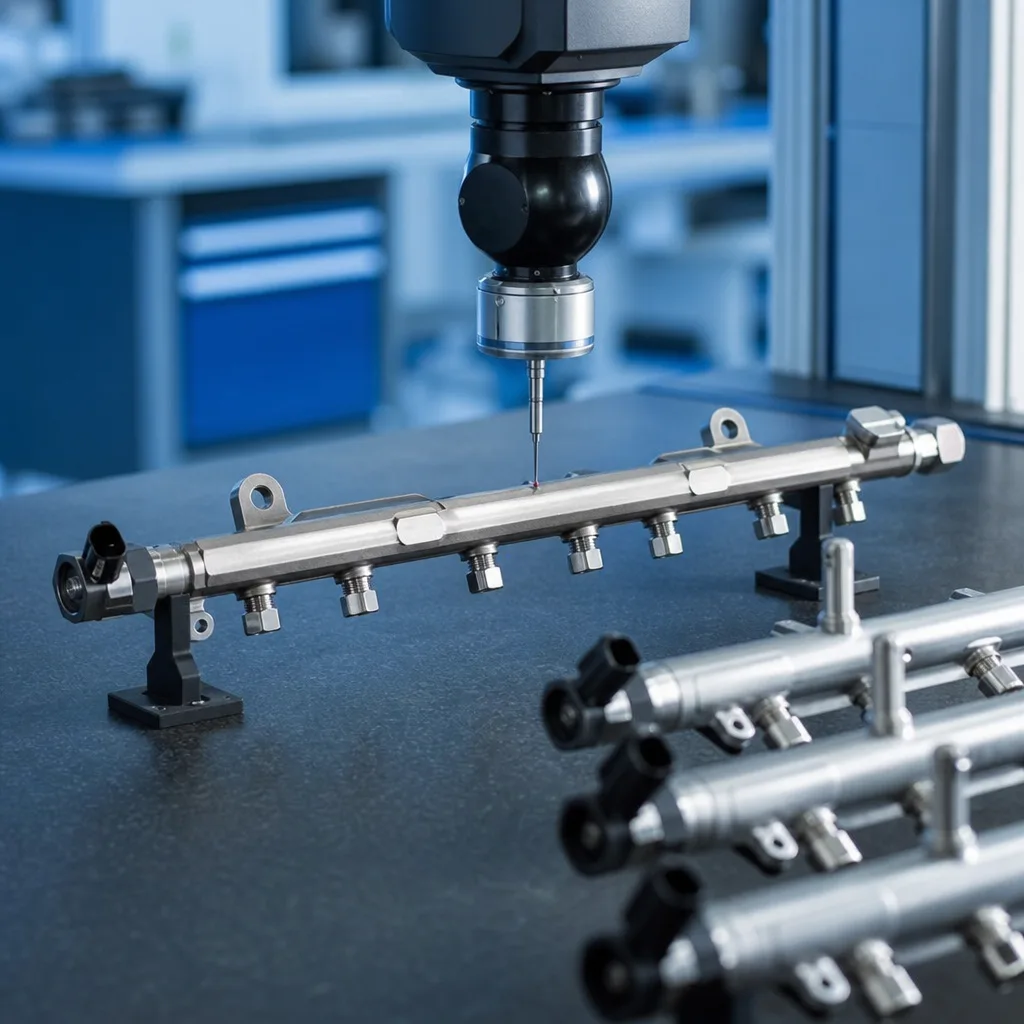
The production route normally begins with casting control and visual screening. It then moves through heat treatment where applicable, CNC machining, deburring, pressure or leak testing, dimensional inspection, cleaning, corrosion protection, and final packing. Critical surfaces and bores are checked against the approved reference using calibrated gauges, height gauges, bore gauges, thread gauges, CMM checks where required, and surface-roughness measurement for sealing faces. Coolant and oil paths are reviewed so leakage, casting flash, chips, or restrictions are not discovered only after installation. For assembled heads, the release discussion also covers valve seat contact, valve-guide clearance, spring seating height, installed spring load, seal fit, and component compatibility.
| Supply format | Best for | Buyer trade-off |
|---|---|---|
| Bare casting | Local machine shops, rebuilders, and buyers with their own machining standards | Lowest starting cost, but final machining, leak testing, cleaning, and dimensional responsibility stay with the buyer |
| Semi-machined head | Buyers who want local finishing while reducing rough-machining time | More control than a raw casting, but still requires local process capability and clear datum agreement |
| Machined head | Distributors, export wholesalers, and replacement-part programmes | Good balance of cost and consistency, but requires correct valve train pairing and buyer approval of key dimensions |
| Fully assembled head | Repair chains, fleet service networks, and fast-moving replacement programmes | Higher unit cost, but less labour at destination and fewer assembly errors when the specification is stable |