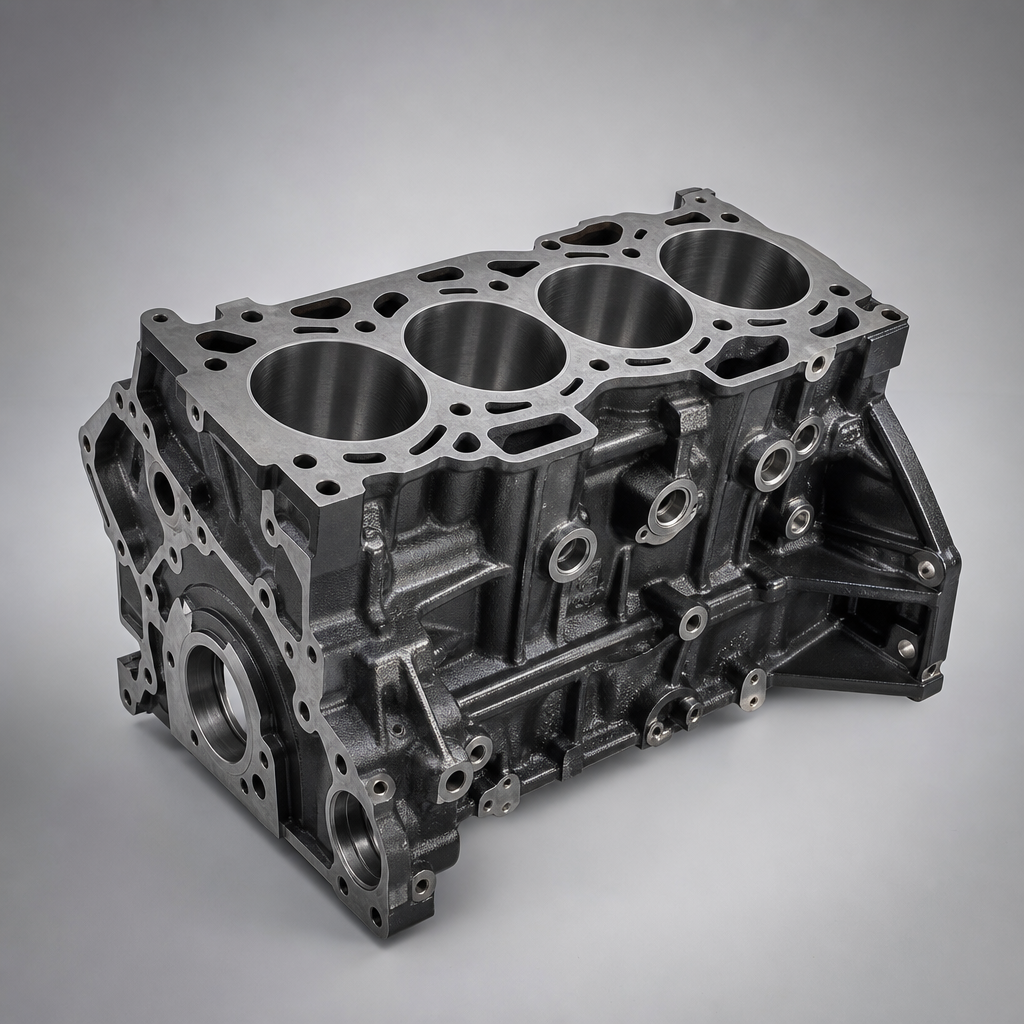
Cylinder Head Opel Supplier: B2B Sourcing Criteria
Choosing a **cylinder head Opel supplier** is not a routine price exercise. It sits at the intersection of metallurgy, machining discipline, fitment accuracy, and supply reliability. A head that looks acceptable on arrival can still create expensive failures later if flatness drifts, seat geometry is unstable, porosity control is weak, or documentation breaks down when a claim appears.
For importers, distributors, and aftermarket programme managers, the useful question is simple: which supplier can repeat the result at volume with the least commercial friction? That means comparing measurable controls rather than polished sales language. In practice, buyers should ask for real operating ranges such as deck flatness within 0.05-0.08 mm after finish machining, valve seat runout within 0.03-0.05 mm, guide bore tolerance typically within +0.015 / +0.035 mm by design, and leak testing at a defined pressure such as 4-6 bar with a 60-180 second hold time. Driventus is an independent aftermarket manufacturer; brand names are referenced for fitment only.
First-pass screen: is this supplier even worth the RFQ?
The fastest way to waste sourcing time is to compare quotes from suppliers that are not controlling the process. Before price analysis, run a short gate review.
Start with five checks:
- Certification: active IATF 16949:2016 and ISO 9001:2015 certification, with scope relevant to engine components
- Manufacturing route: in-house production or tightly controlled subcontracting for casting, heat treatment, CNC machining, valve guide and seat installation, cleaning, and leak testing
- Traceability: batch records covering alloy, process lot, inspection result, machine ID, operator, and packing date
- Compliance support: material declarations and chemical compliance documentation where required under REACH (EC) No 1907/2006
- Audit readiness: documented control plans, PFMEA, incoming inspection, final inspection, and corrective action workflow
A credible cylinder head Opel supplier should also describe the process in concrete terms. For aluminium heads, ask which foundry route is used, which alloy family applies, and whether heat-treatment condition is verified by lot. Typical export programmes ask whether the head is produced in gravity die casting or another controlled casting route, whether the alloy is equivalent to a common aluminium-silicon grade such as AlSi7Mg or AlSi9Cu3 depending on design, and whether hardness or tensile properties are checked by batch.
Then go one level deeper. Ask whether critical datums are machined in one setup or across several setups. That answer matters because it affects cam bore alignment, deck-to-seat position, and manifold interface accuracy.
For distributor and importer programmes, fitment control is another early filter. The supplier should be able to connect OE or aftermarket references to engine code, valve configuration, fuel type, and cooling or sensor differences, then freeze that mapping by revision. If part supersession is handled casually, ordering errors usually follow.
A practical reject rule before RFQ comparison:
- Reject suppliers that cannot provide certificates, traceability format, and sample inspection records within 3-5 working days
- Reject suppliers that quote a unit price but cannot define MOQ, sample timing, repeat lead time, and warranty handling window
- Prioritise suppliers that can confirm whether the head is supplied bare, semi-loaded, or fully assembled with valves, springs, retainers, seals, and seats already controlled as one bill of material
You can review our catalog for current engine component coverage, including related assemblies and mating parts.
Spec deep-dive: the numbers that separate a usable head from a risky one
Cylinder heads fail sourcing reviews when the discussion stays vague. Appearance is not the point. Control of material and geometry is.
Core technical controls
- Material grade control for the aluminium casting or iron head specification used in the application
- Deck flatness inspection after final machining
- Valve seat concentricity and installed interference control
- Valve guide bore tolerance and surface finish
- Cam bore alignment where the design requires line accuracy across journals
- Coolant passage integrity confirmed by pressure or leak testing
- Thread quality in manifold, injector, and fastener locations
- Surface cleanliness before packing to prevent contamination during service
Ask for actual tolerance windows, not a statement that inspection exists. Common checkpoints include:
- Deck flatness: often controlled within 0.05 mm on smaller heads and up to 0.08 mm on larger formats, measured on a CMM, granite table, or dedicated fixture
- Valve seat concentricity/runout: typically within 0.03-0.05 mm relative to guide axis
- Valve guide inside diameter: controlled to drawing, often in a narrow band such as 0.02-0.04 mm total tolerance depending on valve stem size and material pairing
- Seat insert interference: commonly around 0.05-0.12 mm depending on seat diameter, head material, and thermal design
- Cam bore alignment: often checked by air gauge, mandrel, or line-bore fixture, with coaxiality or positional limits typically below 0.03-0.05 mm across the bore set
- Surface finish on gasket faces: commonly specified in Ra 1.6-3.2 um depending on gasket type and OE service requirement
- Thread inspection: use of go/no-go gauges on spark plug, injector, exhaust manifold, intake, and accessory mounting threads
Process detail buyers should request
A serious cylinder head Opel supplier should explain the full production route with evidence. A typical machined aluminium head sequence is:
1. Casting receipt and visual segregation by lot 2. Chemical composition verification by spectrometer or supplier lot certificate review 3. Heat treatment confirmation where applicable 4. Rough machining of datums and critical faces 5. Valve guide and seat installation with controlled press-fit values 6. Finish machining of deck, cam bores, ports, and threaded locations 7. Washing and chip removal 8. Pressure or air leak test on coolant and oil galleries 9. Final dimensional inspection by sampling plan or 100% on critical features 10. Rust prevention or corrosion protection, cavity plugs if required, and export packing
Useful buyer questions:
1. What pressure-test method is used, and what are the test pressure and hold time? 2. Is deck flatness checked on 100% of parts or by sampling plan? 3. Are valve seats and guides produced internally or purchased from approved outside vendors? 4. What containment process is triggered if machining drift is detected during a batch?
Strong answers are specific. For example, a supplier may state that every head is leak-tested at 5 bar for 120 seconds, that deck flatness is checked 100% with digital recording, that guide bore and seat runout are checked every 20-30 pcs per machine, and that any out-of-control result triggers line stop, segregation of the last accepted quantity, and reinspection of the previous 1-2 hours of output.
For manufacturers serving export markets, the quality framework should be visible, current, and documented. See our quality system for the controls used on powertrain components.
Commercial reality check: MOQ, lead time, and planning pressure
Even a technically capable source can still be the wrong supplier for your programme. Buyers need numbers that work in stock planning, container loading, and launch timing.
The table below shows the commercial points most buyers compare during sourcing.
| Sourcing factor | What to verify | Typical procurement concern |
|---|---|---|
| MOQ | Per SKU and mixed-order flexibility | Excess stock on slow-moving references |
| Lead time | Sample lead time, first order, repeat order | Forecast reliability and stock-out risk |
| Tooling status | Existing tooling or new tooling requirement | Upfront cost and launch timeline |
| Packaging | Anti-corrosion protection, tray/carton spec, pallet standard | Damage in sea freight and warehouse handling |
| Documentation | Packing list, COO, inspection report, compliance file | Customs clearance and customer approval |
| Warranty handling | Claim review workflow and response time | Cost recovery and account protection |