cylinder head · 2026-06-03

Cylinder Head Mini Wholesale: Sourcing Guide for Buyers

Buyers searching for cylinder head mini wholesale are usually trying to secure lower-volume replenishment without giving up traceability, machining control, inspection discipline, or export paperwork. That means the sourcing decision should go well beyond piece price. Procurement teams need to confirm alloy grade, casting route, heat treatment where applicable, valve seat and guide installation, deck flatness and roughness, cam tunnel alignment, pressure-test method, coolant and oil gallery cleanliness, export packaging, and mixed-SKU consolidation rules. For aftermarket programmes, the most useful supplier can quote by application or engine code, confirm documentation before production, and repeat the same process route across reorder cycles. Driventus is an independent aftermarket manufacturer; brand names are referenced for fitment only. If you are comparing sources across the EU, UK, US, Canada, Australia, or Brazil, the practical question is not just who can ship. It is who can ship smaller wholesale lots with controlled critical dimensions, workable MOQ logic, and a compliance pack your internal team can approve without rebuilding the file from scratch.

What Buyers Should Define Before Requesting Prices

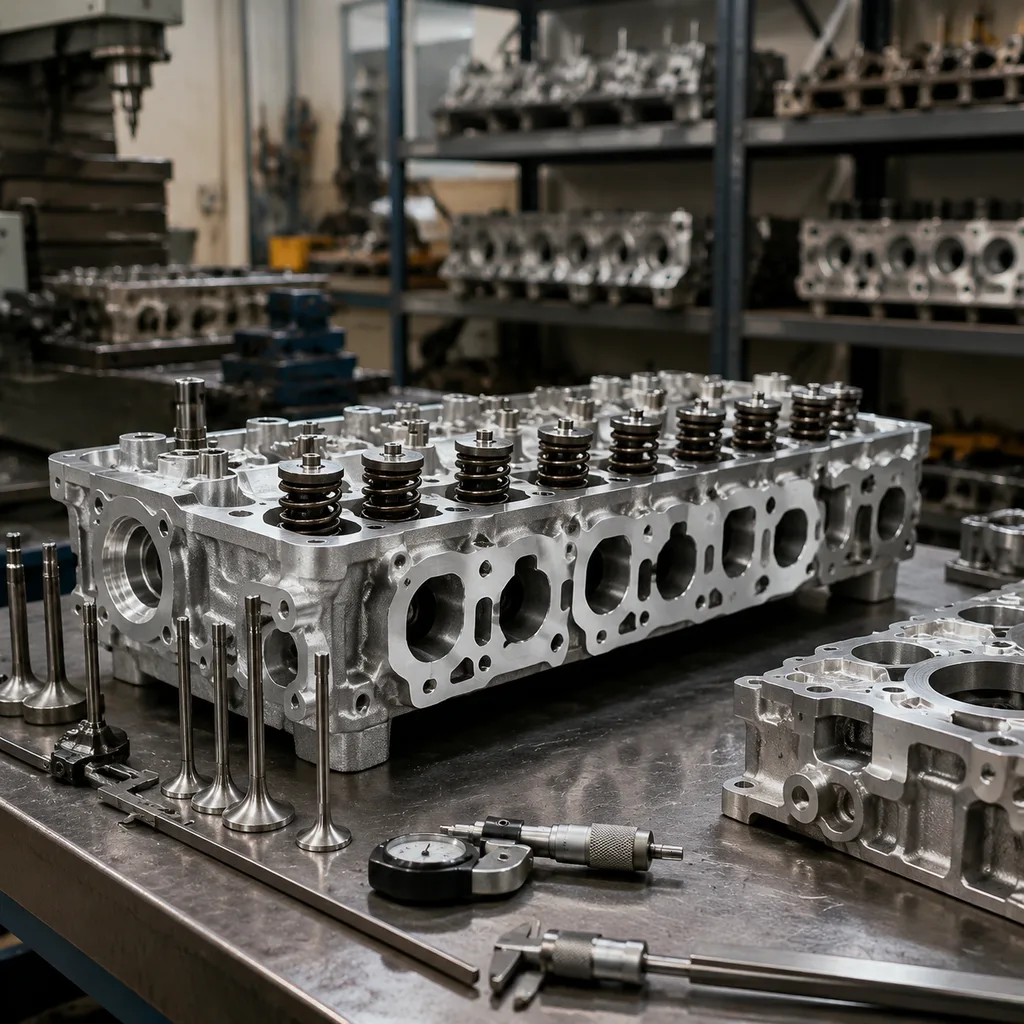
Start by defining the supplied condition in procurement terms. The same cylinder head may be offered as a raw casting, a semi-finished casting with machining allowance, a fully CNC-machined bare head, or a tested assembly with valves, springs, retainers, stem seals, cam caps, core plugs, dowels, or threaded plugs installed. Each option changes the bill of operations, fixture time, inspection route, packing risk, claims exposure, and lead time. A low unit price is not useful if it is based on a different supplied condition from the one your warehouse or customer actually expects.

For cylinder head mini wholesale sourcing, the RFQ should also explain whether the order is a market test, an urgent replenishment, or the first shipment in a rolling supply programme. A supplier quoting a pilot lot needs different information from one reserving recurring CNC capacity and casting stock for monthly call-offs. If mixed part numbers are required, clarify whether the MOQ applies per SKU, per engine family, per machining setup, per pallet layer, or per consolidated shipment.

Use a written RFQ brief that covers application, engine family, engine code, fuel type where relevant, required finish level, supplied condition, inspection expectations, packaging rules, destination market, and commercial model. If you need a broader sourcing basket, start with our catalog and, where relevant, related engine components.

</tr></thead><tbody> </tbody></table>For a small wholesale programme, this level of clarity reduces back-and-forth and makes supplier comparisons more reliable. It also prevents the most common early dispute: both sides agree on a cylinder head price while assuming different machining scope, test scope, assembly content, or packing standard.

Materials, Machining, and Inspection Points That Matter

A cylinder head is not a generic cast part. It manages combustion pressure, coolant flow, oil flow, valve movement, and sealing against the engine block. Procurement teams should ask which aluminium alloy or cast iron grade is used, how melt quality and pouring are controlled, whether T6 heat treatment or stress relief is applied where specified, and where machining control sits in the process. Common aluminium choices for aftermarket heads include Al-Si casting alloys such as A356/AlSi7Mg or ADC12-type die-casting alloys, depending on design and production route. Cast iron heads may require a defined grey iron grade, hardness range, and crack-detection method. If combustion chamber geometry, deck height, valve seat concentricity, or cam bore alignment drifts, the part may bolt on and still fail on compression, oil control, coolant sealing, or long-term durability.

For aluminium cylinder heads, buyers should pay close attention to porosity control, coolant passage integrity, insert retention, and gasket-face finish. A practical RFQ can specify pressure testing of water jackets, visual or borescope checks for gallery cleanliness, and CNC records for critical features. Deck flatness is often held within a narrow tolerance, commonly around 0.03-0.08 mm across the gasket face depending on head length and engine requirement, while surface roughness should match the intended gasket technology rather than a generic polished finish. For cast iron applications, hardness, crack control, machining consistency, and corrosion protection often matter more. In both cases, the inspection plan should separate critical-to-function dimensions from reference dimensions, because not every measurement carries the same field risk.

Key points to verify:

  • Casting material grade, melt or batch number, and traceability route
  • Heat treatment, ageing, or stress-relief process where applicable
  • Deck flatness, surface roughness, and minimum remaining material after machining
  • Combustion chamber volume and critical geometry where specified
  • Valve guide bore position, inside finish, interference fit, and guide protrusion
  • Valve seat insert material, interference fit, runout, contact width, and concentricity
  • Camshaft bore alignment, cam cap matching, bearing oil-hole alignment, and thread quality where applicable
  • Coolant and oil passage cleanliness after machining, including chip and burr control
  • Pressure test result, test medium, hold time, and test pressure for relevant part numbers
  • Plug, dowel, threaded-hole, and gasket-surface verification before packing
  • Surface protection for storage, inland handling, and sea freight

For export buyers, the most useful quality references are process controls aligned to quality system requirements, including IATF 16949:2016 and ISO 9001:2015. Where documentation is needed for material content or restricted substances, ask for support aligned with REACH (EC) No 1907/2006. If the programme requires emissions-related compatibility data, buyers may also ask how validation aligns with ECE R-83 where relevant.

The point is straightforward: the machining specification should be detailed enough that the next batch matches the approved batch. In cylinder head mini wholesale, repeatability matters even more because smaller lots are reordered more often, and differences in machining marks, insert height, label format, or packing method become obvious quickly when distributors compare shipments side by side.

MOQ, Lead Time, and Container Planning

Small wholesale orders usually go off track when MOQ and replenishment logic do not match real demand. A buyer supplying repair chains may need regular call-offs by application, while a regional distributor may prefer quarterly drops that combine fast-moving and slow-moving engine families. The supplier should be able to support both patterns without resetting the process, renegotiating the inspection scope, or changing the packing format every time.

A practical sourcing model looks like this:

1. Confirm annual forecast by SKU, part number, or engine family. 2. Identify fast-moving, medium-moving, and test-market references. 3. Set a pilot MOQ that is large enough for stable casting allocation and CNC setup, but small enough to test demand. 4. Agree whether MOQ is calculated per SKU, per tooling setup, per carton, per pallet, or per shipment. 5. Confirm inner protection, carton count, pallet build, gross weight limits, stack height, and mixed-SKU consolidation. 6. Lock the inspection list and acceptance criteria before the first production run. 7. Review repeat-order lead time after the first shipment, field feedback, and claims data.

For buyers importing into multiple regions, the real cost is not only unit price. It also includes inventory days, freight density, pallet utilisation, claims handling, customs documentation, warehouse relabelling, and whether the supplier can hold casting inventory or machining slots for repeat business. A factory that plans smaller lots well is often more useful than one offering a lower price with unstable scheduling.

Container planning should be discussed early, even if the first order is small. Cylinder heads are heavy, machined, and vulnerable to impact damage if the carton, foam, pallet, or divider design is weak. Ask for carton dimensions, gross and net weight, pallet quantity, stack height, drop-protection method, moisture protection, and photos of export packing. For heavy heads, buyers should also check whether cartons include molded foam, reinforced corners, plastic bagging, desiccant where needed, and pallet strapping that prevents movement during sea freight. If the shipment combines multiple cylinder head references or additional engine components, the supplier should show how SKUs will be separated, labelled, and listed on the packing documents.

Lead time should also be split into stages: casting availability, heat treatment if required, machining queue, assembly if required, inspection, pressure testing, packing, export documentation, and freight booking. That helps procurement teams see whether a delay comes from casting stock, CNC capacity, test results, missing customer approval, or shipping space. If your network spans wholesalers and workshop groups, ask the supplier to price both one-off replenishment and rolling supply so you can compare cash flow, warehouse risk, and service level together.

What the Compliance Pack Should Include

A usable compliance pack should be clear enough for internal approval without a long technical chase. For cylinder head procurement, the goal is to connect the commercial shipment to the production batch, inspection record, packing record, and export documents. This is especially important for cylinder head mini wholesale programmes, where buyers may be approving several part numbers in modest quantities rather than one high-volume SKU.

Ask for the following before placing a volume order:

  • Commercial invoice and packing list with part numbers, quantities, carton count, gross weight, net weight, and pallet count
  • Material declaration, alloy or iron grade, and batch traceability reference
  • Dimensional inspection summary for agreed critical features, including tolerance basis and sampling level
  • Pressure test record, if applicable to the part number, with test pressure, hold time, and result
  • Surface treatment, anti-rust oil, or corrosion protection note
  • Country of origin statement and HS code support where the supplier can provide it
  • Product photos, golden-sample record, or first-article approval record where required
  • Photo record of final packing, pallet build, carton label, and barcode format
  • Any customer-specific label, serial, batch code, or carton marking confirmation
  • Non-conformance and claims-handling contact route for post-shipment issues

Where a customer audit is planned, the supplier should also be ready to explain how records are controlled under IATF 16949:2016 and ISO 9001:2015. That matters because procurement teams often need a paper trail, not just a shipped carton. Record retention, document version control, calibration status for gauges, inspection sampling rules, and non-conformance handling should be understandable before the first container leaves the factory.

The compliance pack should also match the destination market. Buyers importing into the EU or UK may need material and restricted-substance declarations. Buyers shipping to the US, Canada, Australia, or Brazil may place more emphasis on origin, customs classification support, packing accuracy, importer documentation, and label language. Requirements vary by buyer and product programme, so the supplier should confirm what is standard and what must be requested before production.

If you require engineering support beyond a standard part, custom manufacturing is the right path. It lets you define the machining scope, packaging standard, label format, test method, documentation pack, and sample approval route before volume production starts. That is the cleanest way to reduce variance in a small wholesale programme and keep later repeat orders aligned with the original approval.

How Driventus Supports Sourcing Programmes

Driventus is structured for B2B supply rather than retail sales. The conversation starts with application data, engine code, required volume, supplied condition, machining scope, document control, and export plan, not with a generic price list. Buyers can compare options across our catalog and then narrow the request to the exact engine family, supply condition, inspection requirement, packaging format, and destination-market documentation they need.

For procurement teams, the useful signals are predictable production, factory traceability, responsive engineering feedback, and a clear quotation basis. If you are sourcing for aftermarket distribution, OEM supply, or a multi-location repair network, ask for the same data every time: fitment basis, MOQ, lead time, test method, critical inspection points, carton configuration, pallet plan, label format, and documentation scope. That makes cylinder head mini wholesale comparisons cleaner and helps separate real manufacturing capability from simple catalogue availability.

Driventus can support discussions around standard aftermarket replacement, small wholesale replenishment, mixed engine-family sourcing, and programmes that need custom packing or label control. For buyers building a new range, the first shipment can be treated as a controlled pilot: confirm samples or first articles, validate fitment information, inspect packing, review pressure-test and dimensional records, and then move into repeat supply with fewer surprises. For established distributors, the focus is usually continuity: keeping the same specification, the same inspection route, the same carton and pallet standard, and the same export documentation across repeat orders.

If the programme needs adaptation for a special market, a different finish, a packaging rule, or a label requirement, use request a quote and include your target annual volume, sample photos, engine code, application market, required supplied condition, destination port, and any drawing or reference sample you already hold. That shortens the first round of engineering review, avoids unnecessary sampling delays, and gives the quotation team enough detail to recommend the most practical supply route.

Frequently asked questions

Send the engine family, engine code where available, application market, target annual volume, required supplied condition, and any drawing, OE reference, 3D data, or sample reference. If you already have packaging, label, documentation, inspection, or destination-market rules, include those too. The faster the supplier can match the request to a process route, the more accurate the quote will be.

Yes. Smaller lots can still include batch traceability, dimensional checks, pressure testing where required, and photo records of packing. The supplier should confirm what is checked on every piece, what is sampled by batch, which tolerances apply to critical features, and which records will be included with the shipment so the commercial terms match the inspection plan.

Consistency matters more than a single low price. Look for stable casting control, repeatable CNC machining, clear MOQ rules, export-safe packaging, mixed-SKU planning, and documentation that supports internal approval. Certification to IATF 16949:2016 and ISO 9001:2015 is a strong signal, but the underlying process records, gauge control, pressure-test data, and repeat-order discipline matter as well.

If you need a quotation package, share the engine code, target volume, required machining condition, and test scope. Start here: [request a quote](/contact.html)

Request a Quote
Buyer question What the supplier should answer Evidence to request
Which condition is supplied?Raw casting, semi-finished, fully machined bare head, or assembled headProcess sheet, bill of operations, and inspection route
What is the minimum order?MOQ by SKU, engine family, machining setup, pallet, or combined shipmentMOQ table, packing unit, and consolidation rule
How is fitment confirmed?By engine code, OE reference, drawing, 3D data, or sample matchDimensional report, application list, or sample sign-off
What machining is included?Deck, cam tunnel, valve seats, guides, threaded holes, dowel bores, plug areas, and gasket facesMachining specification and critical dimension list
What is the export lead time?Pilot lead time, repeat-order lead time, inspection time, and expedited optionsProduction schedule, inspection timing, and transit estimate
What documents are included?Test data, material traceability, origin, packing list, and label recordSample documentation pack before order approval