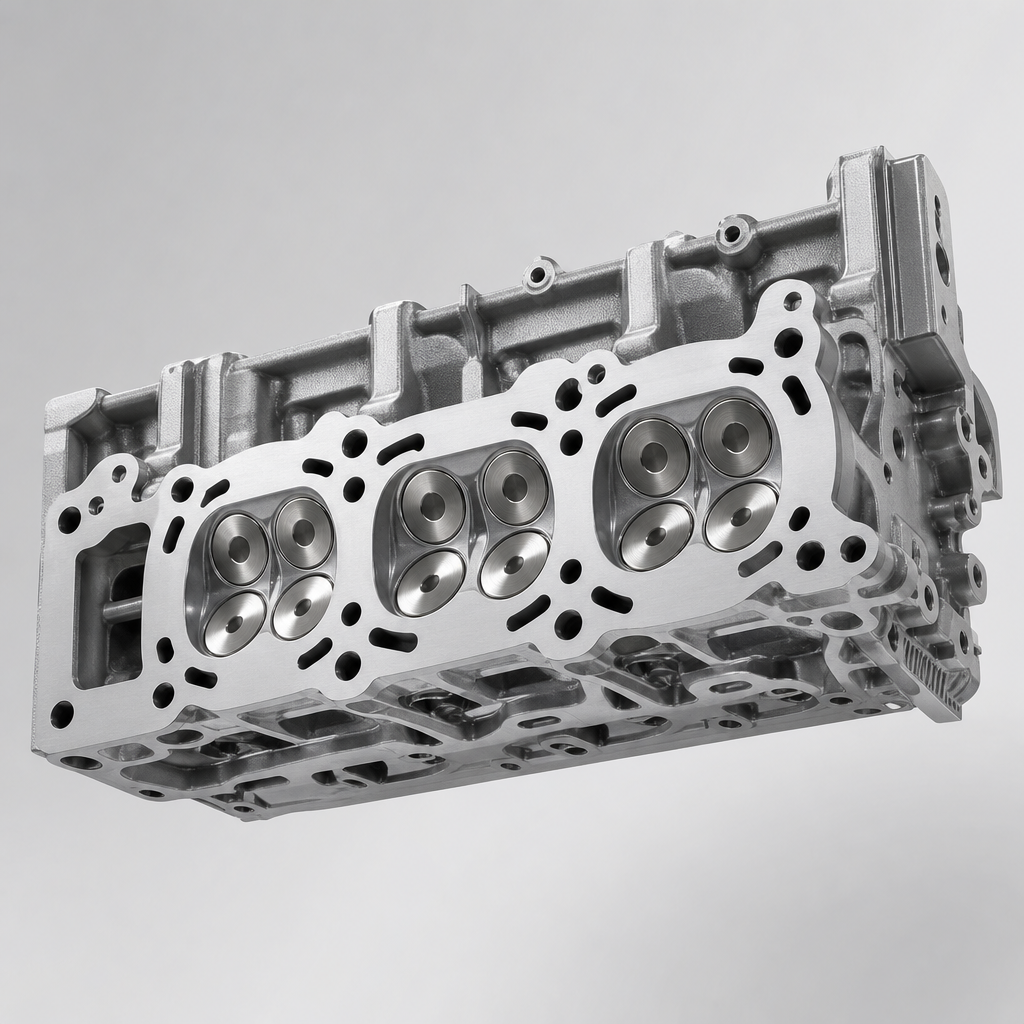
Cylinder Head Iveco OEM Supplier: How Buyers Separate Real Capability from RFQ Noise
Choosing a supplier for Iveco-fit cylinder heads is not a catalogue exercise. It is a risk decision tied to warranty cost, stock exposure, service fill rate, and how quickly your team can isolate a claim when something goes wrong.
Most procurement teams are weighing the same issues: machining consistency, casting integrity, traceability, approval documents, MOQ, and replenishment timing across several engine families. The field failures that hurt most are usually not dramatic at PO stage. They show up later as seat runout, porous castings, cam bore misalignment, poor fire-deck finish, or lot records that cannot be matched to shipped stock.
This article is built as a buying framework rather than a generic checklist. It moves through the decision the way a sourcing team actually does: first screen the supplier, then test for failure modes, then compare capacity and supply terms, then lock down the document pack. A credible cylinder head Iveco OEM supplier should be able to discuss dimensions, inspection frequency, leak-test parameters, and lot traceability in specific terms, not broad quality language.
Start with a go/no-go screen, not the product list
The first question is simple: is this supplier worth deeper review at all?
Many RFQs stall because buyers spend time on SKU coverage before confirming process control. A supplier may list dozens of references and still be weak on the points that drive claims.
Use an early go/no-go screen built around evidence:
- Certification status: Confirm current IATF 16949:2016 and ISO 9001:2015 certification.
- Supply scope: Check whether the factory supplies bare heads, assembled heads, or both.
- Lot traceability: Ask for heat-number traceability, machining batch records, and final inspection reports tied to shipment lots.
- Critical feature control: Verify how valve guide bore, seat runout, cam tunnel alignment, deck flatness, and threaded features are measured.
- Pressure integrity: Confirm 100% leak testing of coolant and oil passages after machining.
- Material compliance: For EU and UK programmes, request declarations aligned with REACH (EC) No 1907/2006 where applicable.
- Export packaging: Review corrosion protection, seat protection, carton strength, pallet standard, and label format.
Then move from claims to numbers. Instead of asking whether parts are "within drawing," ask what acceptance limits are actually used. Useful screening values often include:
- Deck flatness: commonly around 0.03-0.05 mm across the gasket face, depending on application.
- Fire-deck surface finish: often around Ra 1.6-3.2 um depending on gasket type and build spec.
- Valve seat concentricity/runout: typically 0.02-0.04 mm max on the finished seat.
- Valve guide bore tolerance: commonly 0.01-0.03 mm from nominal after final sizing.
- Cam bore alignment: often controlled within about 0.02-0.05 mm cumulative error depending on span.
- Leak-test setting: many buyers expect 3-5 bar with 30-120 seconds hold time and a clear reject rule.
These figures do not replace the drawing. They do expose weak RFQ responses fast. If a supplier cannot discuss controls at this level, the quotation is ahead of the process.
For buyers sourcing beyond one part family, it may also help to review our catalog and the broader /products/engine-components.html range to see whether multiple engine-component lines can sit under one quality system.
Read the likely failure modes before you read the quote
A cylinder head can pass a basic appearance check and still be a bad sourcing decision. The better approach is to review the part by failure mode.
That changes the conversation. Instead of asking what the supplier makes, ask where the part usually fails and how the process prevents it.
Failure mode 1: porous or unstable castings
Ask for:
- foundry source approval method
- melt or heat identification records
- hardness range by material grade
- porosity control method, including X-ray or sampling policy where used
- rejection rule for water-jacket or oil-gallery leakage
A capable supplier should be able to state material windows, sampling frequency, and containment triggers. If porosity trends appear, what happens next? Foundry containment, extra pressure testing, and lot segregation are stronger answers than vague references to experience.
Failure mode 2: seat or guide instability
This is a common source of comeback risk.
Request actual process values for seat and guide interference fit. On many programmes, seat insert interference may sit around 0.05-0.10 mm and guide interference around 0.02-0.06 mm, but the right figure depends on material pair, operating temperature, and head design. What matters is not the exact generic number. It is whether the supplier has a documented range, a check method, and a verification frequency.
Failure mode 3: machining error on critical geometry
Even good castings fail in the field when machining control is weak. Review:
- CNC process flow for deck, seats, guides, cam bores, and threads
- in-process gauging and final CMM or fixture inspection
- gasket-face surface finish control
- valve seat vacuum or leakage verification after assembly
- torque control for inserted components where relevant
Ask a few pointed questions:
- Is seat geometry cut in one operation or several?
- How is tool wear tracked?
- Are offsets recorded by count or only adjusted after drift appears?
- Are guides reamed or finished through another controlled process?
Failure mode 4: nonconformance that disappears into the system
A supplier is not judged only by yield. It is judged by what happens when something fails.
During audit, ask:
- What is the quarantine process for leak-test failures?
- How is rework recorded by lot?
- What percentage is checked 100% and what percentage by sampling?
- What is the gauge R&R result for seat runout and guide bore measurement?
A credible cylinder head Iveco OEM supplier should be able to show practical controls such as 100% leak testing, setup first-off inspection, patrol inspection every 1-2 hours, and final lot audit. Just as important, they should explain how rejected parts are tagged, segregated, reviewed, and blocked from shipment.
Our quality system page gives a summary of the inspection framework used across engine and powertrain components.
Compare commercial offers the way planners do
Technical approval alone does not make a supply line usable. Buyers still need a reorder model that works in the real world.
This is where many quotes look similar on price and very different on execution.
| Sourcing factor | What to request | What it tells you |
|---|---|---|
| MOQ per item | MOQ for bare and assembled heads | How much slow stock you may carry |
| Sample lead time | Days for first sample from drawing or reference | How quickly approval can start |
| Production lead time | Days from PO to shipment | How much pipeline stock you need |
| Tooling policy | Fixture, gauge, or setup charges | Whether landed cost is understated |
| Capacity | Monthly machining output by family | Whether rollout volume is realistic |
| Mix flexibility | Multiple references in one load | Whether inventory can be balanced |
| Packaging | Units per carton, cartons per pallet, export standard | Transit damage exposure |
| Warranty process | Claim window, evidence required, credit/replacement route | Aftermarket risk control |