Crankshaft Volkswagen OEM Supplier: Sourcing and Quality
Procurement teams sourcing a crankshaft Volkswagen OEM supplier usually need three things at once: correct fitment, controlled manufacturing, and predictable supply terms. A crankshaft is not a commodity part when the engine code, journal geometry, stroke, counterweight mass, flange pattern, oil-hole position, thrust arrangement, and surface treatment all have to match the target application. For B2B buyers, the practical questions are lead time, MOQ, test coverage, traceability, packaging durability, and whether the factory can support OE cross-reference work without claiming vehicle manufacturer approval. Driventus is an independent aftermarket manufacturer; brand names are referenced for fitment only. This article explains how we support sourcing for distributors, OEM and Tier-1 programs, export wholesalers, and multi-location repair chains, including documentation, validation, and supply terms that make incoming inspection simpler. If you are comparing suppliers, use the sections below as a working checklist before you request samples, open a private-label project, or issue a production quote request.
What buyers should verify first
When a buyer evaluates a crankshaft Volkswagen OEM supplier, the first filter is fitment evidence, not catalogue breadth. The supplier should be able to map the part to engine code, OE reference, journal count, stroke, thrust arrangement, flange configuration, reluctor or keyway features, and balance strategy. For stock decisions, ask for the minimum data set below before discussing price, because a small geometry difference can create a wrong-fit shipment even when the commercial application name looks correct.
- OE cross-reference and engine family confirmation
- Engine code, displacement, fuel type, and production-year range where available
- Main journal and rod journal diameters, widths, and fillet radius requirements
- Stroke, overall length, flange pattern, pilot bore, and keyway or reluctor features
- Thrust bearing position and thrust face dimensions
- Oil passage layout, chamfer condition, and plug treatment where applicable
- Nitriding, induction hardening, fillet rolling, or other surface-strengthening details
- Static or dynamic balancing requirement and acceptable tolerance
- Packaging method, corrosion protection, and preservation for sea freight
- Available batch traceability, inspection records, and sample retention
For Volkswagen applications, buyers often compare multiple engine variants within one platform. The same commercial model name can cover different crankshaft geometries, and replacement demand may include both older service parts and newer engine families. A supplier that works from drawings, samples, dimensional reports, and cross-reference evidence will reduce the risk of mixed stock, unsuitable machining, or avoidable returns. It is also useful to confirm whether the item is intended for aftermarket replacement, private-label distribution, remanufacturing support, or a controlled OE-style program, because each route can require a different inspection and packaging standard.
Before qualification, share the clearest available input: OE reference, engine code, sample photos, drawing, target annual volume, destination market, and any customer-specific inspection requirements. If you need broader coverage beyond crankshafts, start with our catalog and the engine range on engine components.
Manufacturing control and material options
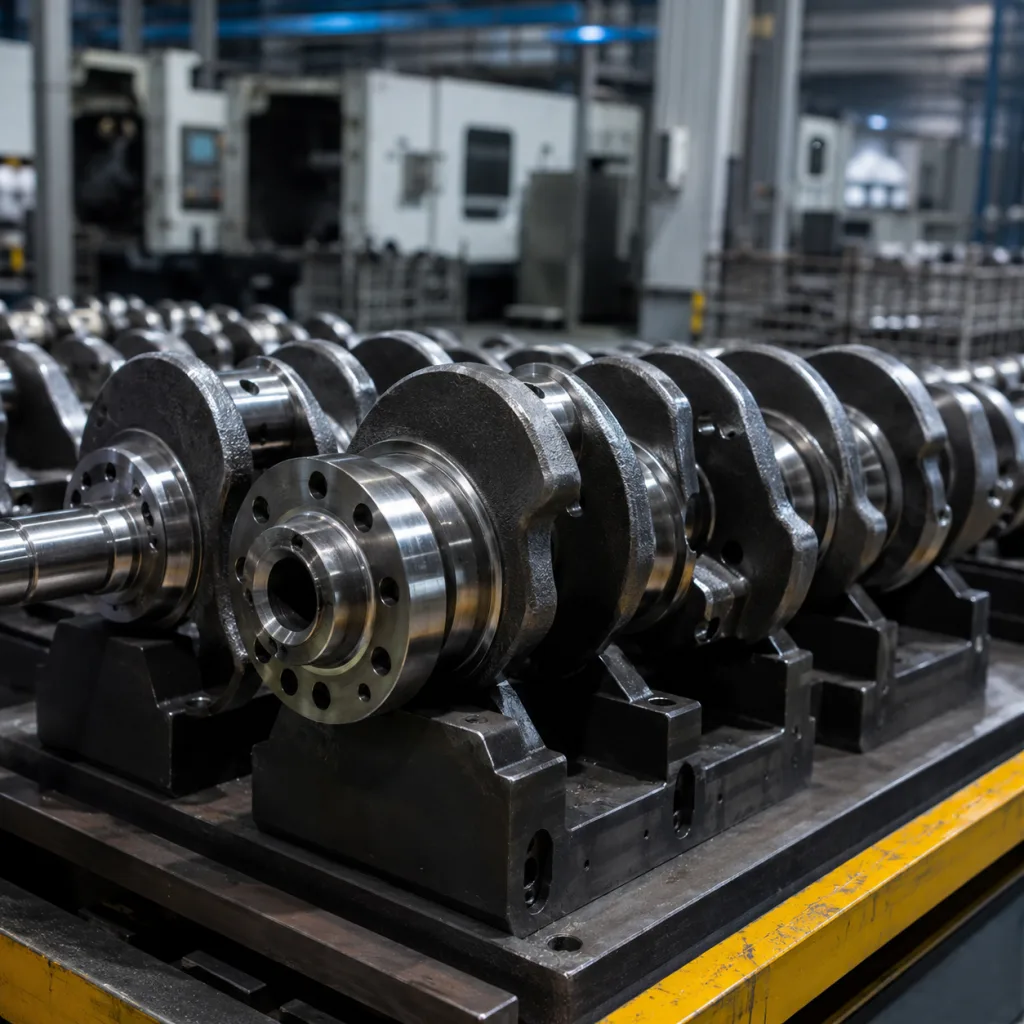
Driventus supplies forged and machined crankshafts with process control suited to export programs. For a Volkswagen program, the key is consistency across material selection, heat treatment, journal machining, oil-hole processing, grinding, balancing, cleaning, and final inspection. The part must deliver the correct geometry and repeatable fatigue performance, while also arriving protected from corrosion and handling damage.
Typical production controls include controlled forging flow, CNC machining of journals and oil passages, fillet radius control, dynamic balancing, controlled grinding, surface-hardness verification, cleaning of oil galleries, and magnetic particle inspection for crack detection. Depending on the engine family and customer specification, the manufacturing route may use forged steel or nodular iron. The correct option is not selected only by price; it depends on engine load, original design, service-market expectation, machinability, and the validation standard required by the buyer.
| Control item | Typical buyer expectation |
|---|---|
| Material route | Forged steel or nodular iron, depending on engine family and performance requirement |
| Raw material control | Heat or batch identification with incoming inspection records |
| Heat treatment | Hardened surface with controlled core properties and documented process parameters |
| Journal finish | Ground to drawing requirement with roundness, taper, and surface roughness control |
| Fillet and oil-hole treatment | Controlled radius, chamfer, and deburring to reduce stress concentration |
| Balance | Static and dynamic balancing to program need, with clear tolerance criteria |
| Inspection | Dimensional check, hardness verification, runout control, and crack inspection |
| Cleaning | Oil passage cleaning and anti-rust treatment before packing |
| Packing | VCI protection, individual partitioning, export carton, and pallet plan where required |