crankshaft · 2026-06-08

Crankshaft Subaru Supplier: B2B Sourcing Guide

Procurement teams sourcing crankshafts for Subaru-fitment programs need more than a price list. The critical checks include application accuracy, dimensional capability, material traceability, heat-treatment control, balancing method, packaging strength and the supplier’s ability to repeat tolerances across production batches. A crankshaft subaru supplier should also be ready to answer factory-audit questions, provide export documentation and share batch-level quality records before a purchase order is released. Driventus Auto Parts manufactures engine and powertrain components in Taizhou, Zhejiang, and supplies aftermarket distributors, repair-chain procurement teams and OEM/Tier-1 sourcing departments in more than 60 countries. This guide explains how to evaluate a crankshaft source for Subaru applications, what technical documents to request, and how to compare MOQ, lead time and validation evidence. Driventus is an independent aftermarket manufacturer; brand names are referenced for fitment identification only.

What Buyers Should Verify First

A sourcing decision for crankshafts should start with a precise application definition. Subaru engines span naturally aspirated, turbocharged and diesel layouts, and similar vehicle descriptions can still point to different crankshaft specifications. Before requesting samples or quotes, procurement teams should confirm engine code, displacement, model-year range, transmission notes and market region.

A practical RFQ package normally includes:

  • Target application, engine family and year range
  • Customer-supplied OE cross-reference list, where available
  • Annual forecast and first-order quantity
  • Required packaging type: neutral, customer label or bulk service packaging
  • Destination port, incoterm and documentation requirements
  • Inspection criteria for journals, thrust faces, oil holes and keyway geometry
  • Any private-label, barcode, carton-size or pallet-marking requirements

For catalogue supply, buyers can compare available crankshaft families through our catalog and review adjacent products under engine components. For drawings, non-standard packaging, private-label cartons or controlled dimensional changes, the correct route is custom manufacturing.

Manufacturing Controls for Subaru-Fitment Crankshafts

Crankshaft purchasing carries higher technical risk than many external engine parts because a failure can lead to severe engine damage. A qualified supplier should be able to explain how it controls material selection, machining, heat treatment, grinding, balancing and final inspection.

Driventus production controls are built around documented process flow, incoming material checks, in-process inspection and final dimensional verification. The company operates under IATF 16949:2016 and ISO 9001:2015, with export-focused document control for B2B customers. Buyers should request evidence that the supplier’s quality system links steel batch, production lot, inspection data and packed part.

Typical controlled points include:

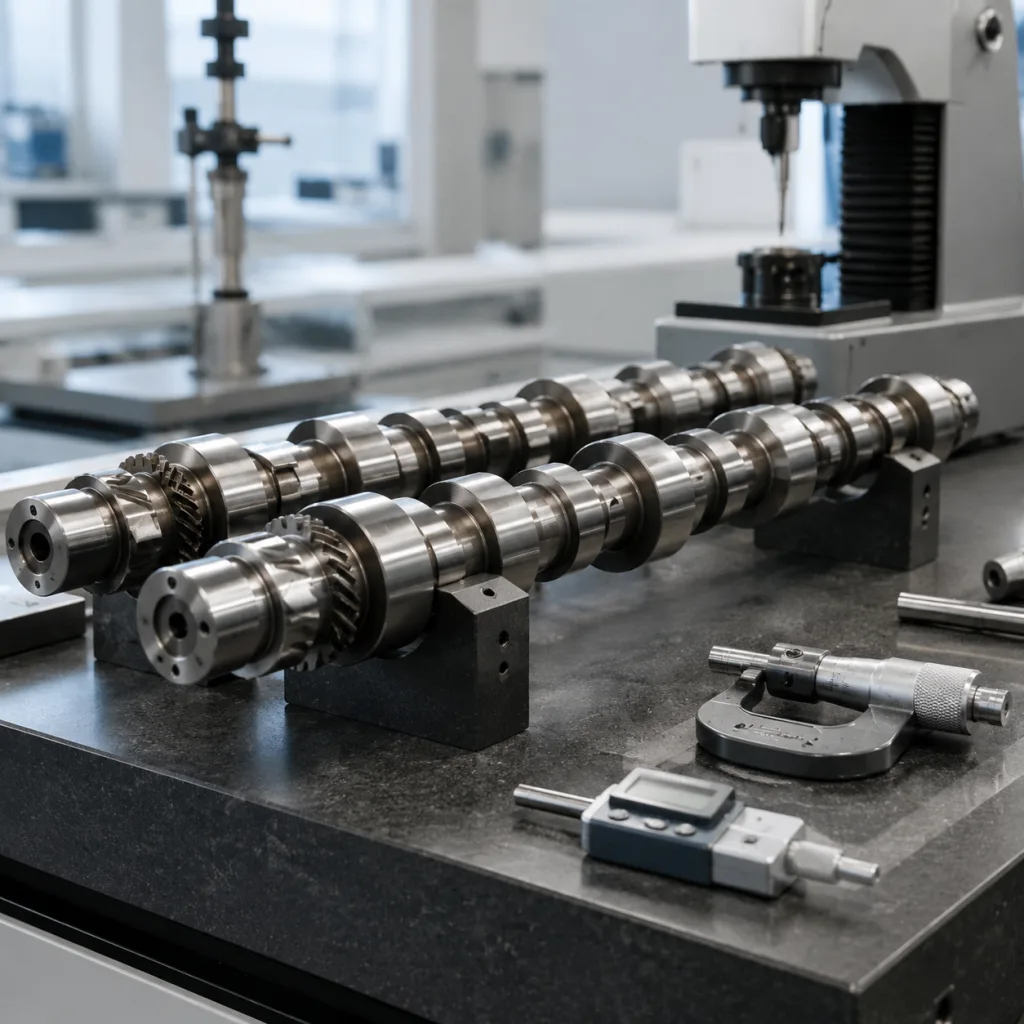
  • Main-journal and rod-journal diameter measurement
  • Journal roundness and cylindricity checks
  • Thrust-face width and surface-finish verification
  • Oil-hole position, chamfer and deburring inspection
  • Runout control after machining and grinding
  • Dynamic balancing for relevant crankshaft designs
  • Hardness checks after heat treatment, where specified
  • Visual inspection for cracks, burrs, dents, blocked oil passages and handling damage

The exact tolerances depend on the drawing, reference sample or confirmed part family. A credible supplier should not quote one universal tolerance for every crankshaft without first confirming the application and production route.

Supplier Evaluation Matrix

A crankshaft subaru supplier should be evaluated on repeatability and risk control, not unit price alone. A low initial quote can be outweighed by inspection sorting, warranty exposure, emergency air freight, customer downtime or rejected replenishment orders. The table below gives procurement teams a practical comparison structure.

</tr></thead><tbody> </tbody></table>For a new supplier, the first order should usually be treated as a controlled release rather than a routine replenishment order. Importers can inspect a pilot lot, compare results with the reference part and then move to scheduled blanket orders once dimensional performance, packaging and documentation are stable.

MOQ, Lead Time and Export Documentation

MOQ depends on the crankshaft family, packaging requirement, current inventory position and whether the order is catalogue supply or drawing-based production. Commercial variables may include casting or forging batch size, grinding fixture availability, heat-treatment schedule, surface-treatment requirement and carton branding. For mixed aftermarket orders, consolidated shipments can reduce per-unit freight cost and simplify receiving.

Lead time also depends on whether the part is in stock, held as semi-finished inventory or requires a new production run. Buyers should separate three milestones during the purchase process: sample readiness, mass-production completion and shipment departure. This prevents confusion between factory lead time, inspection time and total transit time.

A standard export file for crankshaft orders may include:

  • Commercial invoice and packing list
  • Certificate of origin, when requested
  • Inspection report for the production batch
  • Material or hardness report, where agreed
  • Carton label and pallet-mark confirmation
  • REACH (EC) No 1907/2006 statement for EU customers, where applicable
  • Any customer-specific declaration needed for importer records

Repair-chain buyers often need stable replenishment instead of a one-time purchase. In that case, share rolling forecasts, minimum stock targets and preferred shipment windows with the supplier. Distributors should also confirm whether carton dimensions, barcode positions, pallet configuration and private-label artwork can remain consistent across repeat shipments.

Audit Questions to Ask Before Approval

A factory audit does not need to be complicated, but it should focus on the process steps that affect crankshaft reliability and export consistency. Buyers can conduct an on-site audit, appoint a third-party inspector or request a remote document review before sample approval.

Key audit questions include:

  • Is each production lot traceable to material, machining, heat treatment and inspection records?
  • Are measuring instruments calibrated, identified and suitable for journal and runout checks?
  • How are non-conforming crankshafts segregated, recorded and reviewed?
  • What corrective-action process follows a dimensional failure or customer complaint?
  • Are oil holes deburred and inspected after machining?
  • Is packaging designed for heavy engine components and long-distance export handling?
  • Can the supplier provide batch inspection data before shipment?
  • How are drawing changes, customer specifications and private-label requirements controlled?

Driventus supports procurement reviews with process documentation, sample inspection data and packaging confirmation. For buyers that need proprietary dimensions, application consolidation or private-label control, the engineering and sales teams can review the project through custom manufacturing.

Driventus is an independent aftermarket manufacturer; brand names are referenced for fitment identification only.

How to Structure an RFQ

A clear RFQ reduces quotation time and prevents mismatched parts. In a crankshaft subaru supplier search, procurement teams should avoid sending only a vehicle name or a broad model description. Engine code, displacement, production-year range and market region are more useful because crankshaft specifications can vary across applications that appear similar in catalogue data.

A complete RFQ should define target quantity, expected annual demand, packaging requirement, inspection documents, incoterm and delivery schedule. If a sample part is available, include photos of the full crankshaft, main and rod journal areas, flange end, nose end, reluctor features, keyway details and oil-hole layout. If your team requires PPAP-style documentation, state the required elements at quotation stage rather than after production starts. Do not assume that a catalogue crankshaft and a drawing-controlled part will have the same price, MOQ or lead time.

Buyers can review related part families in our catalog, assess certification and inspection controls through the quality system, and then request a quote with part details, forecast, packaging needs and destination market.

Frequently asked questions

Yes. Driventus supplies crankshafts for selected Subaru-fitment engine applications for B2B buyers. Availability depends on engine code, year range, market region and quantity. Brand names are used for fitment identification only, and no vehicle manufacturer approval is claimed.

Importers should request the quotation sheet, application cross-reference, production lead time, packaging details, inspection report format and relevant quality certificates such as IATF 16949:2016 and ISO 9001:2015. EU buyers may also request REACH (EC) No 1907/2006 compliance statements where applicable.

Yes. A controlled sample or pilot lot helps verify journal dimensions, runout, thrust face geometry, oil-hole finish, balancing, documentation and packaging. After approval, buyers can move to scheduled orders or forecast-based replenishment.

If your team is comparing crankshaft sources for Subaru-fitment programs, send the engine details, target quantity and destination market. Driventus can review availability, MOQ and documentation requirements through /contact.html

Request a Quote
Evaluation area What to request Why it matters
CertificationIATF 16949:2016 and ISO 9001:2015 certificatesConfirms a documented automotive quality-management framework
Material controlSteel grade, supplier records and batch traceabilityReduces risk of mixed material, inconsistent hardness or unclear origin
Dimensional capabilityInspection reports for journals, runout and thrust facesConfirms fit, bearing clearance and assembly consistency
Surface controlRoughness readings and visual inspection criteriaSupports bearing life, oil-film stability and reduced rework
ValidationSample inspection, hardness data and balancing recordsProvides evidence before volume release
ComplianceREACH (EC) No 1907/2006 declarations where applicableSupports EU importer compliance files
LogisticsMOQ, packing method, pallet size and lead timeAffects landed cost, warehouse planning and replenishment timing
Audit readinessProcess flow, control plan and corrective-action recordsHelps sourcing teams assess supplier maturity