Crankshaft Pulley Mitsubishi Manufacturer in China
Procurement teams sourcing crankshaft pulleys for Mitsubishi applications need more than a dimensional match. The part sits at the front of the crankshaft, drives accessory belts, and in many designs helps control torsional vibration through a bonded rubber damping layer. A poor pulley can cause belt tracking faults, noise, accessory-drive instability, or premature wear at the crank nose. Driventus manufactures crankshaft pulleys and related engine components in Taizhou, Zhejiang, with export supply to aftermarket distributors, wholesalers, repair-chain programmes, and selected OEM or Tier-1 projects. For import managers and category buyers, the key questions are usually consistent: drawing control, material verification, rubber bonding, runout tolerance, packaging, MOQ, lead time, and whether the supplier can support ongoing cross-reference expansion. This article explains how to assess a crankshaft pulley Mitsubishi manufacturer China sourcing project using factory, quality, and commercial criteria.
Supplier Scope for Mitsubishi Crankshaft Pulley Programmes
Mitsubishi coverage typically includes passenger cars, light commercial vehicles, SUVs, and selected commercial engine families. Buyers may source a single crankshaft pulley for a repair-chain contract or build a wider range covering petrol and diesel applications across multiple markets.
Driventus supports standard aftermarket supply and project-based development. Standard items can be reviewed through our catalog, while pulley families connected with engine components can also be evaluated alongside timing, cooling, gasket, and rotating parts from /products/engine-components.html. For non-standard geometry, private-label ranges, or controlled drawings, buyers can use custom manufacturing to define a dedicated sourcing route.
Documentation: inspection report, material declaration, packing list, country-of-origin documentation, and batch traceability records.
Supply model: MOQ-based production, scheduled call-offs, mixed-container consolidation, and phased range expansion.
Driventus is an independent aftermarket manufacturer; brand names are referenced for fitment only.
Manufacturing Route and Critical Characteristics
A crankshaft pulley is a controlled rotating component, so the sourcing decision should cover machining accuracy and damping reliability. For damped pulleys, the rubber element is not cosmetic; it affects torsional vibration control and long-term pulley stability.
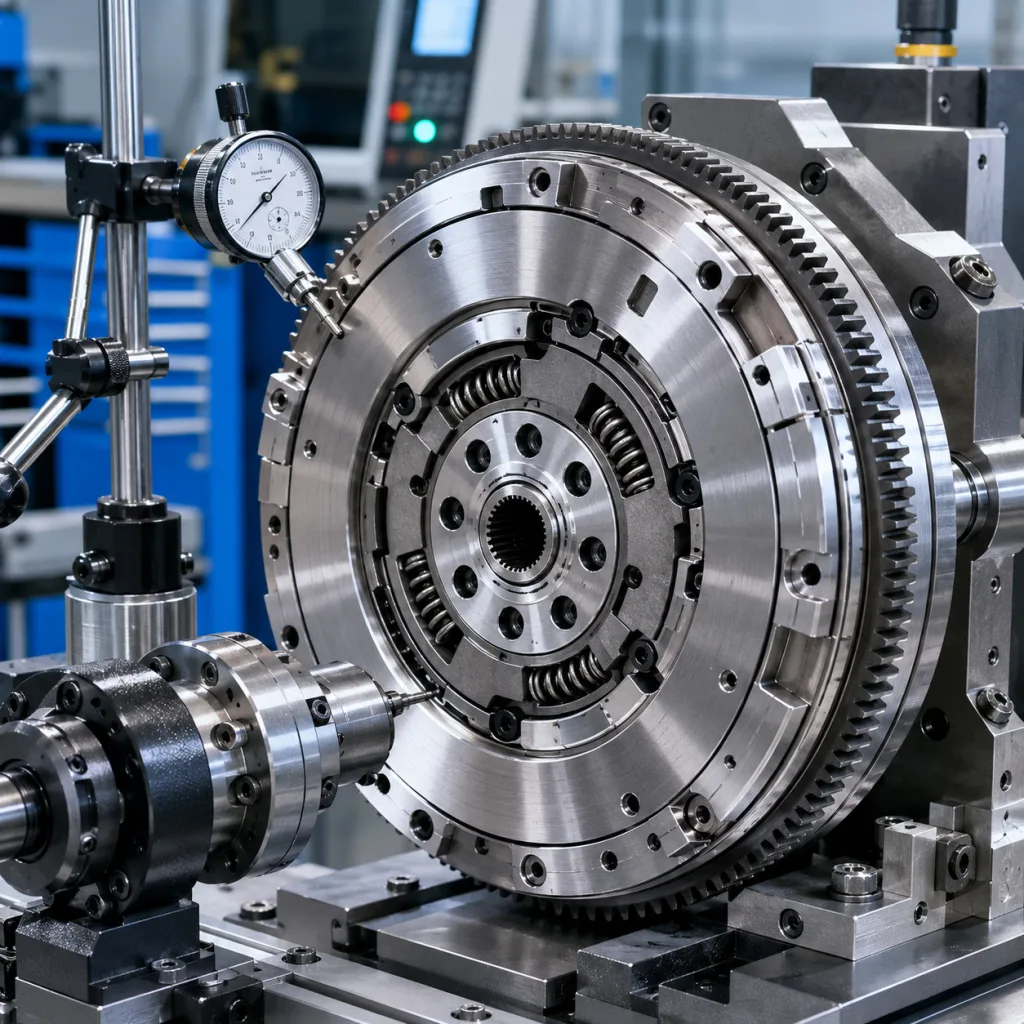
Key production stages normally include blank forming or casting, CNC turning, groove machining, hub bore finishing, rubber bonding where applicable, dynamic balance correction, surface treatment, and final inspection. The process route depends on part design and annual volume.
Control point
Procurement relevance
Typical evidence to request
Hub bore and keyway geometry
Fitment to crank nose and bolt alignment
Dimensional inspection report
Belt groove profile
Belt tracking, noise, and accessory-drive life
Profile gauge record or CMM data
Axial and radial runout
Vibration and belt stability
Runout inspection results
Rubber-to-metal bond
Damped pulley durability
Bonding process record and sample test
Dynamic balance
NVH and bearing load control
Balance report by batch or sample plan
Surface coating
Corrosion resistance in storage and service
Coating specification and salt spray result where required
</tr></thead><tbody> </tbody></table>For buyers comparing suppliers, the strongest signal is consistency in batch documentation. A low sample price has limited value if production lots cannot repeat the same bore, groove, balance, and rubber-hardness controls.
Quality System, Standards, and Audit Readiness
For a crankshaft pulley mitsubishi manufacturer china sourcing project, certification should be treated as the starting point, not the full answer. Driventus operates under IATF 16949:2016 and ISO 9001:2015 frameworks, with process controls structured for automotive production and export supply. Buyers can review the quality system before requesting technical files or audit support.
Relevant quality and compliance references may include:
IATF 16949:2016 for automotive quality management system requirements.
ISO 9001:2015 for quality management system structure and continual improvement.
REACH (EC) No 1907/2006 for restricted substance considerations in EU supply chains.
IMDS reporting when required by OEM or Tier-1 customer workflows.
Customer-specific inspection plans for fitment-critical and safety-relevant engine components.
Factory audit preparation should include a review of incoming material checks, machining control plans, gauge calibration, non-conforming product handling, traceability, packaging inspection, and corrective-action records. For damped pulleys, buyers should also ask how rubber compound batches are controlled and how bond quality is verified.
Driventus can support remote documentation review, video process review, and on-site audit coordination. The most useful audit scope is practical: select one pulley family, follow it from raw material to packing, and verify that the documented control plan matches the actual production floor.
MOQ, Lead Time, and Export Planning
Commercial feasibility depends on the range structure. A high-volume Mitsubishi-fitment pulley can be produced in planned batches, while slower-moving references may need consolidated production with related engine components. Procurement teams should define annual forecast, first-order quantity, target landed cost, and packaging requirements before price negotiation.
Typical sourcing variables include:
MOQ: depends on pulley design, tooling status, material route, and packaging format.
Sample timing: usually shorter for active catalog items; longer for reverse-engineered or drawing-based items.
Production lead time: affected by blank availability, rubber-bonding schedule, machining capacity, coating, inspection, and export packing.
Tooling: required for new rubber-damped constructions, casting blanks, forging routes, or unique groove profiles.
Logistics: sea freight, air freight for urgent samples, mixed-SKU cartons, and pallet-level labelling.
Buyers should avoid approving a programme on sample inspection alone. A better route is to confirm pre-production samples, packaging layout, inspection criteria, and a first mass-production batch report. This helps prevent common import issues such as mixed labels, carton compression, inconsistent anti-rust treatment, or insufficient batch identification.
For distributors, range planning should also include slow-moving SKU policy. Driventus can quote active items separately from development items, allowing buyers to launch faster-moving pulley references first while validating additional coverage.
Cross-Reference Management and Fitment Control
Mitsubishi crankshaft pulley sourcing often begins with an OE reference, an aftermarket competitor number, or a sample removed from an engine. Cross-reference work must be handled carefully because pulley variants can look similar while differing in offset, groove count, outer diameter, bolt pattern, or damping design.
A robust request should include photos, dimensions, target market, engine code where available, and any existing reference numbers. If an OE-style reference is provided, keep the format exact, for example OE 11251… or OE 06A… only when it is already part of the buyer’s source data. Driventus does not claim approval or endorsement by any vehicle manufacturer.
Minimum Fitment Data to Submit
Existing part number or buyer reference.
Vehicle application list by model year and engine.
Pulley outer diameter, hub bore, offset, overall width, and belt groove count.
Bolt pattern and keyway details where applicable.
Photos of front, rear, side profile, and any timing marks.
Annual demand estimate and target launch market.
Fitment validation should compare both geometry and function. For a damped pulley, the rubber ring position, hardness range, and bond width matter as much as the visible metal profile. A part that mounts correctly but shifts belt alignment by a small amount can still create warranty exposure in repair-chain or fleet applications.
How Buyers Should Evaluate Quotations
Price comparison is useful only when quotations are technically aligned. A crankshaft pulley made from a different blank process, coating, inspection level, or packaging specification may not be equivalent. When comparing China suppliers, ask each factory to state the same assumptions in writing.
Use this checklist before supplier nomination:
Confirm whether the quote is for an active item, modified item, or new development.
Request material specification and surface treatment description.
Confirm whether dynamic balancing is included and at what inspection frequency.
Ask for critical dimensions and tolerances used in production inspection.
Confirm rubber compound control for damped pulleys.
Review carton quantity, pallet size, label format, and moisture protection.
Check whether PPAP-style documentation is available if required by the customer.
Confirm Incoterms, sample cost, tooling ownership, payment terms, and production lead time.
Driventus can support distributors and sourcing teams that need a structured comparison package rather than a single-line price. To start a technical and commercial review, buyers can request a quote with target references, volumes, packaging requirements, and any customer-specific inspection criteria.
Frequently asked questions
Provide the existing reference number, application list, photos, main dimensions, groove count, bore size, offset, annual volume, packaging requirement, and target market. A physical sample or controlled drawing is recommended for damped pulleys or uncommon references.
Yes. Driventus can support neutral packaging, customer labels, barcode formats, carton specifications, and private-label export programmes. Requirements should be confirmed before quotation because packaging, label control, and MOQ can affect cost and lead time.
No. Driventus is an independent aftermarket manufacturer; brand names are referenced for fitment only. Product development and supply are based on dimensional matching, material control, inspection, and agreed customer specifications.
For Mitsubishi-fitment crankshaft pulley sourcing, send the reference list, annual volume, target market, and packaging requirements for review. Start with a technical quotation request at /contact.html