Crankshaft Pulley Ford OEM Supplier Sourcing Guide
A Ford-fit crankshaft pulley is not a catalog placeholder. It is a rotating, damped engine component where a small error in bore, offset, rubber bonding, groove geometry, or balance can become belt noise, vibration, warranty claims, or outer-ring movement. That is why sourcing teams need more than a price and a photo. They need proof that the supplier can hold the drawing, repeat the process, protect the part in transit, and separate genuine OE claims from independent aftermarket manufacturing. Driventus supplies crankshaft pulleys and related engine components from Taizhou, Zhejiang, for aftermarket distributors, wholesalers, repair-chain programs, and OEM or Tier-1 sourcing projects. Production follows IATF 16949:2016 and ISO 9001:2015 procedures, with export experience across more than 60 countries. This guide gives buyers a practical way to assess a crankshaft pulley Ford OEM supplier, request the right technical evidence, and structure RFQs that lead to stable quality and commercial outcomes. Driventus is an independent aftermarket manufacturer; brand names are referenced for fitment only.
Decision Gates Before You Nominate a Supplier
Start with the failure risk, not the catalog match. A crankshaft pulley, often called a harmonic balancer on Ford engine programs, transfers crankshaft rotation to belt-driven accessories while helping reduce torsional vibration. The risk rises when a supplier treats it as a simple machined wheel and does not control the relationship between hub, rubber damping element, and outer inertia ring.
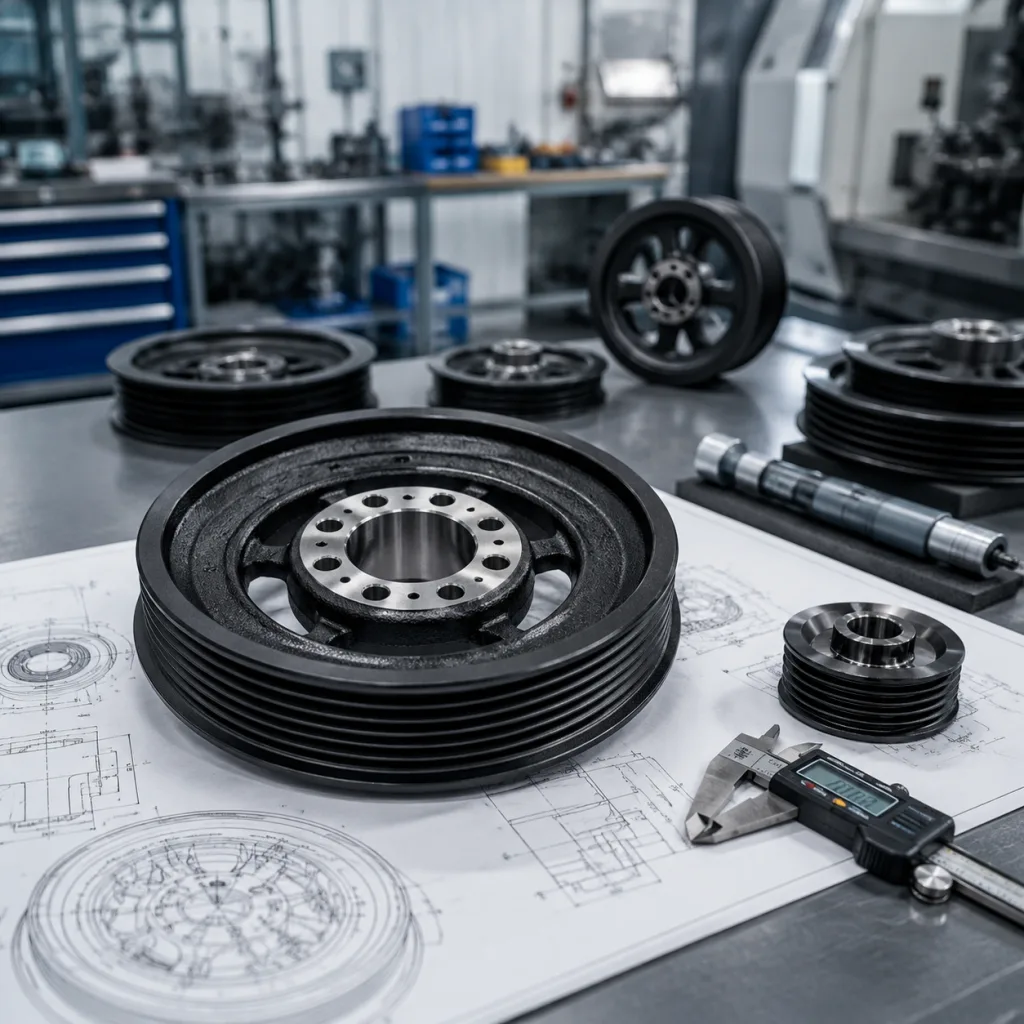
For Ford-fit programs, confirm capability against the target engine family, belt profile, pulley offset, crank bore geometry, keyway design where applicable, bolt pattern, and runout limits. Your RFQ should state outside diameter, bore diameter, pulley width, rib count, pitch, offset from mounting face, keyway width and depth, bolt PCD, center-hole chamfer, and finish requirement. If an OE part-number family such as OE 06A… or OE 11251… appears in the request, use it only as a fitment cross-reference. Final drawing data still controls tooling, sampling, and price approval.
Use nomination gates instead of trusting photos:
Gate 1: drawing or approved sample confirmation
Gate 2: tooling review and first-article approval
Gate 3: pilot order inspection, including packaging review
Gate 4: mass-production release after traceability is proven
At each gate, ask for evidence. A credible crankshaft pulley Ford OEM supplier should provide a process flow, control plan, inspection report, and sample submission record before mass production. Stronger suppliers will also explain how they prevent bond failure, ring movement, corrosion, and packaging damage during long-distance export.
Supplier screening should cover:
Business scope: aftermarket distribution, private label, or OEM/Tier-1 project support
Quality certification: IATF 16949:2016 and ISO 9001:2015 scope relevance
Process control: casting or forging source, CNC machining, rubber bonding, balancing, and inspection
Export readiness: HS code support, carton labeling, palletization, commercial invoice, packing list, and bill-of-lading data
Compliance awareness: REACH (EC) No 1907/2006 for EU chemical substance controls
Where Ford-Fit Pulley Programs Usually Fail
Most crankshaft pulley problems are predictable. They appear when tolerances are assumed, bonding is treated as a black box, or inspection is limited to visual checks. The main technical variables are concentricity, axial runout, belt-groove geometry, rubber damping behavior, torque durability, and corrosion resistance. Small deviations can create belt noise, accessory vibration, premature belt wear, customer complaints, or separation of the outer ring after heat and load cycling.
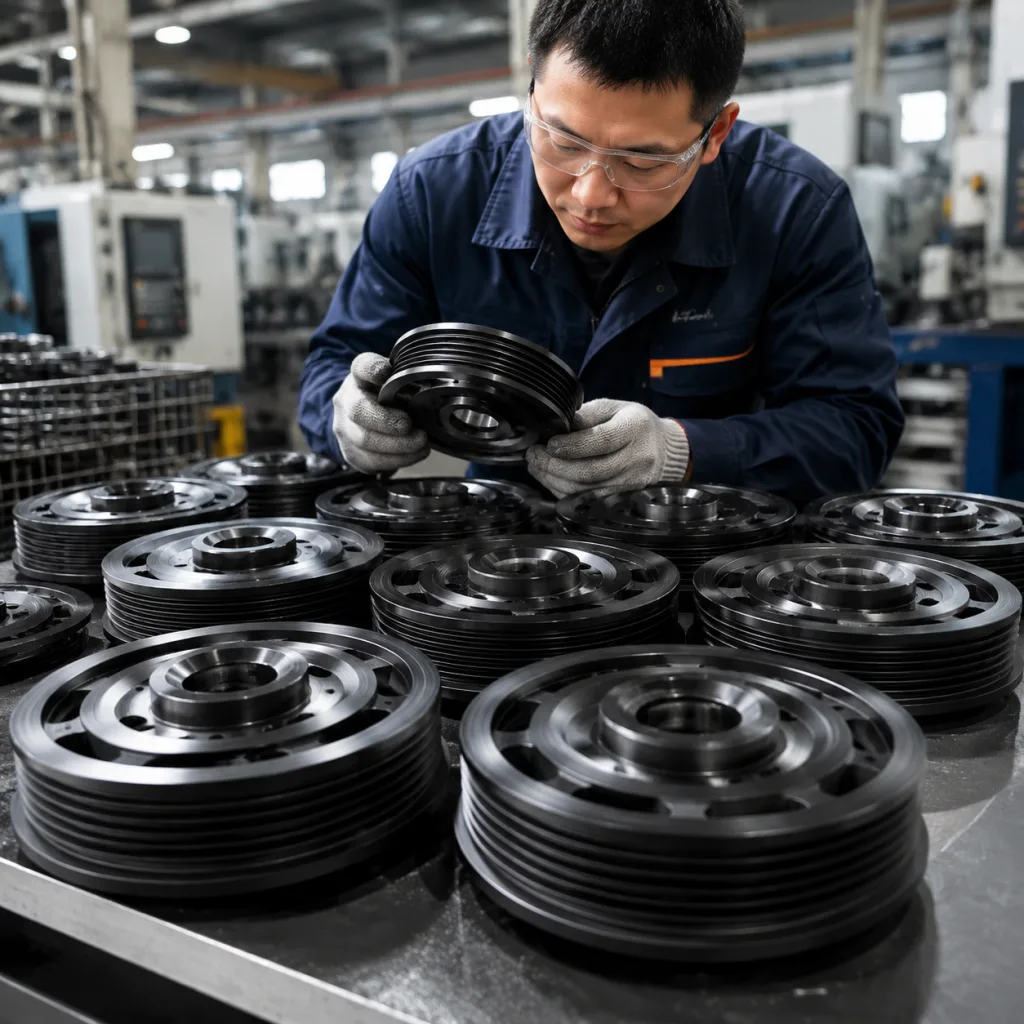
Driventus manages production through controlled machining, bonding, finishing, and inspection stages. A practical route is incoming metal and rubber verification, blank machining, hub and ring CNC turning, groove cutting, surface preparation, primer or adhesive application, rubber vulcanization or bonding, final machining where required, coating, dynamic balance, marking, final inspection, and export packing. Typical checks include coordinate measurement for critical datums, dynamic balance verification where required, rubber adhesion checks, surface hardness verification for metallic sections, and visual inspection for casting defects or coating inconsistency.
Failure mode
Control point
Procurement requirement
Crank nose misalignment
Bore diameter and datum position
Drawing-controlled; common tolerance bands are ±0.02–0.05 mm
Belt tracking noise
Axial and radial runout
Commonly ≤0.10–0.20 mm TIR unless drawing states tighter
Premature belt wear
Rib count, pitch, angle, and effective diameter
Gauge-checked groove profile
Outer ring slip
Adhesive lot, cure time, cure temperature, rubber lot
Sample peel or shear test where specified
Engine-speed vibration
Dynamic balance
g·mm limit or ISO 21940 grade by application
Storage or field corrosion
Zinc phosphate, e-coat, paint, or oiling
Salt spray often 48–240 h when specified
</tr></thead><tbody> </tbody></table>For OEM or Tier-1 projects, request PPAP-level documentation where applicable, including dimensional results, material records, capability evidence, and control plan alignment. For aftermarket programs, a documented first-article inspection, retained golden sample, and production batch traceability are often sufficient, depending on market, warranty exposure, and customer risk.
Set acceptance criteria before samples ship. A useful sample plan is 5–10 pieces for dimensional layout, 1–2 pieces for destructive section or bond review where allowed, and retained masters at both buyer and supplier sites. For repeat production, buyers commonly require AQL final inspection such as general level II with critical defects at 0, major defects at 1.0–2.5, and minor defects at 2.5–4.0, adjusted to warranty risk.
MOQ, Lead Time, and Landed-Cost Trade-Offs
The lowest unit price is not always the lowest cost. A supplier can quote aggressively and still create losses through high MOQ, slow replenishment, weak cartons, missing barcode data, or mixed-SKU pallets that slow inbound receiving. Supplier selection is technical, but it is also operational.
MOQ depends on pulley design, tooling condition, raw material availability, finishing process, and packaging format. Active references in regular production can often support lower quantities than new-tooled or slow-moving applications. As a working benchmark, stocked or shared-production references may start around 100–300 pieces per SKU. Non-stock references commonly require 300–800 pieces per SKU. New development can require 500–1,500 pieces or a tooling contribution, especially when a new casting, forging, rubber mold, balance fixture, or private-label carton is required.
Typical sourcing parameters:
Existing reference MOQ: negotiated by SKU mix, annual forecast, and whether production is already scheduled
New development MOQ: linked to tooling cost, sample validation, and first production run
Sample lead time: usually 30–60 days after drawing or sample confirmation; complex bonded dampers may need 60–90 days
Mass production lead time: commonly 45–75 days after order confirmation, deposit, and packaging approval
Price logic: raw material index, machining time, balance requirement, coating, inspection level, and carton format
Packaging: neutral box, private label box, bulk service packaging, VCI bag, inner sleeve, or palletized export cartons
Shipment terms: FOB Ningbo or Shanghai, with EXW, CIF, DAP, or other Incoterms available by agreement
Separate unit price from total landed cost. For export packing, specify single-piece box size, gross weight limit per carton, carton burst strength or compression target, pallet height, edge protection, moisture protection, and whether mixed-SKU cartons are allowed. Private label orders need earlier planning because printed cartons, barcodes, inserts, and customer-specific labels may have their own minimum runs.
Buyers can review related engine component coverage in our catalog and discuss pulley-specific program planning through custom manufacturing. For consolidated import programs, combining crankshaft pulleys with gaskets, water pumps, pistons, or timing-related parts can improve container utilization, simplify supplier management, and reduce per-unit logistics cost.
Audit Evidence That Matters More Than Certificates
Certificates are only the entry ticket. IATF 16949:2016 and ISO 9001:2015 show that the quality management system has been assessed, but they do not prove that a specific crankshaft pulley family is controlled on the shop floor.
A practical audit should follow one recent batch from finished goods back to source records. Ask for the traveler card or MES record. The chain should connect metal heat number, rubber compound batch, adhesive lot, cure date, operator, machine, gauge ID, coating lot, final inspector, carton label, and warehouse location without manual rewriting. Review the supplier’s quality system before requesting samples so engineering and procurement teams can align inspection criteria early.
Documents to request with RFQ or sample order
Valid IATF 16949:2016 and ISO 9001:2015 certificates with scope matching engine or machined component production
Product drawing or specification confirmation sheet with revision, tolerance, and approved deviation fields
Process flow chart, PFMEA summary, and control plan for the pulley family
Material declaration and REACH (EC) No 1907/2006 compliance statement where required
Dimensional inspection report for first samples, preferably listing all critical and special characteristics
Capability data for controlled dimensions when volume justifies it, commonly Cpk ≥1.33 for stable critical features
Packaging specification with drop-test or compression requirement if applicable
Batch traceability format and retention period, commonly 3–5 years for aftermarket programs unless contract states longer
During audit scoring, treat uncontrolled rubber storage, missing cure records, uncalibrated runout gauges, and unclear rework rules as major findings. Cosmetic burrs, carton scuffing, or incomplete operator training logs may be minor only if containment and corrective action are clear. Define 8D response timing before orders start: 24-hour acknowledgement, 48-hour containment, and root-cause action plan within 5–10 working days.
For EU, UK, US, Canada, Australia, and Brazil importers, documentation consistency reduces customs delays and supports warranty analysis. It also helps category managers compare suppliers on evidence rather than catalog claims, especially when several factories quote the same OE-style reference with different construction details.
RFQ Build Sheet for Ford Applications
Do not send only the phrase crankshaft pulley ford oem supplier and a target price. That phrase describes the sourcing target, not the product. The technical package must identify the engine application, pulley construction, belt arrangement, and performance requirements.
Build the RFQ around the data that controls fit, durability, and receiving efficiency:
Vehicle application range, engine code, displacement, fuel type, market, and model years
OE cross-reference format, for example OE 06A… only when used as a fitment reference
For quote comparison, ask every supplier to return the same template: unit price by quantity break, tooling charge, sample cost, MOQ, sample lead time, mass-production lead time, payment terms, Incoterm, packaging cost, estimated carton quantity, gross weight, and validity period. A useful price-break format is 100, 300, 500, 1,000, and 3,000 pieces per SKU, or the buyer’s real demand bands. Require suppliers to state assumptions instead of hiding them inside the quotation.
Driventus can support reverse engineering from approved samples where drawings are unavailable, but procurement teams should confirm ownership and permitted use of any supplied data. Brand names and application references are used only to identify fitment. Driventus does not claim approval or endorsement by any vehicle manufacturer.
The strongest RFQ response is not always the lowest quote. It is the response that confirms dimensional control, traceable production, realistic lead time, stable packaging, and a repeatable claims-handling process.
Best-Fit Scenarios for Working With Driventus
Driventus is a good fit when the buyer needs more than spot purchasing. Typical cases include stable aftermarket supply, private label support, controlled development, or consolidation across crankshaft pulley and broader powertrain component programs. The company manufactures engine and powertrain components in Taizhou, Zhejiang, and exports to more than 60 countries.
Procurement teams usually engage Driventus when they need:
Multi-SKU sourcing for engine components from a single manufacturing group
Controlled crankshaft pulley production for Ford-fit aftermarket programs
Audit-ready quality records, batch traceability, and first-article reporting
MOQ planning across fast-moving and slow-moving references instead of one rigid SKU rule
Support for distributor packaging, barcoding, carton marking, pallet plans, and export documentation
Technical discussion with engineering staff before tooling, reverse engineering, or sample approval
Consolidation of pulleys with related engine components from engine components
A staged rollout works well for strategic programs. Start with 3–5 priority SKUs for sample approval. Place one pilot order of 100–300 pieces per active SKU where available. Inspect incoming parts against agreed drawings. Then review quarterly demand before adding lower-volume applications. This limits commercial exposure while testing supplier stability, technical responsiveness, and order repeatability.
Driventus is an independent aftermarket manufacturer; brand names are referenced for fitment only.
Frequently asked questions
Yes. Driventus can support neutral packaging or private label packaging, subject to MOQ, artwork approval, barcode requirements, and carton specifications. Brand references are used only for fitment identification.
Request the certification scope, drawing confirmation, first-article dimensional report, material statement, process flow, control plan, and packaging specification. For EU programs, include REACH (EC) No 1907/2006 compliance needs.
No. Driventus is an independent aftermarket manufacturer and does not claim vehicle manufacturer approval or endorsement. Brand names and OE-style references are used only to identify fitment.
Send your application list, annual forecast, packaging requirements, and any approved samples for technical review. To discuss availability, MOQ, and lead time, [request a quote](/contact.html).