Crankshaft Pulley Audi Manufacturer China: Supplier Guide
Buyers sourcing a crankshaft pulley for Audi applications usually need more than a part name. They need the correct hub bore, belt alignment, torsional specification, surface finish, and documentation that will survive a supplier audit. For aftermarket programmes, the main risks are dimensional drift, poor dynamic balance, and mixed-fit references across engine codes. Driventus supplies engine and powertrain components from Taizhou, Zhejiang, with export support for distributors, repair networks, and OEM/Tier-1 buyers. Driventus is an independent aftermarket manufacturer; brand names are referenced for fitment only. This article explains what procurement teams should check before placing volume orders, how to compare material and balance options, and which quality documents matter when the part is sourced from China for EU, UK, US, Canada, or Brazil markets.
What buyers should verify first
Start with the fitment record, not the vehicle badge. For Audi platforms, the same external appearance can hide different crankshaft nose diameters, offsets, and pulley or damper constructions. Review our catalog and, if you need adjacent engine parts, engine components before asking for samples.
Buyer check
Why it matters
Driventus control
Engine code and VIN
Confirms bore, offset, and belt path
Cross-reference by drawing or sample
Damper or solid pulley
Prevents vibration or accessory drive mismatch
Material and construction are specified per reference
Groove profile
Keeps belt tracking stable under load
Profile gauges and first-article inspection
Finish and coating
Affects corrosion and squeal risk
Surface requirement defined on the drawing
Packaging and labelling
Protects traceability in transit
Batch labels and export cartons
</tr></thead><tbody> </tbody></table>For procurement, the correct question is not 'Does it fit an Audi?' but 'Does it fit this engine code, this belt system, and this OE reference revision?'
Materials, balance, and durability
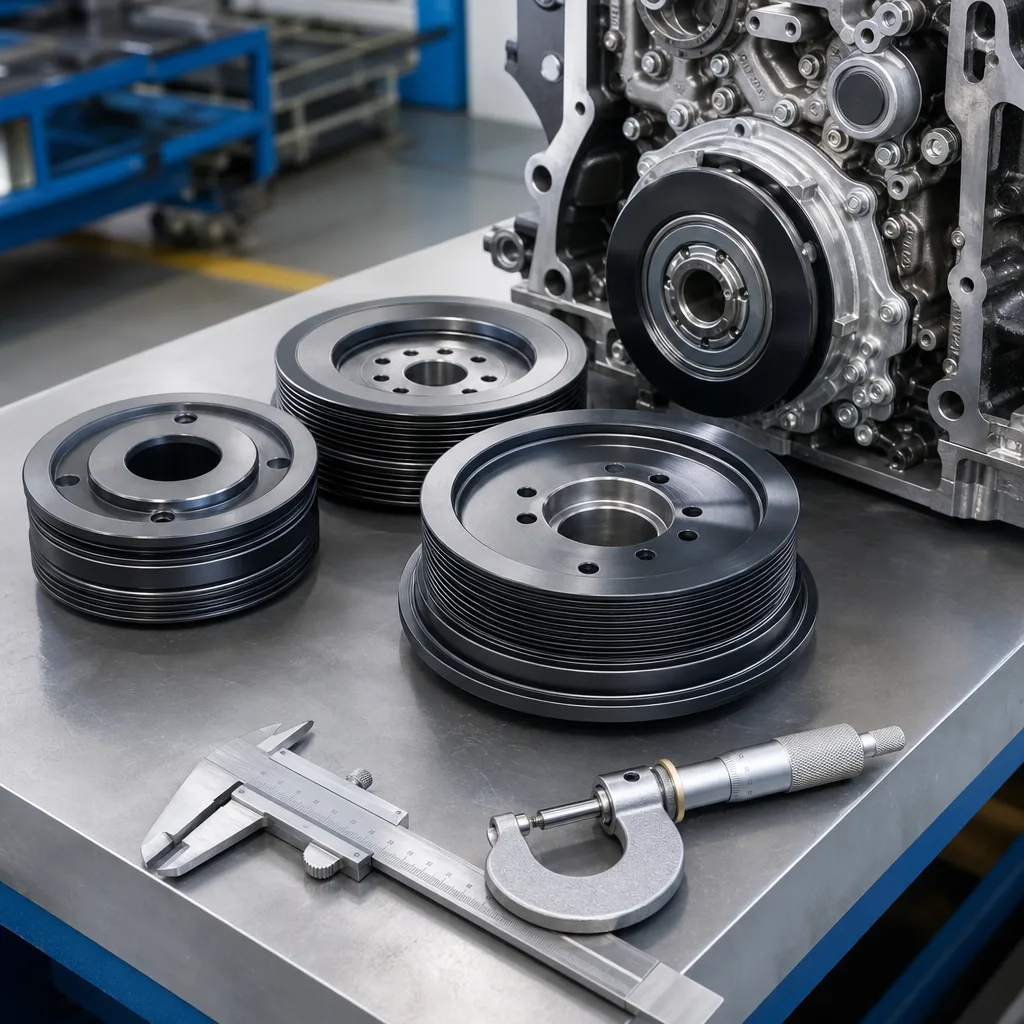
A crankshaft pulley may be a simple drive pulley or a torsional damper assembly. The difference matters because it changes vibration control, weight, and inspection method. For high-volume sourcing, buyers usually ask for a defined material, a fixed mass range, and a balance check on every production lot.
Typical procurement targets include:
Cast iron or forged steel hub for strength and wear resistance
Elastomer-bonded construction where torsional damping is required
Finished radial runout target of 0.05 mm or better on the critical datum
Dynamic balance verification before shipment
Coating or phosphate treatment when corrosion resistance is specified
If the programme needs a coated part, material declarations should be checked against REACH (EC) No 1907/2006. For coated samples, some buyers also request corrosion exposure data aligned with SAE J2527. The practical point is simple: the supplier should be able to show how the part is built, how it is checked, and what changes are controlled on the drawing.
Quality documents that reduce risk
A reliable supplier file is more than a declaration of origin. For B2B buyers, the minimum pack should include dimensional reports, material certificates, traceability records, and a clear revision history for any fitment change.
Driventus operates under a quality system aligned with IATF 16949:2016 and ISO 9001:2015. For new programmes, we can support control plans, first-article inspection, and approval samples before volume release. Where the application is part of a wider engine package, buyers may also ask for system-level evidence that supports the broader validation file, including references to ECE R-83 where relevant to the vehicle programme.
What procurement teams should ask for:
CMM or dimensional inspection report
Balance record for the sampled lot
Material certificate and coating declaration
Packaging specification and labelling format
Change-control notice for any drawing revision
This is the difference between an item that can be purchased and an item that can be qualified.
MOQ, lead time, and factory audit
China sourcing is usually won or lost on process control, not unit price alone. A low quote is not useful if the supplier cannot hold the same offset, finish, and balance spec across repeat orders.
For existing references, buyers typically want a controlled MOQ, stable packaging, and a repeatable re-order path. For new references, the workflow should include sample approval, a pilot run, and final sign-off on the drawing and carton specification before mass production starts.
A factory audit should confirm:
Incoming material checks and lot traceability
In-process gauging at the critical dimensions
Final inspection records for groove, bore, and runout
Document control for revision management
Export packing that protects machined faces and balance marks
If your team is comparing suppliers, ask for evidence rather than promises. Lead time should be explained by tooling status, inspection steps, and logistics plan, not by a generic sales estimate.
When custom manufacturing is justified
Not every programme should buy a catalogue reference. Custom work is justified when the drive system has a unique offset, a non-standard belt width, a different mass target, or a private-label requirement that must be consistent across regions.
The vehicle platform has multiple pulley revisions
The customer wants a revised material or coating
The reference needs branding-neutral packaging for distribution
The programme needs a dedicated inspection fixture or gauge set
The buyer wants one drawing control point across several markets
Custom development is also the safer route when a replacement part must match a specific OE reference by drawing rather than by visual similarity. That is especially important for Audi fitments, where small differences in offset or torsional behaviour can create noise, belt wear, or service returns. For that reason, sample approval should always happen before volume release.
If you need a direct commercial path, use request a quote and include the engine code, drawing, sample photo, and target annual volume.
Frequently asked questions
Yes. Engine code and OE cross-reference are the safest way to prevent fitment errors. Vehicle model alone is often too broad for crankshaft pulley sourcing, especially on Audi applications with multiple revisions.
We can provide dimensional inspection data, material declarations, traceability records, and packaging specifications. For new programmes, we can also support sample approval and revision control under IATF 16949:2016 and ISO 9001:2015.
Yes. Drawing-based and private-label supply are both possible when the technical data is complete. The usual starting point is a sample, target annual volume, and the required finish, balance, and packaging specification.
If you need a drawing check, sample, or private-label supply plan, start with our [request a quote](/contact.html).