Crankshaft Pulley Alfa Romeo Supplier: B2B Sourcing Guide
Procurement teams looking for a crankshaft pulley Alfa Romeo supplier need more than a part-number match. They need controlled dimensions, verified concentricity and balance, stable belt geometry, and a factory that can repeat those results across model years and engine codes without fitment drift. For aftermarket distributors, repair chains, and Tier-1 buyers, the main risks are incorrect pulley offset, belt alignment errors, inconsistent damping on elastomer designs, and variation between shipment batches. Driventus supplies engine and powertrain components from Taizhou, Zhejiang, with export experience in 60+ countries and production managed under IATF 16949:2016 and ISO 9001:2015. Driventus is an independent aftermarket manufacturer; brand names are used for fitment reference only. This guide explains how we support sourcing, which specifications buyers should check, and how to reduce landed-cost and quality risk when evaluating suppliers for Alfa Romeo applications.
What buyers should verify before placing an order
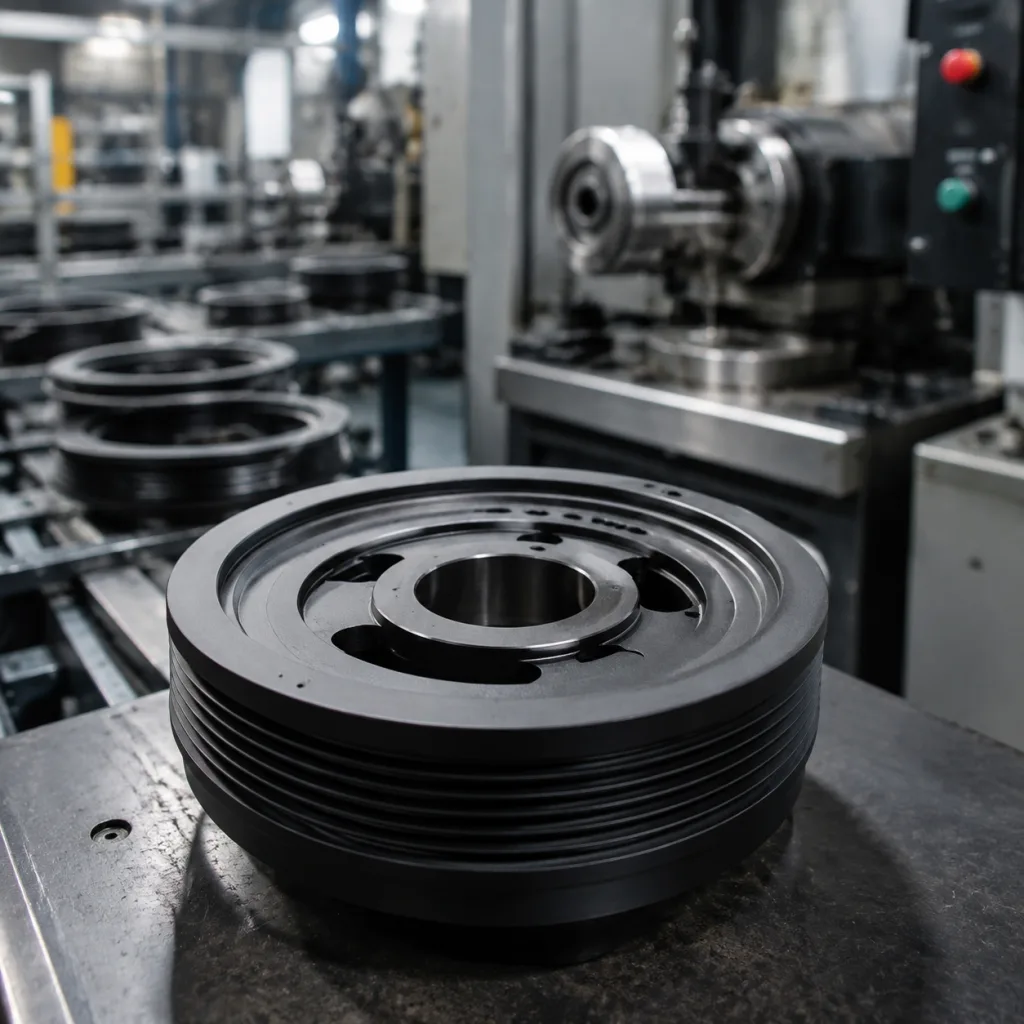
For a crankshaft pulley, fitment is about much more than outside diameter. Buyers should confirm the groove count, offset, bore diameter, keyway or locating feature, hub depth, bolt pattern, and whether the part is a solid pulley or a torsional damper design. A small difference in any of these details can affect belt tracking, accessory drive alignment, or NVH performance.
Minimum procurement checks
- OE cross-reference: confirm the OE reference only when it is already used in your catalogue record and internal fitment file
- Belt profile: V-ribbed or other profile, number of ribs, belt width, and effective running diameter
- Material: cast iron, steel, or aluminium alloy with bonded elastomer, depending on engine design and service requirements
- Runout and balance: verify measured values against your internal acceptance limit and inspection method; many buyers specify total indicated runout at or below 0.10 mm and dynamic balance within a defined gram-centimetre limit
- Surface finish: coating type, machining consistency, corrosion protection, and edge condition
- Packaging: unit protection for export, label traceability, carton strength, and batch coding
- Installation interface: bolt pattern, locating feature, and any sensor or trigger-wheel relationship if applicable
For Alfa Romeo sourcing, two pulleys that look identical can still differ by engine family, production year, crank nose geometry, and accessory layout. A capable supplier should provide dimensional drawings, mass data, and sample verification before mass production. That becomes especially important when a buyer is consolidating SKUs across several European distribution markets or replacing slow-moving OE references with a controlled aftermarket equivalent.
How Driventus supports procurement teams
Driventus is structured for B2B supply rather than retail fulfilment. That distinction matters when buyers need stable monthly replenishment, export documentation, and a clear quality approval path instead of one-off dispatch.
We support:
1. Batch production with traceability for incoming material, in-process checks, and finished goods 2. OEM-style drawing control for confirmed fitment data and revision tracking 3. Private label and neutral packaging for distributors, wholesalers, and regional importers 4. Lower-volume programme support for repair chains and launch-phase orders 5. Custom manufacturing when a customer needs a revised bore, offset, pulley width, groove profile, or damping specification - see custom manufacturing
Our catalog includes engine and powertrain parts across multiple families. Buyers can start with our catalog or review the engine component overview at [/products/engine-components.html].
If your team needs a second-source programme, we can align the part file to your target drawings and supply sample sets for bench verification before release. This approach helps buyers qualify a new supplier while keeping existing inventory flow and warehouse receiving procedures stable.
Quality controls used for pulley production
A supplier should be able to show how each critical feature is controlled from raw material through to the packed carton. Driventus operates under IATF 16949:2016 and ISO 9001:2015, with documented inspection at incoming, in-process, and final stages. Our quality system covers dimensional checks, torque-sensitive assembly steps where relevant, and packaging inspection, giving buyers a clearer audit trail for every shipment.
| Control point | What is checked | Typical purpose | |
|---|---|---|---|
| Incoming material | chemistry, hardness, certification | reduce fracture, wear, and dimensional drift risk | |
| Machining | OD, bore, groove geometry, offset, concentricity | maintain belt alignment and fit consistency | |
| Balance check | static or dynamic balance | reduce NVH, bearing load, and premature wear | |
| Surface inspection | coating coverage, corrosion signs, burrs, defects | improve storage stability and handling quality | |
| Bonding inspection | elastomer adhesion, visual separation, cure consistency | support torsional damping durability | |
| Final audit | label, quantity, fitment code, carton condition | prevent shipment errors and mis-picks |
| Option | Strengths | Risks | Best use case |
|---|---|---|---|
| Catalogue aftermarket supplier | faster availability, lower tooling cost, easier replenishment | broader fitment may need verification and revision control | distributors and repair chains |
| OE-level contract manufacturer | tight process control, stable documentation, stronger validation discipline | higher programme setup effort and longer qualification cycle | Tier-1 and long-term contracts |
| Local reman or small workshop source | short distance, flexible service, low minimum quantities | limited traceability, inconsistent dimensions, and variable finish quality | low-volume urgent replacement |