Crankshaft Opel Manufacturer China: Sourcing Guide
Procurement teams sourcing a crankshaft Opel manufacturer China supplier usually need more than a price. They need dimensional consistency, stable metallurgy, traceable inspection records, and delivery terms that support aftermarket or OEM programme schedules. For Opel applications, buyers should confirm the engine code, OE cross-reference, journal sizes, fillet radii, and heat-treatment method before placing a trial order. Driventus supplies crankshafts as an independent aftermarket manufacturer; brand names are referenced for fitment only. We manufacture in Taizhou, Zhejiang, and export to 60+ countries under IATF 16949:2016 and ISO 9001:2015 systems. This matters when you need repeatable batches, documented control plans, and practical factory-audit evidence. The sections below summarise what to verify, how to compare suppliers, and what technical data to request before award.
What buyers should verify before sourcing
For a crankshaft Opel manufacturer China search, start with the application data, not the supplier name. Confirm engine family, displacement, cylinder count, bearing journal count, thrust location, and OE cross-reference where available. If the catalogue lists an OE number, use it only as a fitment reference, for example OE 06A107065. Do not assume interchangeability across cast, forged, or nitrided variants.
Minimum data request
Engine code and vehicle range
OE cross-reference and supersession history
Main journal and rod journal diameters
Overall length, flange pattern, and keyway dimensions
Material specification and heat treatment
Surface hardness target and depth of hardening
Runout, roundness, and balance limits
Packaging standard and corrosion protection
A serious supplier should answer with drawings, inspection records, and batch traceability. If the response is only a quotation and freight term, the part should be treated as unqualified.
Dimensional control and material requirements
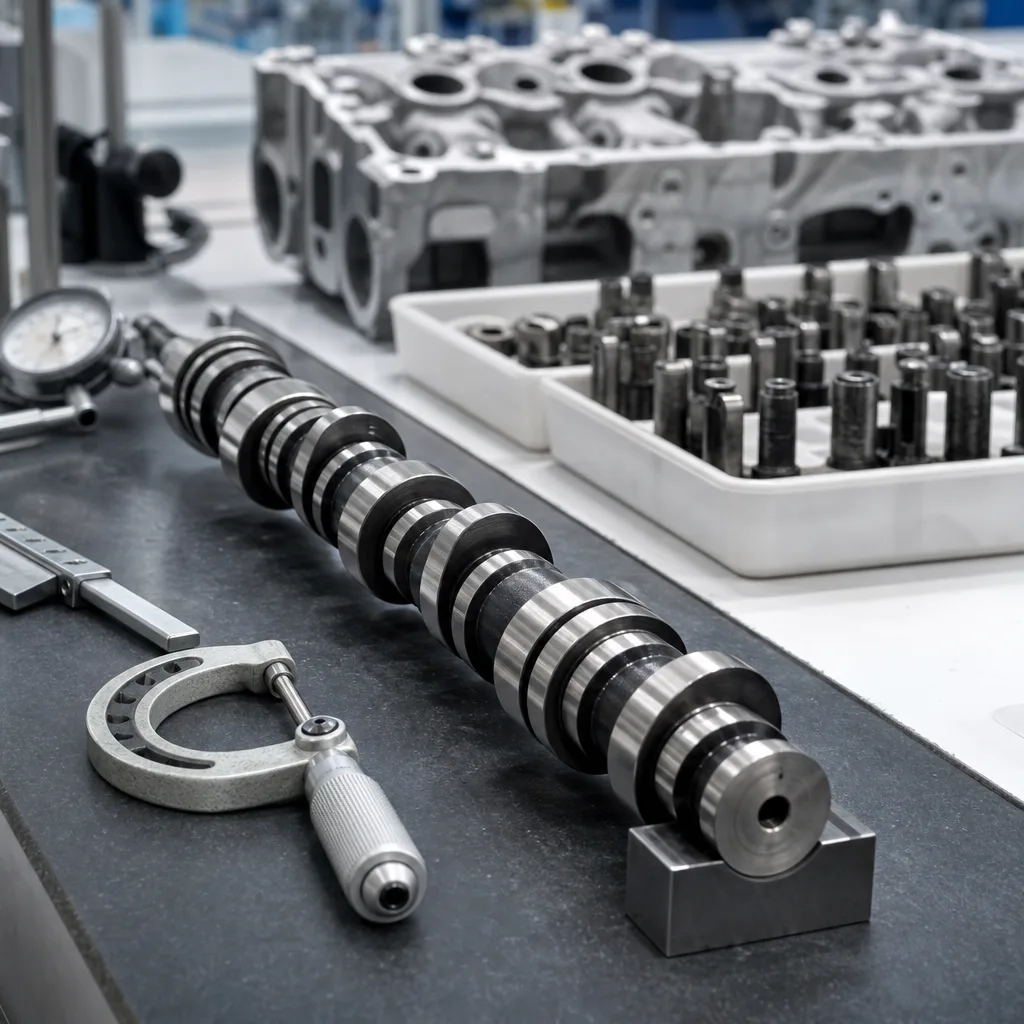
Crankshaft quality is driven by geometry and metallurgy. Buyers should ask for the base material grade, forging or casting route, and the final machining sequence. Typical production checks include journal diameter, fillet radius, offset, straightness, and dynamic balance. For passenger car applications, runout control is commonly specified in microns, not millimetres, and the measurement method should be defined on the drawing.
Item
What to confirm
Why it matters
Material
Forged steel or nodular iron, as applicable
Strength, fatigue life, machinability
Heat treatment
Induction hardening, nitriding, or equivalent
Surface wear resistance
Journal finish
Surface roughness target stated on drawing
Bearing life and oil film stability
Runout
Measured at defined support points
Reduces vibration and seal wear
Balance
Static/dynamic balance method
Lower NVH and bearing load
Fillet radius
Radius and chamfer tolerance
Fatigue resistance at stress points
</tr></thead><tbody> </tbody></table>Driventus validates production against documented control plans under IATF 16949:2016 and ISO 9001:2015. For buyers, that means the supplier should be able to show incoming material control, in-process inspection, final dimensional checks, and nonconformance handling. If your programme requires REACH (EC) No 1907/2006 declarations or surface-treatment substance reporting, request them before sample approval.
Supplier qualification, audit evidence, and MOQ planning
A reliable supplier should support factory audit, sample submission, and repeat order planning. For aftermarket distributors, MOQ is often tied to machining set-up and packaging volume. For OEM or Tier-1 supply, MOQ should be aligned with annual volume, container loading, and batch traceability. Ask whether the plant runs dedicated lines or shared lines for multiple engine families, and how changeover is controlled.
A practical qualification file should include:
Company registration and export experience
IATF 16949:2016 or ISO 9001:2015 certificate copies
Process flow chart and control plan
PPAP-style dimensional report, if requested
Material certificate and heat-treat report
Packaging specification and rust-prevention method
Sample lead time and mass-production lead time
For buyers comparing suppliers in China, the best questions are operational: how many crankshaft families are produced per month, what inspection gauges are calibrated, and what is the corrective-action response time after a failed sample. Those answers matter more than a short quotation cycle.
Validation testing for Opel applications
Before release, the part should be validated against the intended engine architecture and duty cycle. For aftermarket use, dimensional equivalence to the OE reference is the first step. For higher-duty programmes, buyers should also request endurance and surface-performance data.
Useful validation points
Fitment check against connecting rods, main bearings, seals, and flywheel interface
Magnetic particle or crack detection on critical batches
Hardness mapping across journals and fillets
Dynamic balance report for each batch or lot
Corrosion-protection verification after packaging and storage
If relevant, bench or vehicle testing aligned with SAE J2527 or internal fleet-duty protocols
If your target market includes emission-related or noise-sensitive applications, check whether the part must support an ECE R-83-related validation programme at the system level. The crankshaft itself is a mechanical component, but its dimensional stability can affect engine smoothness, bearing load, and service life. Buyers should keep test records linked to lot numbers so field claims can be traced back to the production batch.
Why Driventus is positioned for B2B supply
Driventus manufactures engine and powertrain components in Taizhou, Zhejiang, with export experience across Europe, North America, Latin America, and Oceania. We support aftermarket distributors, OEM / Tier-1 suppliers, and multi-location repair chains with technical documentation, stable production schedules, and controlled packaging.
Our quality system is built around IATF 16949:2016 and ISO 9001:2015. Buyers can also review our catalog and engine components to see adjacent families such as pistons, gaskets, water pumps, and turbocharger-related parts. When a standard part does not match the engine variant, custom manufacturing can be used to define a new drawing, process route, and inspection plan.
Driventus is an independent aftermarket manufacturer; brand names are referenced for fitment only. That disclosure matters in procurement documents, RFQs, and compliance files because it keeps the commercial relationship clear and avoids any suggestion of vehicle-maker endorsement.
Commercial terms that help buyers avoid supply risk
For a crankshaft Opel manufacturer China project, commercial terms should be agreed alongside technical approval. Confirm Incoterms, packing quantity, carton and pallet configuration, label format, and spare-part identification rules. For distributors, it is useful to agree a reorder trigger based on lead time plus safety stock. For repair chains, the more important point is availability of consistent batches over several replenishment cycles.
A typical buyer checklist includes:
Sample lead time
Production lead time
MOQ by engine family
Warranty terms for manufacturing defects
Traceability format by lot or serial
Document set for customs and import clearance
Replacement policy for transit damage or confirmed nonconformance
If you are consolidating multiple crankshaft references into one sourcing programme, ask for a cross-reference table by engine code, OE reference, and application notes. This reduces mis-shipments and helps your warehouse team maintain a cleaner stock record.
Frequently asked questions
Yes. We supply B2B customers with fitment-based crankshafts and technical documentation. Brand names are used for reference only. Final acceptance should be based on engine code, OE cross-reference, and measured dimensions.
Ask for the certificate copies, control plan, material and heat-treatment records, dimensional report, and packaging specification. If needed, request traceability details and a sample inspection report before purchase order release.
Send the engine code, OE reference if available, annual volume, target market, and required packaging. You can then [request a quote](/contact.html) with the technical data attached.
If you need a documented supply proposal for an Opel-fit crankshaft, send your drawings, OE cross-reference, and target volume to review options and lead times at /contact.html