When you compare a crankshaft Land Rover supplier, the first question should not be unit price. It should be whether the part matches the engine family, stroke, journal layout, flange interface, timing trigger, and document set your receiving team needs for approval. Driventus is an independent aftermarket manufacturer; brand names are referenced for fitment only. For procurement teams, the practical checkpoints are dimensional consistency, material traceability, journal finish, balance control, corrosion protection, and export paperwork.
A credible source should be able to discuss main and rod journal geometry, fillet radius control, oil-hole chamfering, heat-treatment route, surface finish, and protective packing without vague claims. It should also support repeat orders with stable lead times, batch traceability, and a documented quality system. The right supplier reduces receiving rejection risk and gives your team an audit trail from raw material heat number to finished crankshaft shipment, especially when the same Land Rover model name can cover different engine configurations across model years and markets.
What procurement teams should verify first
Start with the engine code, displacement, cylinder count, main bearing count, stroke, flange pattern, reluctor or trigger-wheel interface, front keyway or pulley nose, and thrust bearing location. For Land Rover applications, the same vehicle name can cover multiple engine variants, so fitment must be checked at engine level, not by model name alone. A correct sourcing decision starts with the technical identity of the engine, not the badge on the tailgate.
Before you issue a PO, ask for the exact OE reference or engineering cross-reference, plus any drawing-controlled dimensions available for the crankshaft you plan to buy. If the programme is for aftermarket distribution, make sure the supplier can confirm whether the part is for a standard rebuild, an undersize-journal repair route, or a specific engine revision. Many sourcing errors begin when a vehicle application list is treated as an engineering specification.
Before approval, ask for:
Main and rod journal diameters, width, taper, ovality, and total indicated runout limits
Bearing surface finish targets, commonly specified as Ra values on ground and polished journals
Fillet radius control, rolled-fillet or machined-fillet status, and counterweight geometry
Nitriding, induction hardening, or other heat-treatment details, including hardness and case-depth targets where applicable
Dynamic balance status and the correction method used on the finished crankshaft
Rear flange, pilot bore, keyway, pulley-end, oil seal, and trigger-wheel compatibility where applicable
Oil-hole drilling, chamfering, deburring, and cleanliness controls
Packaging method that protects journals, thrust faces, timing surfaces, and oil passages from corrosion and impact
If you are searching for a crankshaft land rover supplier, request a cross-reference against the engine family you actually service, not a generic vehicle label. This is also where our catalog helps buyers narrow the correct part family before sample approval. The goal is to eliminate fitment ambiguity before the first batch is machined, packed, or booked for export.
Dimensional control and material choice
Crankshaft performance is driven by material, heat treatment, machining accuracy, and post-machining verification. For high-load diesel and turbocharged petrol engines, buyers usually compare forged steel, cast steel, and alloy steel routes such as 42CrMo4, 4340, or equivalent grades depending on the application and target cost. The right choice depends on volume, duty cycle, fatigue requirement, machinability, and whether the part must match OE mass properties. In many programmes, the real cost is not the raw blank but variation: out-of-tolerance journals, unstable balance, poor thrust face finish, or repeat corrective work.
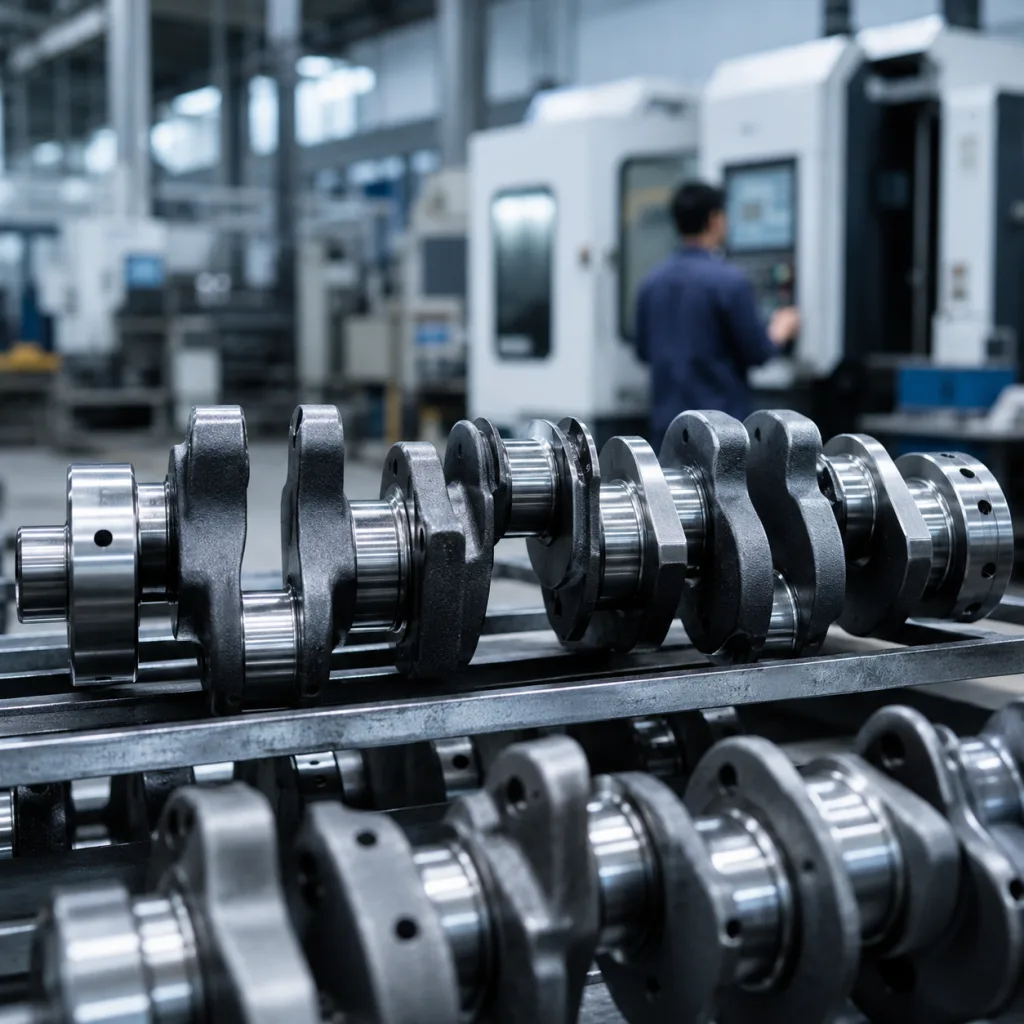
Good dimensional control starts with stable rough machining and continues through heat treatment, straightening, finish grinding, polishing, and final inspection. Buyers should look for evidence that journal roundness, concentricity, fillet radius, thrust face finish, oil-hole deburring, and end-face geometry are controlled at production scale, not only during sample runs. If the shaft is heat-treated after rough machining, ask how the supplier measures distortion, what straightening process is used, and what grinding allowance is reserved for final correction.
Option
Typical use
Strength
Trade-off
Forged steel
High load, long service life
Strong fatigue resistance and grain flow
Higher tooling and process cost
Cast steel or ductile iron route
Mid-volume replacement supply
Good shape stability and lower blank cost
Requires tighter validation on fatigue margin and heat treatment
Reconditioned core
Reman programmes
Lower material waste and faster availability
Requires strict crack detection, undersize control, and core grading
</tr></thead><tbody> </tbody></table>Key checks for a Land Rover programme include main bearing concentricity, rod journal indexing, journal hardness profile, thrust face wear resistance, oil-hole finish, and the balance relationship between counterweights, flange mass, and nose mass. If the application uses a specific OE geometry, ask for dimensional reports that match the engine drawing, not only a visual comparison. For many buyers, the difference between a usable source and a risky one is whether the supplier can document what happens after heat treatment and finish grinding, not just before it.
Quality system, traceability, and standards
A credible supplier should be able to show how raw material is traced through forging or casting, rough machining, heat treatment, straightening, finish grinding, polishing, inspection, preservation, and packing. Driventus operates under quality system controls aligned with IATF 16949:2016 and ISO 9001:2015, which matters when your team needs repeatable process discipline rather than one-off sampling. In practice, that means the supplier should be able to explain lot control, inspection gates, corrective action handling, and how nonconforming material is identified and contained before shipment.
For procurement, the practical document set usually includes:
Mill or material certificate, ideally to EN 10204 3.1 where applicable
Heat number and batch traceability from incoming material to finished part and carton label
Incoming, in-process, and final inspection records
Magnetic particle inspection or other crack-detection records where required by the programme
Hardness and case-depth results when nitriding, induction hardening, or another surface-hardening process is used
Balance verification, runout measurements, and journal dimensional reports
Surface finish measurements for main and rod journals, thrust faces, and sealing surfaces where specified
Calibration status for micrometers, gauges, surface roughness testers, hardness testers, and CMM or roundness equipment
REACH (EC) No 1907/2006 compliance statement for controlled substances in the supply chain
Batch or lot traceability on cartons, packing lists, and commercial paperwork
If your receiving team needs a consistent audit file, ask for the same document pack on every shipment. That reduces delays at customs, warehouse intake, and customer claims review. It also makes supplier performance easier to compare over time, because the data format stays consistent from order to order. For larger programmes, ask whether the factory can provide a first article inspection report, control plan, process flow, PFMEA, or PPAP-style submission if your customer requires it.
Lead time, MOQ, and supply model
For a crankshaft programme, MOQ and lead time depend on whether the part is stocked, made from a semi-finished blank, or produced under a new machining setup. Buyers should separate three cases:
1. Stocked replacement items for fast-moving applications with established inspection records 2. Repeat-production items with validated tooling, stable fixtures, and recurring demand 3. Custom manufacturing for special dimensional, packaging, labeling, or branding requirements
Custom manufacturing is most useful when you need a private-label range, a controlled part revision, packaging built for a distributor network, or a supply model that supports a specific market. For category buyers, the commercial question is whether the supplier can hold journal dimensions, runout, surface finish, hardness, and balance across repeat batches while keeping freight and inventory cost predictable. If the source cannot explain how it plans capacity, tooling, inspection resource, and subcontract heat treatment, the risk usually appears later as missed delivery windows or inconsistent batch quality.
A useful supplier will quote not only unit price, but also sample lead time, bulk lead time, inspection document availability, carton configuration, palletization, corrosion-protection method, and spare capacity for seasonal demand. Ask whether the supplier can support safety stock, forecast-based replenishment, or staggered releases if your demand is uneven. For export programmes, packaging details matter as much as the part itself: VCI protection, anti-rust oil, journal sleeves, end caps, carton compression strength, pallet restraint, and label accuracy can determine whether the shipment arrives ready for intake or becomes a receiving problem.
That matters more than a low initial price if the programme will be reordered. The cheapest quote can become the most expensive option once you factor in rework, rejected shipments, warranty analysis, air-freight recovery, and the time your team spends resolving avoidable issues.
What to ask before you approve a source
Before final approval, ask for proof on the exact engine family you plan to buy. The supplier should be able to answer technical questions with inspection data, not assumptions, because crankshafts are not a category where vague fitment language is acceptable.
Can the supplier confirm fitment by engine code, stroke, main bearing count, and flange interface, not only by vehicle model?
Can it provide a dimensional report or first-article record for the target part number?
What inspection equipment is used for runout, diameter, taper, ovality, surface finish, hardness, and journal geometry?
Is the part dynamically balanced individually or by batch, and what residual imbalance tolerance is used?
Are oil holes chamfered and deburred, and is cleanliness checked before packing?
Are journals, thrust faces, flange surfaces, and seal surfaces protected during storage and export packing?
How does the factory handle nonconforming parts, quarantine, root-cause analysis, and corrective actions?
Can the factory support sample inspection, audit visits, and document requests from your customer?
Does the supplier have a clear process for revision control when an OE reference, machining drawing, or packaging specification changes?
For buyers in the EU, UK, US, Canada, Australia, and Brazil, the best supply partners are usually the ones that respond clearly to these questions. If a source cannot explain the inspection route, the part is still a risk even if the unit price is attractive. A strong answer should include specifics: what is measured, at which process stage, with which gauge or machine, against which tolerance, by whom, and what happens if the measurement misses specification.
If you need a broader view of adjacent powertrain parts, see our engine components range. That helps procurement teams align crankshafts with related parts in the same sourcing cycle, rather than treating each component as an isolated purchase.
Why this matters for aftermarket programs
Aftermarket crankshaft sourcing is not only about replacing a worn component. It is about protecting installer time, reducing warranty claims, and keeping the same specification across multiple distribution channels. A multi-location repair chain needs reliable fitment by engine code. A wholesaler needs stable reorder supply and carton-level traceability. An OEM or Tier-1 buyer needs controlled paperwork, revision control, and predictable process capability. Even small variation in journal finish, hardness, runout, thrust width, or balance can create bearing wear, oil-pressure issues, vibration, or field failure that costs far more than the original part.
The best sourcing model is the one that keeps your rejection rate low and your audit trail complete. That means traceable materials, clear dimensional reports, hardness and balance records where specified, and packaging that protects critical surfaces from corrosion and shipment damage. It also means a supplier that can support sample approval, production release, and repeat orders without quietly changing material route, heat-treatment source, or inspection plan. Procurement teams benefit most when the supplier can demonstrate repeatability, not just offer a low sample price.
For aftermarket channels, consistency is a commercial advantage. Customers remember when a part installs cleanly, runs within specification, and arrives with the paperwork they need. They also remember when a part creates delays at receiving or returns later because fitment data was incomplete. Driventus supports these programmes as an independent aftermarket manufacturer. Brand names are referenced for fitment only.
Frequently asked questions
Use the engine code, displacement, main bearing count, stroke, journal specification, rear flange pattern, front nose configuration, and trigger-wheel or timing interface. Vehicle model alone is not enough because Land Rover names can cover several engine variants and revisions with different crankshaft details.
Yes. We can support custom manufacturing for recurring programmes, including dimensional control, packaging, document sets, carton labeling, and revision control. Share the target volume, engine family, destination market, and any labeling or carton requirements so the quotation matches the intended channel.
Ask for traceability data, inspection records, material certificates, hardness or case-depth results where applicable, balance or runout results, and a compliance statement where required. A consistent document pack makes receiving faster, supports claims handling, and gives your internal team a cleaner audit trail.
If you need a reliable source for Land Rover crankshafts, send your engine code, annual volume, and destination market details. [request a quote](/contact.html)