Crankshaft Citroen Wholesale: Sourcing Guide for Buyers
Buying a crankshaft Citroen wholesale is a specification decision, not a catalogue pick. The wrong OE cross-reference, stroke, journal size, or balance spec can turn a “compatible” part into a return. For wholesale buyers, the real question is not whether the part looks right; it is whether the part can be verified, repeated, and supplied batch after batch. Driventus is an independent aftermarket manufacturer; brand names are referenced for fitment only. We manufacture engine and powertrain parts in Taizhou, Zhejiang, and export to 60+ countries under IATF 16949:2016 and ISO 9001:2015 systems. This article walks through the checks that matter before you place a bulk order, the failure modes that create costly mismatches, and the commercial questions that separate a dependable supplier from a risky one.
Start with the failure modes, not the brochure
Most wholesale mistakes happen before price is negotiated. The part number may look correct, but the engine family can still differ by stroke, thrust arrangement, sensor trigger pattern, or journal size. That is why a crankshaft Citroen wholesale programme should start with the ways these orders fail in the field.
First checks for buyers
Engine code and exact vehicle application
OE reference and supersession status
Main and rod journal diameters
Stroke and thrust face location
Trigger wheel pattern and balance requirement
Packaging, corrosion protection, and label format
If the customer gives only a model name, treat it as a lead, not a specification. The same nameplate can cover different engine variants, and the wrong variant often passes a visual check while failing assembly. For distributors, that creates returns. For repair chains, it creates downtime. For OEM or Tier-1 programmes, it creates traceability problems. If you need a broader engine portfolio, see our catalog and engine components.
Specification deep-dive: the dimensions that decide fit
A crankshaft is interchangeable only when the critical dimensions align. Before quoting, ask the supplier to state the exact values, not just “OEM quality” or “fits Citroen.”
Item
Buyer question
Why it matters
Main journal diameter
Standard or undersize?
Determines bearing selection
Rod journal diameter
Matches OE and bearing spec?
Prevents oil-clearance errors
Stroke
What is the nominal value?
Affects displacement and timing
Runout
What is the allowed limit?
Influences vibration and wear
Hardness
What surface hardness is achieved?
Impacts fatigue resistance
Balance
Is dynamic balancing performed?
Reduces NVH and bearing load
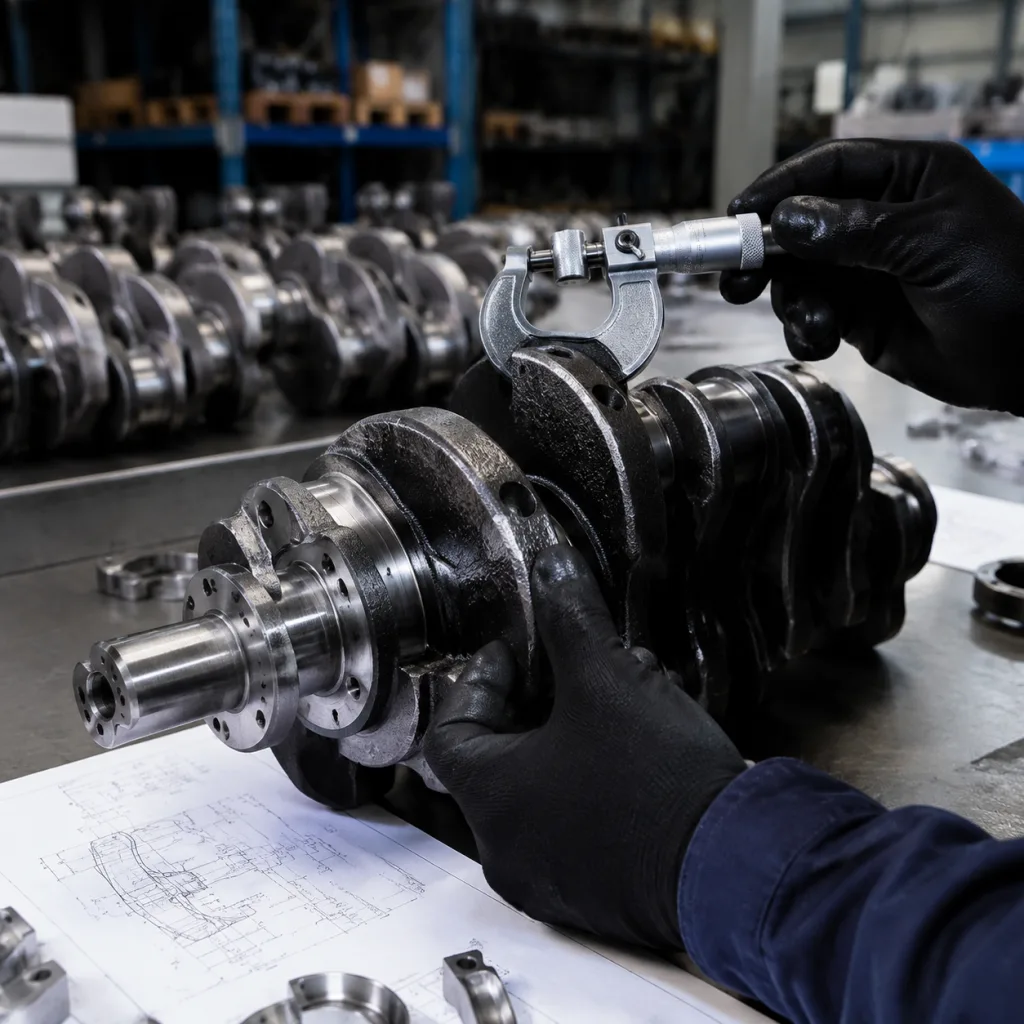
</tr></thead><tbody> </tbody></table>For wholesale supply, ask whether the shaft is forged steel or cast iron, whether fillet rolling is applied, and how cracks and concentricity are inspected. A practical buyer spec should also define journal-to-journal variation, chamfer or radius around oil holes, and whether the part is supplied standard or with undersize or oversize grinding options. Those details affect bearing pairing, installation risk, and return rates.
In many programmes, buyers ask for runout within 0.03 mm to 0.05 mm TIR, journal diameter tolerance around ±0.01 mm to ±0.02 mm, and surface hardness in the 55 HRC to 65 HRC range when induction hardened. Those figures are useful starting points, but the exact target must match the engine family and OE drawing. Buyers in Europe and other regulated markets should also confirm material declarations for REACH (EC) No 1907/2006 when required by the customer. Driventus can support programme-specific verification through custom manufacturing.
MOQ and lead time: where wholesale programmes really break
Wholesale sourcing usually fails on planning, not on price. A supplier can quote attractively and still create risk if MOQ, tooling status, or batch scheduling are vague. Ask for three numbers every time: sample lead time, production lead time, and emergency replenishment capability.
Commercial details to confirm in the RFQ
MOQ per part number or engine family
Sample approval lead time
Standard batch lead time
Packing quantity per carton or pallet
Spare capacity for repeat orders
Incoterms and port options
A good wholesale supplier should tell you whether the part is stock-supported or built to order, and whether each batch receives dimensional inspection and final balancing. That matters for Citroen programmes because low-volume engine variants can sit idle between orders, then return suddenly in volume. As a rough planning guide, samples are often ready in 7 to 15 days if tooling and raw material are available, repeat production in 20 to 45 days, and new-tool or engineering-change orders in 45 to 90 days depending on complexity. MOQ often starts at 30 to 100 pieces for mature aftermarket numbers and rises to 200 to 500 pieces when special balancing, finish, or packaging is required.
Do not compare unit price alone. Ask for landed-cost logic. Confirm whether the quote includes anti-rust oil, VCI bag, export carton, palletizing, and carton drop-test standard. If the supplier cannot state pallet quantity, gross weight, or carton dimensions, the quote is not ready for a wholesale decision. For broader supplier screening, review our quality system before comparing price alone.
Inspection and traceability: what evidence you should ask for
Compatibility claims are not enough. A credible supplier should show how manufacturing and inspection align with IATF 16949:2016 and ISO 9001:2015. For fatigue-sensitive parts, ask for hardness mapping, crack inspection, and balance reports. When a customer requires test references, suppliers may also cite methods such as SAE J2527 for durability-related validation programmes, although the exact test plan depends on the application.
Useful documents to request
Material certificate by heat number
Dimensional inspection report
Balance report
Hardness test record
Packaging specification
Non-conformance and traceability procedure
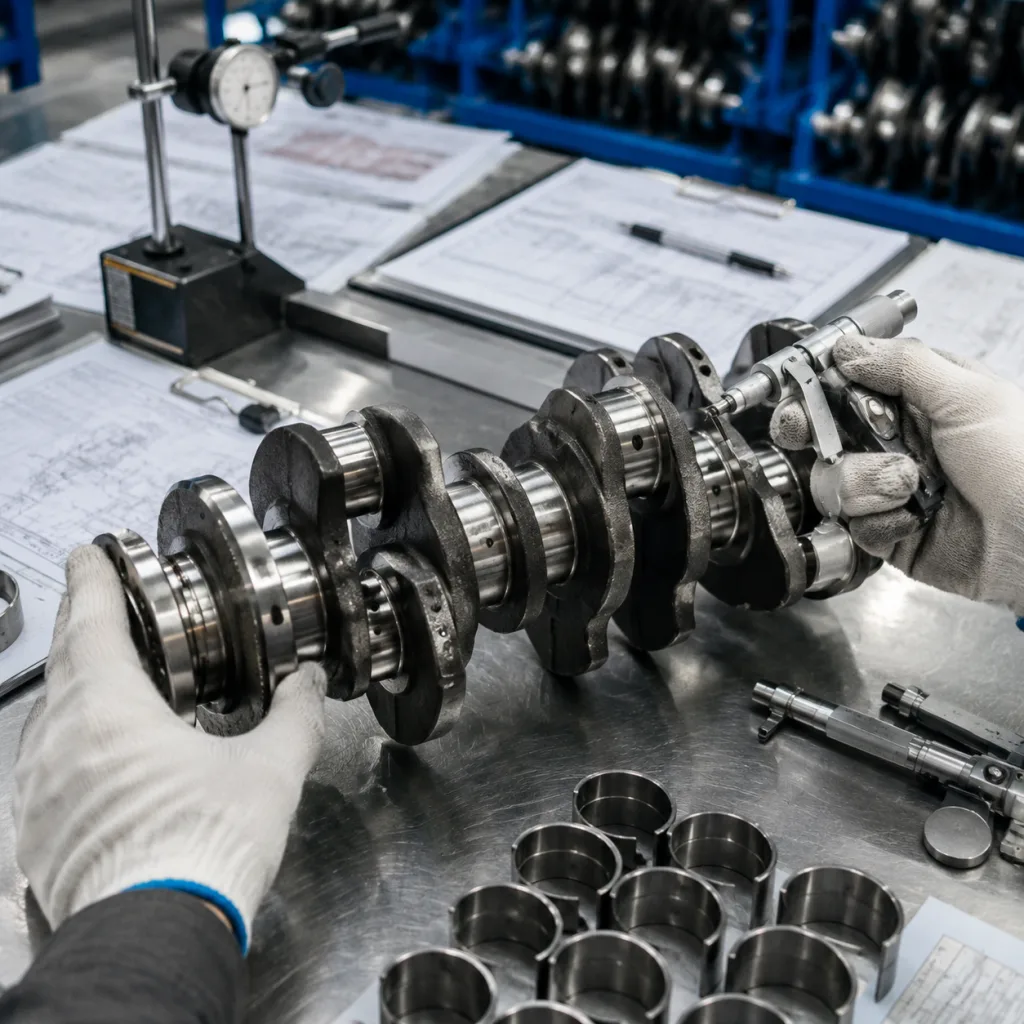
Ask for the full inspection plan, not a certificate summary. The plan should show which dimensions are checked on every piece versus sampled by lot, what gauge resolution is used, and whether serial numbers or batch numbers appear on the crankshaft and outer carton. The most useful wholesale record chain links raw material heat number, forging or casting lot, machining batch, heat-treatment batch, final inspection report, and packing list. If the supplier cannot trace a return to a specific batch, your commercial risk rises quickly.
In addition, buyers may request magnetic particle inspection or crack detection at critical fillets, balancing verification after final machining, and hardness checks at defined locations on the counterweights and journals. If your target market needs emissions-adjacent documentation or engine-family alignment, do not let the supplier imply vehicle-maker approval. Driventus is an independent aftermarket manufacturer; brand names are referenced for fitment only. That statement should appear in commercial documents and on product pages.
Supplier comparison: what matters beyond the unit price
A low quote can hide a high landed cost. The right comparison is supply risk, not the headline number.
Comparison points for wholesale buyers
Unit price versus packaging quality
Batch consistency versus one-off sample quality
Lead time versus on-time delivery history
Traceability versus anonymous stock supply
Technical support versus sales-only communication
For aftermarket distributors, ask whether the supplier can provide carton labels, barcode formats, and mixed-SKU pallet handling. For multi-location repair chains, ask for consistent kit labelling and one-part-one-box packing. For OEM or Tier-1 buyers, inspect process control records and change-notification discipline. A practical commercial comparison should also include payment terms, transit-damage policy, and whether the supplier can hold safety stock for 30, 60, or 90 days against forecast.
If a project needs special machining, counterweights, or engine-family adaptation, bring custom manufacturing into the discussion before launch. The best wholesale partner is the one that can repeat the same part, the same pack, and the same paperwork on every order.
Frequently asked questions
Confirm engine code, OE reference, journal sizes, stroke, balance requirement, and packaging spec. A matching model name is not enough for bulk sourcing.
Yes. Driventus supports programme-specific requirements through custom manufacturing, including label formats, packaging, and dimensional variants where technically feasible.
Yes. We work under IATF 16949:2016 and ISO 9001:2015 systems and can provide relevant inspection and traceability records for wholesale programmes.
If you are sourcing a Citroen crankshaft programme and need pricing, technical confirmation, or batch planning, please use our request form at /contact.html.