Crankshaft Buick Supplier: Sourcing Guide for Buyers
Buyers sourcing a Buick crankshaft need more than a part-number match. They need consistent metallurgy, verified journal geometry, stable runout, and supply terms that fit their channel. For aftermarket distributors, OEM and Tier-1 buyers, and multi-location repair networks, the main risks are dimensional drift, poor surface finish, and uneven heat treatment across batches. Driventus manufactures crankshafts as an independent aftermarket supplier in Taizhou, Zhejiang, and exports to 60+ countries with certification to `IATF 16949:2016` and `ISO 9001:2015`. Driventus is an independent aftermarket manufacturer; brand names are referenced for fitment only. This article outlines what procurement teams should verify when shortlisting a crankshaft Buick supplier, including fitment control, documentation, factory audit points, and the commercial terms that matter for repeat orders.
Fitment first: what a Buick crankshaft buyer must lock down
Start with fitment, not price. A crankshaft Buick supplier should be able to map the part to an engine family, displacement, journal count, thrust location, flange type, and OE cross-reference before anyone talks about samples. If the listing uses an OE number, keep the format exact, for example `OE 06A107065`; one number does not automatically cover every variant.
Minimum buyer checklist
Engine family and displacement
OE cross-reference and application range
Main journal diameter and tolerance
Rod journal diameter and tolerance
Overall length, stroke, and flange details
Nitriding, induction hardening, or fillet rolling requirement
Packaging and corrosion protection for export
The tolerance discussion should be measurable. Ask for target journal tolerances in microns or thousandths of an inch, plus total indicated runout, so receiving inspection can use one standard. “OEM quality” is too loose to control a machining process.
If your sourcing team supports multiple regions, request one dimensional report per batch, not one report per part number. That makes incoming inspection faster and helps isolate claims on first delivery. For repeat programs, lock the revision level. A small stroke or flange change can trigger field-fit problems across the same engine family.
Where supplier quotes usually fail
Many crankshaft quotes look comparable until the hidden gaps appear. The usual failure modes are vague fitment data, unclear MOQs, missing inspection records, and lead times that do not distinguish samples from repeat production.
Item
What to confirm
Why it matters
MOQ
Per part number and per order; ask for sample MOQ and production MOQ separately
Affects inventory risk
Lead time
Sample lead time, first production lead time, and repeat-order lead time
Impacts replenishment planning
Packaging
Rust prevention, VCI bag, oil coating, partitioning, and palletising
Protects machined surfaces
Documentation
COA, dimensional report, material traceability, and photo records
Supports QA and customs files
Warranty terms
Claim window, evidence required, and replacement or credit policy
Reduces dispute time
</tr></thead><tbody> </tbody></table>A good RFQ also asks for price breaks by volume, such as 100, 300, and 500 pieces per part number, because crankshaft pricing often changes with setup time and heat-treatment batch size. If the supplier can hold forecast buffer stock or phase shipments, that can reduce stockouts for repair-chain customers.
The lowest unit price is not always the best landing cost. Freight, packaging, inspection rework, and chargebacks often decide the real number.
Spec deep-dive: the controls that separate good from risky
A credible source should explain the process from forging or casting through machining and final inspection. At minimum, ask how it controls hardness, dynamic balance, concentricity, and surface roughness. Also review gauge calibration, traceability, and incoming material control.
Driventus operates under `IATF 16949:2016` and `ISO 9001:2015`, which are relevant signals for controlled production and documented inspection. For international sourcing, also check compliance screening for `REACH (EC) No 1907/2006` where applicable to materials and coatings.
Audit topics to verify
Material certificate traceability by heat number
Journal grinding and fillet control records
Final balance check method and acceptance limit
Nonconformance handling and corrective action flow
Calibration records for gauges and CMM equipment
Packing inspection and corrosion control
Ask to see the full route card: blank preparation, rough machining, heat treatment, finish grinding, cleaning, balance correction, inspection, and packing. If the supplier uses nitriding, request the case depth target, hardness range, and dwell-time control. If the supplier uses induction hardening, ask for the hardened zone width and how it is measured. Define the documentation pack before launch so every shipment arrives with the same evidence set.
If you audit remotely, ask for live video of the line, not only still images. That gives procurement and quality teams a faster view of machine condition, work-in-process control, and finished-goods storage.
Validation step-by-step: how to prove the part before scale-up
Crankshafts fail when geometry moves outside tolerance, even when the part looks right. Validate the part in a sequence that mirrors how the risk appears in the field.
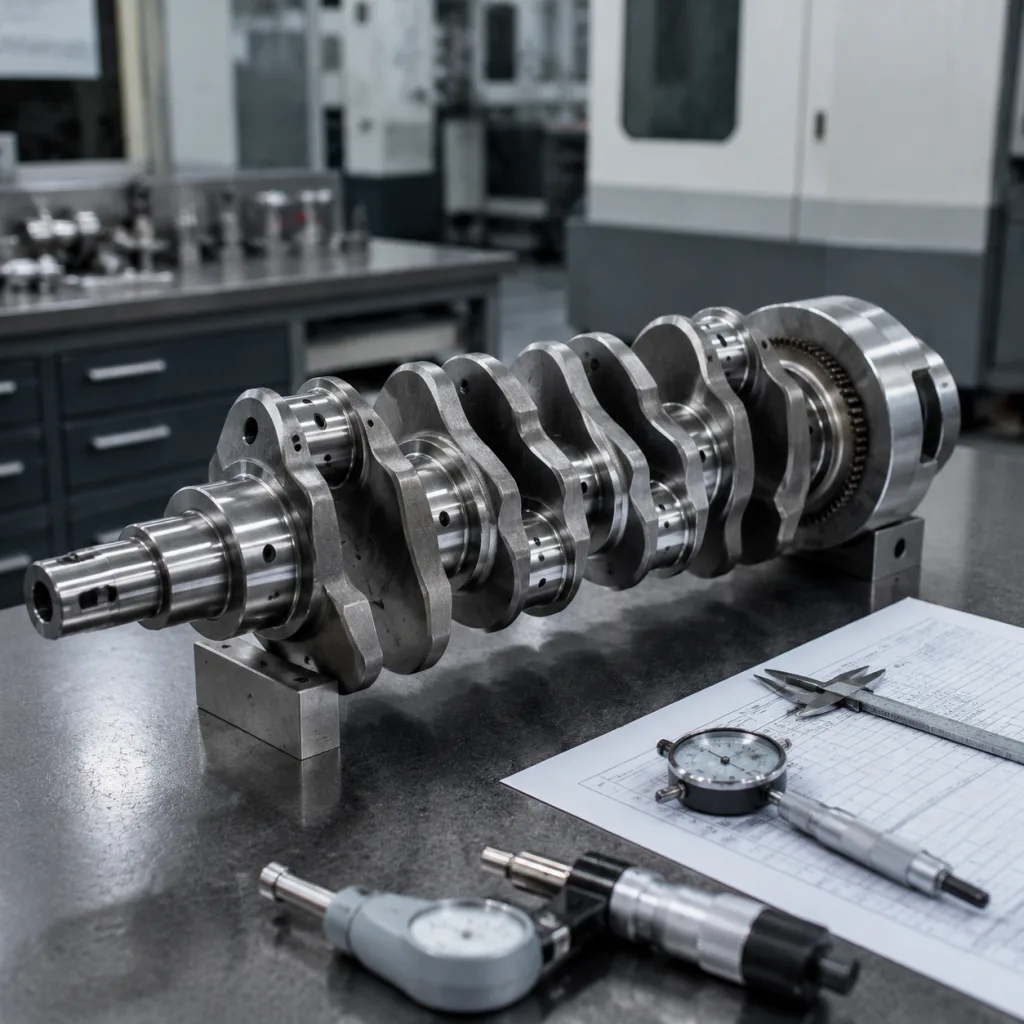
1. Confirm the acceptance points: main journal diameter, rod journal diameter, stroke, total indicated runout, thrust face width, and keyway or flange measurements where relevant. 2. Request hardness verification at defined locations. 3. Add magnetic particle inspection or an equivalent crack-detection method. 4. Check runout, concentricity, and balance. 5. Review surface finish on bearing journals.
The RFQ should define first-article acceptance in measurable terms. List every critical dimension, the tool used, and the stated tolerance. For a high-reliability application, start with a pilot lot, then move to batch release only after the data stays within limit on a repeat run.
If the crankshaft replaces an original part in a demanding engine, ask for endurance or durability data relevant to that family. For export buyers, confirm whether test reports are available in English and whether lot-level traceability remains after shipment. A supplier that can share the raw measurement sheet and the summary pass/fail record makes receiving inspection much faster.
How Driventus fits a sourcing program
Driventus supplies crankshafts as part of a broader engine-component range. Buyers can review our catalog and the engine-component range at /products/engine-components.html when building a consolidated purchase plan.
For programs that need design changes, packaging updates, or a non-standard material specification, custom manufacturing can align the part with customer requirements. That helps when a distributor needs private-label packaging, a Tier-1 buyer needs controlled release quantities, or a repair network wants one pack format across branches.
The quality system page gives a clearer view of the documents buyers typically request during supplier approval. The sourcing goal stays simple: keep the part number stable, keep the inspection records complete, and keep the replenishment path predictable.
When you request a quotation, separate unit price, tooling or setup cost, sample cost, packaging cost, and freight terms. That keeps the landed price easy to compare across suppliers.
RFQ readiness check before you send it out
Before you issue an RFQ, gather the application data, OE reference, target annual volume, packaging requirement, and destination market. That reduces clarification rounds and forces suppliers to quote on the same basis.
Use this sequence: 1. Confirm engine family and OE cross-reference. 2. Define annual volume and forecast split by month. 3. State required inspection documents and packing format. 4. Ask for sample lead time and mass-production lead time. 5. Request a factory audit pack if the part will be placed on approved vendor status.
A usable supplier response should include dimensions, material, surface treatment, sample policy, and claim procedure. Add MOQ, price tiers, payment terms, and a firm lead-time commitment. If any of those are missing, the quote is not ready for a purchasing decision.
For buyers managing multiple branches or export markets, the best outcome is a quote that can be approved without a second round of technical clarification.
Frequently asked questions
Yes, where the application fitment and dimensional requirements are defined. Driventus works from OE cross-reference data, engine family details, and required tolerances to confirm suitability before quotation.
Request a dimensional report, material traceability, packing list, and any agreed test records. For regulated markets, keep compliance files aligned with the customer’s internal approval process.
Compare fitment data, tolerance control, inspection depth, MOQ, lead time, and claim handling. Price matters, but repeatability and documentation usually drive total landed cost.
If you need a crankshaft sourcing quote or a technical review of fitment data, send the application details and target volume through request a quote.