camshaft · 2026-06-16

Camshaft for Skoda Fabia Replacement: B2B Sourcing Guide

Buying a camshaft for Skoda Fabia replacement stock is not a catalogue exercise. One wrong trigger profile, journal size, or heat-treatment route can create timing faults, valve-train noise, oil-feed sensitivity, fast lobe wear, and multi-branch warranty exposure.

For B2B buyers, the commercial question is simple: will this reference fit correctly, survive workshop conditions, arrive undamaged, and stay traceable if a claim appears six months later? This article reframes the sourcing process around those decisions. It covers fitment lock-down, metallurgy, inspection release, validation, MOQ and lead-time planning, packaging, and claim prevention for independent aftermarket programmes. Driventus is an independent aftermarket manufacturer; vehicle brand names and OE-style references are used only to identify fitment. Buyers can review related engine parts in our catalog and discuss programme requirements before placing volume orders.

Start With the Fitment Decision, Not the Price List

The first decision in a camshaft for Skoda Fabia replacement programme is whether the reference is truly the same part your catalogue says it is. Fabia applications vary by engine family, production period, fuel type, valve count, timing-drive design, sensor reference feature, and valve-train layout. Similar-looking shafts can differ only by a trigger slot, journal width, or timing interface—and that is enough to create a field problem.

Before price comparison, build a fitment file for each SKU. It should define engine code, fuel type, valve count, timing sprocket or pulley interface, sensor trigger profile, bearing journal arrangement, and whether the component is an intake camshaft, exhaust camshaft, or single overhead camshaft.

A qualified supplier should be able to cross-reference buyer-supplied OE-style references, such as OE 06A… or OE 11251… where relevant to the programme. These references are identification data only. They are not proof of approval by the vehicle manufacturer. For high-risk or high-volume references, ask for a 3D scan, measured drawing, or full first-article inspection against a physical sample before listing.

Use these checks to separate a confirmed reference from a lookalike:

  • Overall shaft length, datum faces, and journal centre positions, typically checked to drawing tolerances of ±0.05–0.10 mm where specified
  • Journal diameter, oil-feed groove geometry, oil-hole position, and bearing land width
  • Cam lobe lift, base circle, nose radius, flank profile, and opening/closing angular indexing
  • Cam sensor trigger wheel, slot, or reference feature orientation, often requiring angular control within ±0.5–1.0° depending on engine design
  • Timing gear, chain sprocket, or pulley interface, including keyway, taper, dowel, thread, or drive-slot geometry
  • Thrust face width and axial clearance control to avoid end-float noise or binding
  • Compatibility with hydraulic tappets, roller followers, or finger followers, including surface finish and hardness requirements

For replacement programmes, Driventus normally asks buyers to provide sample parts, drawings, OE part-number cross-references, engine-code lists, target markets, and annual volume by reference. This reduces catalogue overlap and prevents mixing camshafts that differ only in a sensor feature, timing interface, or journal detail.

Where Camshafts Fail: Metallurgy and Surface Controls That Matter

Most camshaft failures are not mysterious. They usually begin at the lobe-to-follower contact, the journal oil film, a heat-treatment inconsistency, or a damaged oil passage. That is why buyers should evaluate the process route, not just the application list.

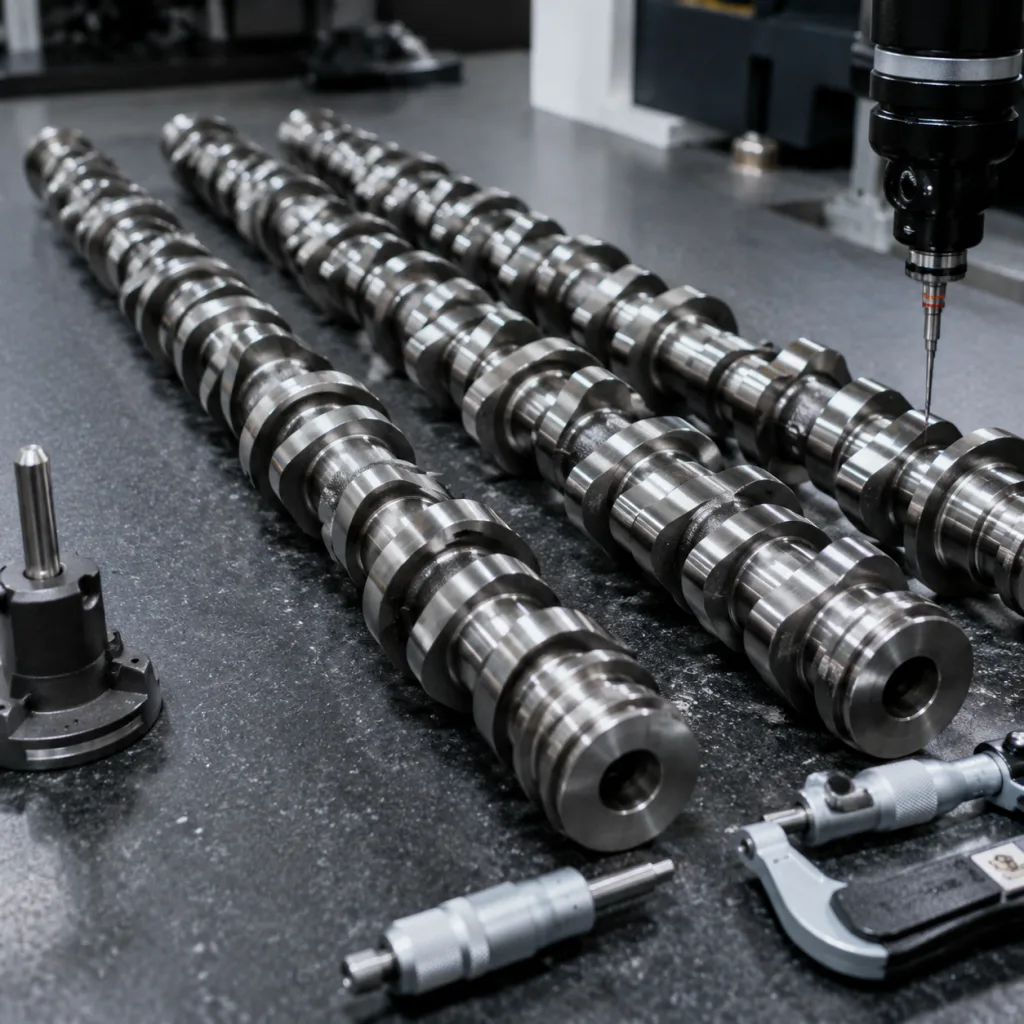
Common manufacturing routes include chilled cast iron, ductile iron, and forged or machined steel. The correct option depends on engine design, follower type, and load requirement. For many passenger-car replacement applications, the target is a hardened lobe surface, stable core strength, controlled straightness, and the correct surface roughness on both lobes and journals.

Lock the route before tooling and PPAP-style sample review. A change from cast iron to steel, or from induction hardening to chilled-lobe processing, can change wear behaviour, cost, process capacity, and lead time.

</tr></thead><tbody> </tbody></table>Driventus production controls are managed under IATF 16949:2016 and ISO 9001:2015. These standards do not define a camshaft dimension or approve a specific vehicle application by themselves. They do, however, support process control, traceability, nonconforming-product handling, and corrective action. Buyers can review our quality system when qualifying a supplier for regular replenishment.

Release the Batch Like a Precision Rotating Part

A camshaft is not a simple metal bar with lobes. It is a rotating timing component, and small errors may only appear after installation—especially when workshops reuse followers, hydraulic lifters, bearing caps, or other valve-train parts.

A sound release plan combines 100% checks on critical features with sampling-based laboratory inspections. For B2B supply, each inspection report should link to the batch number, production date, material heat, operator or line record, and packing lot. If a claim appears later, that traceability decides whether containment takes hours or weeks.

For a new reference, buyers should request first-article inspection on at least 3–5 pieces. For repeat batches, AQL sampling such as general level II can be agreed, with tightened checks on critical-to-function dimensions.

Recommended inspection points:

  • Journal diameter, roundness, cylindricity, and taper, with actual measured values rather than pass/fail only
  • Lobe height, base circle, calculated lift, and angular indexing against the datum feature
  • Keyway, dowel, thread, taper, or timing slot position, including go/no-go fixture verification where practical
  • Cam sensor reference feature position, phase angle, edge condition, and burr control
  • Thread depth and end-face perpendicularity where applicable
  • Oil-hole diameter, chamfer, and burr condition after washing
  • Total indicated runout on datum journals, typically recorded at multiple rotational positions
  • Visual inspection for cracks, dents, corrosion, handling marks, and grinding burns

Packaging and handling controls

Inspection does not help if the shaft is damaged in freight. Camshafts are vulnerable to edge impact during sea freight, cross-docking, and warehouse handling. Export packaging should support the shaft without point loading on lobes, journals, or sensor features.

A robust export pack normally uses one camshaft per inner sleeve or cradle, anti-rust oil or a VCI bag, end caps, foam or moulded pulp supports, double-wall cartons for heavier references, and palletisation that prevents carton crushing. Desiccant may be required for humid routes or long storage cycles.

Specify label data before production packing begins: part number, batch number, production date, quantity, country of origin, barcode format, and private-label code. Carton drop tests from 0.8–1.0 m and 48–96 hour humidity checks are useful before a first container shipment.

For buyers consolidating camshafts with pistons, gaskets, water pumps, or timing components, Driventus can align carton labelling and pallet formats with importer warehouse rules. Related engine parts are available through our catalog and the engine-component range at /products/engine-components.html.

A Launch Sequence That Catches Problems Before the Market Does

A reliable camshaft for Skoda Fabia replacement supply should be validated before commercial launch and checked again during mass production. The plan should reflect real workshop failure modes: lobe wear, journal seizure, timing mismatch, abnormal noise, corrosion after storage, and installation-related damage.

A typical validation package includes:

  • Material certificate showing grade, heat number, and chemical composition limits
  • Hardness report covering lobe nose, flank, journal, and, where relevant, core hardness
  • Dimensional first-article inspection report with actual values on all critical-to-function features
  • Surface roughness report for lobes and journals, measured with stated cut-off and direction
  • Magnetic particle or equivalent crack inspection where specified, especially after heat treatment and grinding
  • Metallographic section analysis from batch samples to verify microstructure, case depth, carbide pattern, or decarburisation control
  • Bench assembly verification with mating valve-train components, bearing caps, timing hardware, and sensor reference features
  • Endurance or rig-test evidence where the project requires it, such as 100–300 hour rig cycling or buyer-defined engine bench validation
  • Salt-spray, humidity, or packaging corrosion checks for export routes and long warehouse storage

For new tooling or a high-volume SKU, use a staged launch: sample measurement, 5–20 piece pilot build, buyer fitment confirmation, pilot batch of 100–300 pieces, then mass production after claim-free installation feedback. Do not skip the pilot stage for a fast-moving reference. A timing or trigger-feature error can scale quickly.

Repeat production should include retained master samples, control plans, gauge calibration records, and defined reaction plans if hardness, runout, or lobe profile trends move toward the specification limit.

For emissions-controlled vehicles, valve timing accuracy can affect engine performance, fuel consumption, diagnostic behaviour, and emissions results. Suppliers should understand the regulatory environment in target markets, including the emissions type-approval context of ECE R-83 in relevant regions. Replacement camshaft sourcing should also consider REACH (EC) No 1907/2006 for material and chemical compliance in the EU supply chain.

Driventus does not claim approval or endorsement by any vehicle manufacturer. The objective is OE-equivalent replacement function for independent aftermarket supply, supported by controlled manufacturing, traceable inspection records, and buyer-agreed validation criteria.

Procurement Trade-Offs: MOQ, Lead Time, Packaging, and Landed Cost

The lowest unit price is often not the lowest programme cost. For importers and multi-location repair chains, margin can disappear through wrong-part returns, inconsistent hardness, poor packaging, slow claim handling, or missing technical documentation. A scorecard makes the trade-offs visible.

Parameter Typical procurement check Practical target or control point Why it matters
Lobe surface hardnessBatch test by specified methodCommonly 55–62 HRC or equivalent, per drawingReduces scuffing, pitting, and accelerated wear risk
Effective hardened depthSection or process validationOften 1.0–3.0 mm for induction-hardened steel designsPrevents soft subsurface wear after break-in
Journal roundnessMeasurement on precision gaugesOften ≤0.005–0.010 mm where specifiedSupports stable oil-film formation
Shaft straightness / runoutRunout inspection before packingCommonly ≤0.03–0.05 mm TIR on datum journalsLimits valve-train noise and bearing wear
Surface roughnessJournal and lobe Ra controlJournals often Ra 0.2–0.4 µm; lobes often Ra 0.3–0.8 µmSupports lubrication, break-in, and follower compatibility
MicrostructureMetallographic samplingNodularity, carbide distribution, case pattern, decarb checkConfirms heat-treatment and casting consistency
CleanlinessDeburring and washing recordNo loose chips; oil holes visually clearHelps prevent abrasive contamination during installation

</tr></thead><tbody> </tbody></table>MOQ is usually driven by heat-treatment batch size, grinding set-up, packaging print quantity, and export carton efficiency. As a practical planning range, buyers often see MOQs of 100–300 pieces per reference for established items, 300–500 pieces for private-label or low-run references, and higher quantities where new tooling, special raw material, or dedicated fixtures are required. Trial orders can be smaller when neutral packaging and existing process tooling are used, but the unit cost will normally rise.

Lead time depends on whether the reference is already in active production. Plan around 7–15 days for available stock and inspection packing, 30–45 days for repeat production, 45–75 days when heat treatment, grinding capacity, or private-label packaging must be scheduled, and 60–90+ days for new development with sample approval.

Compare price on a landed-cost basis: camshaft unit price, testing level, anti-rust packaging, carton artwork, palletisation, inland freight, sea or air freight, duty, and expected claim rate. A cheaper shaft with weak documentation or packaging can cost more after the first container.

Driventus can support standard replacement supply or custom manufacturing when buyers need private-label packaging, controlled drawings, market-specific assortments, or samples made against supplied references. For category managers, the preferred process is sample confirmation, drawing freeze, pilot order, batch report review, and then rolling forecast supply.

Warranty Q&A: When the Part Is Blamed but the System Failed

Buyers source the camshaft, but many warranty cases are shaped by workshop practice. The best defence is not a long disclaimer. It is clear fitting guidance, distributor training, and a claim form that captures useful evidence.

Why do some camshafts show rapid lobe scoring after installation? Common causes include inadequate pre-lubrication, blocked oil galleries, reused worn followers, unsuitable oil, or abrasive debris from a previous engine failure. The shaft may be marked first, but the root cause can sit elsewhere in the valve train or lubrication system.

Which installation mistakes create avoidable claims? Incorrect bearing-cap torque sequence, timing misalignment, dry installation, contaminated oil, follower mismatch, and failure to clean oil galleries are frequent triggers. If the timing belt or chain system is worn, a new camshaft cannot compensate for it.

What should workshop fitting notes include?

  • Confirm engine code, camshaft reference, intake/exhaust position, and sensor feature before installation
  • Replace or inspect followers, tappets, seals, bearing caps, oil seals, timing belt or chain components as required
  • Clean oil galleries and confirm oil feed to the cylinder head before start-up
  • Use assembly lubricant on lobes and journals; do not install dry
  • Check oil level, oil grade, filter condition, and oil-pressure condition before start-up
  • Follow the vehicle service procedure for timing, bearing-cap order, and torque sequence
  • Rotate the engine by hand before first start to confirm valve timing and clearance condition
  • Record mileage, oil grade, related parts replaced, fault codes, and installation date for any claim

What evidence helps separate a manufacturing defect from an installation issue? A useful claim form asks for vehicle VIN or engine code, odometer reading, installation mileage, failure mileage, oil specification, photos before removal, photos of followers or tappets, timing component status, and whether the engine previously suffered belt failure, oil starvation, or metal contamination.

This evidence helps distributors identify genuine production issues faster. It also filters out system-level engine failures, improves consistency across repair-chain branches, and reduces repeat labour claims.

Frequently asked questions

Provide engine code, model year range, fuel type, valve count, intake or exhaust position, target OE-style cross-references such as OE 06A… or OE 11251…, annual demand, required MOQ, packaging requirements, and destination market. A physical sample, drawing, or measured inspection report improves confirmation accuracy.

Yes. Driventus can supply neutral or buyer-specified packaging subject to agreed artwork, carton tests, labelling rules, MOQ, and market compliance requirements. Technical approval is based on samples, drawings, buyer-confirmed fitment data, and agreed inspection records.

No. Driventus is an independent aftermarket manufacturer; brand names and OE-style references are used for fitment identification only. Products are developed for OE-equivalent replacement function and manufactured under controlled quality procedures, without claiming vehicle manufacturer endorsement.

If you are building a camshaft for Skoda Fabia replacement range, share your fitment list, target volumes, MOQ expectation, delivery schedule, and packaging requirements. Our team can review the application data and help you [request a quote](/contact.html).

Request a Quote
Sourcing factor What to request from supplier Procurement impact
Fitment dataEngine codes, OE 06A… / OE 11251… style references, application notes, intake/exhaust positionReduces returns from wrong-part selection
Quality certificationIATF 16949:2016 and ISO 9001:2015 certificatesSupports supplier qualification
Batch traceabilityLot number, inspection report, production date, material heatSpeeds containment if a claim occurs
MOQ and lead timeStandard MOQ, forecast MOQ, production cycle, tooling statusHelps inventory planning and launch timing
Price logicEXW/FOB/CIF basis, packaging cost, test cost, tooling amortisationPrevents misleading unit-price comparison
PackagingExport carton design, label format, corrosion protection, pallet planReduces freight, storage, and handling damage
Claim processEvidence requirements, response time, credit or replacement rulesLimits warranty administration cost